July 10, 2026
When Safe Havens Become Traps: The Counterintuitive Economics of Gold in a Conflict Zone
Most investors operate on a simple mental model: war breaks out, gold goes up. This assumption has been reinforced through decades of market history, from the Gulf War era to the post-9/11 rally and the 2022 Russia-Ukraine shock. However, the relationship between geopolitical stress and precious metals pricing is far more nuanced than this rule of thumb suggests, and gold prices and U.S.-Iran tensions in mid-2026 are delivering a masterclass in that complexity.
The ongoing military exchange between the United States and Iran is not functioning as a conventional safe-haven catalyst. Instead, it is activating a chain reaction through oil markets, inflation expectations, and Federal Reserve policy that is, in many ways, working against gold rather than in its favour. Understanding why requires unpacking the specific transmission mechanisms at work and what they mean for investors navigating precious metals exposure through the remainder of 2026.
When big ASX news breaks, our subscribers know first
The Inflation-Rate Trap: Why This Conflict Is Different
How Oil Becomes the Critical Intermediary
The key to understanding gold's counterintuitive behaviour during the U.S.-Iran conflict lies in recognising that not all geopolitical risk is created equal. The Russia-Ukraine war disrupted European energy supply chains, triggered a flight to safety across multiple asset classes, and created a broad-based demand surge for gold that overwhelmed other macro forces.
The U.S.-Iran situation is structurally different. The geographic concentration of the conflict, centred around Gulf state infrastructure and Iranian coastal provinces, means its primary economic transmission point is crude oil supply. Furthermore, when Iranian armed forces launched attacks on U.S. military infrastructure in Gulf states in early July 2026, following U.S. strikes on Iran's southern coastal and eastern provinces, the immediate market response was an oil price surge rather than a blanket flight to safety assets.
That distinction matters enormously for gold. Higher oil prices feed directly into consumer price inflation expectations. Rising inflation expectations, in turn, push markets to price in a more aggressive Federal Reserve response. Consequently, because gold is a non-yielding asset, it becomes comparatively less attractive when interest rates rise or are expected to rise. The theoretical safe-haven bid gets overwhelmed by the practical cost of holding an asset that pays nothing in a high-rate environment.
The Fed Repricing Event That Drove Gold Lower
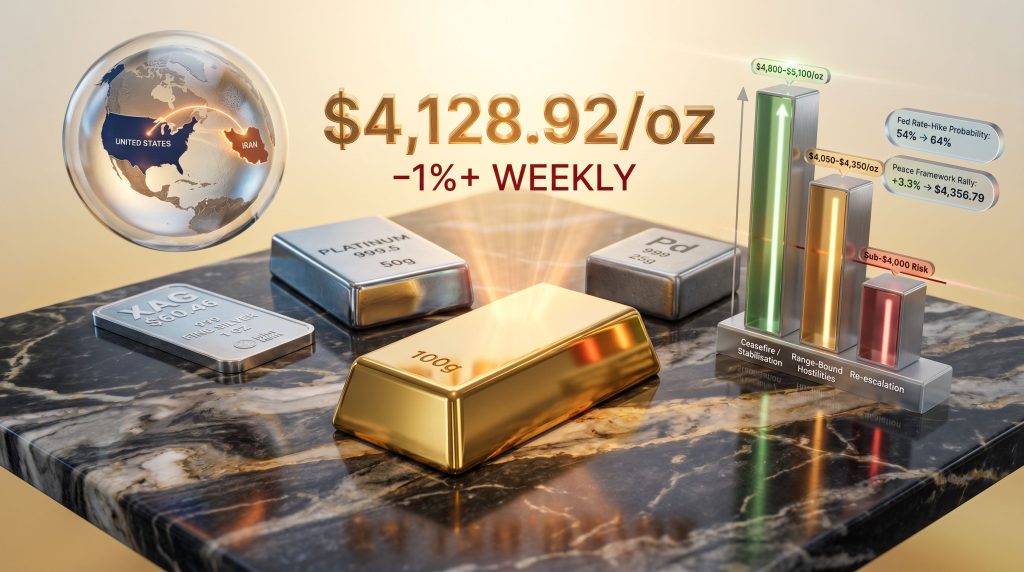
The speed of the rate expectation shift during this conflict period has been striking. Within a single week of intensified strikes, market-implied probability of a Federal Reserve rate hike in September 2026 moved from approximately 54% to 64%, according to data from the CME FedWatch tool. That ten percentage point swing represented a significant repricing of monetary policy risk, and gold felt the full force of it.
Adding weight to this hawkish repositioning, minutes from the Fed's June 2026 meeting, released during this same period, confirmed that policymakers were already expressing deepening concern about elevated inflation. The conflict did not create those concerns, but it amplified them at a moment when markets were already sensitised to the inflation narrative.
The four-force model governing gold's behaviour in conflict scenarios can be summarised as follows:
- Geopolitical Risk Premium supports gold as a store of value and crisis hedge
- Oil-Driven Inflation raises rate-hike expectations, suppressing non-yielding assets
- U.S. Dollar Strength reduces gold's affordability for international buyers
- Safe-Haven Demand provides a price floor but is structurally offset by monetary policy headwinds
In this particular conflict, forces two and three have been dominant, which explains why gold has tracked downward during periods of escalation rather than upward. Gold and bond yields further reinforce this dynamic, as rising rate expectations compound the headwinds for non-yielding assets across economic cycles.
Gold Price Behaviour During the June-July 2026 Conflict Period
A Market Driven by Diplomatic Signals, Not Just Battlefield Events
The most revealing aspect of gold's behaviour during this period is how sharply prices have responded to diplomatic developments rather than military ones. According to Reuters, when a preliminary peace framework between the United States and Iran was announced in mid-June 2026, spot gold surged 3.3% in a single session, reaching $4,356.79 per ounce. The mechanism was direct and fast: oil prices dropped on reduced supply disruption fears, inflation expectations receded, and markets rapidly repriced the probability of near-term Fed rate hikes downward. The dollar weakened in parallel, providing an additional tailwind for gold priced in U.S. currency.
This episode illustrates a critical insight for traders: resolution risk, not just escalation risk, is a variable that needs to be actively monitored and positioned around in conflict-driven markets.
The following table summarises the key market-moving events and their corresponding gold price responses:
| Market Event | Gold Price Response | Key Driver |
|---|---|---|
| U.S.-Iran strikes escalate (late June to early July 2026) | Fell to approximately $4,052 to $4,123/oz | Oil surge driving inflation fears and rate-hike bets |
| Preliminary peace framework announced (mid-June 2026) | Surged to $4,356.79 (+3.3%) | Oil drop, receding rate-hike probability, dollar weakness |
| Intraday recovery (Thursday rebound) | Rose to $4,123.91 | Dollar softening and short-term de-escalation signals |
| Weekly trajectory (as of July 9 to 10, 2026) | On track for greater than 1% weekly decline | Persistent hawkish Fed repricing |
As of July 10, 2026, spot gold was trading at $4,128.92 per ounce, up a modest 0.2% on the day as the U.S. dollar slipped to a one-week low, making dollar-priced bullion more accessible to buyers holding other currencies. U.S. gold futures for August delivery were holding steady at $4,139.50. Despite this intraday recovery, the weekly trend remained negative, with gold headed for a decline of more than 1% over the full week.
The Dollar as an Amplifier
The U.S. dollar's trajectory during this period has not been uniformly supportive of gold. When the dollar strengthens on the back of rising rate expectations, it creates a compounding headwind for gold on two fronts simultaneously: it makes the metal more expensive in foreign currency terms, reducing international demand, while also reflecting the higher opportunity cost environment that makes non-yielding assets less competitive.
The dollar's move to a one-week low on July 10 provided temporary relief, but this needs to be understood as a tactical fluctuation within a broader hawkish repricing trend rather than a structural shift. Moreover, central bank influence on gold pricing adds another layer of complexity, as institutional buying patterns can occasionally buffer against short-term dollar-driven headwinds.
Analyst Forecasts and Scenario Modelling for H2 2026
HSBC's Revised Price Outlook
One of the most consequential analytical developments during this period was HSBC's decision to revise its average gold price forecasts downward for both 2026 and 2027. The bank cited two primary factors: an increasingly hawkish recalibration of U.S. monetary policy expectations and a strengthening U.S. dollar. This was not a minor tactical adjustment but a structural recognition that the macro environment for gold has shifted materially from earlier in the year.
The broader range of analyst scenarios for gold through the remainder of 2026 can be mapped against conflict outcomes:
| Scenario | Conditions Required | Projected Gold Price Range |
|---|---|---|
| Conflict stabilisation or ceasefire | Oil falls, dollar weakens, Fed pivots toward cuts | $4,800 to $5,100/oz |
| Continued low-level hostilities | Oil stays elevated, Fed maintains hawkish stance | $4,050 to $4,350/oz (range-bound) |
| Conflict re-escalation | Oil spikes sharply, inflation surges, rate hikes accelerate | Sub-$4,000/oz risk |
| Full diplomatic resolution | Oil drops sharply, dollar weakens materially | Gold and silver both benefit significantly |
The Oil Price Variable: Gold's Most Critical Swing Factor
KCM Trade's chief market analyst Tim Waterer offered a precise articulation of the conditional outlook for gold at this juncture. His analysis indicated that gold should continue to attract buyers during price dips as long as oil remains near current levels, but that a sharp spike in crude prices would reignite inflation and rate-hike concerns in a way that would meaningfully damage gold's near-term trajectory. This framing establishes oil price stability as the single most important swing variable for gold prices and U.S.-Iran tensions through the second half of 2026.
The consolidation mode characterisation is significant from a market psychology standpoint. It signals that institutional sentiment has not turned decisively bearish on gold, but that traders are unwilling to push the metal meaningfully higher without clearer visibility on the conflict's trajectory and the Fed's response function.
The Broader Precious Metals Complex: A Unified Weakness Signal
Silver, Platinum, and Palladium Align in Weekly Losses
The weakness observed in gold during this period has not been an isolated phenomenon. Every major precious metal recorded a weekly loss in the same timeframe, a pattern that carries specific information about the nature of the selling pressure involved. In addition, the gold and silver reaction to broader macro pressures demonstrates how both metals can move in unison when monetary policy headwinds dominate.
| Metal | Price as of July 10, 2026 | Weekly Change | Key Driver |
|---|---|---|---|
| Spot Gold (XAU) | $4,128.92/oz | Greater than 1% weekly decline | Fed rate-hike repricing dominates |
| Silver (XAG) | $60.46/oz | Weekly loss | Industrial demand uncertainty combined with safe-haven drag |
| Platinum (XPT) | $1,636.68/oz | Weekly loss | Broad macro headwinds |
| Palladium | $1,267.00/oz | Weekly loss | Demand uncertainty across automotive and industrial sectors |
Silver occupies a particularly interesting position in this context. Unlike gold, silver carries a substantial industrial demand component, making it sensitive to growth expectations as well as monetary policy. When both the safe-haven bid and the industrial demand outlook are simultaneously pressured, silver's dual identity becomes a liability rather than a diversification benefit.
The metal rose 0.8% on the day to $60.46, alongside platinum's 1.6% gain to $1,636.68 and palladium's 1.6% move to $1,267, but these intraday recoveries were insufficient to offset accumulated weekly losses across the complex.
When all four major precious metals decline together over the same weekly period, it typically signals institutional-level portfolio repositioning rather than metal-specific selling. This pattern is consistent with a macro risk repricing event, where the dominant driver is monetary policy expectations rather than any single commodity's supply-demand fundamentals.
Strategic Considerations for Investors in Conflict-Driven Gold Markets
Rethinking the Safe-Haven Playbook
The 2026 U.S.-Iran conflict is providing a valuable stress test of conventional safe-haven assumptions. Investors who entered long gold positions purely on geopolitical risk grounds would have found themselves on the wrong side of the trade during escalation phases. However, those who understood the oil-inflation-Fed transmission mechanism were better positioned to anticipate the counterintuitive price action.
Several key principles emerge from this episode for investors considering precious metals exposure:
- Geopolitical conflict does not automatically create bullish conditions for gold when the primary economic transmission mechanism runs through oil and inflation expectations
- The Federal Reserve's policy stance and market-implied rate probabilities need to be monitored as closely as military developments when assessing gold's directional risk
- Diplomatic signals and ceasefire probabilities can be as market-moving as escalation events, making positioning around resolution risk as important as positioning around escalation risk
- Broad precious metals weakness across gold, silver, platinum, and palladium simultaneously indicates macro-driven institutional repositioning rather than fundamental commodity market shifts
- Consolidation phases in gold, where prices stabilise after sharp geopolitical moves, can represent accumulation opportunities for longer-term investors who believe the fundamental structural case for gold remains intact
Comparing the U.S.-Iran and Russia-Ukraine Market Dynamics
The structural difference between these two conflict scenarios is instructive. The Russia-Ukraine conflict triggered broad-based safe-haven buying that overwhelmed competing macro factors, partly because it directly threatened European energy security and created genuine systemic financial risk concerns. Furthermore, gold and geopolitics have historically interacted in ways that depend heavily on the nature and scope of the crisis in question.
The U.S.-Iran conflict, while serious in military terms, has operated primarily through the oil price channel, which loops back into inflation and monetary policy rather than directly into financial system stability fears. That distinction explains why the gold price response has been more conditional and more nuanced in 2026.
Key Triggers to Monitor Through H2 2026
For investors managing precious metals exposure through the remainder of the year, the following variables represent the most important triggers to track:
- Oil price trajectory: Stability near current levels supports the consolidation case for gold; a sharp spike toward or above recent highs risks reigniting inflation fears and pushing rate-hike probabilities higher
- Fed communication: Any shift in language from hawkish to neutral would likely provide an immediate positive catalyst for gold and the broader precious metals complex
- Diplomatic developments: Progress toward a formal ceasefire or peace framework between the U.S. and Iran represents the most potent single catalyst for a gold rally, given how sharply prices responded to the mid-June preliminary framework announcement
- CME FedWatch rate probabilities: The market-implied probability of a September rate hike, currently sitting at 64%, is a real-time indicator of how the oil-inflation-Fed chain reaction is being assessed by institutional traders
- Dollar index movements: DXY weakness provides tactical support for gold; sustained dollar strength would compound the headwinds from elevated rate expectations
The next major ASX story will hit our subscribers first
Frequently Asked Questions
Does geopolitical conflict always push gold prices higher?
No. While gold has a well-established safe-haven reputation, its price response to geopolitical events depends heavily on the economic transmission mechanisms involved. When conflict primarily works through oil prices and inflation expectations, it can trigger a chain reaction that increases Federal Reserve rate-hike probability, which suppresses gold's appeal as a non-yielding asset. The net effect on gold depends on which force dominates in that specific conflict context.
Why did gold fall during the U.S.-Iran military exchange in 2026?
The primary reason is that escalating strikes drove oil prices higher, which intensified inflation concerns and pushed markets to price in a greater probability of Federal Reserve interest rate hikes. Since gold generates no yield or income, it becomes less competitive relative to interest-bearing assets when rates are expected to rise. The hawkish monetary policy repricing outweighed the safe-haven demand component during escalation phases.
What oil price level would be most damaging to gold's outlook?
There is no single threshold, but analyst commentary suggests that a sharp spike in oil prices beyond current elevated levels would be the most damaging scenario for gold prices and U.S.-Iran tensions. The concern is not just the absolute level of oil but the rate of change, as a rapid surge would compress the timeline for inflation expectations to shift and force a more aggressive monetary policy response from the Fed.
What would a U.S.-Iran peace deal mean for gold, silver, and the dollar?
A full diplomatic resolution is widely viewed as the most bullish near-term scenario for precious metals. Yahoo Finance reports that oil prices drop materially when supply disruption fears recede, reducing inflation expectations, shifting rate-hike probabilities downward, and weakening the U.S. dollar. Under stabilisation conditions, analyst price targets for gold range from $4,800 to $5,100 per ounce, a potential upside of more than 15% from current levels. Silver and platinum would likely benefit from the same dynamic.
At what point does safe-haven demand override interest rate headwinds for gold?
Safe-haven demand tends to override monetary policy headwinds when geopolitical conflict creates direct threats to financial system stability or broad-based global economic disruption, rather than operating primarily through commodity prices. The Russia-Ukraine comparison illustrates this: that conflict created systemic risk perceptions that overwhelmed rate concerns. For safe-haven demand to dominate in the context of gold prices and U.S.-Iran tensions, the conflict would likely need to escalate into a scenario with direct implications for global financial infrastructure or major trading partner stability, moving beyond the current oil supply disruption narrative.
Disclaimer: This article is intended for informational and educational purposes only. Nothing contained herein constitutes financial advice, investment recommendations, or a solicitation to buy or sell any financial instrument. Precious metals markets are subject to significant volatility, and past performance is not indicative of future results. Price forecasts and scenario projections represent analyst estimates and market pricing as of the dates referenced and may change materially. Readers should consult a licensed financial adviser before making investment decisions.
Want to Stay Ahead of the Next Major Mineral Discovery on the ASX?
While macro forces like oil prices and Federal Reserve policy shape precious metals markets, significant mineral discoveries on the ASX can deliver extraordinary returns independent of broader commodity cycles — and Discovery Alert's proprietary Discovery IQ model instantly identifies these high-potential opportunities the moment they are announced, turning complex data across more than 30 commodities into clear, actionable insights. Explore historic discovery returns on Discovery Alert's dedicated discoveries page and begin your 14-day free trial to position yourself ahead of the market.