August 24, 2026
When Central Bank Communication Becomes the Market Itself
There is a rarely discussed phenomenon in modern financial markets where anticipation of a single speech generates larger price movements than the speech itself ever could. This dynamic intensifies when the speaker is new to a role, when the institutional stakes are elevated, and when the underlying data arriving in the same week is genuinely ambiguous. All three conditions are present simultaneously in the week of August 24, 2026, as markets orient themselves around the Warsh Jackson Hole speech and gold prices respond to forces that have very little to do with gold's own supply and demand fundamentals.
Understanding what is actually driving bullion right now requires separating three distinct layers: the mechanical relationship between yields, the dollar, and gold pricing; the informational weight carried by a first-term chair's inaugural symposium address; and the longer structural argument that underpins precious metals regardless of what any single policy signal delivers.
When big ASX news breaks, our subscribers know first
The Mechanics Behind Gold's Move: Yields, Dollars, and Opportunity Cost
Gold's relationship with interest rates is frequently mischaracterised as simply an inflation hedge. The more precise framing involves opportunity cost, specifically the cost of holding an asset that pays no interest in an environment where interest-bearing alternatives exist. When Treasury yields fall, the implicit penalty for holding bullion shrinks, making gold comparatively more attractive. Furthermore, gold-bond dynamics play a crucial role in understanding why this relationship extends across entire economic cycles.
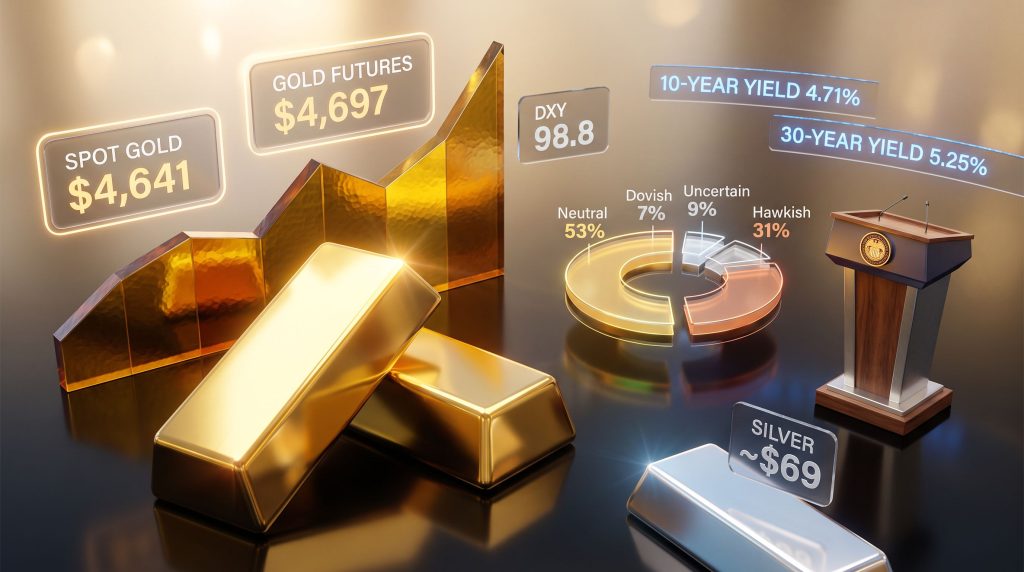
In the days preceding the scheduled address, the 10-year Treasury yield slipped to approximately 4.71% while the 30-year eased to around 5.25%. Neither move was triggered by fresh economic releases. Bond traders were unwinding positioning established the previous week, a form of tactical de-risking ahead of an event that carries genuine uncertainty. This is a subtle but important distinction: gold moved on the anticipation of information rather than on information itself.
Simultaneously, the Dollar Index (DXY) settled near 98.8, close to a three-month low. A weaker dollar lowers the local-currency price of gold for buyers transacting in euros, yen, yuan, and a wide range of emerging market currencies. This mechanism effectively expands the global pool of demand for bullion without requiring any change in sentiment from US-based investors. When yield compression and dollar weakness occur at the same time, their effects on gold compound rather than simply add together, which helps explain why spot gold reached approximately $4,641 and gold futures pushed to around $4,697, the highest levels in over three months, even while nominal long-term yields remain historically elevated.
Key Insight: Gold trading near multi-month highs despite a 10-year yield above 4.7% is not a paradox. Short-term positioning models weight the direction of yield change more heavily than the absolute level, and a falling yield in a high-yield environment carries outsized psychological weight for traders managing cost-of-carry exposure.
Silver, holding near $69, adds a second layer of complexity to this picture. Unlike gold, silver is simultaneously a monetary metal and an industrial input, consumed extensively in solar panels, electronics, and EV components. This dual demand structure means silver's price response to policy signals is typically sharper in percentage terms than gold's, a higher-beta characteristic that creates distinct volatility profiles for each metal across different scenarios. In addition, gold-silver ratio analysis reveals further nuances about how these metals perform relative to one another during periods of policy uncertainty.
Why the Warsh Jackson Hole Speech Carries Unusual Signal Value
The Kansas City Federal Reserve's annual Jackson Hole Economic Symposium has historically served as a platform for consequential policy pivots. The 2022 address preceded an aggressive tightening cycle. The 2020 framework shift toward average inflation targeting was announced from the same stage. Markets have learned to treat this event as a venue where chairs say things that matter, which creates a self-reinforcing dynamic where positioning ahead of the event influences prices regardless of what is eventually said.
Fed Chair Kevin Warsh is scheduled to deliver his inaugural keynote as chair on Friday, August 28, 2026, at approximately 10:00 a.m. ET, pending the Kansas City Fed's official agenda confirmation. The timing places the address 19 days before the September 16 Federal Open Market Committee policy decision, close enough to the pre-meeting blackout window's outer boundary that any guidance, even implicit, carries direct relevance for near-term rate expectations. According to analysis from Barron's, the speech is being closely watched for signals about how Warsh will balance inflation control with broader economic stability.
What elevates this particular address beyond a typical Jackson Hole appearance is the absence of any prior behavioural data. Warsh has not yet established a public communication pattern as chair. Market participants cannot reverse-engineer his likely tone from past press conferences or statement language because none exist in this context. The speech itself becomes a disproportionately large source of new information, amplifying the signal value of whatever tone he adopts.
A Bank of America fund manager survey conducted in August 2026 captured the consensus distribution of expectations:
| Market Expectation | Share of Surveyed Fund Managers |
|---|---|
| Neutral, big-picture tone | 53% |
| Hawkish language | 31% |
| Dovish signals | 7% |
| Uncertain / No view | 9% |
The majority expectation for a measured, framework-oriented address is not a neutral outcome for markets. The asymmetry is what matters: a neutral result changes very little about gold's current trajectory, while a surprise in either direction carries impact disproportionate to the probability assigned to it.
The Wednesday Data Problem: Core PCE and GDP Before Friday
Two high-impact economic releases arrive on Wednesday, August 27, two days before the keynote address, and both carry the potential to recalibrate the pre-speech context meaningfully.
1. Core PCE Inflation (Month-over-Month)
- Consensus expectation: +0.2% month-over-month
- The threshold considered sufficient to shift September rate-hike probability materially higher: +0.3% or above
- Core PCE is the Federal Reserve's preferred inflation gauge, making any surprise reading particularly consequential for how markets frame Warsh's subsequent remarks
2. Second-Quarter GDP Revision (Second Estimate)
- The advance estimate showed annualised growth decelerating to 1.5%
- The revision could move in either direction depending on updated trade and inventory data
- A downward revision reinforces the growth deceleration narrative; an upward revision complicates the case for near-term rate relief
The combination of genuine uncertainty across both releases, before a speech by a chair with no established track record, creates an unusually wide distribution of possible outcomes entering Friday morning.
Scenario Planning:
- Core PCE at 0.3%+ with GDP revised higher: hawkish setup entering Friday; gold faces pre-speech headwinds
- Core PCE at 0.2% with GDP revised lower: dovish setup entering Friday; gold likely extends recent gains
- Mixed data: Warsh's tone becomes the sole interpretive anchor; event-driven volatility risk is highest
Three Scenarios for Gold and Silver After the Speech
Scenario 1: Neutral Tone (Base Case, ~53% Probability)
A broad economic framework discussion with acknowledgment of inflation progress but no explicit rate guidance would leave the existing supportive forces for gold largely intact. Yields and the dollar would likely remain stable near current levels, and bullion would hold its recent gains without adding meaningfully to them. Silver would likely be similarly anchored, with industrial demand providing a price floor.
Scenario 2: Hawkish Surprise (~31% Probability)
Any language that emphasises inflation persistence, signals rate cuts are not near, or suggests the Fed is operating independently of market pricing expectations would likely push yields and the dollar higher simultaneously. This would increase gold's cost-of-carry burden and reduce demand from international buyers through a stronger dollar, creating near-term downward pressure on bullion. Gold in volatile markets has, however, demonstrated resilience even under hawkish conditions, a pattern worth bearing in mind. The magnitude of any pullback would depend on how far market positioning had already shifted toward a dovish interpretation entering Friday.
Scenario 3: Dovish Surprise (~7% Probability)
Acknowledgment of growth risks, signals of flexibility on the rate path, or any framing suggesting conditions for easing are approaching would likely compress yields and the dollar further, extending both existing tailwinds simultaneously. Silver, given its higher beta to risk-on conditions, could potentially outperform gold in percentage terms in this scenario.
| Scenario | Warsh Tone | Yield Direction | Dollar Direction | Gold Outlook | Silver Outlook |
|---|---|---|---|---|---|
| Base Case | Neutral | Stable | Stable | Holds current levels | Holds current levels |
| Hawkish Surprise | Hawkish | Higher | Stronger | Near-term pullback | Follows gold lower |
| Dovish Surprise | Dovish | Lower | Weaker | Extends rally | Outperforms gold |
The Structural Layer That Persists Regardless of Friday's Outcome
Beneath the event-driven setup lies a longer-duration structural argument that does not resolve on any particular Friday morning. When a government's borrowing costs grow large enough that the central bank's own communication posture begins to influence fiscal sustainability, the traditional independence of monetary policy from fiscal considerations starts to erode in practice, even if it is preserved in institutional language.
The US national debt crossing $40 trillion in August 2026 illustrated this dynamic in quantitative terms. Investment bank Jefferies cited fiscal arithmetic rather than Fed policy as the primary reason for turning bullish on gold in the same week. The Treasury's bond buyback programmes, designed to manage the yield curve by reducing long-end supply, have struggled to contain long-end yields on their own. The 30-year sitting at 5.25% despite active intervention suggests that market-based fiscal tools alone are insufficient.
Consequently, the Fed's posture has become an implicit variable in the borrowing cost equation. Central bank influence over gold pricing is therefore not merely cyclical but structural, reinforcing why bullion demand persists even when conventional rate models might suggest otherwise.
This matters for gold because it represents a qualitatively different environment from a standard rate cycle. In a typical cycle, gold responds to rate expectations and then normalises when the cycle turns. In an environment where the central bank's communication has fiscal consequences, the structural incentive to hold assets denominated outside any single currency system persists across cycles rather than resetting between them.
Structural Perspective: The CFTC positioning data as of August 11 revealed that gold's short book had thinned to roughly 64% of its normal level, while silver's remained near 87%. This divergence suggests that the short-covering cushion protecting gold from sharp drawdowns is considerably thinner than silver's, a nuance that carries direct implications for how each metal responds to a hawkish surprise.
The next major ASX story will hit our subscribers first
What Sophisticated Investors Are Watching Beyond the Headline
Several less-discussed dynamics are relevant to understanding the full picture around the Warsh Jackson Hole speech and gold prices:
-
Pre-event yield movements as positioning signals: The basis-point declines observed in the days before the speech were not data-driven. They reflect bond traders unwinding Friday's yield increase, which itself was driven by positioning. Gold investors who understand this can distinguish between durable fundamental shifts and temporary repositioning that may partially reverse after the event.
-
The non-linearity of gold's yield sensitivity: At historically elevated yield levels, even small basis-point declines carry outsized psychological weight for traders managing cost-of-carry models. This non-linearity means gold can outperform relative to what a simple yield-spread model would predict.
-
Dollar weakness as a demand multiplier: A softer dollar does not merely reduce the effective cost of gold for foreign buyers. It also signals to global capital that US assets may be losing relative attractiveness, which can trigger allocations into alternative stores of value including bullion. Furthermore, gold safe-haven demand tends to accelerate when dollar weakness coincides with institutional uncertainty, amplifying the effect beyond what currency mathematics alone would suggest.
-
Silver's industrial demand floor: While gold's price is almost entirely driven by investment and monetary demand, silver's industrial consumption creates a price floor that operates independently of policy expectations. This floor is not visible during rallies but becomes relevant during pullbacks, making silver's risk-reward profile distinctly different from gold's in a hawkish surprise scenario. Analysts at Investing.com note that Warsh's first address will be pivotal in determining how both metals are positioned heading into the autumn policy window.
Frequently Asked Questions
What time does Warsh speak at Jackson Hole?
Fed Chair Kevin Warsh is scheduled to deliver his keynote at the Jackson Hole Economic Symposium on Friday, August 28, 2026, at approximately 10:00 a.m. ET, subject to the Kansas City Federal Reserve's official agenda confirmation.
Why does the Jackson Hole speech affect gold prices?
Gold's price is sensitive to changes in real yields and the US dollar, both of which respond to Federal Reserve policy signals. A speech that shifts rate expectations alters the opportunity cost of holding gold and influences the dollar's trajectory, creating direct transmission channels into bullion pricing.
What is the current gold price ahead of the speech?
As of August 24, 2026, spot gold was trading near $4,641 and gold futures reached approximately $4,697, the highest levels in more than three months. Silver was holding near $69.
What would a hawkish Warsh speech mean for gold?
A hawkish tone would likely push Treasury yields and the dollar higher, increasing the cost of holding non-yielding gold and strengthening the currency in which gold is priced internationally. This combination typically creates near-term downward pressure on bullion.
What economic data should gold investors watch before Friday?
Core PCE inflation and the second-quarter GDP revision both arrive on Wednesday, August 27. A core PCE reading of 0.3% or higher would likely shift September rate-hike expectations and could create headwinds for gold entering the speech.
How does the Dollar Index level affect gold demand globally?
With the DXY near 98.8, close to a three-year low, the local-currency cost of gold is lower for buyers in most major economies. This widens the effective demand pool for bullion without requiring any change in US investor sentiment, acting as a meaningful and often underappreciated tailwind for prices.
Disclaimer: This article is intended for informational and educational purposes only and does not constitute financial or investment advice. All figures and forecasts referenced are based on information available as of the publication date. Past performance is not indicative of future results. Readers should consult a qualified financial professional before making any investment decisions.
Want to Stay Ahead of the Next Major Mineral Discovery Before the Market Reacts?
While macro forces like central bank policy and yield movements shape the broader investment landscape, Discovery Alert's proprietary Discovery IQ model cuts through the noise by delivering real-time alerts on significant ASX mineral discoveries — turning complex data across 30+ commodities into clear, actionable opportunities. Start your 14-day free trial today and see why historic discoveries have generated extraordinary returns for investors who moved early.