June 17, 2026
The Hidden Architecture Behind the Gold Market's Most Misunderstood Moves
Most investors tracking gold in 2025 are watching the wrong signal. The fixation on spot price, moving averages, and rate expectations creates a form of analytical tunnel vision that misses the far more consequential transformation reshaping global finance from the ground up. The real question is not whether gold is in a bull market. The real question is whether gold pricing power moving east represents a slow-motion revolution in what counts as trustworthy collateral.
That distinction matters enormously. When banks lend to each other, when central banks manage reserves, when derivatives are cleared across counterparties, none of these transactions run on money. They run on assets the system trusts enough to pledge against obligations. For the past five decades, that trust has been overwhelmingly concentrated in one instrument: US Treasury securities. What is changing now, gradually but unmistakably, is the composition of that collateral layer.
Understanding this shift is the key to understanding gold pricing power moving east, silver's structural position, and why gold and mining equities are behaving so counterintuitively against a backdrop of record sovereign accumulation.
When big ASX news breaks, our subscribers know first
From Bretton Woods to the Collateral State: How We Got Here
The post-Bretton Woods transition did not simply replace gold with the dollar. It replaced gold-backed settlement with a more elaborate system anchored to US government debt. Through the expansion of repo markets, derivatives clearing, and reserve management practices, Treasury securities became the world's dominant collateral instrument. A key mechanism in this dominance was rehypothecation, the practice of re-pledging collateral that has already been pledged, which effectively multiplied the systemic reach of Treasuries far beyond their face value.
The Bank for International Settlements has described modern finance as a market-based credit system in which the transformation and re-use of high-grade securities through repo and securities lending have replaced traditional deposit intermediation as the core funding mechanism. Within that framework, the currency you hold matters less than the collateral backing it.
This is the conceptual foundation of what veteran commodities trader and author Vincent Lansancy argues in his recently published book on the hidden plumbing of the global financial system. His central thesis is that the financial system runs not on money but on trust, and absent trust, on collateral. The distinction between the two is not semantic. It reframes every major trend in global finance since 2022.
The 2022 Inflection: When Political Risk Entered the Reserve Calculus
The freezing of Russian sovereign assets following the Ukraine conflict introduced a variable that reserve managers had not seriously modelled before: political neutrality risk. Assets held within Western financial infrastructure had always been assumed to be politically inert. That assumption collapsed overnight. Nations that had been quietly diversifying their reserve compositions suddenly had a concrete, real-world demonstration that Treasury securities and dollar-denominated reserves could be rendered inaccessible by geopolitical decree.
Central bank gold demand in 2022 reached an estimated 1,136 tonnes, the highest annual net buying figure since records began in 1950, according to the World Gold Council. The following year, 2023, saw purchases of 1,037 tonnes, marking two consecutive years above the 1,000-tonne threshold. These purchases occurred across widely varying price levels, through rallies and corrections alike, which tells you immediately that sovereign buying is not momentum-driven. It is balance-sheet strategy.
| Dimension | Pre-2022 Framework | Post-2022 Trajectory |
|---|---|---|
| Dominant Collateral | US Treasury Securities | Treasuries + Gold (expanding) |
| Reserve Asset Risk | Assumed politically neutral | Recognised as politically contingent |
| Gold's Institutional Role | Tier 2 reserve asset | Elevated to Tier 1 capital status |
| Marginal Gold Buyer | Speculative and ETF-driven | Sovereign and central bank-driven |
| Price Discovery Hub | London (LBMA) | Shifting toward Shanghai |
| Physical Vault Location | Western-dominated | Accelerating eastward migration |
Who Is Actually Buying Gold and Why the Pattern Is Broadening
The sovereign buyer landscape in 2025 looks materially different from even two years ago. China has been purchasing gold for 19 consecutive months as of mid-2025, and the most recent monthly acquisition was the largest volume recorded across that entire period. Critically, China purchased more gold at elevated price levels than it did during earlier, lower-priced accumulation phases. This is not speculative momentum-chasing. It reflects a multi-decade strategic reserve rebalancing running in parallel with a steady reduction in US Treasury holdings.
Poland now holds gold representing approximately 30% of its total reserve holdings, a benchmark figure that has made Eastern Europe one of the most significant regional accumulation stories of the current cycle. Kazakhstan, Brazil, and a widening cohort of emerging market central banks have entered or deepened their accumulation programmes.
The early wave of BRICS-led sovereign buying has diffused into a broader consensus. The marginal buyer of gold is no longer a small group of geopolitically motivated sovereigns. It is a widening circle of central banks reconsidering what reserve diversification actually means after 2022.
The Turkey episode requires separate analysis because it was widely misread. When Middle East tensions intensified and oil supply flows were disrupted, Turkey, which runs a significant current account deficit with substantial dollar-denominated obligations, was forced to liquidate gold holdings to meet its dollar funding requirements. Gold sold off, which appeared irrational given the geopolitical backdrop.
The mechanism was actually straightforward: Turkey needed dollars, held gold, and had no way to borrow against that gold without selling it first. The same nation subsequently repurchased gold but did not return to US Treasuries, which tells you something important about the durability of reserve diversification even under stress. The more consequential observation is what this episode reveals about a structural gap in the current system, a gap that the concept of HQLA designation is designed to close.
The HQLA Question: Gold's Missing Regulatory Upgrade
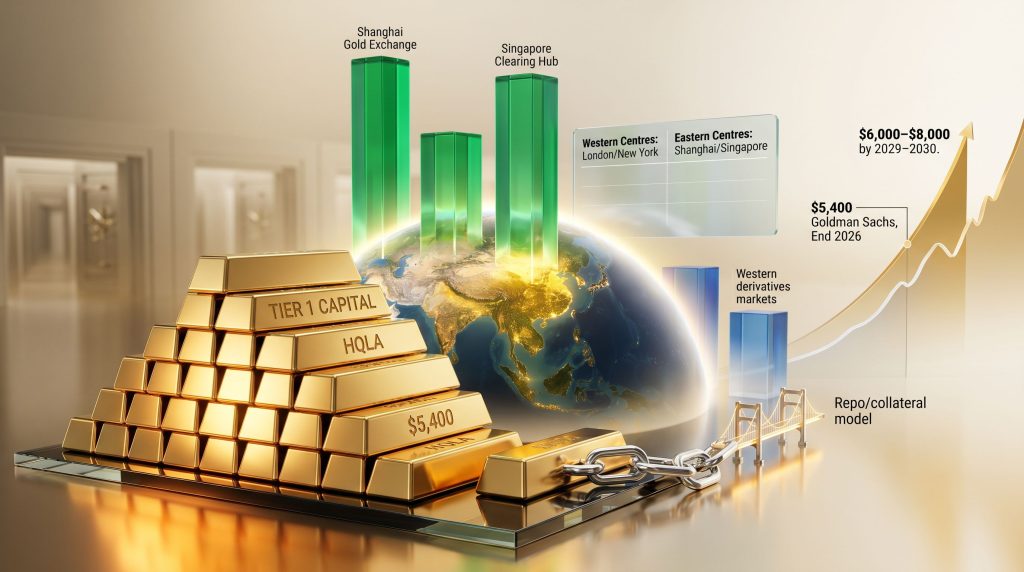
Approximately 18 months prior to mid-2025, gold was elevated to Tier 1 capital status, meaning banks can carry it on their books at full value. This was a meaningful regulatory upgrade, but it did not resolve the deeper limitation. Tier 1 designation does not permit gold to be used as financing collateral. It cannot currently be pledged in repo transactions. The gap between being recognised as a high-quality asset and being usable as a pledging instrument is the central constraint on gold's role in the financial system.
HQLA, or High Quality Liquid Asset, is the regulatory classification that determines which assets can serve as collateral in financial transactions. US Treasury securities hold this classification. Gold does not, despite the fact that its liquidity, depth, and global acceptance arguably qualify it. The institutional resistance to granting gold full HQLA status is less about the asset's quality than about preserving the structural advantage of dollar-denominated debt instruments in global collateral markets.
The practical implication is significant. Consider the following scenario: an African nation with substantial gold reserves needs to finance highway construction. Under the current framework, it must pledge Treasury securities to access the loan. Under a gold-as-HQLA framework, it could pledge its gold holdings, retain the asset, and access the capital. This is precisely the model being advocated within certain spheres of infrastructure finance for Belt and Road partner nations: pledge gold, build infrastructure, retain the asset.
If gold achieved full HQLA status, the forced-sale dynamic that periodically suppresses both gold and silver prices would be eliminated. Nations facing liquidity crises would borrow against their gold rather than sell it. The Turkey episode would not have played out the way it did.
Gold Pricing Power Moving East: The Geographic Reordering of Price Discovery
The physical vault migration that began between roughly 2017 and 2020 was the earliest visible signal of gold pricing power moving east. Significant volumes of physical gold relocated from Western storage centres to Asian vaults during this period. This was not a logistical adjustment. It represented a transfer of physical control that historically precedes pricing influence, as observers of Asian commodity markets have well documented.
The institutional confirmation of this shift arrived when JP Morgan and Deutsche Bank announced a joint venture to establish a Singapore-based gold clearing hub for Asian markets. This is a landmark acknowledgement by major Western financial institutions that the centre of gravity in physical gold price formation has moved. The LBMA and COMEX markets in London and New York retain their legacy role as reference benchmarks, but directional price moves are increasingly originating during Asian trading sessions, with Western markets reacting.
| Dimension | Western Centres (London/New York) | Eastern Centres (Shanghai/Singapore) |
|---|---|---|
| Primary Instrument | Paper and derivatives contracts | Physical allocated gold |
| Buyer Profile | Institutional, speculative, ETF-driven | Sovereign, industrial, long-term |
| Price Discovery Role | Legacy reference benchmark | Emerging physical price formation |
| Vault Infrastructure | Historically dominant | Rapidly expanding |
| Regulatory Posture | HQLA-resistant | Actively promoting gold collateral use |
| Clearing Innovation | Established but static | Singapore hub expansion underway |
Collateral Multipolarity: The Framework That Replaces the Dollar Debate
The dominant narrative in gold-bullish circles, that the dollar is being displaced, fundamentally misreads the transition underway. The dollar will remain the world's primary transaction currency. What is changing is the composition of assets that underpin confidence in dollar-denominated instruments.
A more precise framing is collateral multipolarity: a world in which Treasury securities, gold, and potentially commodity-backed assets and digital instruments all serve as reserve collateral simultaneously. The stablecoin connection is instructive here. A digital dollar wallet backed by a basket of Treasuries, gold, and other assets represents a practical implementation of this principle. The currency denomination remains dollars. The reserve composition behind it diversifies. The currency label stays constant while the collateral architecture beneath it evolves.
| Asset Class | Current Collateral Role | Projected Trajectory |
|---|---|---|
| US Treasury Securities | Dominant global collateral | Remains important, share declining |
| Gold | Tier 1 capital, not yet repoable | Expanding role, HQLA designation pending |
| Silver | Emerging reserve asset in select jurisdictions | Potential collateral role as gold matures |
| Bitcoin | Speculative reserve in some jurisdictions | Uncertain; institutional adoption variable |
| Commodity-Backed Assets | Limited current role | China-driven expansion via infrastructure financing |
The next major ASX story will hit our subscribers first
Silver's Structural Position: The High-Beta Case
The gold-silver ratio has compressed from the 80 to 90 range down toward 60 to 70, a meaningful directional shift even if the ratio remains elevated by historical standards. In nature, gold and silver occur at ratios estimated between roughly 15:1 and 40:1 depending on the geological source, which provides a long-run reference point for how far further compression could run if silver's monetary reclassification accelerates.
Silver's unique challenge is that it sits at the intersection of industrial demand and monetary demand, and those two forces collided sharply in early 2025. China's electrification mandate created a structural floor under physical silver demand, with solar panel manufacturing, electronics, and grid infrastructure competing for supply. When a UBS-managed investment fund structured around silver exposure attracted speculative inflows at the same time industrial buyers were already struggling to source material, the result was a silver squeeze that required regulatory intervention.
Chinese authorities shut down the fund, restricted access to related investment products, introduced capital controls, and India moved simultaneously to restrict silver purchases. The intervention restored stability but also demonstrated exactly how tight the physical market had become. The just-in-time nature of silver supply, with minimal inventory buffer relative to industrial throughput requirements, creates a system with very little tolerance for demand shocks.
The longer-term silver thesis rests on the same HQLA logic as gold. Russia's central bank is already storing silver as a reserve asset. If gold achieves full repoability, silver follows into reserve status with a lag, and the forced-sale dynamic that periodically suppresses prices disappears. At gold prices approaching $10,000, silver's natural ratio compression could mathematically imply prices approaching $300, though this is a scenario projection rather than a prediction, and carries significant uncertainty across multiple dimensions.
Investors should note that all price projections discussed in this article represent illustrative scenarios based on ratio analysis and institutional forecasts. They are not investment advice and should not be treated as reliable indicators of future performance.
Mining Equities: Capital Competition and the Seasonal Recovery Thesis
Gold mining stocks began outperforming earlier in 2025 before reversing sharply, and the explanation has little to do with deteriorating fundamentals. The primary driver is capital allocation competition. The SpaceX IPO pipeline and sustained AI sector momentum are absorbing speculative capital that would ordinarily rotate into resource equities during periods of metal price strength. When a high-conviction technology narrative is generating strong returns, mining stocks, particularly smaller producers, lose the attention competition.
The seasonal recovery thesis centres on Q4 2025. Historically, gold demand strengthens in the fourth quarter as physical buying cycles resume across Asian and Middle Eastern markets. If gold's price momentum resumes on that schedule, mining equities, particularly unhedged, smaller-capitalisation producers, are positioned to deliver leveraged upside relative to the metal itself. The key qualifier is time horizon. These are positions appropriate for multi-year holds, not tactical trades calibrated to quarterly earnings cycles.
Critical Minerals Headlines Relevant to the Broader Sector
Several adjacent stories carry direct relevance to the mining investment thesis:
- A Global Witness report has identified coltan from M23-controlled mines in eastern Democratic Republic of Congo as having entered international supply chains, raising sourcing compliance risks for technology and automotive companies dependent on the mineral.
- Generation Z consumers now account for approximately 25% of US natural diamond demand by value according to industry data, providing a demand-side catalyst for African diamond-producing nations facing structural pressure from synthetic alternatives.
- A PWC analysis has identified Canada as investing less in infrastructure than many global competitors, with potential multi-billion dollar annual spending gaps in critical minerals infrastructure representing a risk to its long-term positioning in the sector.
What the Major Banks Are Forecasting
Institutional price targets for gold have begun diverging, which itself is informative about the uncertainty in timing the next leg of the structural move.
| Institution | Current Target | Timeframe | Notes |
|---|---|---|---|
| Goldman Sachs | $5,400 | End of 2026 | Maintained, not yet revised lower |
| UBS | ~$5,000 | Medium-term | Revised down from ~$5,200 |
| JP Morgan | Not formally revised | 2025 | Signalling limited near-term upside |
| Citibank | Bullish | 18 months+ | Advising against buying the first dip |
Beyond near-term targets, multiple institutional forecasts in the $6,000 to $8,000 range remain active for the 2029 to 2030 window. These longer-horizon targets are not premised on dollar collapse. They are premised on collateral multipolarity, HQLA reclassification, and sustained sovereign accumulation continuing to compound. The structural case does not require a crisis to validate. It requires only the continuation of trends that are already in motion and already being confirmed by central bank behaviour quarter after quarter.
The current correction mirrors the 2022 pattern with notable precision. In 2022, gold experienced five consecutive months of decline following the onset of Federal Reserve tightening. The current cycle is playing out against rate expectation shifts rather than actual hikes, but the market psychology is analogous. Furthermore, the critical difference is that this correction is occurring against a backdrop of accelerating central bank accumulation, not decelerating, which changes the character of what a recovery looks like when seasonal and rate dynamics shift.
The Collateral Is the Story. The Price Is the Symptom.
Every major puzzle in the gold market in 2025, the apparent safe-haven failure during the Middle East crisis, the persistent sovereign buying at elevated prices, the geographic migration of vaults and clearing infrastructure, the silver market squeeze and its regulatory resolution, resolves cleanly once you adopt the collateral framework rather than the price framework. Consequently, gold's eastward shift in pricing is best understood not as a geopolitical story but as a structural one rooted in collateral architecture.
The IMF's dollar share data, which shows the US dollar's portion of global foreign exchange reserves declining from roughly 71% in 1999 to approximately 59% by 2022, does not describe a dollar in crisis. It describes a system in the early stages of collateral diversification. The above-ground gold stock of roughly 208,874 tonnes against annual mine production of 3,000 to 3,600 tonnes means gold's stock-to-flow ratio is unlike any other commodity, which is precisely what makes it suited for collateral rather than consumption roles.
The HQLA designation question will ultimately be answered by geopolitical and regulatory dynamics that cannot be precisely timed. However, the direction of travel, from gold as a peripheral reserve asset toward gold as a repoable, pledgeable, systemically integrated collateral instrument, appears to be one of the more durable structural trends in global finance. The gold pricing power moving east before the regulatory recognition has formally arrived is a sequencing worth watching closely.
This article contains forward-looking statements, price projections, and scenario analyses that involve significant uncertainty. Nothing in this article constitutes financial or investment advice. Readers should conduct their own due diligence and consult qualified financial professionals before making investment decisions.
Want to Know When the Next Major ASX Mineral Discovery Hits the Market?
Discovery Alert's proprietary Discovery IQ model delivers real-time alerts on significant ASX mineral discoveries, cutting through the complexity of over 30 commodities into one clear, actionable metric — so investors can position themselves ahead of the broader market. Explore historic discoveries and their returns, then begin a 14-day free trial at Discovery Alert to gain your market-leading edge.