June 16, 2026
Why Gold Is Rising as the Dollar and Bond Yields Slip
Markets rarely move on a single headline alone. Gold, currencies, bonds, and oil are connected through a chain of expectations about inflation, central bank policy, and global risk appetite. That is the best lens for understanding why gold climbs as Middle East ceasefire hopes pressure dollar and bond yields has become a defining macro theme.
Rather than seeing gold purely as a fear trade, it is more accurate to view it as a price-sensitive asset sitting at the intersection of three forces:
- Real and nominal interest rates
- U.S. dollar direction
- Geopolitical and energy-market uncertainty
When those forces align, gold can rise even when the immediate news appears less alarming. That is exactly what happened as easing conflict expectations in the Middle East helped pull oil lower, weakened the U.S. dollar, and nudged Treasury yields down, improving the backdrop for bullion.
"Gold often reacts less to today's headline than to what that headline may do to tomorrow's inflation path, bond market pricing, and Federal Reserve expectations."
When big ASX news breaks, our subscribers know first
The Geopolitical Shift Behind the Move
A reduction in regional tensions between Israel and Lebanon helped improve sentiment around the possibility of broader de-escalation involving Iran. That mattered well beyond the region itself because energy flows remain central to global inflation expectations.
Reports of a ceasefire agreement between Israel and Lebanon raised hopes that disruption risks linked to the Gulf could ease. In response, oil prices fell by more than 3%, reflecting optimism that the Strait of Hormuz might remain open or face less risk of disruption.
Why the Strait of Hormuz Matters So Much
The Strait of Hormuz is one of the world's most important maritime chokepoints. Roughly one-fifth of globally traded oil moves through it, making it a crucial transmission channel between regional conflict and global inflation.
If markets believe the route is safer, several knock-on effects can follow:
- Oil prices may fall
- Inflation expectations may soften
- Treasury yields may decline
- The dollar may lose some defensive support
- Gold may get support from lower yields and a weaker greenback
This is why hopes of de-escalation can still support gold in the near term. The market is not simply removing a war premium. It is also repricing inflation risk and future rate expectations. Furthermore, these gold safe-haven dynamics remain a critical lens through which traders interpret geopolitical developments.
How Dollar Weakness Supports Gold Prices
Gold is generally priced in U.S. dollars. That creates a mechanical relationship between bullion and the greenback that traders monitor closely.
On the day in focus, the dollar eased about 0.3%, even while remaining near a two-month high. That move made dollar-denominated gold cheaper for buyers using euros, yen, yuan, or other currencies, increasing gold's affordability outside the United States.
The Currency Accessibility Effect
A softer dollar can boost gold through simple purchasing power math:
- Gold is quoted globally in dollars.
- A weaker dollar lowers the local-currency cost of gold for non-U.S. buyers.
- Broader international buying interest can then support spot prices.
This does not guarantee an immediate surge, but it often creates a favourable short-term tailwind.
Why the Dollar Still Caps the Upside
It is also important not to overstate the bullish case. The dollar may have slipped on the day, but it was still hovering near a recent high. That matters because a resilient dollar can limit how far gold rallies, particularly if U.S. economic data stays firm.
"A weaker dollar can help gold bounce, but a still-strong dollar backdrop can also keep that bounce from becoming a full-blown breakout."
Where Gold and Other Precious Metals Stand Now
Current market pricing showed broad strength across the precious metals complex, not just in bullion.
| Instrument | Price | Daily Move |
|---|---|---|
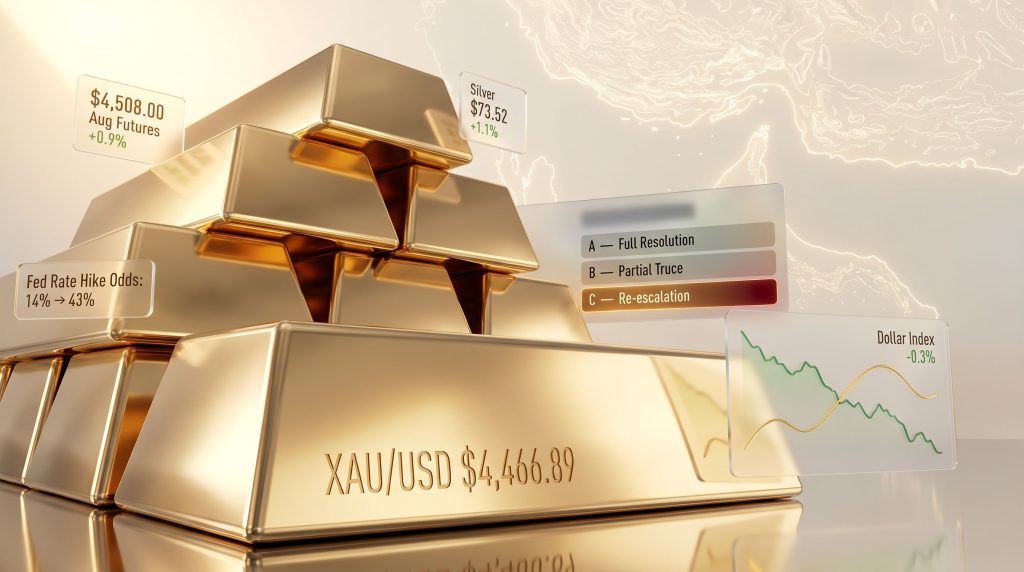
| Spot Gold | $4,466.89/oz | +0.8% |
| U.S. Gold Futures, August | $4,508.00/oz | +0.9% |
| Spot Silver | $73.52/oz | +1.1% |
| Platinum | $1,877.66/oz | +1.0% |
| Palladium | $1,313.50/oz | +0.9% |
Gold was holding just above its 200-day moving average, a closely watched technical level that many discretionary traders and systematic funds use to gauge longer-term trend health.
Why the 200-Day Moving Average Matters
The 200-day moving average is often viewed as a dividing line between structural strength and deeper weakness.
If gold holds above it, traders may interpret that as:
- Trend resilience
- Ongoing institutional support
- A potential base-building phase after a correction
A decisive break below it, by contrast, can trigger trend-following selling or reduce conviction among momentum traders.
How Far Gold Has Already Fallen
Gold previously reached a gold record highs of $5,594.82 per ounce on January 29, 2026. Since the Iran conflict intensified in late February, the metal has fallen about 16% from that peak.
That correction is important context. Gold is recovering within a broader pullback, not yet proving that a new leg higher has fully begun.
Why Lower Bond Yields Help Non-Yielding Gold
Gold does not pay interest. That simple fact is central to its relationship with bond markets.
When Treasury yields fall, the opportunity cost of holding gold also falls. Investors give up less income by allocating money to bullion instead of bonds, which can make gold comparatively more attractive. In addition, understanding gold and bond dynamics can help investors better anticipate how rate movements translate into price action.
On this move, lower U.S. Treasury yields, including the 10-year note, helped reinforce the supportive conditions created by a softer dollar.
The Opportunity Cost Framework
A useful way to think about gold is to compare it with safe government debt:
- If yields are rising, income-generating assets look more appealing than gold.
- If yields are falling, gold becomes more competitive as a store of value.
- If yields fall because inflation fears also ease, gold can still benefit in the short term if the dollar weakens at the same time.
This explains why gold sometimes rises during periods of calming geopolitical stress. Markets may rotate away from the dollar and into alternative defensive assets if rate expectations become less aggressive.
The Biggest Headwind: Inflation and Federal Reserve Risk
The near-term obstacle for gold is not hard to identify. If U.S. inflation proves sticky and the labour market remains strong, the Federal Reserve has less room to ease policy and may even need to keep rates higher for longer.
That would be a challenge for bullion.
Why Jobs Data Matters So Much
The upcoming May U.S. employment report is a major catalyst because it may help shape market thinking about the labour market and the Fed's next moves. A stronger-than-expected print could reinforce the idea that demand remains firm enough to sustain inflation pressure.
Research cited in the outline points to:
- More than 170,000 new jobs as an expected benchmark
- A jump in year-end Fed rate hike probability from about 14% to about 43%
- Persistent concern that energy-related inflation could reappear if Gulf disruptions return
Key Macro Indicators to Watch
| Indicator | Earlier | Current / Latest |
|---|---|---|
| Fed rate hike probability by year-end | ~14% | ~43% |
| May nonfarm payroll estimate | n/a | 170,000+ |
| Oil price move after ceasefire hopes | Elevated | Down 3%+ |
| Dollar Index move | Near 2-month high | -0.3% |
These figures help explain the tension in the outlook. Gold is benefiting from a softer daily macro setup, but still faces a structural challenge if U.S. data keeps pushing rates higher.
"This is the central paradox for gold in 2026: falling immediate stress can help bullion bounce, yet strong growth and sticky inflation can still undermine the metal through tighter monetary policy."
The next major ASX story will hit our subscribers first
Three Scenarios for Gold if Middle East Tensions Evolve
Future gold direction depends heavily on whether regional calm becomes durable or proves temporary.
| Scenario | Ceasefire Outcome | Oil Market Effect | Likely Gold Reaction |
|---|---|---|---|
| A | Broad, durable resolution | Energy prices ease sharply | Bearish to neutral |
| B | Partial or fragile truce | Oil remains volatile | Range-bound to mildly bullish |
| C | Renewed escalation | Supply fears intensify | Strongly bullish |
Scenario A: Durable De-escalation
If a lasting settlement reduces risk around Iran and the Strait of Hormuz, oil could stay lower for longer. That may cool inflation fears and reduce one of the main reasons investors hold gold as a macro hedge.
However, lower inflation does not automatically mean a gold rally. If the market instead concludes that real yields stay firm and safe-haven demand fades, gold could struggle.
Scenario B: Fragile Stability
This is arguably the most realistic middle ground. A truce may hold just enough to keep oil from spiking, but not enough to remove geopolitical risk entirely. In that setting, gold may trade sideways with sharp reactions to each new headline.
Scenario C: Re-escalation
If tensions flare again and threaten shipping routes, oil could quickly reprice higher. That would likely revive inflation fears, increase broader market anxiety, and potentially send gold back toward prior highs.
An experienced independent metals trader cited in market coverage argued that fresh record highs this year look harder to achieve unless broader peace conditions alter the energy and inflation picture materially. That point is notable because it flips a common assumption. In this framework, not every crisis headline is bullish forever, and not every easing of tensions is immediately bearish.
What Broad Precious Metals Strength Is Signalling
Silver outperformed gold on the day, rising 1.1% versus gold's 0.8% gain. Platinum and palladium also advanced.
That pattern can suggest a market that is not purely chasing panic protection. Instead, traders may be expressing a blend of:
- Weaker dollar positioning
- Improved commodity sentiment
- Lower yields
- Selective risk appetite across hard assets
Silver often behaves as both a monetary metal and an industrial metal, so relative strength there can imply a wider pro-metals mood rather than a single-asset gold trade. Furthermore, central bank gold demand continues to provide a structural layer of support beneath these shorter-term price movements.
What Traders Are Watching Next
The next major catalyst is the U.S. labour report, followed by how bond yields and the dollar respond.
Short-term traders are likely focused on three checkpoints:
- Payroll growth above or below the 170,000 area
- Treasury yield reaction, especially in the 10-year note
- Whether gold can stay above the 200-day moving average
If jobs data is hot and yields rebound, gold may struggle to extend gains. If employment data disappoints and rate expectations soften, the current move may gain momentum.
One major bank has reportedly lowered its short-term gold target to $4,000 per ounce, citing persistent inflation pressures and continued uncertainty around Hormuz-related disruption as constraints on a sustained rally. That does not guarantee a decline, but it shows how divided the market remains.
FAQ: Gold, Rates, and Geopolitics
Why does gold rise when the dollar falls?
Because gold is priced in dollars, a weaker greenback reduces the cost for buyers in other currencies, often increasing demand and supporting prices.
Why do falling bond yields help gold?
Gold offers no yield. When Treasury yields decline, investors sacrifice less income by holding bullion, improving gold's relative appeal.
Why is the Strait of Hormuz important for precious metals?
It is a critical oil transit route. Disruptions can raise energy prices, lift inflation expectations, and alter central bank policy expectations, all of which affect gold.
Would a Fed rate hike hurt gold?
Usually yes. Higher rates increase the opportunity cost of holding a non-yielding asset. Gold can still rise during hikes, but usually only if safe-haven demand is strong enough to offset that pressure.
Is gold still in a long-term bull market?
That remains unresolved. Gold is still well below its January 2026 peak after a roughly 16% pullback. The longer-term trend now depends on inflation, Fed policy, and whether Middle East risks fade or return.
Investor Takeaways and Risk Warning
For investors, the key lesson is that gold climbs as Middle East ceasefire hopes pressure dollar and bond yields is not a contradiction. It is a reflection of how interconnected modern markets are. Consequently, understanding gold in recession environments can also provide useful context when assessing gold's resilience across different macro backdrops.
The most important takeaways are:
- Gold's daily direction is still highly sensitive to the U.S. dollar
- Falling Treasury yields improve the case for non-yielding bullion
- Oil and Gulf shipping risks remain central to the inflation outlook
- Strong U.S. jobs data could quickly revive rate-hike fears
- The 200-day moving average is an important technical level to monitor
- A durable regional peace outcome could reduce some of gold's macro support
This article is for informational purposes only and should not be treated as personal financial advice. Market pricing, macro probabilities, and geopolitical expectations can change quickly. Forecasts, scenario analysis, and price targets are inherently uncertain, especially in periods shaped by conflict risk, central bank repricing, and volatile commodity markets.
Want to Capitalise on the Next Major Mineral Discovery Before the Broader Market Does?
Discovery Alert's proprietary Discovery IQ model delivers real-time alerts on significant ASX mineral discoveries, transforming complex mineral data into clear, actionable insights for investors at every experience level — explore historic discoveries that generated substantial returns and begin your 14-day free trial at Discovery Alert to position yourself ahead of the market.