
June 27, 2026
Why Mining Stocks Amplify Every Move in Precious Metals
Precious metals markets operate in long, grinding cycles that routinely frustrate investors chasing short-term price action. Gold and silver do not behave like technology stocks or growth equities. They function as monetary anchors, repositories of purchasing power that expand in relevance precisely when the financial architecture around them deteriorates. Understanding this distinction is the starting point for any serious analysis of a gold and silver miners ETF, because the investment logic flows directly from the monetary thesis rather than from quarterly earnings growth.
The operational leverage embedded in mining companies is not incidental. It is structural. When the gold price rises by 10%, a producer extracting ore at a fixed all-in sustaining cost does not see revenues increase by 10%. If the margin between production cost and spot price doubles, profits can increase by multiples of the underlying metal move.
This asymmetry is what draws sophisticated capital into mining equities during precious metals bull phases, and it is what makes the gold and silver miners ETF category one of the most tactically powerful tools available to investors who hold a constructive view on hard assets.
When big ASX news breaks, our subscribers know first
Understanding the Gold and Silver Miners ETF Category
How Mining ETFs Differ From Holding Physical Precious Metals
Owning physical gold or silver provides direct monetary insurance. The metal sits in a vault, carries no counterparty risk, and does not depend on management quality, operational efficiency, or geological luck. Comparing physical gold vs ETFs reveals that mining ETFs work differently — they provide equity exposure to companies whose profitability scales with the spread between production costs and prevailing metal prices.
A gold bar delivers a 1:1 return relative to spot price appreciation. A senior mining company operating with healthy margins might deliver two to four times that return during the same price advance. A junior miner advancing a high-grade deposit might deliver far more, while also carrying substantially greater risk of operational setbacks, financing challenges, or geological disappointment.
The Investment Case for Equity-Based Exposure to Gold and Silver
The equity route into precious metals suits investors who:
- Want leveraged participation in metal price cycles without using derivatives
- Prefer exchange-traded liquidity over the logistical complexity of physical storage
- Seek dividend income streams, however modest, generated by operating mining businesses
- Wish to access royalty and streaming companies whose revenue structures reduce operational risk
Mining ETFs bundle these characteristics into a single, diversified vehicle, removing single-stock selection risk while preserving the underlying leverage mechanism.
Why Miners Tend to Amplify Precious Metal Price Movements
The amplification effect operates through operating margin expansion. A mining company with all-in sustaining costs of roughly $1,800 per ounce and a gold price at $2,500 operates on a margin of $700. If gold advances to $3,000, that same operation now generates $1,200 per ounce in margin. The revenue from the mine increased by 20%, but the economic profit expanded by over 70%.
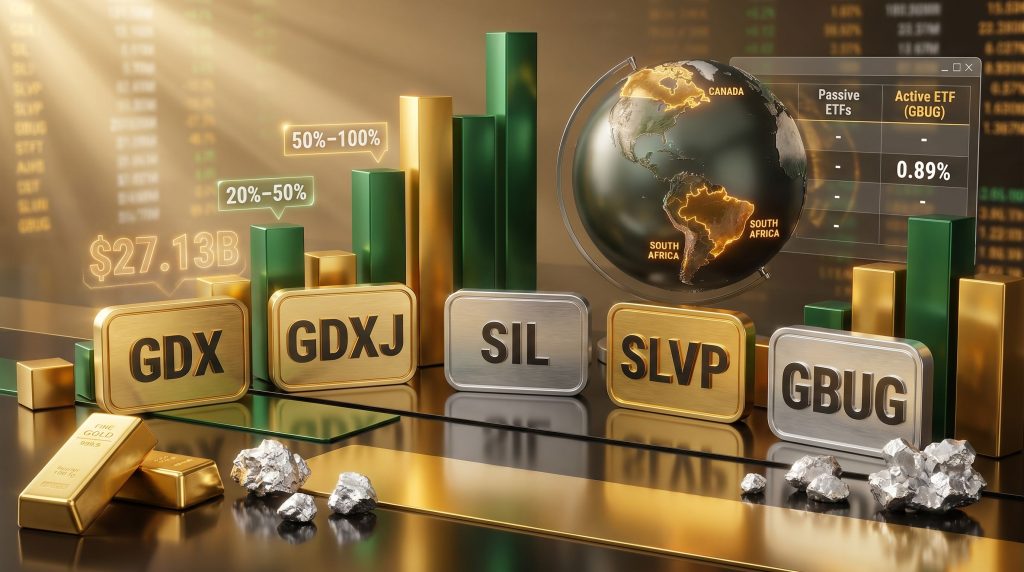
Furthermore, understanding the broader gold-stock market relationship helps contextualise why senior mining equities have historically delivered returns of 20% to 50% when gold and silver advance toward the upper boundary of consolidation ranges. Junior miners, with their higher cost structures and greater operational leverage, have historically extended that range to 50% to 100% in high-conviction cycle phases.
Key Insight: The leverage mechanism in mining stocks is not speculative framing. It is an arithmetic consequence of fixed-cost operations meeting a rising revenue environment. The math favours miners at every stage of a metals price advance, as long as operational execution holds.
The Major Gold and Silver Miners ETFs Compared
Overview of the Primary U.S.-Listed Options in 2026
The gold and silver miners ETF landscape offers investors a range of passive and active structures. The table below outlines the key structural characteristics of the primary vehicles available as of mid-2026.
| ETF Ticker | Full Name | Management Style | Primary Focus | Expense Ratio | Net Assets (May 2026) |
|---|---|---|---|---|---|
| GDX | VanEck Gold Miners ETF | Passive (Index) | Large-cap global gold miners | Low (index-tier) | ~$27.13B |
| GDXJ | VanEck Junior Gold Miners ETF | Passive (Index) | Small/mid-cap gold miners | Low (index-tier) | Variable |
| SIL | Global X Silver Miners ETF | Passive (Index) | Silver mining companies | Low (index-tier) | Variable |
| SLVP | iShares MSCI Global Silver & Metals Miners ETF | Passive (Index) | Global silver mining firms | Low (index-tier) | Variable |
| GBUG | Sprott Active Gold & Silver Miners ETF | Active | Gold + silver miners + royalty/streaming | 0.89% | Variable |
GDX: The Benchmark for Gold Mining Equity Exposure
GDX, managed by VanEck, tracks the MarketVector Global Gold Miners Index and functions as the industry benchmark for gold mining equity exposure. With approximately $27.13 billion in net assets as of May 29, 2026, it is one of the largest sector-specific ETFs globally.
Key structural features include:
- Concentrated exposure to large-cap, globally diversified gold producers
- Passive index replication with low portfolio turnover
- No K-1 tax form obligation for U.S. investors, a structural advantage over commodity partnership-structured vehicles
- High daily liquidity, making it suitable as both a core holding and a tactical trading instrument
GDXJ: Accessing the Junior Mining Tier
GDXJ targets smaller and mid-tier gold mining companies, capturing a segment of the market that carries elevated volatility relative to large-cap producers. The junior tier amplifies the leverage already embedded in senior miners. When gold and silver prices move, junior operators with lower production volumes but higher percentage margin sensitivity can generate outsized equity returns.
Critically, GDXJ also carries no K-1 reporting requirement, preserving the tax simplicity that makes ETF structures appealing to retail investors.
SIL and SLVP: Pure-Play Silver Mining Exposure
For investors who hold a specific thesis on silver rather than gold, SIL and SLVP provide targeted exposure. Considering silver's dual demand profile — monetary store of value combined with industrial utility in solar energy, electronics, and electric vehicle components — these instruments form the core investment thesis:
- SIL (Global X Silver Miners ETF) offers a diversified basket of companies whose primary revenue derives from silver production
- SLVP (iShares MSCI Global Silver and Metals Miners ETF) tracks an MSCI-constructed index with a similar silver-focused mandate
GBUG: The Actively Managed Alternative
Sprott Asset Management, a firm with deep institutional roots in precious metals markets, manages GBUG as an actively constructed portfolio combining gold miners, silver miners, and royalty and streaming companies within a single vehicle. The expense ratio of 0.89% reflects the cost of active stock selection and portfolio management.
The royalty and streaming overlay is a meaningful structural differentiator. Royalty companies provide financing to miners in exchange for the right to purchase a percentage of future production at pre-agreed prices, or to receive a revenue percentage without contributing to ongoing operational costs. This creates a risk profile that participates in metal price upside while insulating against the operational disruptions that periodically affect pure-play producers.
How Do Gold and Silver Miners ETFs Generate Returns?
The Leverage Mechanism: Why Mining Stocks Outperform the Metal
The operating leverage in mining companies stems from cost structure rigidity. Labour, energy, equipment, and permitting costs do not rise in proportion to gold prices. When spot prices advance, the incremental revenue flows disproportionately to the bottom line. This margin expansion is the engine behind the 20% to 50% senior miner move that precious metals analysts reference when gold advances toward the top of its trading range.
Revenue Sensitivity: Operating Margins and the Gold/Silver Price Relationship
A practical way to understand this dynamic is through margin sensitivity analysis. Analysing gold price and mining equities reveals precisely how significant this arithmetic becomes:
| Gold Price (per oz) | AISC (per oz) | Margin (per oz) | Margin Change vs. Base |
|---|---|---|---|
| $2,500 | $1,800 | $700 | Baseline |
| $3,000 | $1,800 | $1,200 | +71% |
| $3,500 | $1,800 | $1,700 | +143% |
The gold price moved 40% from $2,500 to $3,500 in this scenario. The mine's economic margin expanded by 143%. This is the arithmetic foundation of mining stock leverage.
Royalty and Streaming Companies as a Lower-Risk Complement
Structural Note: Royalty and streaming companies earn revenue as a percentage of mine production without bearing direct operational costs, capital expenditure obligations, or labour management responsibilities. During periods of operational disruption, cost blowouts, or geological setbacks at individual mines, these companies continue receiving their contracted revenue streams. This creates a stabilising effect within actively managed precious metals portfolios that include this category alongside direct producers.
What Macroeconomic Conditions Drive Gold and Silver Miners ETF Performance?
The Fiat Currency Erosion Thesis and Long-Term Metal Demand
Gold's performance against major global fiat currencies across 2024 and 2025 was structurally significant. The period represented a decisive repricing of monetary risk rather than a speculative episode. Analysts who have tracked long-term fiat-versus-gold relationships observe that while major advances in gold's purchasing power are typically followed by multi-year consolidation periods, the directional trend across decades consistently favours the metal.
The current consolidation phase is consistent with this historical pattern. Price congestion following a major advance is not evidence of trend failure. It is a normal feature of long-term bull markets, providing accumulation opportunities for investors who understand the underlying monetary dynamics at play.
Inflation Cycles, Stagflation Risk, and Commodity Shipping Dynamics
Several independent macro forces are converging to create a structurally supportive environment for hard assets:
- A 40-year inflation supercycle framework, beginning around 2020, suggests commodity-linked equities may remain elevated in strategic relevance for years ahead
- Geopolitical disruptions affecting major global shipping chokepoints have introduced stagflationary pressure that historically benefits monetary metals and their associated equities
- Freight rate indices and commodity shipping vehicles have emerged as useful leading indicators of broader inflationary momentum for macro-aware precious metals investors
It is worth noting that some commodity shipping ETFs, while useful as tactical tools for capitalising on freight disruptions and then rotating profits into precious metals positions, carry K-1 tax reporting obligations that make them unsuitable for all investor types. This is a meaningful practical distinction when building a multi-instrument precious metals strategy.
Government Debt Trajectories and the Structural Bid for Hard Assets
Across virtually all major economies, fiscal trajectories point toward persistent deficit expansion regardless of political administration. This is not a partisan observation but a structural one. Debt ceiling debates, unfunded liability accumulation, and central bank reserve diversification away from single-currency dominance all reinforce the long-term demand thesis for gold and silver.
The argument made by some long-term precious metals analysts is that linking fiat currencies to gold through any formal reset mechanism would provide only temporary relief unless gold and silver functionally replace paper currency systems. In their absence, periods of deflation may emerge cyclically, but the long-term trajectory of prices across most asset categories remains upward. This framework elevates the strategic case for gold and silver miners ETFs as portfolio components addressing generational monetary risk rather than short-term tactical trades.
Active vs. Passive: Which Gold and Silver Miners ETF Structure Is Right for You?
Comparing the Core Trade-Offs
| Factor | Passive ETFs (GDX, SIL, SLVP) | Active ETF (GBUG) |
|---|---|---|
| Management Style | Rules-based index replication | Discretionary stock selection |
| Expense Ratio | Generally lower | 0.89% (GBUG) |
| Holdings Flexibility | Fixed to index constituents | Can include royalty/streaming firms |
| Transparency | High (index-disclosed) | Moderate (active manager discretion) |
| Best Suited For | Cost-conscious, long-term index investors | Investors seeking manager alpha + diversified precious metals exposure |
| K-1 Tax Form | Not required | Not required |
When Active Management Adds Value in the Mining Sector
Active management in mining ETFs offers the greatest potential added value in specific circumstances:
-
Idiosyncratic risk management: Junior and mid-tier miners carry company-specific risks that index-bound funds cannot avoid. Active managers can reduce exposure to underperforming operators identified through geological, financial, or management quality analysis.
-
Royalty and streaming integration: Index funds cannot include royalty companies unless they qualify as mining equities under index construction rules. Active managers can build royalty exposure deliberately as a portfolio stabiliser.
-
Cycle positioning: During transitions between bear and bull phases, active managers can adjust weighting toward higher-leverage juniors or toward lower-risk royalty companies depending on where risk-reward is most compelling.
The next major ASX story will hit our subscribers first
Key Metrics to Evaluate Before Investing in a Gold or Silver Miners ETF
Evaluating Fund Structure and Suitability
Before committing capital to any gold and silver miners ETF, investors should work through the following assessment framework:
Investor Checklist:
- Does the ETF include royalty and streaming companies, or only direct mine operators?
- What is the balance between junior and senior miner weightings?
- Is the expense ratio proportionate to the management style and track record?
- Are there K-1 tax reporting obligations attached to any component instruments?
- What was the fund's maximum drawdown during previous precious metals bear phases?
- How closely does the ETF's performance track underlying metal price movements?
- What is the average daily trading volume and typical bid-ask spread?
Holdings concentration is also worth scrutinising. Many mining ETFs concentrate 30% to 50% of assets in their top 10 holdings, meaning single-stock events at the largest miners can meaningfully affect overall fund performance despite the diversification framing.
Silver's Role Within a Gold and Silver Miners ETF Portfolio
Silver as Both a Monetary Metal and an Industrial Commodity
Silver occupies a unique position in the precious metals hierarchy. Unlike gold, which derives most of its demand from monetary and investment functions, silver maintains a substantial industrial demand base. Applications in photovoltaic solar panels, semiconductor manufacturing, medical devices, and consumer electronics mean that silver's price is influenced by both monetary policy cycles and global industrial production trends.
This dual-demand characteristic makes silver miners more volatile than gold miners across economic cycles. In inflationary environments with strong industrial activity, silver can outperform gold substantially. In deflationary recessions, silver tends to underperform because industrial demand contracts while monetary demand for gold remains more durable.
The $60 to $70 Support Zone: What Technical Analysts Are Watching
Silver's consolidation within the $60 to $70 price band has attracted significant attention from technical analysts tracking the precious metals complex. This zone represents a structurally significant accumulation area following silver's advance from lower levels, providing a base from which analysts project the next phase of price expansion.
Furthermore, the gold-silver ratio analysis provides additional context for investors building silver positions within this range through SIL, SLVP, or the silver components of GBUG, as they are effectively accessing a historically supported entry point, though no support level guarantees future performance.
How SIL and SLVP Differ in Their Silver Exposure Construction
SIL, managed by Global X, takes a broader approach to silver equity exposure, including companies where silver represents a primary but not exclusive revenue source. SLVP, using an MSCI methodology, applies more rigorous revenue screening criteria to identify companies more purely classified as silver producers.
The practical implication is that SLVP may hold a more concentrated and silver-pure portfolio, while SIL may offer slightly greater diversification across metals but with silver remaining the dominant revenue driver.
Hypothetical Scenario: How a Gold and Silver Miners ETF Portfolio Might Perform in a Metal Price Surge
Scenario Setup: Gold Advances Toward the Upper Range of Its Consolidation Band
Hypothetical Example:
Assume gold advances from a mid-range consolidation level toward the upper boundary of its current trading range, representing a move of approximately 10% to 15% in the underlying metal.
Based on historical leverage ratios observed across previous precious metals cycles:
- GDX (senior gold miners): Historical precedent suggests potential returns of 20% to 50%
- GDXJ (junior gold miners): Historical precedent suggests potential returns of 50% to 100%
- SIL / SLVP (silver miners): Variable, dependent on silver's concurrent move and industrial demand conditions
- GBUG (active blend): Return dependent on portfolio construction and manager positioning at the time of the move
These are illustrative projections based on historical cycle precedent only, not guaranteed outcomes. All investments carry risk of substantial or total loss of capital.
The Role of Junior Miners in Amplifying Cycle Returns
Junior miners derive their leverage not only from operating margin dynamics but also from discovery and development optionality. A junior company advancing a high-grade gold deposit from exploration stage toward production carries embedded option value that is not present in an established large-cap producer. When metal prices rise, that option value can reprice dramatically as project economics that appeared marginal become highly attractive to acquirers and institutional investors.
This is why the CDNX junior resource index, which encompasses many of the companies that eventually feed into GDXJ, has historically delivered moves of 50% to 100% during phases where senior miners were advancing 20% to 50%.
Risk Considerations: Why Leverage Works Both Ways
The same operating leverage that amplifies gains during precious metals advances accelerates losses during price declines. A mining company with narrow margins can move from profitability to cash burn quickly if metal prices retrace. Junior miners face additional risks including:
- Financing dependency: Junior companies frequently require external capital to advance projects, and equity markets may close to them during risk-off periods
- Geological risk: Grade continuity assumptions made in resource estimates do not always translate to economic ore at the production stage
- Regulatory and permitting risk: Project timelines can extend significantly due to permitting delays, community consultation requirements, or environmental review processes
These risks reinforce the argument for ETF-based exposure over individual stock selection for most investors.
Tax Considerations for U.S. Investors in Mining ETFs
What Is a K-1 Tax Form and Why Does It Matter?
K-1 tax forms arise when an investment is structured as a limited partnership rather than a registered investment company. They require investors to report their proportional share of partnership income, which can include ordinary income, capital gains, and various other items that complicate annual tax filing.
Several commodity-linked ETFs, particularly those providing exposure to physical commodities through futures contracts held within partnership structures, generate K-1 forms. This is a legitimate deterrent for retail investors who prefer the simplicity of standard 1099 reporting.
Importantly, GDX, GDXJ, SIL, SLVP, and GBUG are all structured as registered investment companies and carry no K-1 reporting obligations. This structural advantage is one reason why mining equity ETFs are often preferred over direct commodity ETFs when building a precious metals portfolio from a tax efficiency standpoint.
Capital Gains Treatment for Mining ETF Holdings
Mining ETFs held for more than one year qualify for long-term capital gains treatment under standard U.S. tax rules. Short-term positions held under twelve months are taxed at ordinary income rates. Investors with a long-term strategic view on precious metals benefit materially from the preferential rate treatment available on extended holding periods.
Frequently Asked Questions: Gold and Silver Miners ETFs
What is the difference between GDX and GDXJ?
GDX targets large-cap, established gold mining companies tracked by the MarketVector Global Gold Miners Index, while GDXJ focuses on smaller and mid-tier junior miners, a segment that typically carries higher volatility but greater upside potential during precious metals bull phases. The two ETFs are often held together to achieve a blended large-cap and junior exposure across the gold mining sector.
Is GBUG better than GDX for long-term investors?
GBUG's active management approach and inclusion of royalty and streaming companies offer a different risk profile rather than a strictly superior one. Investors who believe active stock selection can generate alpha in the mining sector, and who value the stabilising characteristics of royalty exposure, may find GBUG's 0.89% expense ratio justifiable. Investors primarily focused on cost minimisation and broad market beta will typically favour GDX.
Do gold and silver miners ETFs pay dividends?
Some mining ETFs distribute dividends derived from the dividend income of their underlying holdings. However, dividend yields in the mining sector are generally modest and fluctuate considerably based on commodity price cycles and individual company capital allocation decisions. Investors seeking income as a primary objective should not rely on mining ETF dividends as a consistent income stream.
How do gold miners ETFs perform during recessions?
Performance during recessions depends on the character of the economic contraction. In inflationary recessions, commonly described as stagflation, gold miners have historically outperformed broader equities as monetary demand for gold rises and production costs, already embedded in mine plans, do not accelerate at the same pace as revenue. In deflationary recessions, miners may initially sell off alongside risk assets before recovering as central bank easing drives renewed precious metal demand.
Are silver miners ETFs riskier than gold miners ETFs?
Silver mining ETFs tend to exhibit higher volatility than gold-focused equivalents due to silver's dual role as both a monetary and industrial metal. Economic slowdowns that reduce industrial production can weigh on silver demand in ways that do not affect gold, creating additional drawdown risk for silver-focused mining equities beyond the monetary cycle dynamics that affect gold miners.
Building a Precious Metals Equity Strategy Around Mining ETFs
Combining Senior Miners, Junior Miners, and Royalty Exposure
A structured approach to allocating across the gold and silver miners ETF landscape might consider a tiered framework:
Strategic Allocation Framework (Illustrative Only):
- Core allocation (60-70%): Large-cap miners via GDX for stability, deep liquidity, and reliable beta to gold price movements
- Growth allocation (20-30%): Junior miners via GDXJ for amplified upside capture during bull phases, accepted at higher volatility
- Diversification allocation (10-20%): Active or silver-focused exposure via GBUG or SIL to broaden precious metals mandate and access royalty/streaming risk characteristics
This is an illustrative framework only. It does not constitute financial advice. Individual circumstances, risk tolerance, and investment objectives vary and should be assessed with a qualified financial professional.
Rebalancing Triggers: When to Increase or Reduce Mining ETF Exposure
Investors holding mining ETFs as part of a long-term precious metals strategy should consider pre-defining rebalancing triggers rather than reacting to short-term price action. Rational rebalancing criteria might include:
- Metal price milestones: Adding to positions at defined support zones, reducing at defined resistance levels
- Valuation metrics: Monitoring price-to-net-asset-value ratios for senior miners relative to historical averages
- Macro indicators: Watching real interest rates, central bank reserve composition data, and fiscal deficit trajectories as leading signals for monetary demand shifts
- Sentiment extremes: Using investor sentiment surveys and fund flow data to identify capitulation or euphoria phases that historically precede major reversals
The Role of Mining ETFs Within a Broader Inflation-Hedging Portfolio
A gold and silver miners ETF fits most naturally within a broader inflation-hedging portfolio allocation that might also include inflation-linked bonds, commodity producers in energy and agriculture, and physical precious metals holdings. The mining ETF component contributes leveraged upside participation to metal price appreciation, while physical holdings provide the unconditional monetary insurance that mining equities, as operating businesses, cannot replicate.
Investors who use mining ETFs as tactical tools to generate fiat-denominated profits during precious metals cycle advances, then systematically convert those profits into direct metal holdings, are effectively using the leverage of mining equities to accelerate physical accumulation. This approach combines the tactical return potential of equity leverage with the long-term monetary security of direct metal ownership.
Further analysis and ongoing market commentary on precious metals dynamics is available at Gold-Eagle.com, which publishes regular perspectives from a range of experienced precious metals market analysts.
Disclaimer: This article is for informational and educational purposes only and does not constitute financial advice. All investment decisions involve risk, including the potential loss of principal. Past performance of any investment vehicle, sector, or asset class does not guarantee future results. Readers should consult a qualified financial professional before making any investment decisions. Forecasts, projections, and historical return ranges referenced in this article are illustrative only and based on historical precedent, not guaranteed outcomes.
Want to Know When the Next Major ASX Mineral Discovery Hits the Market?
Discovery Alert's proprietary Discovery IQ model scans ASX announcements in real time, instantly translating complex geological data across 30-plus commodities into clear, actionable signals — giving investors the edge to act before the broader market catches on. Start your 14-day free trial at Discovery Alert today, or explore how historic mineral discoveries have generated extraordinary returns for those positioned early.