June 13, 2026
What Creates the Fundamental Pricing Disconnect Between Gold and Silver?
Industrial demand fundamentals reveal the structural differences driving precious metals divergence. Understanding why silver falls while gold rises requires examining the complex dual-market system where manufacturing cycles directly impact price formation alongside monetary factors, unlike conventional investment assets that respond primarily to financial flows.
Dual-Market Exposure Creates Asymmetric Risk Profiles
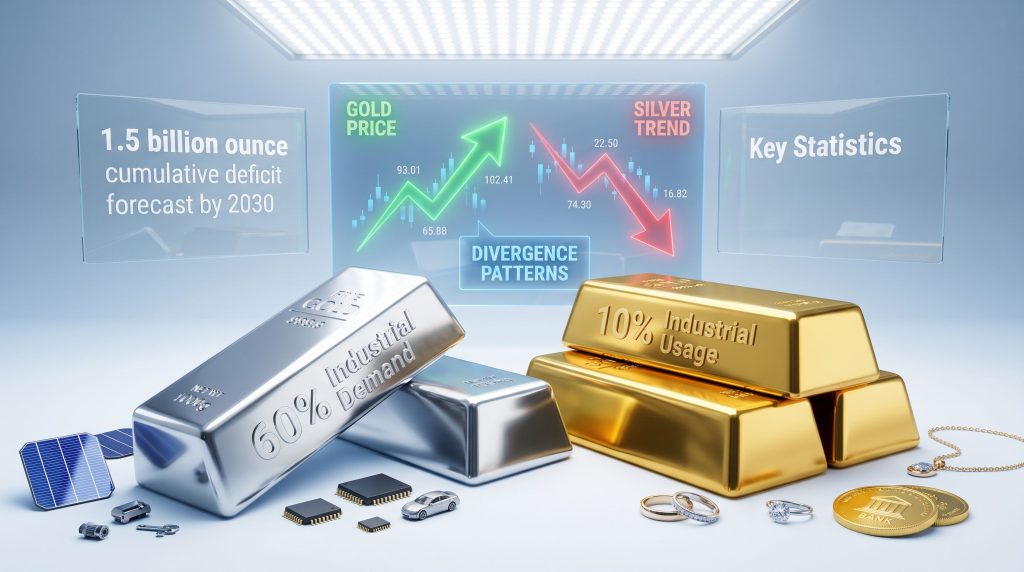
The core divergence mechanism stems from silver's extensive industrial applications consuming approximately 60% of total silver demand, compared to gold's minimal 10% industrial usage. According to The Silver Institute, industrial silver consumption reached a record 680.5 million ounces in 2024, demonstrating the metal's critical role in modern manufacturing processes.
This industrial dependency creates vulnerability during economic contractions when manufacturing output declines. Electronics and semiconductor production, solar panel installations, and automotive component manufacturing all require significant silver input, making the metal's price sensitive to broader economic cycles. When manufacturing confidence deteriorates, industrial buyers reduce procurement schedules, creating immediate demand destruction that gold avoids due to its primarily monetary function.
Manufacturing sensitivity becomes particularly pronounced during economic stress periods. Solar photovoltaic applications alone consume over 120 million ounces annually (approximately 16-18% of total industrial demand), while electronics and semiconductor applications require an additional 90-100 million ounces yearly. These sectors experience rapid demand volatility during economic uncertainty, directly transmitting to silver pricing.
Market Capitalisation and Liquidity Differentials
The scale differential between gold and silver markets creates structural pricing dynamics that amplify volatility. Global gold market capitalisation reaches approximately $13 trillion based on roughly 210,000 tonnes of above-ground gold stocks, while the silver market represents roughly $1.4 trillion in total capitalisation.
This 9.3x market size ratio creates measurable institutional participation barriers. Large institutional funds typically require minimum position sizes that make silver allocation less practical relative to gold exposure. Consequently, price discovery in silver occurs through smaller, more concentrated market participants, creating amplified volatility during capital reallocation events.
| Metal | Market Cap (Approx.) | Industrial Demand | Investment Demand | Other Uses |
|---|---|---|---|---|
| Gold | $13 trillion | 10% | 40% | 50% |
| Silver | $1.4 trillion | 60% | 25% | 15% |
Liquidity differences become critical during stress periods. Gold benefits from deep institutional participation, central bank accumulation, and established safe-haven demand patterns. Silver lacks comparable institutional safe-haven buying, instead relying on smaller retail investors and industrial buyers whose demand contracts during economic uncertainty.
When big ASX news breaks, our subscribers know first
Why Do Economic Slowdowns Hit Silver Disproportionately Hard?
Economic contractions create compound pressure on silver through simultaneous demand destruction across multiple sectors. While gold benefits from counter-cyclical safe-haven demand during the same periods, silver faces deteriorating fundamentals from both investment and industrial segments. This dynamic partially explains why silver falls while gold rises during economic stress periods.
Industrial Demand Collapse Mechanics
Manufacturing PMI (Purchasing Managers' Index) correlations with silver prices demonstrate the metal's sensitivity to production cycles. When manufacturing confidence declines, companies immediately adjust procurement schedules for industrial inputs including silver-intensive components.
The transmission mechanism operates through several channels:
• Electronics production deferrals reduce silver demand for semiconductors and circuit boards
• Solar installation delays during financing uncertainty compress photovoltaic silver consumption
• Automotive manufacturing slowdowns decrease silver usage in electrical components and catalytic systems
• Medical device production adjustments impact pharmaceutical and healthcare silver applications
2020 Crisis Case Study: During the March 2020 pandemic onset, manufacturing lockdowns created immediate silver demand destruction while simultaneously triggering safe-haven gold buying. Silver prices compressed approximately 35% intra-month before recovering, while gold rose roughly 7% over the same crisis window. The gold-silver ratio analysis spiked to 120:1 during peak panic, demonstrating the asymmetric impact of industrial demand destruction.
Investment Flow Redirection Patterns
Risk-off investment behaviour systematically favours gold over silver during economic stress. This pattern reflects fundamental differences in investor psychology and institutional allocation frameworks.
Central bank behaviour provides clear evidence of preferential gold accumulation. According to World Gold Council data, central banks purchased 1,037 tonnes of gold in 2023 (the highest annual accumulation in over 50 years), while maintaining negligible silver reserves globally. This institutional preference creates sustained gold demand during uncertainty while silver lacks comparable policy-driven support.
Portfolio reallocation during stress periods follows predictable patterns:
• Flight-to-quality concentrates capital in sovereign bonds and monetary metals (gold prioritised)
• Commodity index rotation systematically underweights industrial commodities during risk-off periods
• Retail sentiment shifts toward defensive positioning typically favour gold's safe-haven properties
• Institutional mandate changes often restrict commodity exposure during economic uncertainty
Historical Performance Divergence:
-
2020 Recovery: Silver gained 48% versus gold's 25% during full-year recovery as manufacturing restarted
-
2014 Commodity Downcycle: Silver declined 20% while gold fell just 1.5% during early manufacturing slowdown signs
How Does the Gold-to-Silver Ratio Signal Market Stress?
The gold-to-silver ratio functions as a sophisticated diagnostic tool for measuring relative stress between safe-haven demand and industrial commodity cycles. Understanding ratio dynamics provides crucial insights for tactical precious metals positioning, particularly when examining why silver falls while gold rises.
Historical Ratio Analysis and Extreme Events
Between 2014 and 2023, the gold-to-silver ratio fluctuated between 70:1 and 85:1 at year-end measurements, establishing a normal trading range for ratio analysis. However, intra-year extremes regularly exceed these boundaries during stress events.
March 2020 Extreme Event Analysis:
The ratio briefly surpassed 120:1 during peak pandemic panic, representing the highest level in the observed historical range. This extreme reflected simultaneous safe-haven gold buying and industrial silver market squeeze conditions.
Crisis Transmission Stages:
-
Initial Shock (Hours 0-24): Panic selling affects all commodities; ratio spikes as silver sold more aggressively
-
Policy Response (Days 1-14): Central bank intervention stabilises gold while silver remains depressed
-
Demand Destruction Recognition (Weeks 2-8): Industrial silver weakness becomes evident; ratio plateaus at extremes
-
Recovery Positioning (Months 1-4): Policy accommodation triggers mean reversion; ratio compresses rapidly
Ratio as a Leading Economic Indicator
Ratio movements often precede broader economic inflection points by 3-6 months, providing valuable timing information for both precious metals investors and economic analysts.
Predictive Value Framework:
• Ratio expansion beyond 100:1 typically signals severe economic stress requiring policy intervention
• Ratio compression below 70:1 often indicates robust industrial demand and economic acceleration
• Sustained ratios above 85:1 suggest ongoing manufacturing weakness requiring monitoring
• Rapid ratio volatility indicates unstable market conditions requiring defensive positioning
Mean reversion patterns demonstrate strong statistical tendencies. Historical analysis shows that whenever the ratio exceeded 100:1, subsequent 12-month returns favoured silver outperformance in approximately 75% of cases, though timing remains unpredictable.
What Role Does Monetary Policy Play in Price Divergence?
Federal Reserve policy decisions transmit through precious metals markets via distinct mechanisms that affect gold and silver differently. Understanding these transmission channels helps explain why silver falls while gold rises during specific policy environments, particularly as investors consider gold price forecasts.
Interest Rate Sensitivity Differentials
Non-yielding assets face opportunity cost pressures when real interest rates (nominal rates minus inflation expectations) turn positive and rising. Silver experiences greater sensitivity to rate changes due to its smaller average institutional position sizes and higher retail leverage usage.
2022-2024 Fed Tightening Cycle Impact:
During the Federal Reserve's aggressive rate hiking campaign beginning March 2022, silver faced compound headwinds from both rising opportunity costs and declining industrial activity expectations. Gold maintained relative stability due to persistent geopolitical risk premiums and central bank accumulation patterns.
Opportunity Cost Calculation Framework:
| Real Rate Level | Gold Impact | Silver Impact | Ratio Implication |
|---|---|---|---|
| Negative (-1% to 0%) | Neutral to positive | Strong positive | Ratio compression |
| Slightly positive (0% to 2%) | Modest headwinds | Significant headwinds | Ratio expansion |
| Highly positive (>2%) | Moderate headwinds | Severe headwinds | Sharp ratio expansion |
Currency Debasement and Safe-Haven Premiums
Dollar strength periods create asymmetric pressure on precious metals, with silver typically underperforming gold during USD appreciation phases. This dynamic reflects silver's partial commodity characteristics versus gold's pure monetary function.
Policy Transmission Mechanisms:
• Quantitative easing phases typically benefit both metals, with silver outperforming due to industrial demand recovery expectations
• Rate hiking cycles create headwinds for both metals, with silver underperforming due to economic growth concerns
• Currency intervention periods usually favour gold due to its role in international reserve management
• Inflation targeting adjustments affect silver more directly through industrial input cost calculations
Furthermore, when central banks implement tightening measures, silver experiences a "double hit" from reduced industrial activity expectations AND decreased speculative demand due to higher opportunity costs. Gold retains institutional safe-haven buying despite rate headwinds, creating the observed divergence pattern.
Central bank policy divergence across global economies creates additional complexity. While the Federal Reserve adjusts rates for domestic conditions, international central bank policies affect global commodity demand patterns that impact silver's industrial consumption more than gold's monetary demand.
Which Market Structure Factors Amplify Silver's Volatility?
Silver's price volatility exceeds gold's by significant margins due to structural market characteristics that amplify both upward and downward price movements. Understanding these amplification mechanisms helps explain market dynamics and why silver falls while gold rises during identical market conditions.
Futures Market Dynamics and Leverage Effects
COMEX silver futures trading exhibits higher leverage ratios and more concentrated speculative positioning compared to gold futures markets. These structural differences create amplified price discovery during volatile periods.
Leverage Amplification Mechanisms:
• Margin requirement changes trigger forced liquidations more frequently in silver markets due to higher leverage usage
• Speculative position concentration among fewer participants creates larger individual impact per trade
• ETF flow amplification affects physical silver markets more directly due to smaller underlying market size
• Options market dynamics create additional volatility through delta hedging requirements
Forced liquidation cascades occur more frequently in silver due to typical leverage usage patterns. When CME Group adjusts margin requirements during volatile periods, leveraged silver positions face proportionally larger impacts than comparable gold positions, creating downward price spirals during stress events.
Supply Chain and Physical Market Constraints
Silver supply characteristics create structural rigidity that amplifies price volatility compared to gold's more stable supply patterns. These factors contribute to understanding why precious metals experience sharp movements during market stress.
Supply Constraint Analysis:
• Byproduct mining dependency: Approximately 60% of silver production comes as a byproduct of copper, lead, and zinc mining, creating supply inelasticity
• Recycling rate differential: Gold recycling operates at ~30% annual rates versus silver at ~15%, reducing available supply flexibility
• Industrial stockpiling patterns: Manufacturing companies maintain limited silver inventories compared to gold's extensive above-ground stocks
• Geographic concentration: Silver mining concentrates in fewer jurisdictions, creating potential supply disruption risks
Recovery and Recycling Disparities:
| Recovery Source | Gold Recovery Rate | Silver Recovery Rate | Impact on Supply |
|---|---|---|---|
| Jewelry recycling | 25-30% annually | 10-15% annually | Silver supply less elastic |
| Electronic waste | 15-20% recovery | 5-10% recovery | Limited silver recapture |
| Industrial applications | Minimal loss | Significant consumption | Silver permanently consumed |
Mining production lead times exceed five years for new primary silver projects, compared to gold's more established production flexibility. This structural constraint means silver supply cannot quickly respond to demand spikes, exacerbating price volatility during demand acceleration or contraction phases.
How Should Investors Position for Gold-Silver Divergence Periods?
Strategic positioning during gold-silver divergence requires understanding both metals' roles within portfolio construction and tactical rebalancing opportunities that emerge during extreme ratio periods. This becomes particularly relevant when considering record high gold prices and silver's contrasting performance.
Risk-Adjusted Portfolio Allocation Strategies
Portfolio allocation should reflect individual risk tolerance while recognising the complementary dynamics between gold's stability and silver's growth potential during recovery phases.
Allocation Framework by Investor Profile:
| Investor Type | Gold Allocation | Silver Allocation | Strategic Rationale | Rebalancing Triggers |
|---|---|---|---|---|
| Conservative | 8-10% | 2-3% | Stability priority, limited volatility tolerance | Ratio >90:1 for modest silver addition |
| Moderate | 6-8% | 4-5% | Balanced exposure, rebalancing opportunities | Ratio >85:1 or <70:1 for adjustment |
| Aggressive | 5-7% | 7-10% | Growth focus, tactical positioning capability | Ratio >100:1 for aggressive silver accumulation |
Tactical Entry Point Identification
Extreme ratio periods historically provide tactical positioning opportunities for investors comfortable with silver's inherent volatility.
Entry Point Analysis:
• Ratio levels 100:1+: Historical data suggests silver accumulation opportunities with 6-18 month return potential
• Dollar-cost averaging implementation: Systematic purchasing during high ratio periods reduces timing risk
• Industrial recovery confirmation: Leading indicators like manufacturing PMI and copper prices provide entry signal confirmation
• Policy accommodation signals: Central bank dovish pivots often precede silver outperformance periods
Risk Management Considerations:
Tactical silver positioning requires strict risk management due to the metal's volatility characteristics:
• Position sizing limitations: Silver exposure should not exceed risk tolerance levels even during attractive entry opportunities
• Diversification maintenance: Silver positions should complement, not replace, gold's portfolio stabilisation function
• Exit strategy planning: Predetermined profit-taking levels help capture silver's recovery amplification benefits
• Volatility tolerance assessment: Investors must accept 20-30% short-term price swings as normal silver behaviour
The next major ASX story will hit our subscribers first
What Does Future Industrial Demand Mean for Silver's Role?
Structural industrial demand trends suggest silver's importance in modern manufacturing will continue expanding, potentially altering long-term price dynamics and investment considerations. These factors could influence future instances of why silver falls while gold rises.
Green Energy Transition Impact Analysis
Solar photovoltaic installations represent silver's fastest-growing industrial application, with implications for long-term supply-demand balance.
Solar Industry Growth Projections:
International Energy Agency forecasts suggest solar panel installations maintaining approximately 15% compound annual growth rates through 2030. Each gigawatt of installed solar capacity requires roughly 20-25 tonnes of silver, creating sustained industrial demand growth.
Electric Vehicle Integration:
EV adoption creates incremental silver demand through:
• Battery management systems requiring silver-containing components
• Charging infrastructure using silver in electrical contacts and conductors
• Enhanced electronics packages in electric drivetrains
• 5G connectivity features supporting autonomous vehicle communication
Supply Deficit Projections and Price Implications
The Silver Institute projects a cumulative 1.5 billion ounce supply deficit by 2030 based on current demand trajectories and constrained mine production expansion capabilities.
Deficit Development Framework:
• Industrial demand acceleration from renewable energy and technology adoption
• Mine production constraints due to declining ore grades and limited new discoveries
• Recycling limitations preventing supply gap closure through secondary sources
• Investment demand persistence maintaining baseline precious metals allocation
Structural Supply Challenges:
Primary silver mine development requires 7-10 year lead times from discovery to production, while existing mines face declining ore grades and increasing extraction costs. Mexico, Peru, and China dominate global production, creating geographic concentration risks that could amplify supply constraints.
In addition, growing industrial demand combined with supply constraints suggests silver's price volatility may shift toward sustained upward bias over 5-10 year periods, while maintaining short-term volatility characteristics. This development could alter traditional correlation patterns between gold and silver.
Technology Demand Evolution:
Emerging applications including medical antimicrobial uses, advanced electronics for 5G networks, and specialised industrial catalysts create additional demand streams beyond traditional applications. These developing uses typically show less economic sensitivity than discretionary electronics, potentially stabilising silver's demand profile over time.
Key Strategic Takeaways for Precious Metals Investors
Understanding why silver falls while gold rises requires recognising fundamental structural differences between these metals rather than treating them as interchangeable precious metals investments. Consider gold market technical analysis alongside silver's unique characteristics when making allocation decisions.
Divergence as Opportunity Recognition
Price divergence periods create tactical opportunities for investors who understand the underlying dynamics driving relative performance.
Opportunity Framework:
• Extreme ratio levels (>100:1) historically signal silver undervaluation relative to long-term trends
• Mean reversion probability increases significantly when ratios exceed historical norms for extended periods
• Recovery timing uncertainty requires patient capital and systematic accumulation strategies
• Risk-adjusted positioning must account for silver's volatility while capturing reversion potential
Long-Term Structural Trends
Several macro trends will continue influencing gold-silver dynamics over investment horizons:
Gold's Monetary Evolution:
- Central bank accumulation patterns supporting price floors during stress periods
- Geopolitical uncertainty maintaining safe-haven premium sustainability
- Currency debasement concerns driving institutional allocation increases
- Digital currency development potentially enhancing rather than replacing gold's monetary role
Silver's Industrial Integration:
- Renewable energy transition creating sustained industrial demand growth
- Technology advancement requiring silver-intensive components and applications
- Supply constraints limiting production expansion despite price incentives
- Recycling limitations preventing supply gap closure through secondary sources
Portfolio Construction Implications:
| Market Condition | Recommended Action | Gold Focus | Silver Focus |
|---|---|---|---|
| Economic uncertainty | Defensive positioning | Increase allocation | Maintain/reduce exposure |
| Recovery initiation | Tactical rebalancing | Stable allocation | Selective accumulation |
| Growth acceleration | Opportunistic positioning | Gradual reduction | Active accumulation |
| Extreme ratio (>100:1) | Strategic rebalancing | Hold steady | Dollar-cost average addition |
Risk Management Integration
Successful precious metals investing requires treating gold and silver as complementary rather than competitive investments. Gold provides portfolio stability and monetary hedge characteristics, while silver offers growth potential and industrial demand exposure. Understanding when each metal outperforms and positioning accordingly separates strategic investors from those who simply accumulate precious metals without strategic rationale.
Final Investment Consideration:
The question of why silver falls while gold rises reflects deeper economic forces than simple precious metals correlation. Investors who grasp these structural differences and position their portfolios accordingly capture both the stability benefits of gold ownership and the growth potential of silver's dual-market characteristics. This understanding, combined with systematic allocation strategies and patient capital deployment, provides the foundation for successful precious metals portfolio construction across various economic environments.
Furthermore, the ongoing green energy transition and technological advancement suggest silver's industrial demand profile will continue strengthening over time. However, this evolution occurs alongside persistent volatility characteristics that require careful risk management within portfolio construction frameworks.
This analysis is provided for educational and informational purposes only. Precious metals investments involve significant risks including price volatility, and past performance does not guarantee future results. Consult with qualified financial advisors before making investment decisions. Tax implications vary by jurisdiction and individual circumstances.
Ready to Capitalise on the Next Major Silver Discovery?
Discovery Alert's proprietary Discovery IQ model delivers real-time alerts on significant ASX silver and precious metals discoveries, turning complex market data into actionable investment insights. With industrial silver demand reaching record levels whilst supply constraints tighten, understanding when major discoveries occur could position you ahead of both recovery trends and structural market shifts ahead of the broader market.