
August 7, 2026
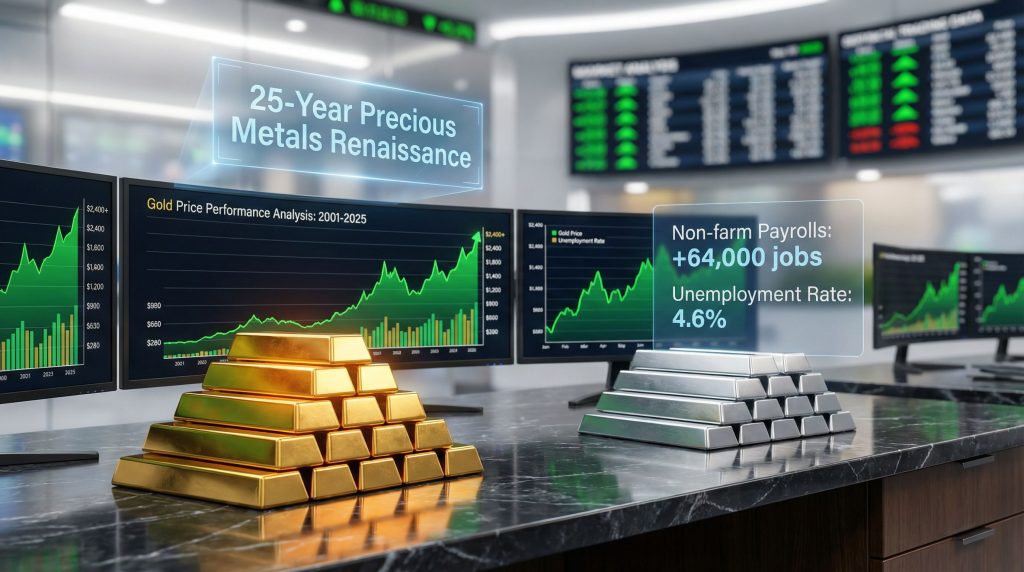
The global financial landscape has undergone unprecedented transformation over the past quarter-century, with traditional investment frameworks increasingly challenged by monetary policy uncertainty, currency debasement concerns, and geopolitical instability. These macro-level forces have created sustained demand for alternative wealth preservation vehicles, fundamentally altering how institutional and retail investors approach portfolio construction and giving rise to what many analysts now recognise as a gold and silver renaissance.
Understanding the Modern Precious Metals Renaissance: A Multi-Decade Investment Paradigm Shift
The emergence of what market analysts term a "precious metals renaissance" represents more than temporary safe-haven buying. This phenomenon reflects a systematic shift in investment demand curves, driven by persistent economic and political conditions that began materialising around 2000. Unlike previous precious metals cycles characterised by supply constraints or speculative excess, the current environment demonstrates sustained structural demand across multiple investor categories.
Modern portfolio theory increasingly incorporates precious metals as essential diversification tools rather than speculative positions. This transition from tactical to strategic allocation has created multi-decade investment trends that contrast sharply with historical boom-bust patterns. Understanding these dynamics requires examining both the underlying economic forces and the technical market structures that support continued investor interest in gold and silver assets.
The contemporary precious metals analysis reveals an "upward shift in the investment demand curve" that began around 2000, distinguished from previous cycles by its structural rather than speculative nature.
Defining the Contemporary Gold and Silver Renaissance Period
The current gold and silver renaissance encompasses a 25-year period marked by sustained investor interest despite intermediate price corrections. This extended timeframe contrasts with shorter-duration speculative cycles, such as the 1977-1980 period that witnessed rapid price appreciation followed by sharp reversals.
Key Timeline Characteristics:
• 2001-2011: Initial renaissance phase with gold rising from approximately $280 to $1,900 per ounce
• 2011-2016: Consolidation period without the collapse typical of speculative bubbles
• 2016-2025: Renewed upward momentum reaching record levels above $4,300 by December 2025
• Sustained Investment Flow: Consistent institutional and retail demand throughout all phases
The structural nature of this cycle becomes apparent when comparing price recovery patterns. Unlike the 1980s collapse that saw precious metals remain depressed for two decades, the post-2011 correction maintained elevated price floors and resumed upward trajectory within five years.
Investment Demand Curve Evolution Since 2000
Traditional precious metals demand historically centred on jewellery manufacturing and industrial applications, with investment demand representing a smaller, more volatile component. The renaissance period has inverted this relationship, establishing investment demand as the primary price driver.
Demand Structure Transformation:
| Period | Primary Demand Driver | Price Volatility | Duration |
|---|---|---|---|
| 1968-1980 | Supply constraints + speculation | Extremely high | 3-4 years |
| 1980-2000 | Industrial/jewellery demand | Low to moderate | 20 years |
| 2001-2025 | Investment/wealth preservation | Moderate to high | 25+ years |
The sustained investment demand reflects what analysts characterise as a fundamental shift in portfolio allocation preferences. Furthermore, institutional investors increasingly view precious metals as permanent portfolio components rather than tactical trades, creating more stable demand patterns despite price volatility.
Central bank accumulation patterns further demonstrate this structural shift. Post-2008 central bank gold purchases have averaged significantly higher than historical norms, with many institutions transitioning from net sellers to net buyers. This official sector demand provides additional stability to investment-driven price trends.
Statistical Evidence of Paradigm Shift in Investor Behaviour
Exchange-traded fund (ETF) inflows provide quantifiable evidence of changing investor behaviour. Gold ETF assets under management have grown exponentially since 2003, reaching hundreds of billions in total value. This institutional infrastructure facilitates broader investor participation whilst maintaining physical market connectivity.
Professional money managers increasingly incorporate precious metals allocations into diversified portfolios, moving beyond traditional 60/40 equity-bond frameworks. Modern portfolio optimisation models frequently suggest 5-15% precious metals allocation for optimal risk-adjusted returns, institutionalising what was previously considered alternative investing.
The development of sophisticated precious metals investment vehicles, including futures-based ETFs, mining equity indices, and structured products, has democratised access whilst maintaining investment-grade characteristics. This infrastructure supports sustained institutional participation across market cycles.
When big ASX news breaks, our subscribers know first
What Economic Forces Are Driving the 25-Year Precious Metals Surge?
Multiple concurrent economic developments have created an environment conducive to sustained precious metals demand. Unlike single-factor bull markets, the current renaissance reflects convergent pressures across monetary policy, fiscal policy, geopolitical relations, and structural economic changes.
Macroeconomic Instability Factors
Monetary policy uncertainty has emerged as a primary driver of precious metals investment demand. Extended periods of ultra-low interest rates, quantitative easing programmes, and unconventional monetary policies have raised concerns about currency stability and purchasing power preservation.
Employment Market Deterioration Signals:
Recent U.S. employment data demonstrates weakening economic momentum that historically supports precious metals demand:
• November 2024 Job Creation: 64,000 non-farm payroll additions, significantly below trend
• Unemployment Rate Trajectory: Rising from 4.0-4.2% range to 4.6% by November 2024
• Employment Momentum: Declining job growth beginning April-May 2024, continuing through year-end
These employment trends suggest economic deceleration that may prompt additional Federal Reserve policy accommodation, creating conditions that historically favour precious metals investment demand.
Geopolitical tensions contribute additional uncertainty premiums to precious metals pricing. Trade conflicts, sanctions regimes, and regional military conflicts create risk environments that support safe-haven asset demand. The interconnected nature of global financial systems amplifies these risks, making wealth preservation strategies more attractive to institutional and individual investors.
Structural Changes in Global Financial Markets
Financial system complexity has increased dramatically since 2000, creating new categories of systemic risk that traditional hedging strategies inadequately address. Derivative markets, high-frequency trading, and algorithmic investment strategies contribute to periodic market dislocations that highlight the value of physical asset diversification.
Central Bank Policy Framework Changes:
Central banking approaches have evolved significantly since the 2008 financial crisis, adopting more aggressive intervention strategies that create unintended consequences:
• Balance Sheet Expansion: Major central banks maintain elevated asset holdings relative to GDP
• Forward Guidance Complexity: Policy communication has become more nuanced and uncertain
• International Coordination: Reduced policy coordination increases currency volatility
• Unconventional Tools: Implementation of negative interest rates and yield curve control
These policy innovations represent departures from historical central banking practices, creating uncertainty about long-term monetary stability that supports precious metals allocation strategies.
Currency competition dynamics have intensified as emerging market economies develop alternatives to traditional reserve currencies. Central bank gold accumulation patterns reflect concerns about currency concentration risk and desires for monetary policy independence.
Gold Price Performance Analysis: From $35 to Record Highs
Gold price evolution since 1968 demonstrates distinct phases corresponding to different monetary and economic regimes. Understanding these historical patterns provides context for current price levels and future trajectory expectations, particularly when considering the historic gold surge witnessed in recent years.
Historical Price Trajectory Breakdown
Gold Price Milestone Analysis:
| Period | Price Range | Key Drivers | Market Characteristics |
|---|---|---|---|
| 1968-1974 | $35-$195 | Bretton Woods collapse | Initial price discovery phase |
| 1977-1980 | $150-$850 | Stagflation, energy crises | Speculative acceleration |
| 1980-2000 | $850-$280 | Volcker policies, economic stability | Extended bear market |
| 2001-2011 | $280-$1,900 | Financial crisis, QE implementation | Renaissance phase one |
| 2016-2025 | $1,050-$4,300+ | Global uncertainty, monetary expansion | Renaissance continuation |
The 1968 starting point of approximately $35 per ounce represents the final fixed-rate reference before gold prices began floating in international markets. This transition marked the beginning of modern precious metals price discovery, establishing market-based valuation mechanisms that continue today.
The 1977-1980 spike to $850 demonstrates classic speculative bubble characteristics, with rapid price appreciation followed by equally dramatic reversals. Gold fell from its January 1980 peak throughout the subsequent decade, reaching approximately $350 by 1990. This pattern contrasts sharply with post-2000 price behaviour.
Technical Analysis of Current Price Levels
December 2025 gold prices approaching $4,400 per ounce represent the culmination of a multi-year advance that began accelerating in 2019. Current levels approach but have not yet exceeded the October 2024 record high, suggesting continued investor interest at these elevated valuations.
Recent Price Action Patterns:
• October 2024 Peak: Approximately $4,400 per ounce establishing new all-time high
• December 16, 2025: Intraday high of $4,367.68 for February COMEX contracts
• Support Levels: Price corrections have maintained support above $4,000
• Volume Characteristics: Sustained institutional buying interest at record levels
The ability of gold prices to approach previous record highs after intermediate corrections demonstrates underlying demand strength. Historical precedent suggests speculative peaks are followed by sharp reversals, whilst structural demand supports prices through temporary weakness.
Monthly average pricing methodology helps distinguish between intraday volatility and sustained trends. November 2024 monthly averages provide baseline references for evaluating whether current price levels represent sustainable valuations or temporary dislocations.
Silver Market Dynamics: The Industrial-Investment Dual Nature
Silver's unique position combining industrial demand with investment interest creates more complex market dynamics than gold. This dual nature results in higher price volatility whilst providing multiple demand support mechanisms across economic cycles. For instance, concerns about a potential silver market squeeze have intensified market interest in recent months.
Silver's Unique Position in the Renaissance
Silver price evolution demonstrates even more dramatic volatility than gold whilst following similar long-term trends. The 1980 speculative peak reached approximately $49-50 per ounce before collapsing to $15 within three months, illustrating silver's propensity for extreme price movements.
Silver Price Historical Framework:
• Pre-2003: Prices remained below $5.50 for extended periods
• 2003-2004: Initial breakout above historical resistance levels
• 2005: First monthly average above $40 since 1980 collapse
• 2011 Peak: Monthly average of approximately $35 per ounce
• 2019-2025: Renewed advance reaching $64 by December 2025
Current silver prices at $64 per ounce represent substantial advancement from the November 2024 monthly average of $38.26. This appreciation reflects both investment demand and expectations of continued industrial consumption growth.
COMEX Silver Market Structure Analysis
Detailed examination of COMEX silver markets reveals normal operational patterns despite promotional claims of supply shortages or market disruption. December 2025 delivery data provides insight into actual market conditions versus speculative narratives.
COMEX Silver Market Data (December 15, 2025):
| Metric | Current Level | Analysis |
|---|---|---|
| December Contract Deliveries | 58 million ounces | Consistent with historical active contract patterns |
| Registered Inventory | 545.6 million ounces | Down 2.1 million from November, normal turnover |
| Market Functionality | Operating normally | Contrary to claims of system breakdown |
| Inventory Turnover | Regular pattern | Most delivered silver remains in COMEX depositories |
Market analysis contradicts promotional claims of "billion ounces taken out of the market" or impending delivery system failure. December contract deliveries align with typical active month patterns from recent years, indicating normal market operations rather than exceptional circumstances.
Recent COMEX delivery patterns demonstrate normal market functionality, with 58 million ounces delivered through mid-December representing typical activity levels rather than extraordinary demand pressure.
The maintenance of 545.6 million ounces in registered inventories, despite active deliveries, indicates adequate supply availability to support market operations. Regular inventory turnover reflects normal business activity rather than supply shortage conditions.
Price Volatility Patterns Compared to Gold
Silver's price volatility consistently exceeds gold's, reflecting both smaller market capitalisation and dual demand characteristics. Industrial demand provides baseline support whilst investment demand creates amplified responses to economic uncertainty.
The industrial component of silver demand creates price sensitivity to economic growth expectations, manufacturing activity, and technological developments. Electronics, solar panels, and medical applications represent growing consumption categories that provide fundamental demand support.
Investment demand for silver often demonstrates leverage characteristics relative to gold, with silver prices appreciating more rapidly during precious metals bull markets and declining more sharply during corrections. However, this pattern reflects both speculative interest and the perception of silver as a more accessible precious metals investment.
How Do Current Precious Metals Prices Compare to Historical Peaks?
Evaluating current precious metals prices requires both nominal and inflation-adjusted analysis to determine whether recent advances represent genuine wealth preservation or merely keeping pace with currency debasement. This comparison provides essential context for investment decision-making and helps inform gold price forecast assessments.
Inflation-Adjusted Price Analysis
Converting historical precious metals prices to current purchasing power reveals important insights about real value appreciation over time. The 1980 gold peak of $850 per ounce represents significantly higher real purchasing power when adjusted for consumer price inflation through 2025.
Real Price Comparison Framework:
Using Consumer Price Index adjustments, the January 1980 gold peak of approximately $850 equals roughly $3,200-3,400 in 2025 dollars, depending on specific inflation measures employed. Current gold prices above $4,300 therefore represent genuine inflation-adjusted appreciation beyond the previous speculative peak.
Silver's inflation-adjusted comparison proves more complex due to extreme 1980 price levels. The peak near $50 per ounce equals approximately $180-200 in 2025 purchasing power, indicating current prices at $64 remain well below inflation-adjusted historical highs despite substantial recent appreciation.
Platinum Group Metals Renaissance Potential
Platinum prices have demonstrated significant recovery potential, advancing to approximately $1,880 by December 2025. This represents substantial appreciation from multi-year lows whilst remaining below all-time nominal highs reached in 2007-2008.
Platinum Market Dynamics:
The 2007-2008 platinum price spike to record levels resulted from temporary supply disruptions in South African mining operations caused by power outages. Automotive industry panic buying amplified price appreciation until normal production resumed and recession reduced vehicle demand.
Current platinum price advancement reflects different fundamental factors:
• Supply Concerns: Ongoing South African operational challenges
• Russian Supply Risk: Geopolitical sanctions creating supply uncertainty
• Automotive Demand: Expected recovery in platinum group metals consumption
• Investment Interest: Broader precious metals renaissance including PGMs
However, market analysis suggests caution regarding sustainability of recent gains. Supply disruption concerns may prove overestimated whilst demand recovery expectations could disappoint, creating conditions for investment-driven price reversals.
What Economic Indicators Signal Continued Precious Metals Strength?
Economic data trends provide forward-looking indicators for precious metals demand sustainability. Employment conditions, monetary policy expectations, and broader economic momentum offer insight into likely investment demand patterns for 2026 and beyond.
Employment and Economic Weakness Indicators
U.S. employment data released December 16, 2025, demonstrates continued economic momentum deterioration that historically supports precious metals investment demand. Multiple indicators suggest weakening conditions that may prompt policy responses favourable to alternative assets.
November 2024 Employment Analysis:
| Metric | Current Level | Trend Analysis | Precious Metals Impact |
|---|---|---|---|
| Non-farm Payroll Creation | 64,000 jobs | Declining since April 2024 | Highly supportive |
| Unemployment Rate | 4.6% | Rising from 4.0-4.2% range | Supportive |
| Employment Momentum | Weakening | Six-month deceleration trend | Strongly supportive |
| Corporate Hiring Sentiment | Cautious | Multiple constraining factors | Supportive |
The dramatic decline in monthly job creation beginning in April-May 2024 suggests underlying economic weakness that extends beyond seasonal adjustments. Corporate hiring caution reflects multiple concurrent challenges affecting business confidence and expansion plans.
Rising unemployment rates from historically low levels indicate potential economic inflection points that have historically preceded monetary policy accommodation. Federal Reserve responses to deteriorating employment conditions typically involve interest rate adjustments that support precious metals investment appeal.
Federal Reserve Policy Implications
Weakening employment data increases probability of Federal Reserve policy responses in 2026 that could support continued precious metals demand. Historical patterns suggest central bank concern about economic deterioration leads to accommodative policies that reduce opportunity costs of holding non-yielding assets.
Potential Policy Response Scenarios:
• Interest Rate Adjustments: Either increases to combat inflation or decreases to stimulate growth
• Monetary Policy Uncertainty: Conflicting economic signals complicating policy decisions
• Communication Challenges: Forward guidance difficulty in uncertain environment
• Unconventional Tool Consideration: Potential return to quantitative easing or similar programmes
Economic data scheduled for release throughout December 2025 will provide additional insight into Federal Reserve decision-making frameworks. Retail sales, consumer price index, initial jobless claims, and manufacturing output data will either confirm or contradict employment weakness signals.
The combination of economic uncertainty and monetary policy complexity creates conditions historically favourable to precious metals investment demand. In addition, investors seeking portfolio stability amid policy uncertainty often increase alternative asset allocations regardless of specific policy directions chosen.
The next major ASX story will hit our subscribers first
Investment Strategies for the Ongoing Precious Metals Renaissance
Developing appropriate precious metals investment strategies requires understanding both the structural demand factors supporting the renaissance and the tactical considerations for implementation across different market conditions. Analysis of the gold‑silver ratio analysis can provide additional insights for strategic allocation decisions.
Portfolio Allocation Frameworks
Modern portfolio theory increasingly recognises precious metals as essential diversification components rather than speculative positions. Academic research demonstrates that small allocations to precious metals can significantly improve risk-adjusted portfolio returns across multiple time horizons.
Strategic Allocation Considerations:
• Wealth Preservation Objective: 10-20% allocation for capital preservation focus
• Growth-Oriented Portfolios: 5-10% allocation for diversification benefits
• Conservative Income Strategies: 15-25% allocation for inflation protection
• Risk Parity Approaches: Variable allocation based on volatility adjustments
The sustained nature of the current precious metals renaissance supports strategic rather than tactical allocation approaches. Attempts to time precious metals markets often result in missed opportunities due to the episodic nature of major price advances.
Dollar-cost averaging strategies prove particularly effective for precious metals accumulation, smoothing volatility impact whilst ensuring consistent exposure to structural demand trends. Monthly or quarterly purchase programmes align with long-term wealth preservation objectives whilst reducing timing risk.
Physical vs. Financial Precious Metals Investments
Investment implementation options range from physical metal ownership to sophisticated financial instruments, each offering distinct advantages and disadvantages depending on investor circumstances and objectives.
Physical Ownership Advantages:
• Direct Asset Control: No counterparty risk or financial intermediary dependency
• Privacy Considerations: Transactions can maintain anonymity depending on jurisdiction
• Crisis Protection: Accessible during financial system disruptions
• Tangible Asset Appeal: Psychological comfort of physical possession
Financial Instrument Benefits:
• Liquidity Convenience: Easy buying and selling through brokerage accounts
• Storage Solutions: No physical custody requirements or insurance needs
• Cost Efficiency: Lower transaction costs and ongoing expenses
• Fractional Access: Ability to invest smaller amounts with precise allocation
Exchange-traded funds provide institutional-quality exposure with retail accessibility, combining physical backing with financial market convenience. Leading precious metals ETFs maintain full physical backing whilst offering daily liquidity and professional custody services.
Precious metals mining equities offer leveraged exposure to underlying metal prices whilst introducing company-specific and operational risks. This approach may appeal to growth-oriented investors seeking amplified precious metals exposure through established equity markets.
Future Outlook: Will the Renaissance Continue Through 2026-2030?
Assessing the sustainability of the precious metals renaissance requires analysing both the persistence of underlying demand drivers and potential developments that could alter current market dynamics.
Scenario Analysis for Precious Metals Demand
Base Case Scenario: Continued Economic Uncertainty (60% probability)
Economic and political conditions that have supported precious metals demand since 2000 appear likely to persist through the remainder of the 2020s. Monetary policy complexity, geopolitical tensions, and structural economic imbalances suggest continued investor interest in wealth preservation assets.
Key supporting factors include:
• Persistent Inflation Concerns: Central bank credibility challenges maintaining price stability
• Geopolitical Instability: Multiple regional conflicts and trade tensions
• Fiscal Policy Sustainability: Government debt levels constraining policy options
• Currency Competition: Emerging alternatives to traditional reserve currencies
Bull Case Scenario: Accelerated Renaissance (25% probability)
Intensification of current trends could drive precious metals prices substantially higher through 2030. This scenario involves acceleration of currency debasement, escalation of geopolitical conflicts, or financial system instability that dramatically increases safe-haven demand.
Potential catalysts include major financial institution failures, currency crises in developed economies, or significant expansion of military conflicts affecting global trade and financial stability.
Bear Case Scenario: Economic Stabilisation (15% probability)
Resolution of current economic and political challenges could reduce precious metals investment demand, leading to price consolidation or correction. This scenario requires successful inflation control, geopolitical conflict resolution, and restoration of financial system confidence.
Key Risk Factors and Market Vulnerabilities
Several developments could disrupt the precious metals renaissance despite favourable underlying conditions:
Investment Demand Reversibility:
Unlike industrial or jewellery demand, investment demand can reverse rapidly during market sentiment shifts. ETF outflows, institutional reallocation, and speculative position unwinding could create significant downward price pressure even amid supportive fundamental conditions.
Supply Response Capabilities:
Sustained high prices may eventually stimulate increased mining production, recycling activity, and technological substitution that could moderate price appreciation. Lead times for mining project development suggest supply responses would occur gradually rather than immediately.
Central Bank Policy Normalisation:
Successful economic stabilisation and inflation control could enable central banks to normalise monetary policies, potentially reducing precious metals' appeal relative to interest-bearing alternatives. This risk appears moderate given persistent economic challenges but remains a potential long-term headwind.
Technological Disruption:
Development of superior store-of-value technologies or investment alternatives could reduce precious metals' unique positioning. Cryptocurrency adoption represents one potential challenge, though regulatory uncertainty and volatility limit near-term substitution potential.
Frequently Asked Questions About the Gold and Silver Renaissance
Is This Renaissance Different from Previous Bull Markets?
The current precious metals renaissance demonstrates several distinguishing characteristics that separate it from historical cycles, particularly the 1970s-1980 speculative period.
Structural vs. Cyclical Factors:
Previous precious metals bull markets typically resulted from temporary supply constraints, currency crises, or speculative excess. The current renaissance reflects sustained structural changes in the global financial system that support continued investment demand across multiple economic cycles.
Duration analysis reveals significant differences: the 1977-1980 cycle lasted approximately three years before reversing sharply, whilst the current renaissance has sustained momentum for over two decades with only intermediate corrections rather than collapse.
Institutional Participation:
Modern precious metals markets benefit from sophisticated investment infrastructure including ETFs, futures markets, and professional custody services that facilitate institutional participation. This infrastructure supports more stable demand patterns compared to historically retail-dominated markets.
Central bank participation has shifted from net selling to net buying since 2010, providing additional demand stability that was absent during previous cycles. Official sector accumulation creates baseline demand that supports prices during private investor sentiment shifts.
How Long Could This Investment Cycle Continue?
Historical analysis of extended commodity cycles suggests the precious metals renaissance could persist for several additional years, potentially extending through 2030 or beyond depending on underlying economic and political developments.
Historical Precedents:
Extended commodity cycles in other markets have lasted 20-30 years, driven by structural demand shifts rather than temporary dislocations. The precious metals renaissance, beginning around 2000, appears consistent with this timeframe pattern.
Critical Monitoring Factors:
Key developments that could signal cycle maturity include:
• Inflation Expectation Stabilisation: Successful central bank credibility restoration
• Geopolitical Tension Resolution: Meaningful progress toward conflict resolution
• Alternative Investment Development: Superior store-of-value technologies
• Economic Policy Effectiveness: Successful structural reform implementation
The persistence of multiple concurrent challenges supporting precious metals demand suggests the renaissance has additional years to develop before reaching natural exhaustion. However, markets can change rapidly based on unexpected developments.
Positioning for the Next Phase of Precious Metals Evolution
The evidence supporting a sustained precious metals renaissance appears compelling, with structural demand factors likely to persist through the remainder of the 2020s. Economic uncertainty, monetary policy complexity, and geopolitical instability create an environment historically favourable to alternative asset demand.
Key Takeaways for Investors
Strategic Implementation Principles:
• Long-term Perspective: Focus on structural trends rather than short-term price movements
• Diversified Approach: Combine physical ownership with financial instruments for optimal exposure
• Risk Management: Maintain appropriate position sizing within overall portfolio context
• Regular Review: Monitor economic indicators for potential trend changes
The sustained nature of current precious metals demand suggests strategic allocation approaches will prove more effective than tactical trading strategies. Dollar-cost averaging and rebalancing programmes can help maintain target allocations whilst reducing timing risk.
Market Outlook Summary
Current economic indicators support continued precious metals investment demand through 2026 and potentially beyond. Employment weakness, monetary policy uncertainty, and persistent geopolitical tensions create conditions that historically favour alternative asset allocation.
Expected Price Behaviour:
Precious metals prices are likely to continue advancing with increased volatility as various economic and political pressures intensify. Gold prices approaching $4,400 per ounce and silver above $60 represent substantial appreciation but may not constitute final peaks if underlying conditions persist.
Critical Monitoring Framework:
Investors should track employment data, Federal Reserve policy communications, geopolitical developments, and inflation expectations for early indicators of potential trend changes. Furthermore, economic stabilisation or conflict resolution could alter demand dynamics more rapidly than gradual supply responses.
The gold and silver renaissance appears positioned to continue as long as fundamental economic and political uncertainties persist. Whilst specific price predictions remain speculative, the structural demand factors supporting precious metals investment appear likely to maintain relevance throughout the remainder of this decade.
For investors seeking additional insights into precious metals markets, the CPM Group's Gold and Silver Renaissance Webinar provides professional analysis of current market conditions. Similarly, Kitco's live webinar on gold and silver renaissance offers expert perspectives on market developments and investment strategies.
Disclaimer: This analysis is for informational purposes only and does not constitute investment advice. Precious metals investments involve significant risks including price volatility, storage costs, and opportunity costs. Past performance does not guarantee future results. Consult with qualified financial advisors before making investment decisions.
Ready to Capitalise on the Next Major Mineral Discovery?
Discovery Alert's proprietary Discovery IQ model provides instant alerts on significant ASX mineral discoveries, transforming complex geological data into actionable investment insights just like the precious metals renaissance has created sustained opportunities for informed investors. Explore how historic discoveries have generated substantial returns and begin your 30-day free trial today to position yourself ahead of the market.