
May 20, 2026
The Architecture of Monetary Honesty: What the Gold Standard and Trade Imbalance Correction Mechanism Reveal About Modern Finance
Across centuries of economic experimentation, one pattern emerges with uncomfortable consistency: monetary systems that lack a hard external constraint tend to drift toward excess. Governments spend beyond their means, trade deficits compound rather than correct, and the accumulated weight of unchecked borrowing eventually demands resolution. Understanding why this happens requires looking backward — and examining the gold standard and trade imbalance correction mechanism reveals a logic that remains more relevant than its dismissal would suggest.
When big ASX news breaks, our subscribers know first
What Is the Price-Specie-Flow Mechanism and Why Does It Matter?
The gold standard and trade imbalance correction mechanism were not separate features of historical monetary architecture. They were the same feature, operating through a single elegant feedback loop known as the price-specie-flow mechanism, first formally articulated by Scottish philosopher and economist David Hume in 1752 — predating the publication of Adam Smith's Wealth of Nations by nearly a quarter century. (Source: Encyclopaedia Britannica; EconLib, Library of Economics and Liberty)
The conceptual foundation Hume established was deceptively simple: in a world where gold in the monetary system served as money, trade imbalances carried their own correction mechanism. No treasury committee, diplomatic summit, or central bank intervention was required to initiate it. The flows of physical metal between nations did the work automatically.
Step-by-Step: How the Mechanism Operated
- A trade deficit emerges — Country A imports more from Country B than it exports
- Gold settles the difference — Physical gold transfers from Country A to Country B as payment
- Money supply contracts in Country A — The outflow of gold reduces the domestic monetary base
- Downward pressure on prices and wages follows — With less money circulating, domestic costs soften over time
- Export competitiveness recovers — Country A's goods become progressively cheaper on world markets, stimulating external demand
- Country B experiences the mirror effect — Gold inflows expand its money supply, elevating domestic prices and gradually softening its export advantage
- The imbalance converges without external intervention — deficit and surplus narrow organically as relative prices shift across borders
Key Insight: The mechanism was directionally reliable, but not instantaneous. Historical research, including analysis published by the St. Louis Federal Reserve, confirms that central banks regularly used interest rate adjustments to assist and accelerate the adjustment process. The system was self-correcting in principle, but not entirely passive in practice.
A Short History of Monetary Debasement: From Rome to the Reserve Currency
The story of why the gold standard mattered begins much earlier than its formal adoption. Long before central banks existed, the impulse to spend beyond available resources was managed through a cruder tool: reducing the actual metal content of coins while maintaining their face value.
This practice, known as currency debasement, is arguably the oldest form of monetary inflation. Its consequences were identical to those of modern money creation: more currency units chasing the same quantity of goods, producing a sustained erosion of purchasing power.
- The silver content of the Roman denarius fell from approximately 85% in the 1st century AD to under 5% by the 3rd century, a debasement that contributed to the inflationary pressures destabilising the late Roman economy
- Medieval European kingdoms repeated the practice during periods of fiscal stress, mixing base metals into coins to finance military campaigns
- The modern equivalent involves central bank balance sheet expansion rather than metallurgical dilution, but the economic outcome follows the same trajectory
The transition from physical coinage to paper currency preserved monetary discipline only as long as paper remained a genuine claim on a fixed quantity of metal. Once that tether was loosened, the historical pattern of gradual debasement reasserted itself in a new institutional form.
The Monetary Timeline: From Gold Coin to Fiat Architecture
| Era | Monetary Form | Basis of Value | Trade Correction Active? |
|---|---|---|---|
| Ancient and Medieval | Gold and silver coinage | Intrinsic metal content | Informal, via specie flows |
| Early Modern | Gold-backed banknotes | Redeemable claim on vault gold | Yes, via convertibility |
| Classical Gold Standard (1870s to 1914) | Convertible currency at fixed parity | Fixed gold weight per currency unit | Yes, automatic via price-specie-flow |
| Bretton Woods (1944 to 1971) | USD-anchored currencies | USD convertible to gold at $35 per troy ounce | Partial, via reserve currency discipline |
| Post-1971 Fiat Era | Unbacked paper and digital currency | Government decree only | No structural automatic mechanism |
How the Gold Standard Constrained Government Spending
Beyond trade correction, the gold standard imposed a separate and equally significant discipline on domestic fiscal behaviour. This constraint is frequently overlooked in discussions of monetary history, yet it explains much of why modern public debt levels have reached their current scale.
Under a gold-linked system, governments seeking to run budget deficits were forced to compete for a finite supply of physical metal in private credit markets. The consequences of excessive borrowing were sequential and automatic:
- Increased government borrowing demand competed directly with private sector credit needs
- Interest rates rose as finite gold reserves were stretched across competing claims
- Private investment contracted, slowing economic activity and employment
- Tax revenues declined, deepening the fiscal shortfall rather than resolving it
- Debt servicing costs escalated, creating a structural ceiling on how far deficit accumulation could realistically proceed
This feedback loop did not eliminate government borrowing entirely. However, it imposed a hard external ceiling that prevented the multi-decade compounding debt trajectories that now define the fiscal position of most advanced economies. The constraint was real, consequential, and built into the system's architecture rather than dependent on political will.
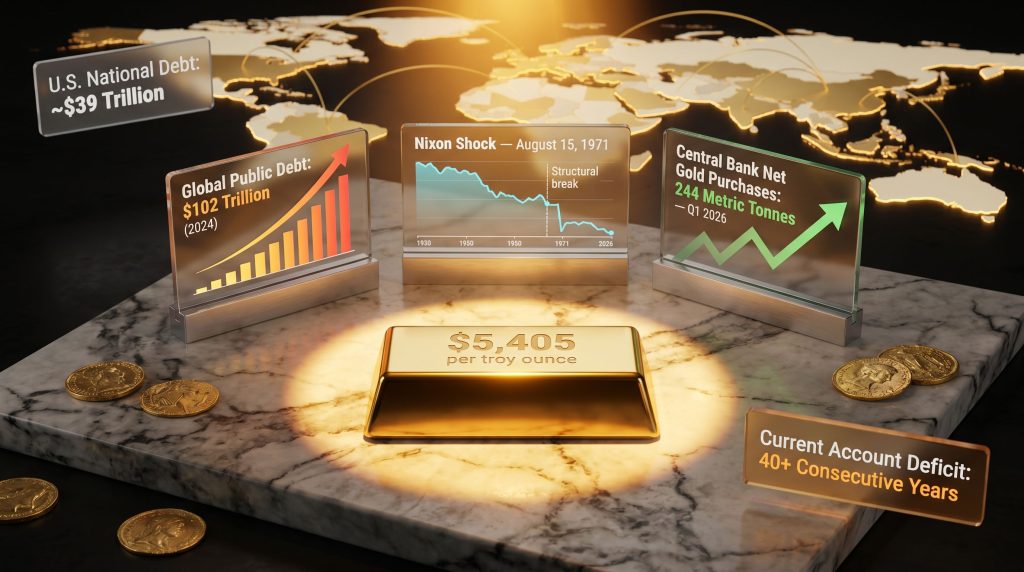
Global public debt reached a record $102 trillion as of 2024 — a figure that monetary historians argue would have been structurally impossible to accumulate under a gold-convertible monetary framework. (Source: UNCTAD, A World of Debt 2025)
The Nixon Shock: When the Last Constraint Was Removed
The postwar monetary order established by the Bretton Woods Agreement in 1944 represented a partial preservation of gold discipline. Under this system, the U.S. dollar was convertible to gold at a fixed rate of $35 per troy ounce, and all other participating currencies were pegged to the dollar. This concentrated the gold constraint in a single reserve currency, creating structural resilience but also a dangerous single point of failure.
On August 15, 1971, U.S. President Richard Nixon announced the suspension of the dollar's convertibility into gold. The Nixon Shock explained how this event permanently severed the final institutional link between the global monetary system and a hard commodity constraint.
The consequences were architectural, not merely policy-level:
- Fixed exchange rates collapsed as the Bretton Woods system unwound
- All major currencies transitioned to fiat status, backed solely by government authority
- The automatic price-specie-flow correction mechanism ceased to operate
- Central banks acquired the structural capacity to expand money supplies without an external hard limit
What followed was not an immediate crisis, but a slow structural divergence. Trade imbalances that would previously have triggered automatic correction were instead financed through debt issuance and capital account recycling. Furthermore, deficit spending that would have encountered rising rates and fiscal pushback under gold convertibility could now be sustained indefinitely with central bank support.
The next major ASX story will hit our subscribers first
What Happens to Trade Imbalances Without a Gold Anchor?
The standard response to this question in modern economics is that flexible exchange rates perform the same corrective function that gold flows once did. A country running a persistent trade deficit should, in theory, see its currency weaken — effectively replicating the price adjustment logic of the price-specie-flow mechanism.
In practice, however, several structural forces consistently prevent this clean adjustment:
- Reserve currency dynamics mean that countries holding large USD reserves have an institutional incentive to suppress their own currency's appreciation, sustaining U.S. deficits rather than allowing them to self-correct
- Central bank exchange rate management is routinely used by export-oriented economies to protect competitive positioning
- Capital account recycling allows surplus nations to reinvest trade earnings into U.S. financial assets, effectively financing the deficit rather than correcting it
- Political tolerance for imbalance is substantially higher in a fiat system, where deficits can be sustained through debt issuance rather than gold outflows that are finite and visible
The empirical result of these dynamics is a structural U.S. current account deficit that has persisted in nearly every year since the early 1980s — more than four consecutive decades of imbalance that a gold-linked monetary system would have worked to compress within years, not generations.
The Accumulated Imbalance: Key Data Points
| Metric | Figure | Source |
|---|---|---|
| Global public debt (2024) | $102 trillion (record) | UNCTAD, A World of Debt 2025 |
| U.S. current account deficit duration | Persistent since early 1980s | Center for Global Development |
| U.S. national debt (2026) | Approximately $39 trillion | U.S. Treasury |
| Central bank gold purchases, Q1 2026 | Net 244 metric tonnes | World Gold Council |
| Gold price record (2026) | $5,405 per troy ounce | Market data |
Gold Standard vs. Modern Fiat: A Structural Comparison
| Feature | Classical Gold Standard | Modern Fiat System |
|---|---|---|
| Trade imbalance correction | Automatic via gold flows and price adjustment | Requires exchange rate movement, capital flow, or policy action |
| Government spending constraint | Hard ceiling via finite gold supply | No structural ceiling; debt monetisation available |
| Inflation mechanism | Constrained by rate of physical gold supply growth | Determined by monetary policy decisions |
| Currency debasement risk | Low — supply growth limited to approximately 1-2% per year via mining | High — supply expandable by decree |
| Speed of trade adjustment | Slow but structurally bounded | Flexible but potentially indefinite |
| Systemic debt accumulation | Self-limiting via interest rate feedback | Unconstrained without political discipline |
(Sources: St. Louis Fed; World Gold Council — The Classical Gold Standard; Georgetown Journal of International Affairs)
An Important Nuance: The Limits of the Theoretical Model
The price-specie-flow mechanism is frequently presented as a fully automatic, frictionless system. Historical evidence, however, requires a more precise assessment.
Economic historians note several qualifications that are rarely included in introductory accounts:
- Adjustment was often slow — the transmission from gold outflows to price changes to trade rebalancing could take years, not months
- Central banks were active participants — interest rate adjustments were regularly deployed to manage the pace and direction of gold flows, meaning the system was never purely passive
- Capital flows could delay the correction — international lending allowed deficit countries to temporarily offset gold outflows, postponing rather than preventing the adjustment
- Wage and price rigidity complicated transmission — in practice, nominal wages and prices did not always respond as smoothly as the theoretical model assumed, particularly during deflationary adjustments
As researchers at the Georgetown Journal of International Affairs have noted, applying fixed-exchange-rate logic directly to modern flexible currency systems can produce misleading analytical conclusions. The mechanism's original context matters when evaluating its relevance to contemporary policy debates.
Why Central Bank Behaviour Signals a Reassessment of Fiat Stability
One of the more analytically significant developments of the current monetary era is the behaviour of the institutions best positioned to understand fiat currency risk: central banks themselves. Considering gold as ultimate money, this institutional behaviour becomes all the more striking.
Central bank gold buying reached a net 244 metric tonnes in Q1 2026, representing the fastest pace of accumulation in over a year, according to World Gold Council data. Critically, this occurred while gold was trading at a record price of $5,405 per troy ounce — indicating that acquisition cost was not the primary consideration driving these decisions.
This is the fifteenth consecutive year of net central bank gold buying, a duration that removes any possibility of interpreting the trend as tactical rather than structural. Institutions with full access to modern monetary instruments and sovereign debt markets are allocating to the one asset class whose supply characteristics cannot be influenced by political decree.
Analytical Implication: Gold's annual mine production adds approximately 1 to 2% to the total above-ground stock each year — a supply growth rate that cannot be accelerated by government instruction. This supply inelasticity is the same property that made gold the foundation of monetary systems for centuries, and it remains the property that distinguishes it from every fiat instrument available to modern investors.
Gold's gold safe-haven role has been demonstrated across currency crises, sovereign debt restructurings, and the complete collapse of multiple monetary regimes. This consistency is not a product of historical sentiment or cultural tradition. It is the direct consequence of a supply characteristic that no monetary authority has ever been able to replicate or override.
Disclaimer: This article is intended for informational and educational purposes only. It does not constitute financial or investment advice. All investments carry risk, including the potential for partial or total loss of capital. Past performance is not indicative of future results. Readers should consult a qualified financial adviser before making investment decisions. Forward-looking statements and historical comparisons are analytical in nature and should not be interpreted as predictions of future outcomes.
Frequently Asked Questions: Gold Standard and Trade Imbalance Correction
What is the price-specie-flow mechanism?
The price-specie-flow mechanism is the automatic process through which trade imbalances corrected themselves under a gold standard and trade imbalance correction mechanism. When a country ran a trade deficit, gold flowed outward to settle the imbalance, contracting the domestic money supply and placing downward pressure on domestic prices and wages. As local costs fell, the country's exports became more competitive internationally and import demand softened, gradually closing the deficit. The surplus country experienced the reverse process simultaneously. David Hume first formalised this mechanism in 1752.
Was the gold standard's trade correction truly automatic?
Directionally, yes. However, the speed and completeness of adjustment varied considerably in practice. Central banks regularly used interest rate policy to manage the pace of gold flows, and wage rigidities frequently slowed the price transmission process. The system provided structural discipline rather than instantaneous correction.
Why did the gold standard ultimately end?
The gold standard constrained governments' ability to finance expenditures exceeding available gold reserves, which became politically untenable during periods of large-scale deficit spending. The final break occurred on August 15, 1971, when the U.S. suspended dollar-to-gold convertibility, ending the Bretton Woods system and transitioning the global economy to fully fiat monetary architecture.
How does the modern fiat system attempt to correct trade imbalances?
Under flexible exchange rate systems, currency depreciation is the primary theoretical correction mechanism. A weaker currency makes exports cheaper and imports more expensive, replicating the price adjustment logic of the gold standard and trade imbalance correction mechanism. In practice, reserve currency dynamics, central bank intervention, and capital account recycling frequently prevent this adjustment from operating cleanly, allowing imbalances to persist indefinitely.
Why do investors hold gold in a fiat monetary environment?
Gold's fixed supply characteristics mean its purchasing power cannot be eroded through monetary expansion. Investors allocating to gold in a fiat environment are maintaining exposure to the same supply-inelastic property that made gold the foundation of monetary systems across multiple centuries: its structural immunity to debasement by political decree.
Want to Position Yourself Ahead of the Next Major ASX Mineral Discovery?
Discovery Alert's proprietary Discovery IQ model delivers real-time alerts on significant ASX mineral discoveries, transforming complex mineral data into clear, actionable insights for investors at every level of experience — explore the historic returns major discoveries have generated and begin your 14-day free trial to secure a genuine market-leading advantage.