August 1, 2026
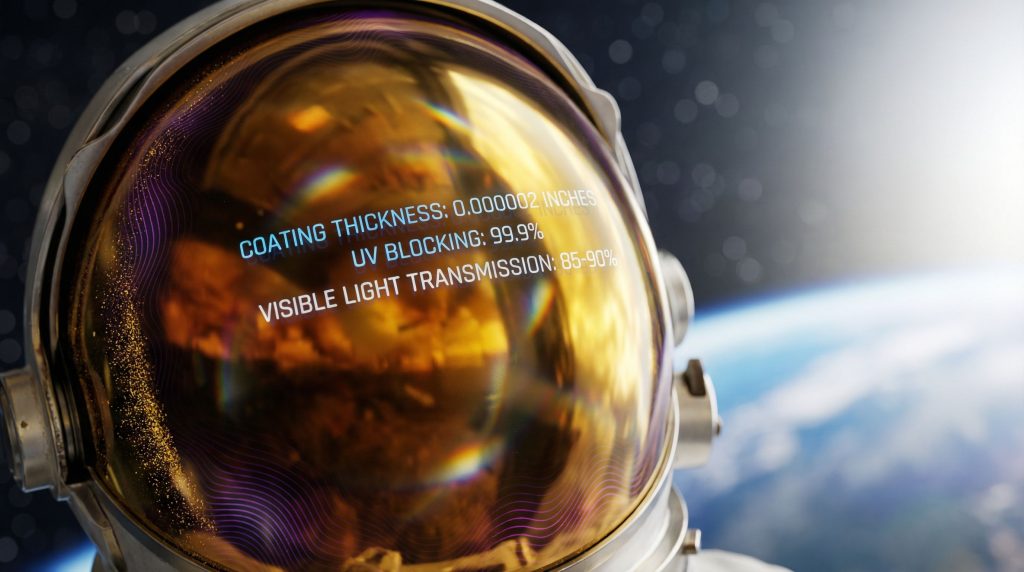
Gold visors for astronauts represent one of the most sophisticated engineering solutions protecting human vision in space's harsh electromagnetic environment. Without atmospheric filtration systems, the full spectrum of solar radiation presents immediate hazards requiring advanced materials science for crew safety.
The Physics of Space Radiation and Vision Protection
Solar radiation intensity at Earth's distance measures approximately 1,361 watts per square meter outside the atmosphere, compared to roughly 1,000 watts per square meter at sea level. This represents a 36% increase in direct exposure when atmospheric protection disappears entirely.
The electromagnetic spectrum in space includes several dangerous wavelengths. Extreme ultraviolet (EUV) radiation from solar activity poses significant risks to unprotected eyes. UV-C wavelengths (100-280 nm) completely blocked by Earth's ozone layer reach full intensity in space. Furthermore, intense infrared radiation causes thermal damage to retinal tissues. X-ray emissions during solar flare events create additional hazards. Additionally, visible light at intensities exceeding safe exposure thresholds requires careful management.
Gold's atomic structure provides unique electromagnetic interaction properties through its 79 electrons and specific conduction band characteristics. When electromagnetic radiation strikes gold surfaces, free electrons absorb photon energy and oscillate at frequencies that effectively block harmful wavelengths whilst permitting visual light transmission.
When big ASX news breaks, our subscribers know first
How Gold Visors for Astronauts Filter Dangerous Radiation
Electron Beam Evaporation Manufacturing Process
Creating effective protection requires precision manufacturing techniques capable of producing uniform coatings measuring approximately 50.8 nanometers in thickness. The electron beam evaporation process directs high-energy electrons at pure gold targets, vaporising the metal for controlled deposition onto polycarbonate substrates.
Key Manufacturing Parameters:
| Specification | Measurement | Purpose |
|---|---|---|
| Coating Thickness | 50.8 nanometers | Optimal electromagnetic filtering |
| Gold Purity | 99.99% (24-karat) | Maximum reflectance properties |
| Vacuum Pressure | 10⁻⁶ Torr | Contamination prevention |
| Deposition Rate | 0.1-0.5 nm/second | Uniform layer formation |
| Electron Energy | 5-20 keV | Controlled vaporisation |
Electromagnetic Filtering Mechanisms
Gold's optical properties enable selective wavelength management through specific physical mechanisms. Infrared radiation encounters gold's electron plasma resonance frequency, causing 95% reflection of thermal wavelengths. Moreover, ultraviolet radiation experiences both reflection and absorption, with 99.9% blocking efficiency protecting astronaut vision systems.
The precise thickness specification balances protection with visibility requirements. Coatings exceeding optimal parameters reduce visible light transmission below operational thresholds. Conversely, insufficient thickness permits dangerous radiation exposure.
Evolution of Space Helmet Technology Through Mission Programs
Apollo Program Innovations (1961-1972)
The Lunar Extravehicular Visor Assembly (LEVA) system established fundamental gold coating technology during humanity's first lunar exploration missions. Gold visors utilised dual-layer protection combining thermal management with optical filtering capabilities.
Apollo Visor Design Features:
• Polycarbonate substrate materials providing impact resistance
• Manual deployment mechanisms for adjustable solar protection
• Emergency backup visor configurations for critical situations
• Side sunshields offering peripheral radiation management
• Triple-layer thermal protection integrating multiple material systems
Historical mission data reveals that Apollo 17 astronauts, during the final lunar mission in December 1972, experienced optimal visor performance throughout 22 hours of lunar surface operations. Temperature variations between -250°F in shadow and +250°F in direct sunlight demonstrated gold coating durability under extreme thermal cycling.
Contemporary Artemis Program Advancements
Modern space exploration demands exceed Apollo-era capabilities, requiring enhanced materials science and manufacturing precision. The Axiom Extravehicular Mobility Unit (AxEMU) incorporates decades of technological advancement in optical protection systems.
Artemis Visor Technology Improvements:
• High-definition optics enabling enhanced visual clarity
• Advanced scratch resistance protecting against lunar dust abrasion
• Integrated pressure equalisation systems for extended operations
• Flip-down emergency shading providing additional protection options
• Anti-fogging technologies maintaining visibility during temperature transitions
Contemporary manufacturing techniques achieve coating uniformity within ±2 nanometers across entire visor surfaces, compared to Apollo-era tolerances of ±10 nanometers. In addition, this precision supports asteroid mining advances requiring enhanced optical systems for space-based operations.
Material Science Comparison for Space Applications
Comprehensive Material Analysis
Gold's superiority in space applications emerges from specific combinations of physical, chemical, and optical properties that alternative materials cannot replicate effectively. This technological excellence contributes to broader mining industry evolution across terrestrial and space-based operations.
Comparative Material Performance:
| Material | UV Protection | IR Reflection | Corrosion Resistance | Thermal Stability | Manufacturing Cost |
|---|---|---|---|---|---|
| Gold | 99.9% blocking | 95% reflection | Excellent | High | Premium |
| Silver | 85% blocking | 98% reflection | Poor (oxidation) | Moderate | Medium |
| Aluminium | 70% blocking | 85% reflection | Fair | Low | Budget |
| Titanium | 80% blocking | 60% reflection | Excellent | Excellent | High |
Why Gold Outperforms Alternative Materials
Gold's chemical stability prevents oxidation and corrosion indefinitely, even under extreme space conditions. Unlike silver, which forms sulfide compounds and loses reflectivity over time, gold maintains consistent optical properties throughout extended mission durations.
Thermal performance represents another critical advantage. Gold's melting point of 1,064°C and excellent thermal conductivity enable stable operation across space temperature ranges exceeding 500°F variations between sunlight and shadow.
Manufacturing compatibility allows precise adhesion to polycarbonate substrates without degradation. Alternative materials often require complex preparation procedures or experience adhesion failures under thermal cycling stress.
Industrial Applications Driving Gold Demand Beyond Space
Electronics Industry Consumption Patterns
The technology sector consumes approximately 228 tonnes of gold annually, primarily for electronic applications requiring reliable conductivity and corrosion resistance. This industrial demand reflects gold's practical utility extending far beyond monetary applications.
Primary Electronics Applications:
• Circuit board connections requiring permanent reliability
• Semiconductor wire bonding in integrated circuit manufacturing
• Connector plating for aerospace and military systems
• Optical equipment coatings for precision instrumentation
• Medical device components demanding biocompatibility
Emerging Technology Applications
Space-proven gold coating technology creates opportunities in terrestrial applications facing similar environmental challenges. These developments support gold and copper exploration activities meeting increasing industrial demand.
Emerging Applications:
• Deep-sea exploration equipment requiring corrosion resistance
• High-altitude aircraft systems experiencing radiation exposure
• Industrial welding protection managing intense electromagnetic radiation
• Military optical devices operating in extreme conditions
• Solar panel enhancement improving energy conversion efficiency
Jewellery production accounts for 44% of global gold demand, consuming approximately 1,550 tonnes annually. However, industrial applications continue expanding as technology sectors recognise gold's unique performance characteristics. This growing demand influences gold price forecast models considering industrial consumption patterns.
Future Developments in Space Visor Technology
Next-Generation Material Sciences
Advanced research programmes explore enhanced gold alloy systems and hybrid coating technologies for improved space applications. Potential developments include smart-tinting capabilities enabling automatic adjustment to changing light conditions.
Emerging Technology Concepts:
• Electrochromic integration providing variable opacity control
• Heads-up display compatibility incorporating augmented reality systems
• Self-healing coating matrices automatically repairing micro-damage
• Nanostructured surfaces enhancing optical performance characteristics
• Multi-spectral filtering optimising protection across electromagnetic spectrum
Manufacturing Scale and Cost Optimisation
Increasing commercial space activity drives demand for cost-effective manufacturing processes. Advanced deposition techniques and recycling programmes may reduce per-unit costs whilst maintaining aerospace-grade performance standards.
Automated manufacturing systems could achieve production scales supporting hundreds of annual space missions, compared to current limited production volumes for government space programmes.
The next major ASX story will hit our subscribers first
Commercial Spinoff Technologies From Space Research
Consumer Product Applications
Space-developed gold coating technology influences numerous commercial applications across multiple industries. These innovations support gold investment strategies considering technological applications beyond traditional holdings.
Consumer Applications:
• Premium sports sunglasses incorporating space-grade optical protection
• Automotive glass systems reducing thermal load in vehicle interiors
• Architectural window coatings improving building energy efficiency
• Professional photography equipment enabling specialised lighting control
• Industrial safety equipment protecting workers from radiation exposure
Investment Market Implications
Growing space industry activity creates sustained industrial gold demand patterns affecting precious metals markets. Commercial space ventures, satellite manufacturing, and space tourism development may significantly increase gold consumption for specialised applications.
Market Demand Factors:
• Satellite constellation deployment requiring radiation-resistant components
• Space tourism growth needing passenger protection systems
• Lunar mining operations demanding durable equipment coatings
• Mars exploration missions requiring long-duration material performance
• Commercial space stations incorporating extensive life support systems
Technical Specifications and Performance Standards
Optical Performance Requirements
Gold visors for astronauts must meet stringent performance criteria balancing protection with operational visibility. Modern specifications require 85-90% visible light transmission whilst blocking harmful radiation wavelengths.
Performance Standards:
• UV-A blocking: 99.5% minimum (315-400 nm wavelengths)
• UV-B blocking: 99.9% minimum (280-315 nm wavelengths)
• UV-C blocking: 100% (100-280 nm wavelengths)
• Infrared reflection: 95% minimum (700-2500 nm wavelengths)
• Visible transmission: 85-90% (400-700 nm wavelengths)
Durability and Longevity Testing
Space mission requirements demand materials capable of withstanding multiple EVA (extravehicular activity) operations without performance degradation. Gold coatings undergo extensive testing including thermal cycling, abrasion resistance, and radiation exposure simulation.
Lunar dust presents particular challenges, with particles measuring 70 micrometers average diameter and possessing sharp, angular surfaces. Gold coatings must maintain optical clarity despite repeated dust exposure and cleaning procedures.
Understanding the Science Behind Gold's Effectiveness
Quantum Mechanical Principles
Gold's electromagnetic interaction properties derive from its electronic structure containing 79 protons and corresponding electron configurations. The metal's conduction band electrons exhibit specific resonance frequencies that interact selectively with different wavelengths of electromagnetic radiation.
When infrared photons encounter gold surfaces, conduction electrons absorb energy and oscillate at frequencies that re-emit the radiation as reflected light. This process prevents thermal energy transmission whilst maintaining material integrity.
Ultraviolet wavelengths possess higher photon energies that cause more intense electron oscillations. Gold's electronic structure enables both reflection and controlled absorption of UV radiation, effectively preventing transmission to protected surfaces behind the coating.
Engineering Trade-offs and Design Optimisation
Optimal visor design requires balancing multiple performance parameters including protection, visibility, weight, durability, and manufacturing cost. Engineers must consider mission-specific requirements and operational constraints when specifying coating parameters.
Design Optimisation Factors:
• Mission duration affecting required coating longevity
• Environmental conditions including temperature ranges and radiation levels
• Operational requirements determining minimum visibility standards
• Weight constraints limiting substrate and coating thickness
• Cost limitations influencing material selection and manufacturing processes
Modern computer modelling enables precise optimisation of coating thickness and composition for specific mission parameters, reducing development time and improving performance reliability.
Gold visors for astronauts represent sophisticated engineering solutions addressing fundamental challenges of space exploration. As humanity expands beyond Earth, these proven technologies will continue evolving whilst creating new applications across terrestrial industries. The intersection of materials science, optics, and space technology demonstrates gold's essential role in humanity's most demanding applications, establishing its value far beyond traditional monetary functions.
Ready to capitalise on the next major mineral discovery?
Discovery Alert instantly alerts investors to significant ASX mineral discoveries using its proprietary Discovery IQ model, turning complex mineral data into actionable insights just like how advanced materials science transforms gold into sophisticated space protection systems. Explore Discovery Alert's dedicated discoveries page to understand why historic mineral discoveries can generate substantial returns, then begin your 14-day free trial today to position yourself ahead of the market.