July 8, 2026
When Capital Follows Certainty: The Strategic Logic Behind Precious Metals Consolidation in Latin America
Across global commodity markets, one dynamic has become increasingly difficult to ignore: the growing divergence between where mineral wealth actually sits in the ground and where institutional capital chooses to flow. Africa, West Asia, and Central Asia collectively hold more than half of the world's critical and precious mineral deposits, yet these regions attract a disproportionately small fraction of global exploration budgets. The reasons are rarely geological. They are almost always structural, rooted in permitting unpredictability, fiscal opacity, and the compounding risk premium that accompanies political instability.
It is precisely this context that gives the Goldgroup Gold Resource merger approval its broader significance. The transaction, finalised at the shareholder level on July 2, 2026, is not simply a corporate combination. It is a statement about where sophisticated mining capital sees the most durable risk-adjusted returns at this particular moment in the global mining cycle. Furthermore, understanding this deal requires situating it within the broader trends of mining industry consolidation that have reshaped the sector over recent years.
When big ASX news breaks, our subscribers know first
The Mechanics of a Dual-Jurisdiction Deal
The structural complexity of this transaction is worth examining carefully, because it reveals the deliberate architecture required to bind two publicly listed companies operating across multiple regulatory environments.
The deal operates simultaneously under two distinct legal frameworks:
- A British Columbia Plan of Arrangement under Division 5 of Part 9 of the Business Corporations Act, covering the Canadian corporate elements of the transaction
- A reverse triangular merger governed by Colorado law, through which a wholly owned intermediary, Goldgroup Merger Sub Inc., executes the combination with Gold Resource Corporation emerging as a fully owned subsidiary
The British Columbia Supreme Court granted judicial endorsement of the plan of arrangement, satisfying one of the more demanding pre-closing prerequisites. On the U.S. side, Gold Resource's proxy statement, filed with the Securities and Exchange Commission on May 29, 2026, served as the primary disclosure vehicle for American stockholders ahead of the vote.
What makes reverse triangular mergers particularly useful in cross-border precious metals transactions is their preservation of the target company's legal identity while transferring economic and operational control. Gold Resource does not disappear in a legal sense at closing; it becomes a wholly owned subsidiary, which simplifies the transfer of existing contracts, permits, and regulatory licences without triggering the renegotiation that an outright asset purchase might require. In Mexico's mining sector, where concession and environmental permit transfers can be administratively intensive, this structural choice carries genuine practical value.
Shareholder Conviction: Reading the Vote Data
The voting outcomes from both meetings provide a useful signal about investor sentiment, and the numbers are instructive.
| Metric | Detail |
|---|---|
| Approval Date | July 2, 2026 |
| Goldgroup Shares Voted | 280,061,700 (92.88% of outstanding) |
| Votes in Favour (Goldgroup) | More than 99.99% of ballots cast |
| Votes in Favour (GRC) | 96,312,452 |
| Votes Against (GRC) | 4,681,241 |
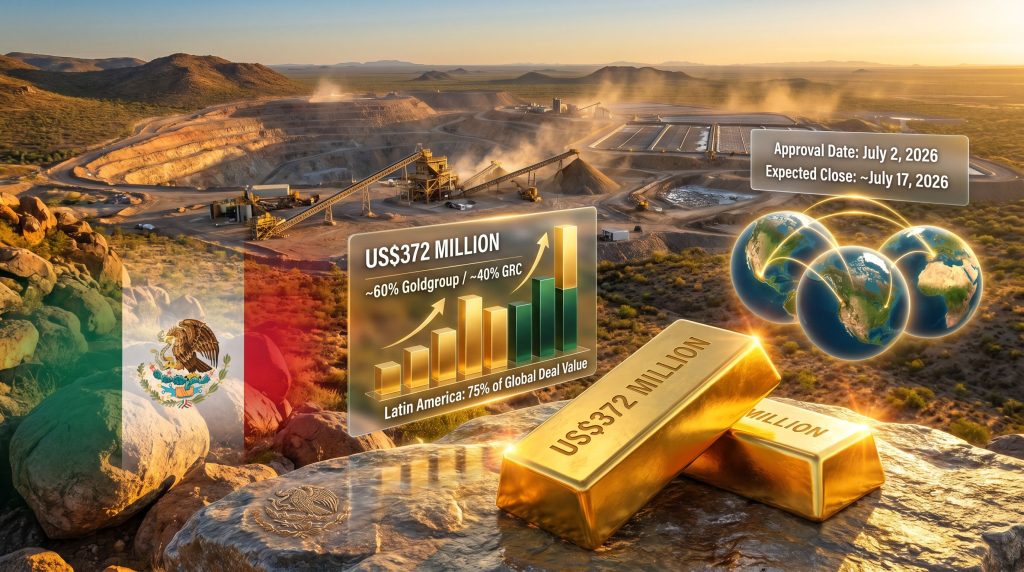
| Transaction Valuation | Approximately US$372 million (fully diluted, in-the-money) |
| Post-Merger Ownership Split | ~60% Goldgroup / ~40% GRC shareholders |
| Share Exchange Ratio | 0.3619 Goldgroup shares per GRC share (post-consolidation) |
| Expected Closing Date | On or around July 17, 2026 |
A 92.88% participation rate at the Goldgroup meeting is notably high by the standards of junior to mid-tier mining company general meetings, where retail-heavy share registers frequently produce turnout well below 70%. The near-unanimous approval margin on the Goldgroup side, combined with GRC stockholder approval by a ratio of roughly 95% to 5%, suggests that both shareholder bases had absorbed the deal rationale and found it compelling. According to official announcements, both parties moved swiftly to confirm the outcome.
Alongside the merger vote itself, Goldgroup shareholders ratified a suite of accompanying governance actions: new Articles of Incorporation, the appointment of Davidson & Company LLP as external auditor, the formal election of a new board of directors, and the adoption of an Omnibus Equity Incentive Plan under which 3,750,000 pre-consolidation stock options (equivalent to 937,500 post-consolidation) were granted to directors at a US$1.55 exercise price, vesting immediately with a one-year expiry.
The 4-for-1 Consolidation: Purpose, Process, and Investor Implications
One day after shareholder approval, Goldgroup confirmed that it and Gold Resource had jointly set the consolidation ratio at one post-consolidation share for every four pre-consolidation shares held. This ratio was established under the terms of the Arrangement Agreement and Plan of Merger, originally dated January 25, 2026, and subsequently amended on May 15, 2026.
The mechanics are straightforward, but the strategic intent matters. The NYSE American exchange, which serves as the primary U.S. listing venue for small and mid-capitalisation resource companies, imposes minimum share price thresholds that many junior miners cannot meet without first reducing their outstanding share count. The consolidation is the mechanism by which Goldgroup restructures its equity to cross that threshold.
Important investor note: Goldgroup has explicitly stated that no assurance exists that its NYSE American listing application will be approved, even after the consolidation is complete. TSX Venture Exchange approval of the consolidation itself also remains a prerequisite before it takes legal effect. Investors should treat the exchange listing as a conditional outcome requiring independent approval processes.
The strategic importance of a successful NYSE American listing extends beyond the symbolic. Access to U.S. institutional capital pools, eligibility for inclusion in North American precious metals indices, and broader coverage from U.S.-based equity analysts collectively represent a meaningful re-rating opportunity. For a combined company of this scale, moving from a TSXV-listed junior to a dual-listed mid-tier producer could meaningfully expand the potential investor base. In addition, how gold price moves influence re-rating timelines remains a key variable for investors to monitor.
Asset Portfolio: What the Combined Company Actually Owns
The merged entity assembles a geographically diversified portfolio across two countries and four principal assets.
| Asset | Location | Status | Key Detail |
|---|---|---|---|
| Cerro Prieto Mine | Sonora, Mexico | Producing (heap leach) | 100% owned by Goldgroup |
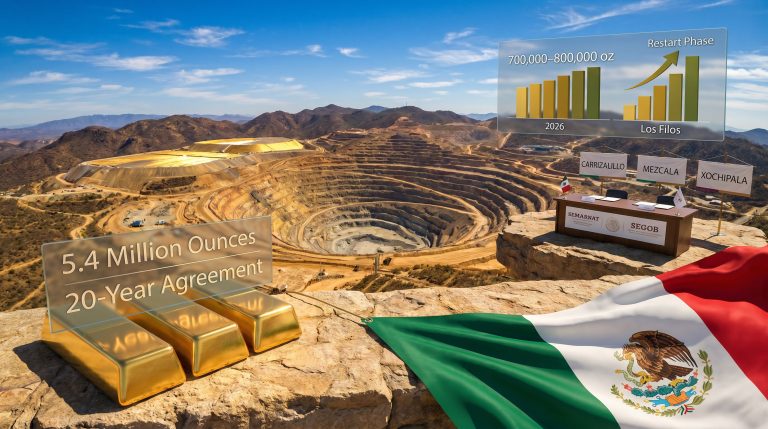
| San Francisco Project | Sonora, Mexico | Permitted; restart targeted late 2026/early 2027 | 1.226Moz M&I gold resources; 33,667ha |
| Don David Mine | Oaxaca, Mexico | Producing | Contributed by Gold Resource |
| Back Forty Project | Michigan, USA | Development stage | Contributed by Gold Resource |
The San Francisco Project: Distressed Asset Acquisition as Value Creation
The San Francisco project warrants particular attention from an investment analysis perspective because of how it was acquired. Goldgroup obtained the asset through a Concurso Mercantil proceeding, which is the Mexican equivalent of a court-supervised insolvency or restructuring process. Acquiring a formerly operating, fully permitted mine through insolvency proceedings typically allows a buyer to enter at a materially lower cost basis than a competitive open-market transaction would produce, because distressed sellers and court-supervised processes prioritise creditor recovery over maximising sale price.
The practical implications are significant:
- The asset arrives with existing infrastructure intact, including two developed open pits, heap leach processing facilities, and supporting site services, eliminating the capital expenditure associated with greenfield construction
- The 1.226 million ounces of Measured and Indicated gold resources across 33,667 hectares provides a defined production foundation from which restart economics can be modelled
- Management has identified multiple large-scale exploration targets within the land package, meaning organic resource growth is achievable without stepping beyond the existing tenement boundary
- A restart production target of late 2026 or early 2027 implies that the asset could be generating cash flow within roughly 12 to 18 months of deal closing, a timeline that is unusually short for any project entering production from a standing start
Heap Leach Processing: Understanding the Technology
Both the Cerro Prieto mine and the San Francisco project utilise heap leach processing, a method that is worth understanding in terms of its economic and operational characteristics. In heap leaching, crushed ore is stacked on lined pads and irrigated with a dilute cyanide or acid solution, which percolates through the material and dissolves the target metal. The pregnant solution is then collected and processed to recover the gold.
Heap leaching is well-suited to lower-grade open pit oxide gold deposits because its capital intensity is substantially lower than conventional milling circuits. Operating costs per ounce can be competitive when ore grades are sufficient to support solution recovery rates. The trade-off is that heap leach recoveries are typically lower than mill recoveries, and the process is sensitive to ore mineralogy, particularly when sulphide minerals are present. That Goldgroup operates two heap leach assets in the same geological corridor in Sonora suggests an operational familiarity with the method that should translate into genuine cost management capability across the combined portfolio.
Latin America's Mining M&A Supercycle: Context and Causation
The Goldgroup Gold Resource merger approval does not occur in isolation. It is one transaction within a much larger capital reallocation story playing out across Latin America. Consequently, the broader context of gold M&A activity and its drivers deserves careful consideration.
During the first three quarters of 2025, global mining M&A activity reached approximately US$30 billion, with Latin America accounting for roughly 75% of total deal value. Since 2021, Latin American mining deal values have risen by more than 200%, while African deal activity declined by nearly 80% over the same period, according to the Future Minerals Barometer Report 2025, prepared by McKinsey & Company in collaboration with S&P Global Market Intelligence and GlobeScan.
The divergence reflects something deeper than short-term sentiment. McKinsey's 2024 Global Materials Perspective notes that mining sector productivity has grown at approximately 1% per year since 2018, a figure that underscores why capital efficiency and operational discipline now matter as much as resource scale. In that environment, jurisdictions offering transparent permitting, legal predictability, and existing infrastructure corridors command a structural premium.
GlobeScan's research highlights that while Africa and West Asia hold enormous untapped potential, persistent barriers around policy frameworks, infrastructure gaps, and financing structures continue to divert capital toward Latin America and specifically toward Mexico's established mining belts. These consolidation pressures are unlikely to ease in the near term, making transactions of this kind increasingly common.
Mexico's Sonora Corridor: Why It Attracts Repeat Capital
Sonora is not merely Mexico's most prolific precious metals state by accident. The combination of Precambrian and Palaeozoic basement rocks overlain by Tertiary volcanic sequences has produced a diverse range of deposit types, from epithermal gold-silver systems to porphyry copper-gold and skarn mineralisation. The Cerro Prieto and San Francisco assets sit within a corridor that has attracted sustained foreign direct investment from Canadian and U.S.-listed producers for decades, in part because the geological prospectivity is well-documented and the workforce is experienced.
For Goldgroup, concentrating two of its four assets within the same state creates tangible operational advantages: shared logistics networks, common contractor relationships, overlapping regulatory familiarity, and the potential for future processing consolidation as both assets ramp up production concurrently.
The next major ASX story will hit our subscribers first
Remaining Steps Before Closing
With shareholder approvals secured from both companies, the path to closing on or around July 17, 2026 involves the following remaining conditions:
- TSXV approval of the 4-for-1 share consolidation
- Satisfaction or formal waiver of all remaining closing conditions under the Arrangement Agreement and Plan of Merger
- Formal completion of the reverse triangular merger, at which point Gold Resource shares will cease to trade and the company becomes a wholly owned subsidiary
Following closing, the integration agenda includes restarting production at San Francisco, integrating the Don David Mine operational systems into Goldgroup's management infrastructure, pursuing the NYSE American listing application, and activating the Omnibus Equity Incentive Plan to align executive incentives with long-term combined company performance. A completed definitive feasibility study for the San Francisco restart will also form a critical part of the post-merger technical programme. Court approval for the Canadian elements of the deal was confirmed separately, providing additional regulatory certainty ahead of the anticipated closing date.
Frequently Asked Questions
What was the total value of the Goldgroup Gold Resource merger?
The transaction was valued at approximately US$372 million on a fully diluted, in-the-money basis at the time of shareholder approval.
When did shareholders vote on the deal?
Both Goldgroup Mining and Gold Resource Corporation shareholders voted separately to approve the combination on July 2, 2026.
What share exchange ratio applies to GRC stockholders?
GRC stockholders will receive 0.3619 Goldgroup shares per Gold Resource share, calculated on a post-consolidation basis.
Why is the 4-for-1 consolidation being conducted?
The consolidation is designed to bring Goldgroup's per-share price to a level that satisfies minimum listing thresholds for the NYSE American exchange.
What does the combined company own?
The merged entity controls the Cerro Prieto heap leach gold mine and San Francisco project in Sonora, Mexico; the Don David gold mine in Oaxaca, Mexico; and the Back Forty development project in Michigan, USA.
What ownership split results from the merger?
Gold Resource stockholders are expected to hold approximately 40% of the combined company, with legacy Goldgroup shareholders retaining approximately 60%.
Has the deal received court approval?
Yes. The British Columbia Supreme Court granted approval for the plan of arrangement, removing one of the key judicial prerequisites for closing.
When is closing expected?
The transaction is targeted to close on or about July 17, 2026, subject to remaining closing conditions and regulatory approvals.
This article contains forward-looking statements and references to merger timelines, production targets, and exchange listing outcomes that are subject to change. Readers should conduct independent research and consult qualified financial advisers before making investment decisions. The NYSE American listing application remains conditional and is not guaranteed.
Want to Capitalise on the Next Major Precious Metals Discovery Before the Market Moves?
The consolidation wave reshaping Latin American mining signals exactly the kind of structural opportunity that Discovery Alert's proprietary Discovery IQ model is built to identify — scanning ASX announcements in real time and translating complex mineral data into actionable insights for both traders and long-term investors. Explore historic discoveries and the returns they generated, then begin your 14-day free trial to ensure you're positioned ahead of the market when the next significant announcement lands.