August 6, 2026
Global energy markets face unprecedented structural challenges as institutional analysis increasingly points toward sustained commodity price weakness throughout 2026. The convergence of accelerating supply growth across multiple regions, inventory accumulation dynamics, and shifting demand patterns creates a complex macroeconomic environment that extends far beyond traditional cyclical adjustments. Understanding these fundamental forces requires examining how oil price movements translate into price discovery mechanisms across international energy markets.
Structural Supply Imbalances Drive 2026 Energy Market Outlook
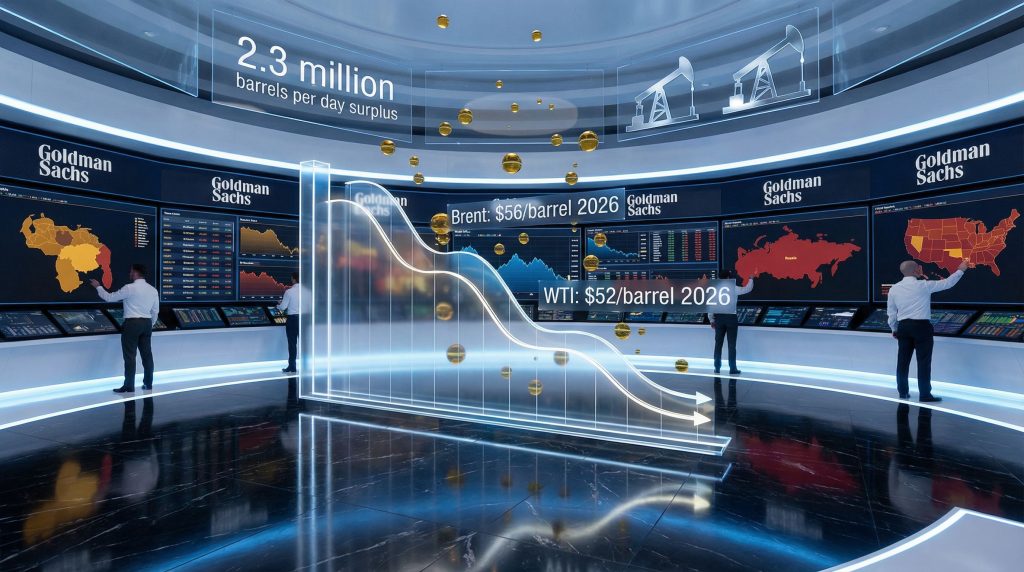
The Goldman Sachs oil price forecast 2026 centers on fundamental supply-demand dynamics that reflect structural market changes rather than temporary disruptions. The investment bank projects Brent crude averaging $56 per barrel and WTI crude at $52 per barrel throughout 2026, with fourth-quarter floors reaching $54 and $50 respectively. These projections represent significant departures from current trading levels, as Brent futures hover around $63 per barrel while West Texas Intermediate holds near $59.
The analytical framework underlying this bearish outlook emphasises inventory accumulation mechanisms that create sustained downward pressure on spot prices. As OECD inventory builds accelerate beyond typical seasonal patterns, storage costs and opportunity costs necessitate price adjustments to clear marginal barrels from global markets. This represents a fundamental shift from deficit conditions that supported higher prices in previous years.
Market participants must recognise that these projections reflect conviction in persistent oversupply rather than temporary market imbalances. The Goldman Sachs oil price forecast 2026 distinguishes between cyclical price weakness and structural surplus conditions that require multi-year rebalancing processes.
Critical Price Transmission Mechanisms
The forecasted price ranges serve specific economic functions beyond simple supply-demand equilibrium. At $50-56 per barrel, crude oil prices create three simultaneous market responses:
• Capital allocation constraints that reduce return-on-investment attractiveness for marginal projects
• Operational threshold effects where high-cost production becomes temporarily uneconomical
• Demand elasticity responses that stimulate consumption across transportation, heating, and petrochemical sectors
These transmission mechanisms operate through working capital dynamics and investment cycle adjustments that extend beyond immediate price responses. Energy companies facing compressed margins must prioritise operational efficiency while deferring long-cycle capital commitments that require sustained higher price signals.
When big ASX news breaks, our subscribers know first
Quantifying the 2026 Supply Surplus Challenge
The Goldman Sachs oil price forecast 2026 projects a 2.3 million barrels per day surplus emerging throughout the year, representing one of the most significant supply-demand imbalances in recent market history. This oversupply scenario stems from multiple converging factors that compound traditional market dynamics.
Regional Supply Additions:
• Venezuelan production recovery: +0.4 mb/d reflecting sanctions modifications and infrastructure rehabilitation
• Russian output enhancement: +0.5 mb/d despite geopolitical constraints and export limitations
• U.S. production growth: +0.3 mb/d from completion of major shale projects and operational efficiencies
• Additional non-OPEC contributions: Undisclosed volumes from various regional producers
The magnitude of this surplus requires understanding that global oil demand growth typically ranges between 1-2 mb/d annually under normal economic conditions. A 2.3 mb/d surplus effectively represents 12-24 months of typical demand growth, creating substantial inventory accumulation pressures that markets must absorb through price adjustments.
Inventory Dynamics and Storage Economics
Rising global oil stocks create storage opportunity costs that necessitate price concessions for inventory holders. When supply additions exceed demand growth rates, marginal barrels require price discounts to justify continued storage expenses and working capital commitments. This mechanism operates independently of speculative positioning or geopolitical risk premiums.
The OECD inventory accumulation projected for 2026 reflects structural oversupply rather than strategic stockpiling decisions. Commercial inventory holders facing rising storage costs and declining price expectations accelerate destocking through price reductions, creating downward pressure that persists until supply growth moderates or demand acceleration absorbs excess volumes.
Market Rebalancing Through Price Discovery Mechanisms
The Goldman Sachs oil price forecast 2026 assumes no additional OPEC production cuts despite the organisation's historical tendency to intervene during price weakness. This assumption reflects current member country fiscal pressures, market share considerations, and spare capacity limitations that constrain coordinated intervention capabilities.
OPEC's strategic position has evolved significantly since previous intervention cycles. Member countries face mounting domestic fiscal requirements that prioritise revenue generation over market share preservation. Saudi Arabia and UAE maintain spare production capacity but choose not to deploy it given revenue optimisation considerations and political pressures for sustained oil export earnings.
Price-Driven Supply Response Dynamics
Market rebalancing occurs through price-driven supply responses that operate across multiple timeframes:
Short-term adjustments (6-12 months):
-
Marginal well economics: High-cost production faces immediate profitability challenges
-
Completion deferrals: Drilled but uncompleted wells await higher price signals
-
Operational optimisation: Companies prioritise lowest-cost production assets
Medium-term responses (1-3 years):
-
Capital expenditure reductions: Lower prices reduce new project economics
-
Investment cycle adjustments: Long-cycle projects require sustained price signals
-
Technology deployment: Enhanced efficiency partially offsets price pressures
The effectiveness of these mechanisms depends on sustained price signals rather than temporary market disruptions. U.S. shale operators, in particular, demonstrate rapid response capabilities to price changes, with production adjustments occurring within 6-12 months of sustained price movements.
Medium-Term Recovery Prospects and Timeline
The Goldman Sachs oil price forecast 2026 envisions a fundamental market transition beginning in 2027, with surplus conditions gradually evolving toward balanced markets and eventual deficits. This rebalancing timeline reflects deceleration in non-OPEC supply growth and sustained demand expansion across developing economies.
2027 Price Projections:
• Brent crude: $58 per barrel average (revised downward by $5 from prior estimates)
• WTI crude: $54 per barrel average (similarly revised downward by $5)
These revisions reflect upgraded supply assumptions that account for enhanced U.S. production capabilities, Venezuelan recovery acceleration, and Russian output resilience despite sanctions constraints. The downward adjustments demonstrate how supply forecasting directly influences equilibrium price calculations.
Long-Cycle Investment Constraints and Price Support
The 2030-2035 price trajectory projects Brent and WTI averaging $75 and $71 respectively, reflecting recognition that sustained underinvestment during 2014-2020 creates subsequent supply constraints. This framework assumes energy transition policies do not catastrophically reduce demand trajectories while geopolitical market risks permit normal capital deployment.
Key Price Support Factors:
• Depletion from mature fields requiring continuous investment for production maintenance
• Deepwater and Arctic project economics demanding sustained $70+ price signals for development
• Infrastructure bottlenecks constraining rapid supply response capabilities
• Regulatory constraints extending project development timelines and costs
Major integrated oil companies require 5-10 year payback periods for multibillion-dollar capital commitments, creating natural price floors as depletion necessitates continuous replacement investment. Furthermore, these projections acknowledge that current low prices eventually create supply constraints that support higher future valuations.
Geopolitical Risk Scenarios and Market Disruption Potential
While the base case scenarios exclude major supply disruptions, several geopolitical developments present material upside risks to price projections. These scenarios could fundamentally alter supply-demand balances through involuntary production losses or export constraints.
Iran Supply Disruption Analysis:
• Potential production loss: 1-2 mb/d removed from global markets
• Price impact estimate: $10-20 per barrel upside risk
• Mechanism: Sanctions escalation or regional military conflict affecting export capabilities
Iranian crude production currently operates around 3.2 million barrels per day, with limited alternative export routes due to existing U.S. sanctions regimes. Military conflict or comprehensive sanctions escalation could remove substantial volumes from global markets within weeks, requiring immediate supply responses from other producers or demand destruction through higher prices.
Regional Conflict and Infrastructure Vulnerabilities
Russia-Ukraine Energy Dimensions:
The ongoing conflict creates multiple pathways for energy market disruption beyond current baseline assumptions. Ukrainian targeting of Russian energy infrastructure, European sanctions escalation, or transportation bottlenecks could constrain Russian crude exports beyond levels incorporated in current forecasting models.
Russian crude exports historically route through Baltic terminals and pipeline systems that face vulnerability to infrastructure disruptions. Additional sanctions targeting Russian energy revenues could force supply redirections to Asian markets at discounted prices, altering global crude flow patterns and regional price differentials.
Venezuela Political-Economic Stability:
The projected 0.4 mb/d Venezuelan production increase assumes political stability and continued sanctions relief that may prove optimistic. U.S. policy continuity regarding Venezuela sanctions remains uncertain, while PDVSA operational capacity faces infrastructure constraints that could limit production recovery sustainability.
Foreign investment in Venezuelan energy infrastructure requires legal and regulatory clarity that current political conditions may not provide. Production recovery timelines face delays from equipment shortages, skilled workforce limitations, and transportation bottlenecks that could constrain output below forecasted levels.
Investment Strategy Implications and Market Positioning
The energy price forecasts create distinct investment themes across energy value chains that extend beyond traditional upstream and downstream categorisations. Understanding these implications requires analysing how sustained low prices affect different business models and operational strategies, with experienced investors seeking investment strategy insights to navigate market complexity.
Upstream Sector Strategic Positioning
Short-term headwinds face traditional exploration and production companies as margin compression challenges operational cash flows and investment returns. Companies with low breakeven costs maintain competitive advantages during price weakness, while high-cost producers face operational deferrals or asset impairments.
Operational Excellence Priorities:
• Cost structure optimisation through technology deployment and operational efficiency
• Capital discipline maintenance avoiding projects requiring higher price assumptions
• Portfolio high-grading focusing on lowest-cost, highest-return assets
• Financial flexibility maintaining balance sheet strength for market volatility
U.S. shale operators demonstrate particular sensitivity to price changes given their rapid-cycle development models and variable cost structures. Companies with strong drilling inventories and efficient completion techniques maintain flexibility to adjust production volumes based on price signals.
Downstream and Petrochemical Opportunities
Lower crude oil prices create margin expansion opportunities for refining and petrochemical operations through reduced input costs and improved processing economics. Refiners benefit from crude-product spreads while petrochemical producers gain feedstock cost advantages.
Refining Sector Benefits:
• Crack spread expansion as product prices adjust slower than crude oil
• Inventory valuation gains during price decline periods
• Capacity utilisation optimisation as economics improve across configurations
Petrochemical Competitive Advantages:
• Feedstock cost reductions improving naphtha and gas oil economics
• Export competitiveness enhancement particularly for energy-intensive products
• Margin sustainability through integrated value chain optimisation
Hedging Strategy Recommendations and Risk Management
Goldman specifically recommends shorting the 2026Q3-December 2028 Brent time-spread to capitalise on projected near-term weakness followed by medium-term recovery. This strategy allows investors to express conviction in the surplus timeline while positioning for subsequent rebalancing.
Time-Spread Strategy Components:
-
Short 2026 positions reflecting projected surplus conditions and inventory builds
-
Long 2027-2028 positions anticipating market rebalancing and deficit emergence
-
Risk management through defined time horizons and position sizing
Energy producers facing price downside should consider 2026 hedging programmes that protect cash flows while maintaining upside participation for potential geopolitical disruptions. Hedging strategies must balance downside protection with operational flexibility as market conditions evolve.
The next major ASX story will hit our subscribers first
Global Economic Transmission and Regional Impact Analysis
The projected oil price weakness functions as a global economic stimulus mechanism, particularly benefiting oil-importing economies through reduced input costs and enhanced consumer spending power. Lower energy prices create deflationary pressures that provide central banks additional monetary policy flexibility.
Consumer Economics and Demand Stimulation
Household Budget Impact:
• Transportation cost reductions increasing discretionary income availability
• Heating and energy bill decreases improving household cash flows
• Consumer confidence enhancement through perceived economic improvement
Energy cost reductions disproportionately benefit lower-income households that allocate higher percentages of income to transportation and energy expenses. This demographic spending pattern creates consumption multipliers that stimulate broader economic activity across retail and services sectors.
Industrial Competitiveness Enhancement:
• Manufacturing input cost reductions improving export competitiveness
• Transportation and logistics savings reducing distribution costs
• Chemical feedstock advantages benefiting downstream industries
Regional Economic Divergence Patterns
Oil-Exporting Economy Challenges:
Oil-dependent economies face fiscal pressure intensification as government revenues decline with lower prices. Middle Eastern producers, Russian Federation, and various African exporters must accelerate economic diversification programmes while managing reduced hydrocarbon income streams.
Gulf State Adaptation Strategies:
• Sovereign wealth fund utilisation for fiscal deficit financing
• Economic diversification acceleration reducing oil dependency ratios
• Infrastructure investment continuation despite revenue constraints
• Social spending prioritisation maintaining political stability
Oil-Importing Economy Benefits:
Major importing nations including China, India, Japan, and European Union members gain current account improvements through reduced energy import costs. These savings create fiscal space for infrastructure investment while reducing inflationary pressures on monetary policy, as noted by Goldman Sachs commodity outlook projections.
Asian Growth Acceleration Potential:
• Manufacturing competitiveness enhancement through lower energy costs
• Consumer spending power increases stimulating domestic demand
• Export sector advantages from reduced production costs
Energy Transition Implications and Technology Investment
Lower oil prices present complex implications for energy transition timelines and renewable technology deployment. Reduced fossil fuel costs may slow adoption rates for alternative technologies while simultaneously providing economic relief that supports longer-term transition investments. However, renewable energy transitions continue advancing despite short-term commodity price fluctuations.
Renewable Energy Investment Dynamics
Short-term adoption challenges emerge as lower oil and gas prices improve fossil fuel competitiveness relative to renewable alternatives. Electric vehicle adoption rates may decelerate as gasoline becomes more affordable, while industrial electrification projects face extended payback periods.
Policy Response Considerations:
• Carbon pricing mechanisms may require adjustment to maintain renewable competitiveness
• Subsidy programme modifications compensating for reduced economic incentives
• Infrastructure investment acceleration ensuring transition momentum maintenance
Long-term transition resilience ultimately depends on policy frameworks rather than commodity price cycles. Government commitments to carbon reduction targets and renewable energy mandates provide investment certainty independent of short-term fossil fuel price movements.
Technology Development and Innovation Cycles
Lower energy prices create innovation pressure for efficiency improvements and cost reductions across energy technologies. Renewable energy developers must accelerate cost reduction timelines while fossil fuel companies invest in operational efficiency and environmental performance improvements.
Research and development priorities shift toward breakthrough technologies that maintain competitiveness across price cycles rather than incremental improvements dependent on specific price assumptions. This dynamic accelerates innovation in energy storage, grid integration, and alternative fuel technologies.
Market Psychology and Investor Sentiment Analysis
The analytical forecasts reflect conviction that contrasts with market sentiment patterns typically driven by geopolitical events and speculative positioning. Understanding this divergence requires recognising how fundamental analysis differs from momentum-based trading strategies.
Behavioural Finance Considerations:
• Loss aversion among energy investors facing sustained price weakness
• Anchoring biases preventing adjustment to new supply-demand realities
• Herding effects as institutional investors align with consensus forecasts
Energy sector valuations often reflect sentiment extremes that create opportunities for contrarian investors with longer investment horizons. The projected 2026 weakness followed by 2027-2030 recovery suggests value accumulation opportunities for investors willing to withstand near-term volatility.
Institutional Investment Flows and Capital Allocation
ESG investment mandates continue influencing capital allocation away from traditional energy sectors independent of price forecasts. This structural shift creates persistent underinvestment in conventional energy infrastructure that ultimately supports longer-term price recovery scenarios.
Pension fund and institutional constraints limit energy sector exposure based on environmental considerations rather than financial returns. This dynamic reduces capital availability for long-cycle projects while creating supply constraints that support future price appreciation.
Please note: The forecasts and projections discussed in this analysis involve significant uncertainty and should not be considered as guarantees of future performance. Energy markets are subject to numerous variables including geopolitical events, technological developments, and policy changes that can materially affect outcomes. Investors should conduct their own due diligence and consider their risk tolerance before making investment decisions based on these projections.
Could Energy Market Volatility Present Hidden Investment Opportunities?
Energy markets face unprecedented structural challenges, but smart investors understand that market downturns often create exceptional opportunities in related sectors. Discovery Alert's proprietary Discovery IQ model delivers real-time alerts on significant ASX mineral discoveries, helping subscribers identify actionable trading opportunities across mining and energy commodities as markets evolve. Begin your 30-day free trial today and position yourself ahead of market-moving discoveries whilst others focus solely on traditional energy plays.