
June 22, 2026
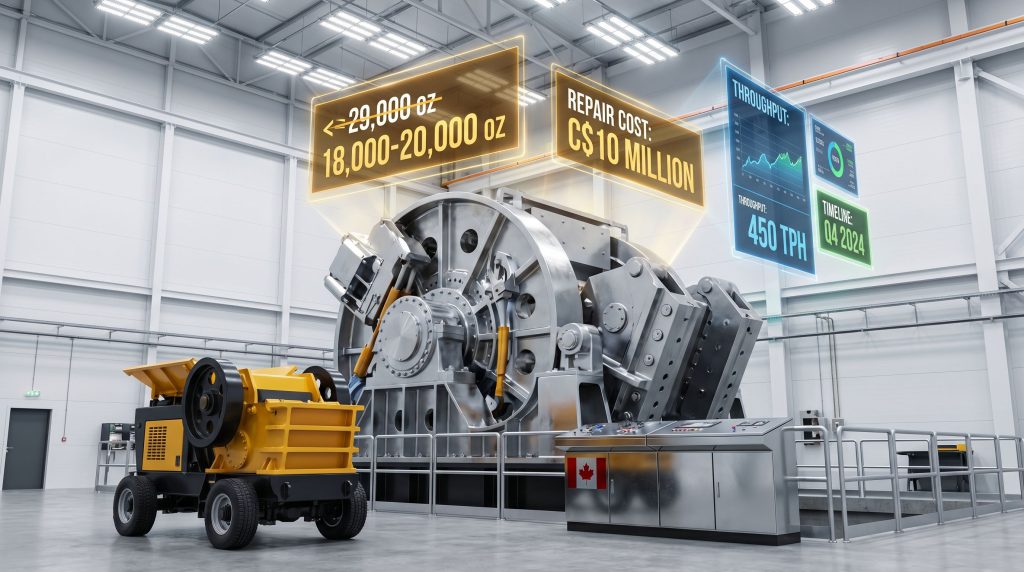
The recent fire incident at B2Gold's Goose mine in Nunavut demonstrates how quickly operational disruptions can impact production schedules and financial forecasts. The Goose mine fire damage impact has forced significant revisions to quarterly output targets, highlighting the vulnerabilities inherent in modern mining operations where single equipment failures can cascade through entire processing systems.
Understanding Critical Infrastructure Dependencies in Modern Gold Operations
Large-scale gold processing facilities operate as integrated systems where each stage depends on consistent upstream performance. The crushing circuit serves as the initial gateway for all ore entering the processing stream, making it a critical bottleneck that can halt downstream operations entirely when compromised. Furthermore, these industry evolution trends continue to drive increased automation and interconnectedness.
Primary vs. Secondary Crushing Systems in High-Throughput Mines
Modern gold operations typically employ multi-stage crushing configurations designed to reduce run-of-mine ore from natural pit fragmentation down to mill-feed specifications. At facilities processing 4,000 tonnes per day, like the Goose mine fire damage impact demonstrates, crushing circuits must maintain consistent throughput to prevent mill feed shortages.
Primary crushers handle the largest rock fragments directly from the pit, while secondary and tertiary stages provide progressive size reduction. The integration of vibrating screens and conveyor systems between stages creates classification points where material flow can be monitored and controlled.
However, this same integration creates single points of failure where equipment damage can disrupt the entire processing chain. For instance, operational challenges increasingly require boosting safety measures across all mining sectors.
The Goose mine's fire incident on April 16, 2026, which affected only the crushing circuit while sparing the mill and power facilities, illustrates both the compartmentalized design of modern plants and the specific vulnerability of pre-milling equipment to fire hazards.
Emergency Response Protocols for Industrial Fire Events
When fires occur in crushing circuits, immediate containment becomes critical to prevent spread to adjacent processing areas. The Goose mine fire damage impact was minimized through rapid emergency response deployment, with no injuries reported despite the evening timing of the incident.
Fire suppression systems in crushing areas must account for the presence of conveyor belts, electrical equipment, and potential fuel sources from hydraulic systems. Proper isolation procedures involve shutting down conveyor movement, de-energising electrical systems, and isolating hydraulic lines to prevent fire spread through connected equipment.
Personnel evacuation protocols in remote mining locations require additional considerations for medical response capabilities and communication with off-site emergency services. This is particularly critical in Arctic regions where external support may be hours away.
When big ASX news breaks, our subscribers know first
What Happens When Core Processing Equipment Goes Offline?
Production disruptions from crushing circuit failures create immediate throughput constraints that propagate through the entire operation. The Goose mine's Q2 2026 production forecast revision from 29,000 oz to 18,000-20,000 oz represents a 31-38% reduction, demonstrating the substantial impact of primary processing equipment failures. These disruptions often align with broader supply chain challenges affecting the mining sector.
Throughput Impact Assessment Methodologies
Calculating production losses requires understanding both the direct capacity reduction and the time required to implement alternative processing solutions. Mobile crusher deployment can partially restore throughput, but typically operates at 60-70% of fixed installation capacity due to setup limitations and material handling inefficiencies.
The C$10 million repair cost estimated for the Goose mine fire damage impact reflects both direct equipment replacement and the complexity of restoring integrated crushing systems. This cost must be weighed against production losses, which at current gold prices could represent $18-22 million in revenue impact from the 9,000-11,000 oz Q2 shortfall alone.
Mobile crusher utilisation requires rapid mobilisation of equipment, site preparation for temporary installations, and integration with existing conveyor and screening systems. The logistics complexity increases exponentially in remote locations where equipment must be sourced from distant suppliers.
Financial Modelling for Unplanned Maintenance Events
Emergency equipment repairs involve multiple cost categories beyond the direct replacement expenses. Insurance coverage for business interruption must be evaluated against deductible thresholds, while revenue impact calculations extend across quarterly reporting periods.
The maintenance of full-year guidance at 170,000-230,000 oz despite the Q2 disruption signals management confidence in recovery capacity. However, this requires careful financial modelling to ensure feasibility, particularly when considering current gold price forecast trends.
This implies that Q3-Q4 production must exceed normalised quarterly targets to compensate for the Q2 shortfall. Budget allocation for emergency repairs often competes with planned capital expenditures, creating resource allocation challenges that can impact long-term operational development schedules.
How Do Mining Companies Maintain Production During Equipment Repairs?
Maintaining production continuity during major equipment repairs requires deploying alternative processing workflows and backup systems. The Goose mine's response strategy demonstrates multi-layered contingency planning through on-site mobile equipment combined with third-party sourcing.
Alternative Processing Workflows and Backup Systems
On-site mobile crusher availability provides immediate response capability without waiting for external logistics. These portable units operate independently with their own power systems, enabling rapid deployment while permanent repairs proceed. However, their reduced capacity compared to fixed installations necessitates extended operating hours or modified processing schedules.
Third-party equipment sourcing expands available capacity but introduces logistics challenges, particularly in remote locations. Equipment mobilisation requires transportation planning, site preparation, and integration with existing processing infrastructure.
The concurrent scheduling of run-of-mine bin and apron feeder installation during repair periods optimises downtime by completing multiple projects within a single maintenance window. This approach maximises long-term operational capability whilst minimising total production disruption.
Timeline Optimisation for Concurrent Repair and Upgrade Projects
Integrating emergency repairs with planned capital improvements requires careful project coordination to avoid resource conflicts. The Q3 2026 completion timeline for both crushing circuit restoration and apron feeder installation demonstrates strategic maintenance scheduling.
Resource allocation between maintenance and development activities must balance immediate production restoration with long-term capacity improvements. Mill feed preparation alternatives during repairs may include modified screening procedures or utilisation of pre-crushed ore stockpiles if available.
Consequently, apron feeder integration improves material handling consistency from stockpile to crusher, reducing future operational vulnerabilities and enhancing feed rate control capabilities.
Production Forecasting Under Operational Constraints
Revising production forecasts during equipment disruptions requires balancing immediate capacity constraints with recovery timeline confidence. The Goose mine's guidance adjustment methodology illustrates the complexity of maintaining annual targets despite quarterly shortfalls.
Quarterly Output Adjustment Methodologies
The revision from 29,000 oz to 18,000-20,000 oz for Q2 represents significant production guidance adjustment, yet B2Gold maintained full-year guidance at 170,000-230,000 oz. This approach requires management confidence in repair completion timing and post-restoration production acceleration.
Statistical modelling for reduced throughput scenarios must account for mobile crusher efficiency rates, repair completion timelines, and ramp-up periods following equipment restoration. The wide full-year guidance range provides management flexibility but indicates material uncertainty regarding operational recovery timing.
Additionally, comprehensive gold market analysis informs these production forecasting decisions. Companies must balance operational constraints with market opportunities to optimise revenue outcomes.
Comparative Performance Analysis: Q1 vs. Q2 Projections
| Quarter | Original Forecast | Actual/Revised | Variance | Key Factors |
|---|---|---|---|---|
| Q1 2026 | Internal target | 42,876 oz | +Exceeded | Normal operations |
| Q2 2026 | 29,000 oz | 18,000-20,000 oz | -31% to -38% | Fire damage impact |
| Full Year | Internal target | 170,000-230,000 oz | Maintained | Q3-Q4 recovery |
The Q1 performance of 42,876 oz, which exceeded internal forecasts, validates the mine's capacity to surpass baseline targets under normal operations. This performance provides confidence for aggressive Q3-Q4 production scheduling to offset Q2 losses.
Recovery requirements for H2 2026 demand substantially elevated output compared to normalised quarterly production. This suggests either higher processing rates post-repair or utilisation of ore stockpiles accumulated during reduced operations.
Risk Management Frameworks for Arctic Mining Operations
Arctic mining operations face compounded risks from geographic isolation, extreme weather conditions, and limited supply chain access. The Goose mine's location in Nunavut, Canada, within the Back River Gold District, exemplifies these operational challenges.
Environmental and Logistical Challenges in Nunavut
Remote mining operations require pre-positioned contingency assets due to extended supply chain timelines. Equipment cannot typically be expedited from southern suppliers during winter months, making on-site redundancy essential rather than optional.
Arctic logistics considerations include:
• Ground access restrictions during frozen periods
• Summer-only shipping windows (typically July-October)
• Equipment delivery timelines measured in months
• Cold weather equipment specifications required
• Limited external emergency response capability
The 9-year mine life with projected 2.3 million oz output requires long-term risk management planning that accounts for seasonal operational constraints. Furthermore, equipment replacement logistics across multiple winter cycles must be carefully planned.
Business Continuity Planning for Extreme Weather Operations
Cold weather equipment reliability becomes critical when replacement parts may not be available for months. Mobile crushers and ancillary equipment must be rated for extreme cold operation, with hydraulic fluid viscosity, bearing lubrication, and electrical systems requiring specialised specifications.
Emergency supply chain activation procedures must account for seasonal access limitations and pre-positioned inventory requirements. Backup power systems, emergency fuel reserves, and facility protection protocols become essential operational capabilities rather than contingency measures.
The Goose mine's maintenance of on-site mobile crushing equipment demonstrates the critical importance of pre-positioned assets in Arctic operations. This enables rapid deployment without external logistics dependencies.
Technical Specifications and Operational Resilience
Modern gold processing facilities incorporate compartmentalised designs where failure of one circuit doesn't cascade to dependent systems. The 4,000 tpd design capacity at Goose represents contemporary large-scale processing infrastructure with built-in resilience features.
Crushing Circuit Design Standards for High-Volume Operations
Secondary crusher configurations in high-throughput applications typically employ cone or gyratory crushers sized to maintain consistent feed to downstream milling circuits. Integration with vibrating screens and conveyor systems enables continuous material classification and transport between processing stages.
Fire prevention protocols in crushing circuits focus on:
• Electrical system inspection to prevent arc initiation
• Conveyor belt condition monitoring for friction-related fire risks
• Crush chamber cleanliness to minimise combustible material accumulation
• Fire suppression system maintenance and regular testing
• Hydraulic system integrity to prevent fluid leaks
The compartmentalised design evident in the Goose mine fire damage impact, where the mill and power facility remained unaffected, reflects contemporary best practices in operational resilience and fire containment.
Mobile Crushing Technology: Capabilities and Limitations
Portable crushing equipment provides essential backup capacity but operates under inherent constraints compared to fixed installations. Setup requirements, material handling logistics, and power system limitations typically result in 60-70% of permanent capacity performance.
Mobile crusher deployment considerations:
• Site preparation requirements and foundation specifications
• Power supply integration with existing electrical systems
• Material feed and discharge conveyor connections
• Dust suppression and environmental compliance
• Maintenance access and service requirements
Cost-per-tonne analysis for temporary processing solutions must account for equipment rental rates, setup costs, reduced efficiency rates, and extended operating schedules required to maintain throughput targets.
The next major ASX story will hit our subscribers first
Market Impact Assessment and Investor Considerations
Equity market reactions to operational disruptions reflect investor assessment of management response capability and long-term production impact. The 1.6% stock decline following the Goose mine incident represents measured market response to a contained operational issue. According to B2Gold's official update, the company's transparent communication helped maintain investor confidence.
Share Price Volatility Following Operational Disruptions
The modest market reaction suggests investor confidence in B2Gold's contingency planning and management communication. With a market capitalisation approaching $9 billion, the company's size and operational diversification provide resilience against single-mine disruptions.
Investor communication strategies during production adjustments must balance transparency regarding operational challenges with confidence in recovery capabilities. Maintaining annual guidance whilst acknowledging quarterly impacts demonstrates management credibility in handling operational uncertainty.
Furthermore, Mining.com reported that industry analysts viewed the company's response as professional and well-managed, contributing to market stability.
Annual Guidance Maintenance Strategies
The preservation of 170,000-230,000 oz range despite Q2 disruption signals management confidence in Q3-Q4 acceleration capabilities. This guidance maintenance strategy requires careful balance between achievable targets and investor expectations.
Long-term mine life impact assessment across the 9-year operational timeline provides context for investors evaluating the significance of temporary production disruptions. Single-quarter impacts carry less weight when viewed against multi-year production schedules.
Production acceleration strategies for H2 2026 may include:
• Extended operating hours post-repair completion
• Processing of accumulated ore stockpiles
• Optimisation of mill throughput rates
• Deferred maintenance scheduling to maximise available operating time
FAQ: Mining Equipment Fire Recovery
What determines the severity of crushing circuit fire damage?
Damage assessment focuses on structural integrity of crushing chambers, electrical system components, and conveyor mechanism condition. Localised fires typically require 8-12 weeks for complete restoration, depending on equipment complexity and replacement part availability.
How quickly can mobile crushers restore production capacity?
Mobile crusher deployment typically achieves 60-70% of normal throughput within 2-3 weeks, subject to equipment availability and site preparation requirements. Remote locations may experience extended deployment timelines due to logistics constraints.
What insurance coverage applies to mining equipment fires?
Comprehensive mining insurance typically covers equipment replacement costs, business interruption losses, and emergency response expenses, subject to deductible thresholds. Coverage evaluation requires assessment of direct damage costs versus production loss valuation.
How do seasonal constraints affect Arctic mining repairs?
Arctic operations face equipment delivery windows limited to summer months, making rapid repair completion critical. Winter repairs may require air freight of smaller components, whilst major equipment replacement awaits seasonal shipping access.
What factors influence production forecast adjustments during repairs?
Forecast revision methodology considers mobile crusher capacity rates, repair completion timelines, ramp-up periods, and management confidence in recovery acceleration. Wide guidance ranges provide flexibility for operational uncertainty.
Conclusion: Operational Resilience in Modern Mining
The technical response to equipment failures in contemporary mining operations demonstrates the critical importance of comprehensive contingency planning, backup system availability, and flexible processing alternatives. Modern facilities incorporate compartmentalised designs that prevent cascade failures, whilst mobile equipment deployment provides essential production continuity during repair periods.
Arctic mining operations require enhanced resilience planning due to logistical constraints and seasonal access limitations. The Goose mine fire damage impact illustrates how rapid emergency response, pre-positioned backup equipment, and strategic repair scheduling can minimise production disruption even in challenging operational environments.
Investment considerations for mining operations must account for operational resilience capabilities alongside production capacity and resource quality. Companies demonstrating effective crisis management and maintained guidance credibility during operational challenges typically experience reduced market volatility and sustained investor confidence across unexpected disruption events.
This analysis is based on publicly available information and general mining industry practices. Readers should consult current financial statements and professional investment advice before making investment decisions. Production forecasts and technical specifications may change based on operational developments and market conditions.
Ready to Identify the Next Mining Opportunity Before Market Impact?
Discovery Alert provides instant notifications on significant ASX mineral discoveries, powered by its proprietary Discovery IQ model, ensuring subscribers can quickly capitalise on actionable opportunities like major equipment incidents that affect production forecasts. Explore why operational disruptions and recovery capabilities at established mines often create investment opportunities by visiting Discovery Alert's discoveries page and begin your 14-day free trial today to position yourself ahead of market movements.