June 17, 2026
Government Research Initiatives Transform Critical Minerals Processing
Australia's mining sector stands at a pivotal juncture where technological innovation converges with national strategic imperatives. The integration of advanced processing technologies with traditional mineral extraction represents more than incremental improvement—it signals a fundamental restructuring of how the nation approaches resource development. Furthermore, this transformation emerges against the backdrop of global supply chain vulnerabilities and mounting recognition that raw material export models fail to capture maximum economic value from Australia's exceptional mineral endowments. ABx advances rare earths strategy with twin government grants, positioning the company at the forefront of this revolutionary shift.
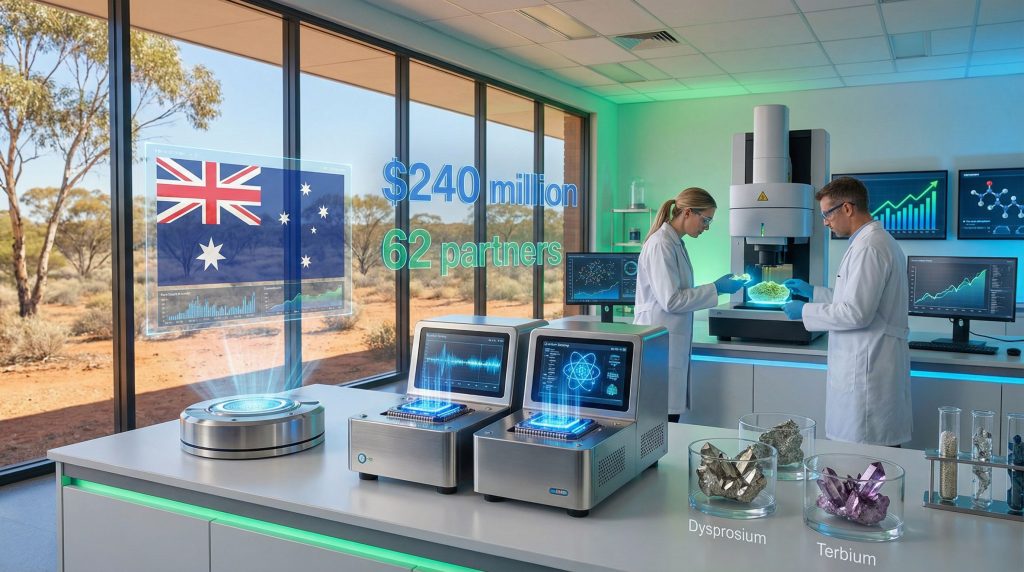
The Critical Metals for Critical Industries Cooperative Research Centre (CMCI CRC) exemplifies this strategic pivot, mobilizing $240 million in total funding with $53 million in direct government support. This initiative encompasses 62 partner organizations spanning mining companies, research institutions, and industry bodies, creating an unprecedented ecosystem for technology development focused specifically on high-value critical minerals processing.
The government's contribution represents approximately 22 percent of total funding, indicating substantial industry confidence and commitment to cost-sharing arrangements. Consequently, this financial structure demonstrates both private sector validation of the research program's commercial potential and strategic government recognition that critical minerals processing capabilities represent essential national infrastructure rather than purely commercial ventures.
Key Program Statistics:
- Total CMCI CRC funding: $240 million
- Government contribution: $53 million
- Industry partners: 62 organizations
- Focus areas: Advanced refining technologies for high-value critical minerals
- Cost-sharing ratio: 78% industry, 22% government
When big ASX news breaks, our subscribers know first
Advanced Quantum Technologies Revolutionize Mineral Detection Capabilities
Traditional mineral exploration relies heavily on laboratory-based assay processes that create significant bottlenecks in project development timelines. The transition from field sampling to laboratory analysis and subsequent decision-making can extend project evaluation phases by weeks or months, directly impacting capital efficiency and competitive positioning in rapidly evolving markets.
The Critical Technologies Challenge Program addresses these constraints through a targeted $2.4 million allocation for quantum-enabled geometallurgy sensor development. This technology specifically targets clay-hosted rare earth deposits, representing a specialized application designed to optimize detection and processing of ionic adsorption clay formations.
Quantum sensing technologies exploit quantum mechanical principles to achieve measurement precision beyond classical instrumental limits. Applied to rare earth detection, these sensors theoretically enable real-time elemental composition analysis in field settings, fundamentally altering exploration economics and operational decision-making processes. In addition, this innovation exemplifies how AI mining innovation is reshaping traditional exploration methodologies.
Technology Advantages:
- Real-time in-field mineral composition analysis
- Reduced dependence on centralized laboratory assays
- Enhanced exploration efficiency and cost reduction
- Improved processing optimization through immediate data feedback
- Accelerated project evaluation and development timelines
The quantum sensor technology specifically addresses ionic adsorption clay deposits because these formations present unique analytical challenges requiring sensitive detection of exchangeable ionic species. Traditional field instruments often lack the precision necessary to accurately characterize rare earth concentrations and compositions in these complex geological environments.
Strategic Value of Ionic Adsorption Clay Deposits
Ionic adsorption clay deposits represent one of the most economically viable sources of heavy rare earth elements available outside China's dominant processing infrastructure. These formations differ fundamentally from conventional hard-rock rare earth deposits through their unique mineralogy and processing requirements. However, they align with broader energy transition minerals essential for global decarbonisation efforts.
In ionic adsorption clays, rare earth elements exist as exchangeable ions weakly bonded to clay mineral surfaces rather than incorporated into crystal lattice structures. This ionic bonding enables selective acid leaching or ion-exchange recovery processes that potentially offer higher efficiency and lower environmental impact compared to traditional hard-rock rare earth processing methods.
Strategic Value Drivers:
| Element | Primary Applications | Strategic Importance |
|---|---|---|
| Dysprosium | High-performance wind turbine magnets | Critical for renewable energy infrastructure |
| Terbium | Electronic displays and lighting systems | Essential for technology sector development |
| Neodymium | Electric vehicle motors and generators | Key component for transportation electrification |
| Yttrium | Advanced ceramic applications | Strategic material for defense systems |
The elemental composition of ionic adsorption clays typically favors heavy rare earth elements (dysprosium, terbium, yttrium) relative to light rare earth elements (lanthanum, cerium, neodymium). This compositional profile proves strategically significant because heavy rare earth elements command substantially higher market prices due to limited global supply and critical applications in high-performance permanent magnets.
Heavy rare earth elements enable permanent magnets to maintain magnetic properties at elevated temperatures, making them indispensable for applications including wind turbine generators, electric vehicle motors, and advanced defense systems. The concentration of these elements in ionic adsorption clay deposits positions such formations as strategically important resources for technological and defense applications.
Research Partnerships Accelerate Commercial Development Pathways
The collaborative model employed by major research initiatives creates synergies between different aspects of the critical minerals value chain. Companies participating in these programs gain access to cutting-edge technologies, shared research costs, and accelerated development timelines through coordinated expertise integration. This approach represents a significant shift towards mining industry innovation through collaborative research models.
ABx Group's participation demonstrates strategic partnership selection, with the company engaging in both the comprehensive CMCI CRC program and the specialized Critical Technologies Challenge Program. This dual-program approach enables simultaneous advancement of upstream exploration technologies (quantum sensors) and downstream processing capabilities (advanced refining methods). Moreover, ABx advances rare earths strategy with twin government grants through this comprehensive research participation approach.
According to Mark Cooksey, ABx Group's Managing Director and Chief Executive Officer, the company strategically utilises its technical expertise and industry relationships to identify the most valuable research and development partnerships. This approach reflects industry recognition that collaborative research programs offer mechanisms to more rapidly develop and create enhanced value from mineral projects.
Partnership Benefits:
- Cost Distribution: Shared research and development expenses across multiple participants
- Technology Access: Exposure to cutting-edge processing and exploration technologies
- Timeline Acceleration: Coordinated research efforts reduce time-to-market for new technologies
- Risk Mitigation: Collaborative approach distributes technical and financial risks
- Knowledge Integration: Access to diverse expertise across geology, metallurgy, and engineering disciplines
The 62-partner composition of the CMCI CRC integrates three distinct knowledge streams: geological and mining expertise from industry participants, process engineering and technology development capabilities from research institutions, and market intelligence and commercialisation experience from established industry players. Consequently, this integration reduces gaps between laboratory-scale technology demonstration and commercial-scale application.
Economic Transformation Through Domestic Processing Capabilities
Government-backed research initiatives target fundamental transformation of Australia's position in global critical minerals markets. Rather than maintaining traditional raw material export models, these programs aim to establish domestic processing capabilities that capture substantially greater value from mineral resources. Additionally, these initiatives support comprehensive waste management solutions essential for sustainable development.
The strategic positioning reflects recognition that critical minerals processing represents essential national infrastructure comparable to energy or telecommunications systems. This framing elevates rare earth processing from purely commercial considerations to matters of national economic security and strategic autonomy.
Economic Impact Projections:
- Export Value Enhancement: Processed materials command premium pricing compared to raw ore exports
- Employment Creation: High-technology processing facilities generate skilled manufacturing positions
- Supply Chain Security: Domestic processing reduces dependence on offshore refining capabilities
- Strategic Positioning: Enhanced bargaining power in international critical minerals markets
- Innovation Ecosystem: Research infrastructure supports broader technology sector development
The investment structure of these programs, with substantial industry cost-sharing, indicates private sector confidence in commercial viability. The 78 percent industry funding contribution in the CMCI CRC demonstrates that participating companies view these initiatives as strategic investments rather than opportunistic funding capture.
Australia's historical position as a raw material exporter created vulnerability to price volatility and limited value capture from exceptional mineral endowments. The development of domestic processing capabilities aims to establish Australia as a value-added supplier of finished critical minerals products rather than a commodity ore exporter.
Global Supply Chain Vulnerabilities Drive Strategic Response
The concentration of rare earth processing capabilities in China has created strategic vulnerabilities for Western economies dependent on these materials for defence systems, renewable energy infrastructure, and advanced manufacturing. Australian research programs specifically target technologies that establish alternative supply chains for critical materials. Furthermore, the Australian mining industry recognises the strategic importance of developing domestic capabilities.
China currently controls approximately 85 percent of global rare earth processing capacity, despite holding only about 35 percent of known reserves. This concentration emerged through decades of strategic investment in processing infrastructure and willingness to accept environmental costs associated with traditional rare earth refining methods.
Supply Chain Diversification Objectives:
- Dependency Reduction: Minimise reliance on single-source suppliers for strategic materials
- Security Enhancement: Establish secure supply chains for defence and aerospace applications
- Market Competition: Create competitive alternatives to existing processing monopolies
- Alliance Coordination: Support allied nations' supply chain resilience initiatives
- Technology Innovation: Develop environmentally superior processing methods
How Does Supply Chain Concentration Impact National Security?
The strategic importance of supply chain diversification extends beyond immediate commercial considerations. Rare earth elements enable critical technologies including precision-guided munitions, radar systems, satellite communications, and advanced electronic warfare capabilities. Supply disruptions could significantly impact defence readiness and national security capabilities.
Historical precedents demonstrate the strategic leverage associated with critical minerals supply concentration. China's 2010 export restrictions on rare earth elements triggered global recognition of supply vulnerability and accelerated international efforts to develop alternative sources and processing capabilities. In response, countries worldwide began exploring government-backed R&D initiatives to secure their critical mineral supply chains.
The next major ASX story will hit our subscribers first
Next-Generation Processing Technologies Address Environmental Challenges
Research initiatives focus on developing environmentally sustainable and economically viable processing technologies that overcome traditional challenges associated with rare earth extraction and refinement. Conventional rare earth processing generates significant environmental impacts through acid consumption, radioactive waste production, and toxic byproduct creation.
Ionic adsorption clay processing offers potential environmental advantages through reduced acid requirements and lower radioactive material content compared to hard-rock rare earth deposits. The ionic bonding mechanism enables selective extraction methods that minimise waste generation and environmental disturbance.
Technology Development Focus Areas:
- Selective Extraction: Ion-exchange methods targeting specific rare earth elements
- Acid Minimisation: Reduced sulfuric acid consumption in leaching processes
- Waste Reduction: Improved separation efficiency minimising byproduct generation
- Energy Optimisation: Enhanced process efficiency reducing energy consumption
- Water Management: Closed-loop systems minimising water usage and contamination
The integration of advanced technologies including artificial intelligence, machine learning, and real-time process optimisation enables more precise control over extraction and separation processes. These capabilities potentially achieve higher product purities while reducing environmental impacts and operating costs. However, successful implementation requires comprehensive data-driven mining operations that integrate multiple technological systems.
Environmental sustainability increasingly influences investment decisions and regulatory approvals for mining projects. Technologies that demonstrate superior environmental performance provide competitive advantages in permitting processes and stakeholder acceptance.
Investment Implications and Commercial Opportunities
The convergence of government support, technological advancement, and strategic necessity creates compelling investment opportunities in Australia's critical minerals sector. Companies positioned within research ecosystems benefit from accelerated development timelines, reduced technical risks, and enhanced access to cutting-edge technologies.
Government funding reduces development risks by providing financial support for technology validation and pilot-scale testing. This risk reduction enables companies to pursue more ambitious technological approaches that might otherwise prove commercially prohibitive for individual organisations. In this context, ABx advances rare earths strategy with twin government grants, demonstrating strategic positioning within this evolving landscape.
Investment Considerations:
- Risk Mitigation: Government funding and research partnerships reduce technical development risks
- Technology Access: Participation in research programs provides exposure to advanced processing methods
- Strategic Positioning: Early involvement in emerging technologies creates competitive advantages
- Market Timing: Growing global demand for critical minerals supports long-term market fundamentals
- Policy Support: Strategic importance ensures continued government backing for sector development
The strategic classification of critical minerals as essential national infrastructure indicates sustained government commitment to sector development regardless of short-term commodity price fluctuations. This policy stability provides investment confidence for long-term capital commitments required for processing facility development.
Companies engaging in multiple research programs simultaneously, like ABx Group's participation in both the CMCI CRC and Critical Technologies Challenge Program, demonstrate strategic approaches that maximise technological exposure while diversifying research risks across different development pathways.
Commercial Development Timelines and Milestones
While research initiatives provide valuable technological foundations, commercial production timelines depend on multiple factors including project development phases, market conditions, regulatory approvals, and technology validation requirements. The integration of advanced technologies may accelerate some development aspects while requiring additional validation phases for novel processing methods.
Technology development typically progresses through distinct phases from laboratory validation to pilot-scale demonstration and ultimately commercial implementation. Each phase requires progressive validation of technical performance, economic viability, and environmental compliance.
Development Milestone Framework:
| Phase | Timeline | Key Activities | Success Metrics |
|---|---|---|---|
| Technology Validation | 1-2 years | Laboratory testing and optimisation | Technical feasibility demonstration |
| Pilot Plant Operations | 2-3 years | Small-scale production testing | Process validation and cost modelling |
| Commercial Planning | 3-4 years | Engineering design and permitting | Financial viability and regulatory approval |
| Construction Phase | 4-5 years | Facility construction and commissioning | Operational readiness achievement |
| Full-Scale Production | 5-7 years | Commercial production and optimisation | Target production rates and product quality |
The quantum sensor technology development represents a specialised application with potentially shorter validation timelines due to its exploration-phase focus rather than processing-phase complexity. Field testing of sensing equipment typically requires less extensive validation compared to full-scale processing facilities.
Regulatory approval timelines for new processing technologies depend on environmental assessment requirements, community consultation processes, and technology precedent availability. Novel processing methods may require extended regulatory review periods compared to established technologies with proven performance records.
Strategic Positioning in Global Critical Minerals Markets
Australia's coordinated approach to critical minerals development through government-backed research initiatives positions the country as a potential leader in sustainable rare earth processing. This strategic positioning aims to capture significant value as global demand for critical minerals continues expanding driven by renewable energy deployment, electric vehicle adoption, and defence modernisation programs.
The combination of abundant mineral resources, advanced research capabilities, stable regulatory environments, and strategic partnerships with allied nations creates unique competitive advantages for Australian critical minerals development. These factors provide foundation for establishing Australia as a preferred supplier of processed critical minerals to global markets. Moreover, ABx advances rare earths strategy with twin government grants exemplifies how individual companies leverage these broader strategic advantages.
Competitive Advantages:
- Resource Endowment: Substantial rare earth reserves including strategic ionic adsorption clay deposits
- Research Excellence: World-class research institutions and technology development capabilities
- Regulatory Stability: Established mining regulatory framework and political stability
- Strategic Partnerships: Alignment with allied nations seeking supply chain diversification
- Environmental Leadership: Development of environmentally superior processing technologies
The strategic timing of these initiatives aligns with global recognition of critical minerals supply vulnerabilities and accelerating demand from clean energy transitions. Countries including the United States, Canada, and European Union nations actively seek diversified critical minerals suppliers to reduce dependence on Chinese processing capabilities.
Australia's positioning as a reliable supplier with democratic governance, environmental standards, and strategic alliance relationships provides competitive advantages in markets where supply security considerations increasingly influence procurement decisions beyond pure economic factors. This positioning particularly benefits companies developing comprehensive approaches to the sector's challenges.
Investment Disclaimer: This analysis is for informational purposes only and does not constitute investment advice. Critical minerals projects involve significant technical, commercial, and regulatory risks. Potential investors should conduct independent due diligence and seek professional financial advice before making investment decisions. Government funding and research participation do not guarantee commercial success or future profitability. Market conditions, commodity prices, and regulatory requirements may materially impact project viability and investment returns.
Want to Capitalise on Australia's Critical Minerals Revolution?
Discovery Alert's proprietary Discovery IQ model delivers instant notifications on significant ASX mineral discoveries, including breakthrough developments in the critical minerals sector that are transforming Australia's mining landscape. With government-backed research initiatives creating unprecedented opportunities for rare earths and processing technologies, discover why major mineral discoveries can lead to substantial returns by exploring historic examples of exceptional market outcomes. Begin your 14-day free trial today at Discovery Alert to position yourself ahead of the market as these transformative technologies reach commercial development.