June 17, 2026
The Scale Problem in Critical Minerals: Why Deposit Size Is Everything
In the global race to secure supply chains for the energy transition, one factor consistently separates transformative projects from incremental ones: deposit scale. Rare earth and titanium development is not simply a matter of finding mineralisation. It requires finding mineralisation large enough, shallow enough, and geologically consistent enough to justify the decade-long journey from discovery to sustained production. Most deposits that enter the exploration pipeline never reach that threshold. A small subset does, and when they do, the market pays close attention.
The Resouro Tiros rare earth and titanium project in Brazil sits firmly in that rare category. Its resource base, economic parameters, and dual-commodity architecture place it among a very small cohort of undeveloped critical mineral systems capable of genuinely moving the needle on global supply chain diversification.
When big ASX news breaks, our subscribers know first
How Rare Earth and Titanium Markets Are Converging Around Supply Risk
The Structural Forces Reshaping Critical Mineral Demand
To understand the significance of a project like Tiros, it is necessary to first understand the market forces reshaping demand for the minerals it hosts. Rare earth elements (REEs) such as neodymium, praseodymium, dysprosium, and terbium are not interchangeable commodities. Each plays a specific, difficult-to-substitute role in high-performance permanent magnets used in electric vehicle motors, offshore wind turbines, and defence-grade electronics. The magnet rare earth fraction, often referred to as the NdPr-Dy-Tb suite, commands price premiums that reflect both their technical criticality and their extreme geographic supply concentration.
Titanium dioxide operates in a different but equally strategic market. As an industrial pigment, TiO₂ dominates the coatings, plastics, and paper industries globally. As a precursor to aerospace-grade titanium metal, it feeds one of the most technically demanding manufacturing sectors on earth. Supply tightness in both the pigment and aerospace feedstock markets has persisted through recent years, supporting prices well above historical norms.
What makes the current environment particularly significant for developers is not simply demand growth. It is the active effort by Western industrial governments and corporations to rebuild rare earth supply chains that have become dangerously dependent on a single geographic source for both rare earths and titanium feedstocks. This structural shift elevates the strategic value of any large, development-ready deposit in a politically stable jurisdiction, regardless of the precise commodity price at any given moment.
Why Minas Gerais Matters Beyond the Geology
Brazil's Minas Gerais state is one of the most prolific mining jurisdictions on earth. It hosts world-class iron ore operations, the world's dominant niobium production, and a regulatory and infrastructure ecosystem built around large-scale mineral extraction. For a project of Tiros's ambition, this context matters enormously.
Access to established logistics corridors, experienced local workforces, environmental baseline data accumulated over decades of mining activity, and regulatory precedent for bulk-tonnage operations all compress the timeline and capital requirements for advancing a new project through permitting and into production. Furthermore, critical minerals demand from Western nations makes Minas Gerais an increasingly attractive destination for strategic capital.
What the JORC Resource Numbers Actually Mean
Decoding the Scale of the Tiros Deposit
The 2025 JORC-compliant resource update for the Tiros project confirmed a deposit of genuinely unusual scale. Understanding what these numbers represent requires some translation for investors unfamiliar with resource classification conventions.
| Resource Category | Tonnage | TiO₂ Grade | TREO Grade |
|---|---|---|---|
| Measured and Indicated | ~1.4 billion tonnes | ~12% TiO₂ | ~4,000 ppm |
| Total Project Resource | ~1.9 billion tonnes | ~12% TiO₂ | ~3,900-4,000 ppm |
| High-Grade Domain | ~136 million tonnes | 23% TiO₂ | 8,860 ppm TREO |
The distinction between the 1.4 billion tonne measured and indicated figure and the 1.9 billion tonne total resource reflects JORC's classification hierarchy. Measured and indicated resources carry higher geological confidence, supported by closer-spaced drilling and more rigorous data validation. Inferred resources, which make up the balance, are geologically plausible but require additional work to upgrade. For economic studies, the higher-confidence categories carry the most weight.
The high-grade domain within the deposit is particularly significant. At 23% TiO₂ and 8,860 ppm TREO, this concentrated core grades nearly double the project average for titanium and more than twice the average for rare earths. In bulk-tonnage mining, the ability to prioritise high-grade domains in early mine planning can dramatically improve early-year cash flows and project-level economics before the operation scales into lower-grade material.
A lesser-known but critical insight in rare earth project evaluation is that not all TREO is created equal. A deposit grading 4,000 ppm TREO dominated by cerium and lanthanum, which have very limited market applications and low price points, is fundamentally different from one with meaningful contributions from neodymium, praseodymium, dysprosium, and terbium. The Tiros deposit's reported inclusion of magnet-suite rare earths within its TREO fraction is what elevates its economic significance beyond the headline grade.
Project Footprint and Ownership
The project spans approximately 497 km² across 28 mineral concessions, with Resouro Strategic Metals holding a 90% interest through its Brazilian operating subsidiary. The near-surface nature of the mineralisation across this footprint is a geological characteristic that directly compresses capital intensity. Without the need for deep pit infrastructure or underground access development, the initial capital expenditure profile is materially lower than equivalent-scale projects requiring significant pre-stripping or underground development.
Breaking Down the Preliminary Economic Assessment
What the Numbers Say, and What They Do Not
The Preliminary Economic Assessment released by Resouro returned economics that are, by any reasonable benchmark, exceptional for a greenfield development project.
| Financial Metric | Tiros PEA Result |
|---|---|
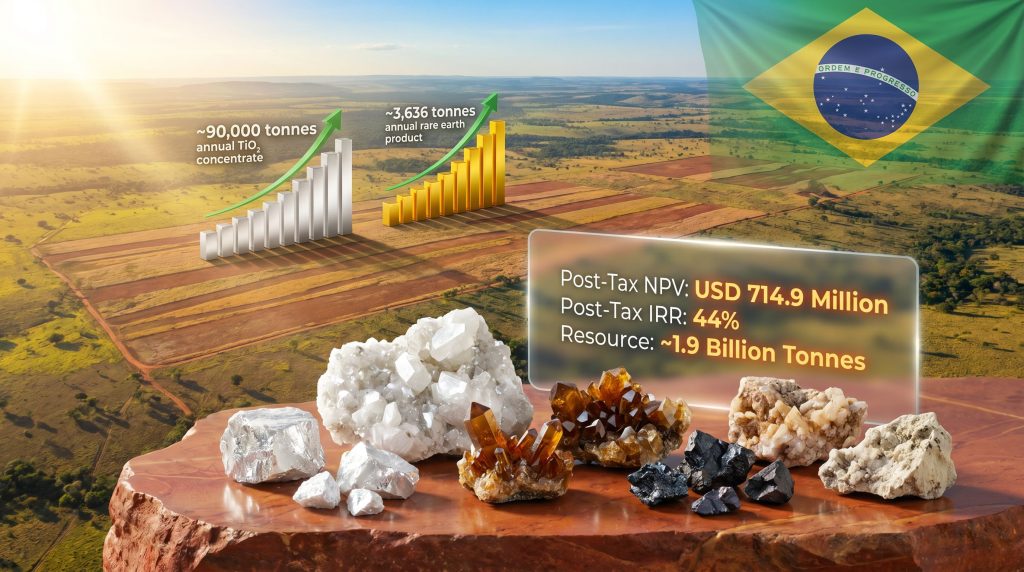
| Post-Tax NPV (8% discount rate) | USD 714.9 million (~CAD 1 billion) |
| Post-Tax IRR | 44% |
| Annual Processing Rate | 500,000 tonnes per annum |
| Annual TiO₂ Concentrate Output | ~90,000 tonnes |
| Annual Rare Earth Product Output | ~3,636 tonnes |
| Initial Mine Life | 20 years |
| Resource Utilisation (Starter Phase) | Less than 1% of total resource |
A 44% post-tax IRR is not simply good. It is exceptional. Institutional project financing for greenfield mineral developments typically requires an IRR above 15-20% to clear the initial investment committee threshold. Projects that return 44% post-tax attract a fundamentally different quality of investor attention, including strategic offtake partners, sovereign wealth vehicles, and downstream processors seeking to secure long-term feedstock supply.
It is equally important to understand what a PEA does not confirm. As an early-stage economic study, it is built on resource estimates that include inferred material, processing assumptions that require pilot-scale validation, and commodity price forecasts that may differ from actual market conditions at the time of production. The path from a compelling PEA to a construction decision requires a Pre-Feasibility Study, a definitive feasibility study, environmental approvals, and project financing. Each stage carries its own risks and timeline variability.
The Dual Revenue Stream Advantage
One of the most structurally attractive features of the Tiros project is its dual-commodity revenue architecture. Most mining projects are exposed to a single commodity price cycle. When that commodity falls, the entire project's economics deteriorate simultaneously. Tiros, however, generates revenue from two distinct markets that do not necessarily move in correlation with each other.
-
Titanium dioxide concentrate targets industrial and pigment markets driven by construction, automotive coatings, and aerospace demand cycles.
-
Mixed rare earth carbonate captures value from the magnet rare earth market, which is primarily driven by EV production volumes, wind energy installation rates, and defence procurement cycles.
A sustained downturn in TiO₂ pigment pricing may coincide with accelerating EV adoption supporting rare earth carbonate prices, and vice versa. This non-correlation provides a natural hedge that improves the project's financing bankability and reduces the probability of catastrophic economic outcomes from single-commodity price shocks.
The Phased Development Logic: Why Starting Small Is Strategically Intelligent
Risk Architecture in Large-Scale Mining Projects
The instinct for large mining companies to maximise production from the outset is understandable but frequently destructive. History is littered with large-scale mining projects that overestimated demand, underestimated capital costs, and destroyed shareholder value by building ahead of the market. Resouro's decision to design a starter operation processing 500,000 tonnes per annum reflects a more sophisticated understanding of how large projects should be advanced in the current capital markets environment.
The phased development rationale operates across multiple dimensions:
-
Capital efficiency: A smaller initial operation requires significantly less upfront financing, expanding the pool of potential capital providers and reducing dilution risk for existing shareholders.
-
Operational proof-of-concept: Establishing that the processing flowsheet performs as modelled at commercial scale is essential before committing to a much larger capital expenditure program.
-
Social licence construction: Operating responsibly at modest scale within Minas Gerais communities before expanding creates the goodwill and regulatory track record needed to support future development approvals.
-
Market timing optionality: Generating early cash flows while retaining more than 99% of the resource base as a development asset preserves optionality to expand when commodity prices, financing conditions, and geopolitical demand dynamics are most favourable.
The theoretical implication of consuming less than 1% of the total resource over a 20-year starter mine life is rarely discussed explicitly: at starter-scale throughput, the project's resource base could theoretically sustain production for centuries. This is not a claim about planned mine life, but it is an important signal about the project's capacity for phased expansion without resource constraint.
Competitive Positioning Among Global Rare Earth and Titanium Developers
Where Tiros Sits in the Global Development Pipeline
Understanding Tiros's competitive position requires comparing it against the broader universe of undeveloped rare earth and titanium projects globally.
| Attribute | Tiros Project (Brazil) | Typical Peer Benchmark |
|---|---|---|
| Total Resource Size | ~1.9 billion tonnes | 100-500 million tonnes |
| TiO₂ Grade | 3-8% typical | |
| TREO Grade | 1,500-3,500 ppm typical | |
| Revenue Streams | Dual (TiO₂ + REE) | Typically single commodity |
| Processing Method | Conventional | Varies; many require novel flowsheets |
| Jurisdiction | Minas Gerais, Brazil | Various |
| Development Stage | PEA Complete (2025) | Varies widely |
The combination of resource scale, above-average grade in both commodities, conventional processing methodology, and jurisdictional stability places Tiros in a very small global cohort. Most rare earth projects globally face at least one of the following structural challenges: marginal grade, exotic processing chemistry, jurisdictional risk, or single-commodity revenue exposure. Tiros, based on current data, faces none of them in a primary sense.
Conventional Processing: An Underappreciated Advantage
One of the least-discussed but most practically significant attributes of the Tiros project is its use of conventional mineral processing and hydrometallurgical techniques. Many rare earth and titanium projects require novel or experimental processing flowsheets that have never been demonstrated at commercial scale. This introduces metallurgical risk that can delay permitting, complicate financing, and ultimately prevent projects from ever reaching construction.
Conventional processing pathways, by contrast, benefit from existing engineering knowledge, available equipment supply chains, and regulatory familiarity. Environmental regulators in jurisdictions with established mining frameworks have experience assessing the impacts of standard processing techniques. This significantly reduces the uncertainty around permitting timelines, which is one of the primary sources of delay and capital cost overruns in mine development globally. Consequently, considerations around grade and permitting become far more manageable for projects with conventional flowsheets.
The next major ASX story will hit our subscribers first
Key Risks and the Development Pathway Forward
What Investors Need to Weigh Carefully
A project of this scale and economic potential does not advance without meaningful execution risk. Investors evaluating the Tiros project should maintain clear-eyed awareness of the following factors:
-
PEA-stage uncertainty: Early economic assessments carry a wider margin of error than later-stage studies. Capital and operating cost estimates, commodity price assumptions, and metallurgical recovery projections all require validation through more rigorous feasibility work.
-
Permitting timeline variability: Brazil's environmental and mining permitting frameworks are well-established in Minas Gerais, but regulatory processes across jurisdictions introduce timeline risk that is difficult to predict precisely.
-
Commodity price sensitivity: The project's NPV and IRR figures are calculated against specific price assumptions for both TiO₂ and mixed rare earth carbonate. Significant movements in either commodity price could materially alter the project's economics in either direction.
-
Metallurgical confirmation at scale: Pilot-scale and demonstration-scale processing programs are required to confirm that the processing flowsheet performs as modelled before a definitive financing decision can be made.
-
Financing execution: Securing project-level financing at terms that preserve adequate equity value for shareholders is a distinct execution challenge, regardless of how compelling the underlying project economics appear.
The Road from PEA to Production
The development pathway from a completed PEA to first production involves a structured sequence of de-risking milestones:
-
Completion of a Pre-Feasibility Study incorporating updated resource classification and refined cost estimates.
-
Pilot-scale metallurgical testing program to validate processing recoveries and confirm product specifications.
-
Environmental Impact Assessment submission and regulatory engagement within Minas Gerais.
-
Offtake agreement negotiations with downstream TiO₂ processors and rare earth carbonate consumers.
-
Project financing mandate, capital structure determination, and financial close.
Each milestone incrementally reduces project risk and, historically, has been associated with rerating events in the equity markets as capital markets reprice the probability of project execution success.
Brazil's Critical Minerals Trajectory and What Tiros Represents
A Country at a Strategic Inflection Point
Brazil's geological endowment in critical minerals is extraordinary and, relative to its economic potential, still underexploited. The country already dominates global niobium production and hosts significant lithium and rare earth mineralisation. The advancement of the Resouro Tiros rare earth and titanium project in Brazil signals a broader shift in how international capital markets and industrial supply chains are beginning to view the country as a Tier-One critical minerals jurisdiction.
Australia's own critical minerals strategy offers a useful parallel, demonstrating how national-level policy frameworks can accelerate the transition from exploration-stage assets to production-ready projects. Brazil appears to be on a comparable trajectory, with Tiros potentially serving as a flagship demonstration of what the country's critical mineral endowment can deliver.
If the Tiros project progresses through feasibility and into production, it would represent one of the few projects globally capable of simultaneously supplying meaningful volumes of both titanium feedstock and magnet-suite rare earth carbonate to Western industrial supply chains. That dual capability, combined with the project's scale and conventional processing pathway, positions it as a structurally important asset in a global landscape where supply chain diversification is no longer a policy aspiration but an industrial imperative.
The market's initial response to the PEA announcement, with Resouro shares rising 8.7% on the Toronto Stock Exchange followed by a further 3.2% gain the following session, reflects investor recognition that the project's economic parameters are genuinely exceptional. Whether that recognition translates into sustained re-rating will ultimately depend on how efficiently and credibly the company executes its de-risking pathway over the coming years.
Disclaimer: This article is intended for informational purposes only and does not constitute financial advice. The Tiros project is at the preliminary economic assessment stage, and all financial metrics, resource estimates, and economic projections are subject to material uncertainty. Readers should conduct their own due diligence and consult qualified financial advisers before making investment decisions. Past share price performance is not indicative of future results.
Want to Stay Ahead of the Next Major Critical Minerals Discovery?
Discovery Alert's proprietary Discovery IQ model instantly translates complex ASX mineral announcements across more than 30 commodities into clear, actionable insights — so investors can identify significant opportunities the moment they emerge. Explore how historic discoveries have generated exceptional returns on the Discovery Alert discoveries page, and begin your 14-day free trial today to secure a market-leading edge in critical minerals investing.