
August 2, 2026
When Wearable Machines Meet Strategic Materials: The Hidden Minerals Problem Inside Military Exoskeletons
Every technology revolution carries a materials problem underneath it. The shift from steam to electric power demanded copper at industrial scale. The transition to solid-state electronics created a dependency on silicon purity that took decades to industrialise. Today, the emergence of powered wearable systems for military use is revealing a dependency that most analysts have been slow to examine: the relationship between military exoskeletons and rare earths is not incidental. It is architectural.
This analysis works through that dependency from the inside out, starting with actuator physics, moving through material selection logic, and arriving at the supply chain geography and procurement risk calculus that defence planners need to account for in 2026 and beyond.
"The rare earth dependency embedded in military exoskeletons is best understood not as a standalone technology risk, but as one node within the broader defence critical minerals challenge that spans radar systems, guided munitions, submarine propulsion, and advanced jet platforms. Isolating it from that wider context understates its strategic significance."
When big ASX news breaks, our subscribers know first
The Engineering Constraint That Defines the Entire Design Space
Wearable powered systems impose a constraint that does not appear in most other electromechanical applications: the machine's mass is carried by the person it is supposed to be helping. Every gram added to the frame, actuator housing, or battery pack is a gram that the wearer must support. This creates a hard mass budget that propagates through every design decision, from motor diameter to controller architecture to harness materials.
Within that budget, the actuator is where the materials problem becomes acute. A joint that assists the hip or knee during a loaded carry must generate substantial torque in a package small enough not to impair natural movement. That combination of high torque output and minimal volume points, with very little design flexibility, toward rare earth permanent magnets.
Neodymium-iron-boron (NdFeB) magnets currently deliver the highest magnetic energy density of any commercially available permanent magnet technology, a property documented across DOE Critical Materials Assessments and IEEE magnet engineering literature. The practical consequence is that a motor using NdFeB can be made significantly smaller than one using ferrite magnets at equivalent torque output. For a hip actuator designed to assist load carriage, that size difference can determine whether the device is wearable or not.
This is not a peripheral materials consideration. It is a load-bearing dependency that sits at the centre of the actuator architecture. Furthermore, understanding rare earth supply chains is essential for any programme office seeking to manage this exposure across a multi-year acquisition cycle.
Passive, Powered, and Hybrid: Why the Distinction Drives REE Demand
Not all exoskeleton systems are equally dependent on rare earth materials. The critical variable is whether a system uses powered actuation, passive mechanical assistance, or a hybrid of both.
| System Type | Core Mechanism | REE Dependency | Typical Application |
|---|---|---|---|
| Passive exoskeleton | Springs, dampers, mechanical linkages | Minimal to none | Load redistribution, posture support |
| Powered exoskeleton | Electric motors, sensors, battery, controller | High (NdFeB or SmCo magnets) | Active joint assistance, lift augmentation |
| Hybrid exosuit | Rigid structural frame with soft textile interface | Moderate | Terrain-adaptive load carriage |
Passive systems redirect forces mechanically and use no rare earths in their core mechanism. Powered systems are architecturally dependent on high-torque-density actuators, and that dependency flows directly from the magnet chemistry. Defence evaluators and procurement planners increasingly focus on the powered-versus-passive axis rather than the rigid-versus-soft distinction, since that is where the materials exposure and the performance ceiling both live.
Inside a Powered Joint Actuator: Where Rare Earths Are Physically Embedded
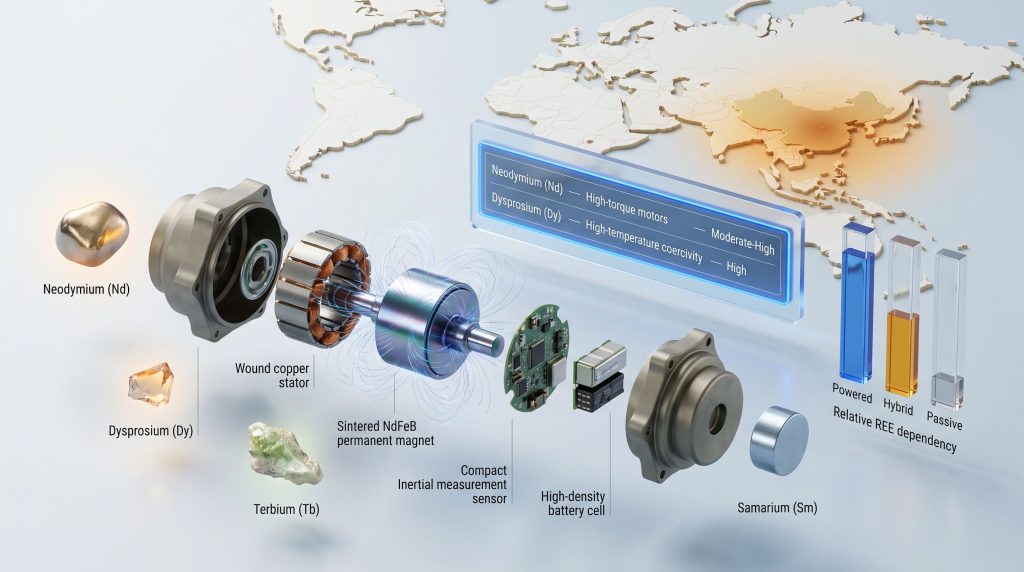
Understanding the materials dependency requires understanding what a powered joint actuator actually contains. A typical hip or knee assist actuator in a military-critical minerals context integrates the following components in sequence:
- Motor housing containing a permanent magnet rotor and a wound stator
- Permanent magnet assembly where NdFeB or SmCo magnets generate the magnetic field that produces torque
- Power electronics that regulate current delivery and modulate torque output in real time
- Sensor array including inertial measurement units and force sensors that detect joint angle, velocity, and load
- Control processor running real-time assistance algorithms that match motor output to the wearer's movement intent
- Battery pack delivering stored electrical energy across the duty cycle
Rare earth elements are physically present in components two and four, and in any integrated display or indicator subsystem. The magnet assembly is where the bulk of the REE content by mass resides. The sensor array draws on REE-enabled miniaturised magnetic and optical components that improve signal quality and reduce packaging volume.
The dependency is not distributed evenly across the system. It is concentrated at the performance-critical points where no current alternative delivers equivalent results within the mass budget.
Which Elements Do What: A Function-by-Function Breakdown
Each rare earth element in a powered exoskeleton performs a specific and often non-substitutable function. Understanding these roles is essential for assessing where supply disruption actually bites.
| Element | Primary Function | Performance Consequence | Supply Risk Level |
|---|---|---|---|
| Neodymium (Nd) | Structural backbone of NdFeB magnets | Enables compact, high-torque motor design | Moderate-High |
| Praseodymium (Pr) | Co-constituent in NdPr alloy | Functionally interchangeable with Nd in many formulations | Moderate-High |
| Dysprosium (Dy) | High-temperature coercivity enhancement | Prevents demagnetisation under sustained load in warm environments | High |
| Terbium (Tb) | Alternative coercivity additive | Used when Dy supply or cost is constrained | High |
| Samarium (Sm) | SmCo magnet alternative chemistry | Superior thermal and corrosion tolerance versus standard NdFeB | Moderate |
| Yttrium (Y) | Display phosphors, optical coatings | Efficient light emission in status displays and AR components | Moderate |
| Cerium (Ce) | Polishing compounds, optical manufacturing | Precision surface finishing of lenses and sensors | Low-Moderate |
| Lanthanum (La) | Optical glass, catalyst in electronics manufacturing | Supporting manufacturing quality in sensor and display production | Low-Moderate |
Sources: USGS Mineral Commodity Summaries 2026; DOE Critical Materials Assessment 2023; IEEE magnet engineering literature
The Heavy Rare Earth Problem: Dysprosium and Terbium Under Operational Conditions
The thermal performance requirement is not an edge case in defence environments. It is a design baseline. Desert heat, enclosed motor housings during sustained operation, and high-duty-cycle loading all push magnet temperatures toward thresholds where standard NdFeB grades begin losing coercivity irreversibly.
Dysprosium and terbium additions shift that demagnetisation threshold upward. Without them, a motor working hard under load in a hot environment can permanently weaken its own magnets, reducing torque output in a way that cannot be corrected in the field. This is documented in peer-reviewed magnet metallurgy literature and reinforced across DOE materials assessments that treat heavy REE performance contributions as a recurring design constraint rather than a theoretical concern.
What makes this particularly significant from a supply chain perspective is that dysprosium and terbium are far less abundant than light rare earths like neodymium. According to USGS mineral commodity data, heavy rare earth availability is a more binding constraint than light REE supply for programmes specifying high-temperature magnet grades. Price volatility at the Dy and Tb level flows directly into motor bills of material and can destabilise cost estimates for multi-year production contracts.
One technically important mitigation is grain-boundary diffusion, a manufacturing technique that concentrates dysprosium or terbium at the surfaces of crystal grains within the magnet rather than distributing them uniformly throughout the bulk material. This approach achieves equivalent high-temperature coercivity while consuming significantly less heavy REE per unit. DOE technology roadmaps and peer-reviewed magnet manufacturing literature identify this as a meaningful near-term pathway to reduced heavy REE intensity, though it requires specialised furnace infrastructure and process control capability that is not universally available.
Samarium-Cobalt as a Strategic Design Choice
SmCo magnets offer a different performance trade-off. Their superior thermal stability and corrosion resistance make them attractive for high-duty-cycle applications where sustained motor loading and environmental exposure are the binding design constraints. Defence electromechanical suppliers select SmCo when thermal margins dominate the design decision rather than peak magnetic energy density.
The trade-off is cost and cobalt exposure. Cobalt carries its own geopolitical risk profile, with supply concentrated in the Democratic Republic of Congo and subject to its own set of procurement and ethical sourcing considerations. Programmes that shift from NdFeB to SmCo to reduce heavy REE exposure may inadvertently increase cobalt supply risk, a substitution that requires careful lifecycle cost and supply chain analysis rather than a reflexive materials swap.
Supply Chain Stage-by-Stage: Where the Risk Actually Lives
The journey from rare earth ore to a functioning exoskeleton actuator passes through five distinct industrial stages, each with its own geographic concentration profile and failure mode. In addition, the rare earth processing challenges at each stage compound the overall strategic exposure for defence programmes.
-
Mining and concentration: Ore is extracted and mechanically upgraded into mineral concentrates. This stage is the most geographically dispersed, with producing nations across China, Australia, the United States, and Myanmar.
-
Chemical separation: Multi-stage solvent extraction isolates individual rare earth oxides from one another. Both the IEA and USGS have consistently identified this as the most strategically concentrated and technically difficult-to-replicate step in the entire value chain.
-
Oxide-to-metal reduction and alloying: Separated oxides are converted into NdFeB or SmCo alloy feedstock through specialised furnace processes requiring metallurgical expertise that has historically been concentrated in a small number of facilities.
-
Magnet manufacturing via powder metallurgy: Alloy is milled, pressed, sintered, precision-machined, and coated. This stage is yield-sensitive and quality-critical, with failure modes including corrosion, mechanical chipping under vibration, and thermal cycling demagnetisation.
-
Motor assembly and system integration: Finished magnets are assembled into actuators alongside electronics, harnesses, and environmental seals, then qualified under MIL-STD-oriented testing including ingress protection, salt fog exposure, vibration, and thermal cycling.
"Chokepoint 1 — Separation Capacity: Chemical separation infrastructure cannot be built quickly. The facilities require specialised solvent extraction equipment, hazardous waste handling systems, and decades of accumulated process expertise. DOE and IEA supply chain analyses have repeatedly flagged this step as the primary bottleneck in any strategy to diversify REE supply away from existing concentrated capacity."
"Chokepoint 2 — Heavy REE Availability: Dysprosium and terbium scarcity is a structural feature of the rare earth mineral system, not a temporary market condition. Programmes specifying high-temperature magnet grades carry materially higher exposure to Dy and Tb price swings than those using standard NdFeB formulations."
"Chokepoint 3 — Magnet Finishing Quality: Sintering, precision machining, and protective coating are yield-sensitive processes where failures propagate downstream as field reliability problems. Corrosion, chipping under vibration, or demagnetisation during thermal cycling all translate into increased sustainment costs and reduced operational availability."
China accounts for a dominant share of global rare earth separation capacity and magnet manufacturing output, a point consistently reiterated across assessments from the U.S. DOE, USGS, and IEA. This concentration means that even programmes using modest REE quantities per unit face meaningful exposure to geopolitical disruption, export control shifts, or pricing decisions made entirely outside the Western defence industrial base.
The next major ASX story will hit our subscribers first
Where Military Exoskeletons Actually Deliver Value in 2026
The most important analytical discipline when evaluating military exoskeleton programmes is separating demonstrated value from aspirational marketing. As of 2026, the technology's most defensible near-term value proposition is operational throughput in controlled or semi-controlled environments, not battlefield transformation. For instance, critical minerals demand projections for powered wearable systems are already influencing how defence procurement offices frame their acquisition strategies.
Task categories where peer-reviewed biomechanics research and defence evaluation cycles show measurable, reproducible benefit include:
- Repetitive heavy lifting during ammunition and supply loading and unloading at forward logistics bases
- Physically constrained maintenance work on vehicles, aircraft, and naval vessels where posture and lift demands are extreme
- Ordnance handling where load weight and movement repetition together create cumulative injury risk over a shift
- Shipyard and depot maintenance roles where workers perform the same high-load movements across multi-hour periods
These task environments share a common structural characteristic: charging infrastructure can be pre-positioned, maintenance support is accessible, and the operational tempo accommodates the time required to don and doff the system. These are not concessions to the technology's limitations. They are the conditions under which it delivers genuine, measurable returns.
| Performance Parameter | Typical Range (2026) | Primary Constraint |
|---|---|---|
| Powered assist endurance | 2 to 8 hours per charge | Varies significantly by assist level, terrain, load, and ambient temperature |
| REE magnet content per system | Tens of grams to approximately 300g NdFeB or SmCo | Depends on motor count and joint configuration |
| Global exoskeleton market size | Low single-digit billions USD | Includes medical and industrial segments; military fraction is smaller |
| Military deployment status | Structured evaluations and limited pilots | Broad combat fielding not yet achieved as of 2026 |
| Technology Readiness Level range | TRL 5 to 7 | Varies by system type and application context |
Sources: IDTechEx; Frost & Sullivan; U.S. Army DEVCOM public updates; manufacturer technical documentation; IEEE wearable robotics literature; USGS Mineral Commodity Summaries 2026
Where the Technology Still Falls Short
Honest assessment of military exoskeleton capability requires equal attention to persistent limitations. Current evaluation cycles from NATO STO and U.S. Army human factors research document the following unresolved challenges:
- Extended dismounted operations: Power limits, heat accumulation inside the system, donning and doffing time, and interference with other soldier-worn equipment remain unresolved for multi-hour field patrols over uneven terrain
- Environmental reliability: Mud, salt fog, and extreme temperature exposure continue to be flagged as gating factors for broader field adoption
- Fit and human factors: Poorly fitted systems or those producing laggy control responses can increase perceived exertion and introduce new injury patterns rather than preventing them
- Battery logistics burden: Every powered exoskeleton creates downstream requirements for chargers, spare batteries, cold and hot weather management procedures, and diagnostic tools that must be resourced within unit sustainment pipelines
A particularly underappreciated risk is what defence human factors researchers describe as the compensation effect: when a system feels unreliable or poorly matched to the user's movement intent, wearers instinctively resist the device's assistance rather than accepting it. Consequently, this can result in higher metabolic expenditure than carrying the load without the exoskeleton at all. This has been observed across multiple evaluation cycles and represents a failure mode that is invisible to performance metrics measured in laboratory conditions. A detailed breakdown of exoskeleton development factors from a defence community perspective reinforces many of these findings.
The Procurement Risk Calculus for Defence Planners
"Procurement Planning Note: Defence programmes acquiring powered exoskeletons should treat rare earth magnet sourcing as a supply chain risk management item from the earliest acquisition planning stages. Discovering material sourcing constraints after contract award creates schedule exposure, cost variance, and potential qualification failures that are far more expensive to resolve than proactive supply chain risk mapping conducted before requirements are finalised."
Individual exoskeleton programmes use relatively modest REE quantities per unit, but procurement at scale across multiple platforms amplifies exposure significantly. Price swings in dysprosium and terbium flow directly into motor bills of material and can destabilise cost estimates for multi-year production contracts in ways that programme offices may not anticipate if rare earth market dynamics are not integrated into acquisition planning.
Export control and traceability requirements add another layer of complexity. Advanced motors, integrated sensors, and control software in military-grade powered exoskeletons may be subject to export restrictions affecting international collaboration and allied procurement programmes. DoD supply chain risk management guidance creates magnet and material sourcing traceability expectations that must be planned for as procurement requirements rather than resolved reactively.
Allied-nation diversification efforts are progressing across the United States, European Union, Japan, and Australia, with investments framed explicitly around defence critical materials resilience. However, as U.S. Government Accountability Office reporting and industrial strategy releases make clear, investment commitments and operational processing capacity are not the same thing. Building midstream rare earth separation and magnet manufacturing facilities requires multi-year construction and commissioning timelines, not months.
Future Pathways: Reducing REE Dependency Without Sacrificing Performance
Three Technical Trends Reshaping the Materials Equation
Grain-Boundary Diffusion Scaling
This technique concentrates Dy or Tb at the surfaces of crystal grains inside the magnet rather than distributing them uniformly throughout the bulk material. The result is equivalent high-temperature coercivity at meaningfully lower heavy REE consumption per magnet unit. Peer-reviewed manufacturing literature and DOE technology roadmaps identify this as a near-term, commercially viable pathway to reduced heavy REE intensity that is already being adopted by leading magnet manufacturers.
Passive and Hybrid Mechanism Substitution
Joints with lower torque density requirements can be redesigned to use ferrite magnets or replaced with passive mechanical elements such as springs, clutches, or elastic bands that require no rare earths at all. This reduces system-level REE exposure without compromising assist performance in applications where peak torque is not the binding constraint. Some industrial exoskeleton manufacturers have already reported design choices along these lines, and defence-oriented programmes are beginning to evaluate similar approaches.
Magnet Recycling Infrastructure
Recovering rare earth magnets from machining waste and end-of-life motor assemblies is technically feasible and receiving growing investment. However, the current constraints are collection logistics and quality assurance for recycled feedstock rather than fundamental process capability. Furthermore, as explored in this analysis of recycling rare earth minerals for military demand, the role of recycling is best understood as a supplemental source that can reduce primary demand at the margin rather than a primary supply pathway for the foreseeable future.
Adoption Timeline: A Scenario-Based View
| Timeframe | Most Likely Development | Key Enabling Condition |
|---|---|---|
| 1 to 3 years | Expanded logistics and sustainment pilots in U.S. and allied militaries | Improved battery endurance and fit system maturity |
| 3 to 5 years | Limited fielding in specialised units with controlled operational environments | Ruggedisation qualification under MIL-STD frameworks |
| 5 to 10 years | Broader sustainment-role adoption; incremental combat-role evaluation | Allied-nation REE processing capacity coming online |
| 10 or more years | Potential combat integration if power, heat, and mobility constraints are resolved | Next-generation battery technology and passive hybrid designs |
A Practical Mitigation Architecture
Programmes seeking to manage rare earth supply risk without waiting for structural market changes can pursue several complementary strategies:
- Diversified magnet sourcing: Qualify suppliers across multiple geographies and avoid single-nation dependency in production contracts
- Modular actuator design: Systems architected to accept components from multiple motor and magnet suppliers reduce single-point-of-failure exposure across both initial procurement and long-term sustainment
- Alternative magnet grade pre-qualification: Qualify ferrite or SmCo alternatives for joints where thermal or torque requirements permit substitution, before a supply disruption forces an emergency qualification under schedule pressure
- Grain-boundary diffusion specification: Where high-temperature performance is required, specify diffusion-processed magnets that achieve coercivity targets with lower Dy and Tb content per unit
Frequently Asked Questions: Military Exoskeletons and Rare Earths
What rare earth elements are most critical to military exoskeleton performance?
Neodymium and praseodymium form the structural backbone of NdFeB magnets and are present in the largest quantities by mass. Dysprosium and terbium are present in smaller amounts but are more supply-constrained and are essential for maintaining motor performance in hot or high-load environments. Samarium is the primary constituent of SmCo magnets used in high-duty-cycle applications. Yttrium, europium, cerium, and lanthanum appear in display, optical, and manufacturing support roles.
Are military exoskeletons deployed at operational scale in 2026?
As of 2026, publicly documented activity centres on structured evaluations, limited pilot programmes, and task-specific trials primarily in sustainment and logistics roles. U.S. Army DEVCOM updates and NATO STO experimentation reporting reflect this picture. Some devices may be in operational use in specific, limited contexts, but broad fielding under documented procurement contracts has not been publicly confirmed.
How does battery logistics shape the practical value of powered systems?
A powered exoskeleton's utility depends heavily on duty cycle and the logistical infrastructure available. Short bursts of high-intensity assistance during defined tasks work well with periodic battery exchanges. Continuous powered assistance across extended operations creates battery weight, endurance, and management demands that must be resourced explicitly within unit sustainment pipelines. This is a planning requirement, not an engineering problem that further actuator development alone will resolve.
Do rare earth supply risks materially affect exoskeleton programme planning?
They can and should. Price swings or availability disruptions affecting dysprosium and terbium flow directly into motor bills of material and can destabilise cost estimates for multi-year production contracts. DOE and USGS critical material risk frameworks provide the analytical vocabulary for quantifying this exposure within defence acquisition planning. That said, near-term programme risk is still dominated by engineering and human factors challenges for most programmes, and rare earth supply risk is best understood as one important contributor within a broader supply chain and lifecycle cost management picture rather than the single determining factor.
Disclaimer: This article contains forward-looking scenario projections and market estimates drawn from third-party analytical sources including IDTechEx, Frost & Sullivan, and publicly available government reports. These projections involve inherent uncertainty and should not be interpreted as investment advice or procurement recommendations. Technology readiness levels and adoption timelines represent analytical assessments based on publicly available information as of mid-2026 and are subject to revision as programmes develop.
Want to Track ASX Discoveries in the Critical Minerals Driving Next-Generation Defence Technology?
As the race to secure rare earth and critical mineral supply chains intensifies, Discovery Alert's proprietary Discovery IQ model delivers real-time alerts on significant ASX mineral discoveries — instantly translating complex data into actionable opportunities for investors at every level. Explore historic discoveries and their returns or start your 14-day free trial today to position yourself ahead of the market.