June 17, 2026
The Hidden Bottleneck in Western Rare Earth Strategy
For decades, the global conversation around rare earth supply chains fixated almost entirely on mining. Governments catalogued mineral deposits, exploration companies drilled test holes across remote terrain, and analysts mapped resource estimates with meticulous precision. Yet the actual chokepoint was never in the ground. It was always downstream, in the chemistry labs and solvent extraction circuits where raw ore gets transformed into the purified oxides that technology manufacturers actually need.
This distinction matters enormously when evaluating where the USA Rare Earth Colorado processing facility fits within the broader effort to build a resilient, non-Chinese rare earth supply chain. The Wheat Ridge, Colorado demonstration plant is not simply another exploratory milestone. It represents an attempt to close the most consequential gap in Western critical minerals infrastructure: the processing gap.
When big ASX news breaks, our subscribers know first
Why Processing Capacity Is the Real Rare Earth Problem
Mining rare earth ore is technically challenging but commercially feasible across many jurisdictions. Processing that ore into separated, high-purity oxides is a fundamentally different challenge. It demands highly specialised hydrometallurgical expertise, significant capital infrastructure, and years of process refinement to achieve consistent product quality.
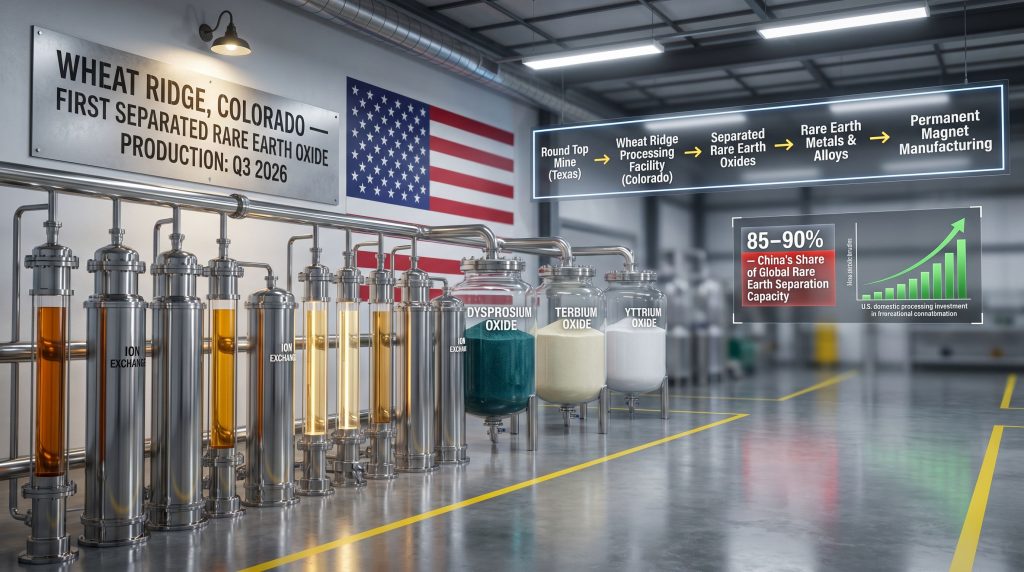
Furthermore, rare earth processing challenges are compounded by the scale of Chinese dominance in this space. China controls an estimated 85 to 90 percent of global rare earth separation and refining capacity. This concentration of processing infrastructure, rather than mining alone, represents the most structurally significant vulnerability in Western rare earth supply chains.
This means that even if Western nations successfully mine rare earth ore at scale, without domestic processing capacity they remain dependent on Chinese refineries to convert that ore into usable products. The Wheat Ridge facility is explicitly designed to address this vulnerability by building and validating the processing knowledge required before committing to large-scale commercial infrastructure.
What the Wheat Ridge Facility Is and How It Operates
From R&D Laboratory to Demonstration-Scale Processing
The Wheat Ridge facility did not emerge overnight. Originally established in 2020 as a pilot-scale process development laboratory, the site has undergone progressive technical evolution through successive R&D validation phases. Its current status as a demonstration-scale hydrometallurgical facility reflects years of iterative refinement in separation chemistry and process engineering.
This developmental history is significant from a technical risk management perspective. Demonstration-scale facilities occupy a critical position in the industrial development hierarchy, sitting between small-batch laboratory experiments and full commercial production plants. They are large enough to generate statistically meaningful process data but small enough to allow rapid reconfiguration when separation parameters need adjustment.
Core Processing Technologies: Solvent Extraction and Ion Exchange
The plant employs hydrometallurgical processing, a wet chemistry approach that uses aqueous solutions to selectively dissolve, separate, and purify target elements from complex ore matrices. The core separation technologies include solvent extraction and ion exchange techniques, with earlier development work incorporating continuous ion exchange and continuous ion chromatography methodologies, commonly referred to in the industry as CIX and CIC.
These are not trivial technologies. Solvent extraction for rare earth separation involves cascading mixer-settler circuits where immiscible organic and aqueous phases are repeatedly contacted to transfer rare earth ions selectively from one phase to another. The selectivity of this process depends on carefully controlled pH levels, organic extractant concentrations, diluent compositions, and temperature profiles. Getting this chemistry right for heavy rare earths, which have similar ionic radii and therefore resist easy separation from one another, is precisely the kind of expertise that China spent decades developing and that Western processors are now racing to replicate.
Automation and Real-Time Process Monitoring
What distinguishes the USA Rare Earth Colorado processing facility from earlier generation processing plants is its integration of automated control systems and real-time monitoring technology. A multidisciplinary team of engineers, scientists, and process technicians operates the site with the explicit objective of testing and refining separation flowsheets before they are locked into the design of a larger commercial plant.
The facility functions as a process validation engine as much as a production unit, generating the technical dataset that will directly inform the Round Top project feasibility study, expected to be completed by the end of 2026 and published in early 2027.
This sequencing reflects a disciplined approach to capital deployment. By validating processing assumptions at demonstration scale first, the company avoids the costly risk of discovering fundamental process deficiencies only after committing hundreds of millions of dollars to commercial construction.
The Multi-Source Feedstock Strategy
One of the more strategically interesting aspects of the USA Rare Earth Colorado processing facility is its deliberately diversified approach to raw material inputs. Rather than being designed as a single-source processing plant, the Wheat Ridge facility is structured to handle ore and material from multiple origins simultaneously.
| Feedstock Source | Location | Material Type | Strategic Role |
|---|---|---|---|
| Round Top Project | West Texas | Primary rare earth ore | Core long-term domestic supply input |
| Serra Verde | Brazil | Rare earth ore | International feedstock diversification |
| Third-Party Sources | Various | Commercial rare earth material | Processing flexibility and throughput optimisation |
| Recycled Magnet Waste | Various | Secondary material | Circular economy and supply resilience |
Why Feedstock Diversification Matters
Processing a variety of feedstocks is not merely a commercial convenience. It generates comparative technical data across different ore chemistries, which helps engineers understand how the separation flowsheet behaves when input mineralogy changes. This knowledge is directly applicable to commercial plant design, where feedstock variability over a mine's life is a practical reality that process engineers must account for.
Recycled Magnet Waste: An Underappreciated Input Stream
The inclusion of recycled magnet waste as a feedstock category deserves particular attention. Neodymium-iron-boron permanent magnets, which are the dominant magnet type used in electric vehicle motors and wind turbine generators, contain significant concentrations of dysprosium and terbium as grain boundary additives. As the installed base of electric vehicles grows globally, the volume of end-of-life magnet material available for recycling will increase substantially over the coming decade.
Processing this secondary material through hydrometallurgical circuits is technically demanding because magnet alloys present different chemical dissolution challenges compared to primary ore. Building this processing competency at demonstration scale now positions the facility to capture a growing recycled rare earth stream as the circular economy for critical minerals demand continues to mature.
The Target Elements: Heavy Rare Earths and Their Strategic Value
Why Heavy Rare Earths Command a Structural Premium
The facility's primary focus on dysprosium, terbium, and yttrium reflects a deliberate targeting of the highest-value, most supply-constrained segment of the rare earth market. Understanding why requires a brief explanation of rare earth chemistry and market structure.
Rare earth elements are conventionally divided into light rare earths, which include elements such as lanthanum, cerium, praseodymium, and neodymium, and heavy rare earths, which extend from samarium through lutetium plus yttrium. This division roughly corresponds to atomic weight and ionic radius, but more importantly, it corresponds to deposit type and global production geography.
Heavy rare earths are predominantly hosted in ionic adsorption clay deposits concentrated in southern China. These deposits, which are mined through in-situ leaching, have historically supplied the overwhelming majority of global dysprosium and terbium output. Outside China, very few known deposits contain economically significant heavy rare earth concentrations, which is precisely what makes the Round Top project in West Texas an unusually valuable geological asset.
Applications Driving Demand
The demand case for dysprosium and terbium is anchored in one critical application: high-performance permanent magnets. Adding dysprosium to neodymium-iron-boron magnets dramatically increases their coercivity, which is the resistance to demagnetisation at elevated temperatures. This property is essential for electric vehicle traction motors, which operate in high-temperature underbonnet environments. Terbium serves a similar function and is frequently used in combination with dysprosium to optimise magnet performance while managing raw material costs.
- Electric vehicles: Each EV drive motor contains several kilograms of rare earth permanent magnet material, with heavy rare earth content varying by motor design and performance specification.
- Wind turbines: Direct-drive wind turbine generators use large permanent magnet assemblies where heavy rare earth additions ensure long-term coercivity stability in variable temperature and field conditions.
- Defence systems: Guided munitions, radar systems, sonar arrays, and electric drive systems for naval vessels all incorporate rare earth permanent magnets where supply chain provenance is increasingly a defence procurement consideration.
- Advanced manufacturing: Industrial robots, precision motors, and magnetic resonance imaging systems represent additional demand vectors that are expanding as manufacturing automation accelerates globally.
Vertical Integration as a Competitive Moat
Mapping the Full Value Chain
The Wheat Ridge facility does not exist in isolation. It occupies a specific and intentional position within a vertically integrated business architecture that USA Rare Earth is constructing from raw ore through to finished magnet products.
Round Top Mine (West Texas)
         ↓
Wheat Ridge Processing Facility (Colorado)
         ↓
Separated Heavy Rare Earth Oxides
         ↓
Rare Earth Metals and Alloys Production
         ↓
Permanent Magnet Manufacturing
Why Integration Changes the Competitive Equation
Vertical integration in rare earth supply chains matters for reasons that go beyond simple margin capture. Each stage of the value chain represents a distinct technical discipline with its own barriers to entry. A company that controls mining, separation chemistry, metal reduction, alloy production, and magnet pressing can offer downstream customers something that no single-stage operator can: guaranteed supply continuity across the entire production sequence.
This is particularly valuable for defence contractors and automotive manufacturers who are under increasing political and commercial pressure to demonstrate that their critical component supply chains do not pass through Chinese-controlled chokepoints. For these customers, paying a premium for vertically integrated domestic supply is increasingly a procurement preference rather than a luxury.
The next major ASX story will hit our subscribers first
The Geopolitical Context: Why Now?
The Non-Chinese Processing Race
The launch of the USA Rare Earth Colorado processing facility coincides with a period of accelerating investment in non-Chinese rare earth processing capacity globally. Consequently, critical minerals geopolitics are reshaping how governments and investors approach the entire supply chain. Several other jurisdictions are at various stages of developing competing capabilities.
| Country/Region | Key Processing Initiatives | Current Status (2026) |
|---|---|---|
| United States | Wheat Ridge (CO), MP Materials (CA) | Active and scaling |
| Australia | Lynas Rare Earths, Kalgoorlie processing | Operational |
| Canada | Various exploration and pre-development projects | Predominantly pre-commercial |
| Europe | EU Critical Raw Materials Act-driven initiatives | Policy framework and early-stage |
| Brazil | Serra Verde integrated rare earth operations | Active |
What this competitive landscape reveals is that while progress is being made across multiple fronts, operational demonstration-scale processing capacity outside China remains genuinely scarce. Most Western initiatives are still in policy formulation, feasibility study, or early construction phases. Facilities that are actually operating and generating real process data occupy a structurally differentiated position in this emerging competitive field.
The Round Top Feasibility Study Connection
Every processing run conducted at Wheat Ridge contributes to the technical evidence base that will underpin the Round Top feasibility study. This is not incidental. Feasibility studies for rare earth projects require validated metallurgical recoveries, confirmed reagent consumption rates, and demonstrated product specifications across a representative range of processing conditions.
Generating this data through a demonstration facility before the feasibility study is finalised is both technically rigorous and strategically sound. In addition, US critical minerals policy increasingly incentivises this kind of domestic processing investment, further strengthening the commercial case for advancing the Round Top project timeline. The feasibility study is targeted for completion by the end of 2026, with publication expected in early 2027.
Market Response and Investor Signal Reading
What a 7% Single-Session Gain Actually Communicates
The approximately 7 percent share price gain recorded on the day USA Rare Earth announced the commencement of operations at Wheat Ridge carries a specific informational content that is worth unpacking. In the critical minerals investment universe, exploration and development milestones tend to generate muted market reactions because they represent potential rather than demonstrated capability.
Operational milestones are different. A facility that is physically running and generating process data has crossed a threshold that capital markets assign meaningfully higher probability weightings to eventual commercial success. The market reaction reflected a reassessment of execution risk rather than a change in the fundamental demand thesis.
For investors in critical minerals companies, operational proof points consistently move share prices more decisively than resource estimate upgrades or policy announcements, because they demonstrate that technical and logistical challenges have been overcome rather than merely anticipated.
However, this dynamic is worth monitoring closely as the facility moves toward first oxide production targeted for Q3 2026. Each successive production milestone, from first oxide output through to confirmed product specifications, represents an additional data point that further de-risks the investment case.
Key Facts at a Glance
| Metric | Detail |
|---|---|
| Facility Location | Wheat Ridge, Colorado |
| Operational Status | Commenced operations, June 2026 |
| First Oxide Production Target | Q3 2026 |
| Primary Target Elements | Dysprosium, terbium, yttrium and broader heavy REEs |
| Feedstock Sources | Round Top (TX), Serra Verde (Brazil), third-party, recycled magnets |
| Processing Technology | Hydrometallurgy, solvent extraction, CIX/CIC |
| Feasibility Study Publication | Early 2027 |
| Site Established | 2020 (pilot and R&D phase) |
| Commercial Production Target | Later this decade (Round Top) |
Frequently Asked Questions
What is the USA Rare Earth Colorado processing facility?
The Wheat Ridge facility is a hydrometallurgical demonstration plant designed to separate and purify rare earth oxides from multiple feedstock sources. Originally established as a pilot-scale R&D site in 2020, it has progressively advanced to demonstration-scale operations, with first separated oxide production targeted for Q3 2026.
What rare earth elements does the facility produce?
The facility is focused on heavy rare earth oxides, with primary emphasis on dysprosium, terbium, and yttrium. These elements are critical inputs for permanent magnet manufacturing used in electric vehicle motors, wind turbines, and defence systems.
How does the Colorado facility relate to the Round Top project?
The Wheat Ridge facility processes ore from the Round Top project in West Texas as one of its primary feedstock inputs and generates the metallurgical validation data required to complete the Round Top feasibility study, which is expected to be published in early 2027.
Why does the facility use multiple feedstock sources?
Processing diverse feedstocks generates comparative technical data across different ore chemistries, which strengthens the process engineering knowledge base and improves the robustness of the commercial plant design that will follow the current demonstration phase.
What processing technology does the Wheat Ridge facility use?
The facility employs hydrometallurgical techniques including solvent extraction and ion exchange separation methods. Earlier development phases also incorporated continuous ion exchange and continuous ion chromatography approaches, which are advanced separation technologies particularly suited to heavy rare earth differentiation.
Disclaimer: This article is intended for informational purposes only and does not constitute financial advice. Statements regarding future production timelines, feasibility study outcomes, and commercial milestones involve forward-looking assumptions that are subject to technical, regulatory, and market risks. Readers should conduct their own due diligence before making investment decisions.
Want to Identify the Next Major Critical Minerals Discovery Before the Market Does?
Discovery Alert's proprietary Discovery IQ model delivers real-time alerts on significant ASX mineral discoveries — instantly transforming complex geological data into actionable investment insights for both short-term traders and long-term investors. Explore historic examples of exceptional returns from major mineral discoveries and begin your 14-day free trial today to position yourself ahead of the market.