August 11, 2026
Graphene aluminum-ion battery technology represents a significant departure from conventional lithium-ion energy storage systems, offering potential solutions to critical industry challenges including charging speed limitations, thermal safety concerns, and supply chain vulnerabilities. This innovative approach leverages aluminum's abundance and graphene's unique properties to create energy storage systems that operate outside traditional performance trade-offs. Furthermore, the technology's development coincides with broader shifts in battery metals investment strategies as industries seek alternatives to lithium-dependent systems.
Aluminum represents Earth's third most abundant element, yet its application in advanced energy storage has remained largely unexplored until recent technological advances in electrode design and electrolyte formulation. The convergence of graphene manufacturing capabilities with aluminum electrochemistry creates new possibilities for energy storage systems that operate outside conventional performance trade-offs between power density, safety, and cycle life.
Understanding the Core Technology Behind Next-Generation Energy Storage
Graphene aluminum-ion battery systems utilise abundant aluminum as the primary charge carrier, fundamentally departing from lithium-based energy storage approaches. Unlike traditional lithium-ion cells that depend on lithium intercalation processes, these alternative systems employ aluminum ions moving between electrodes through specialised ionic liquid electrolytes.
The operational mechanism centres on aluminum ions (Al³⁺) shuttling between a metallic aluminum anode and engineered porous graphene cathode during charge-discharge cycles. This process occurs within recently developed chloride-free electrolyte formulations that facilitate rapid ion transport while maintaining electrochemical stability across extended cycling periods.
According to testing conducted by the Battery Innovation Center in Bloomington, Indiana, current prototype configurations achieve approximately 58 Wh/kg on one-hour charge protocols and 26 Wh/kg when charged within six-minute timeframes. These performance metrics represent significant progress from early coin cell demonstrations to multilayer pouch-cell configurations.
Core Components Comparison:
| Component | Traditional Li-ion | Graphene Al-ion |
|---|---|---|
| Anode | Graphite/Silicon | Metallic Aluminum |
| Cathode | Metal Oxides | Engineered Graphene |
| Electrolyte | Organic Carbonate | Chloride-Free Ionic Liquid |
| Current Collector | Copper/Aluminum | Aluminum Foil |
Bob Galyen, veteran battery industry figure with nearly five decades of experience, characterised the technology as representing a fundamental departure from incremental improvements. The aluminum-graphene platform functions as a new platform that can potentially open markets and use cases that were previously uneconomic or impractical, leveraging aluminum and graphene to demonstrate a viable pathway reducing dependency on traditional lithium-based systems while delivering substantial enhancements in charge time and power density.
The electrode architecture employs both anode and cathode structures utilising aluminum foil current collectors rather than copper-based systems common to lithium-ion chemistry. This design eliminates copper dependency while enabling the chloride-free electrolyte formulation to maintain ionic conductivity across repeated fast-charge events without decomposition byproducts that typically accumulate and increase impedance.
When big ASX news breaks, our subscribers know first
Addressing Critical Limitations of Current Battery Technology
Energy storage industry faces mounting pressure to overcome lithium-ion's inherent constraints: thermal runaway risks, limited charging speeds, and supply chain vulnerabilities tied to scarce materials. Traditional battery chemistry depends on materials with concentrated geographic production and volatile pricing dynamics.
Lithium prices experienced 75% decline from peak levels in 2022-2023 before resuming volatility patterns characteristic of commodities with limited supply elasticity. Meanwhile, the Democratic Republic of Congo controls approximately 70% of global cobalt production, creating single-source dependency risks for battery manufacturers seeking supply chain resilience.
Thermal runaway represents the leading cause of aircraft cargo hold fires involving battery shipments, with documented incidents increasing across commercial aviation. Lithium-ion systems require complex thermal management infrastructure, active cooling systems, and multi-layer fire-suppression hardware that adds 15-25% to overall pack mass while consuming 3-8% of available energy for thermal regulation under normal operating conditions.
Resource Abundance and Supply Chain Resilience
Aluminum comprises 8.1% by weight of Earth's crust, making it the third most abundant element after oxygen and silicon. Global aluminum production reached 64 million tonnes in 2023, supported by established recycling infrastructure that recovers approximately 75% of discarded aluminum through existing industrial processes.
Geographic distribution of aluminum refining capacity spans multiple continents including Australia, China, Canada, the United States, and Iceland, reducing single-nation dependency risks that currently affect lithium, cobalt, and nickel supply chains. Recycled aluminum requires only 5% of the energy required for primary smelting, supporting circular economy integration with established economic incentives.
Craig Nicol, CEO of Graphene Manufacturing Group, articulated the development priority approach focused on customer sampling and field testing programs. In addition, recent developments in battery recycling breakthrough technologies further demonstrate industry momentum toward sustainable materials management. The development program expects continued performance improvement as engineering addresses known parameters related to capacity, voltage, and weight specifications, with customer testing of pouch cells planned for 2026 followed by small-scale commercial production partnerships.
Enhanced Safety Profile Through Chemistry
Aluminum-ion electrochemistry eliminates lithium's tendency toward thermal runaway through different oxidation mechanisms. Moreover, this development aligns with broader critical minerals strategy initiatives seeking diversified material sources. Aluminum operates through intercalation and de-intercalation processes without forming dendrites that trigger internal short circuits characteristic of lithium systems under stress conditions.
Safety Advantage: Aluminum-ion systems operate without thermal runaway mechanisms that affect lithium-ion batteries, potentially eliminating complex cooling systems and fire-suppression hardware requirements.
Chloride-free electrolyte formulations maintain electrochemical stability across extended temperature ranges without producing degradation products that compromise battery performance. This chemistry advancement potentially enables system simplification by eliminating active battery management thermal cooling systems, passive thermal housings, and multi-layer fire-suppression assemblies.
The elimination of thermal management complexity reduces overall pack weight and manufacturing requirements while removing continuous energy allocation to cooling subsystems that typically characterises lithium-ion installations in demanding applications.
Ultra-Rapid Charging Performance Metrics
Recent independent testing reveals charging capabilities that dramatically exceed conventional battery performance benchmarks. Laboratory results demonstrate charge rates approaching 60-70 times faster than standard lithium-ion cells under controlled testing protocols.
Documented Charging Performance:
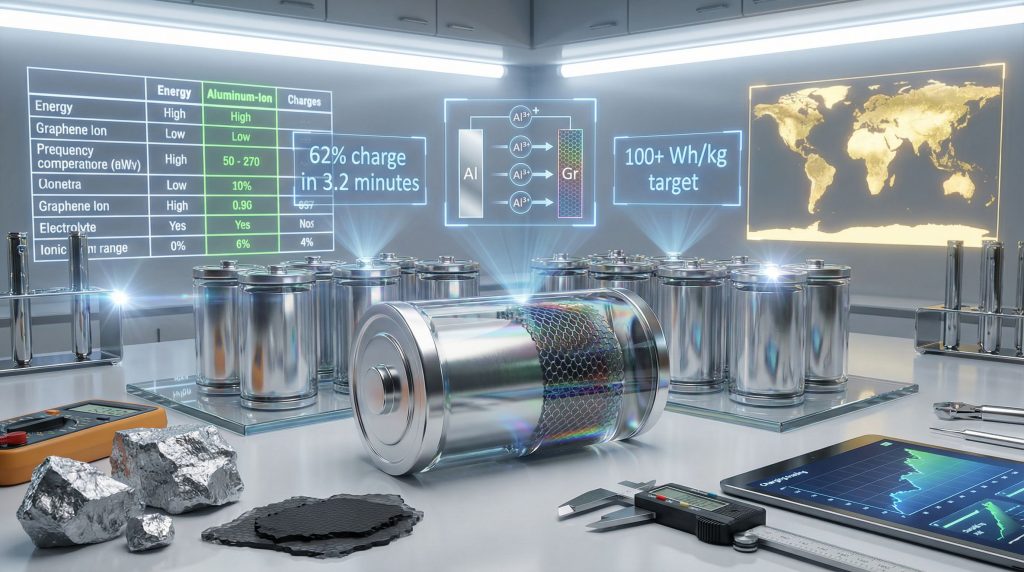
• 62% state of charge achieved in 3.2 minutes
• Near-complete charging within 6 minutes total cycle time
• Power density significantly higher than lithium titanate alternatives
• Stable performance across hundreds of ultra-fast charge cycles
Comparative analysis shows standard lithium-ion cells typically requiring 30-60 minutes for full charge cycles, while specialised lithium titanate oxide (LTO) cells achieve comparable fast-charging performance but command significant pricing premiums of 30-50% above standard lithium-ion equivalents.
Bob Galyen characterised the six-minute full-charge capability as a transformative operational constraint removal. The ability to charge from empty to full in roughly six minutes represents a change that could influence how designers approach electric vehicles, stationary storage, and other high-power systems by removing energy density as the primary optimisation driver for high-power applications.
Cycle Life and Durability Under Fast-Charging Stress
Extended testing protocols demonstrate performance stability across thousands of ultra-fast charge cycles without degradation patterns typical in lithium-ion systems subjected to equivalent stress conditions. Current prototype testing shows stable performance across hundreds of fast-charge cycles without the early wear and capacity degradation that commonly affects lithium-ion and sodium-ion chemistries under accelerated charge rates.
Development Target Specifications:
• Cycle life target: 20,000+ full charge-discharge cycles
• Performance comparison: Exceeds lithium-ion specifications of 500-1,500 cycles
• Durability benchmark: Approaches specialised lithium titanate performance of 10,000+ cycles
Standard lithium-ion cycle degradation stems from solid electrolyte interphase (SEI) layer expansion, lithium plating, and crystal structure changes during rapid charging. Aluminum intercalation chemistry avoids these failure modes through different electrochemical mechanisms that maintain structural integrity under repeated cycling stress.
Current Performance Benchmarks vs. Development Targets
Testing conducted by the Battery Innovation Center provides the first comprehensive performance assessment of multilayer pouch-cell prototypes. Current configurations demonstrate clear performance trade-offs between charging speed and energy density, reflecting deliberate engineering priorities for high-power applications.
Energy Density Comparison:
| Battery Type | Energy Density (Wh/kg) | Charge Time | Cycle Life |
|---|---|---|---|
| Standard Li-ion | 150-250 | 30-60 min | 500-1,500 |
| Lithium Titanate | 70-80 | 10-15 min | 10,000+ |
| Graphene Al-ion (Current) | 26-58* | 6 min | 10,000+ |
| Graphene Al-ion (Target) | 100+ | <6 min | 20,000+ |
*Performance varies by charging protocol
Trade-offs Between Energy Density and Power Performance
Current prototype design reflects deliberate engineering trade-offs optimising for rapid charge capability and extended cycle life rather than maximum energy storage density. Higher pore density in graphene cathode structures facilitates rapid aluminum-ion diffusion, reducing apparent energy density while enabling fast intercalation kinetics essential for ultra-rapid charging.
The 26 Wh/kg performance on six-minute charge protocols versus 58 Wh/kg on one-hour charge cycles demonstrates the fundamental electrochemistry principle: faster charge extraction requires lower utilisation of available electrochemical potential, resulting in reduced apparent capacity per unit weight.
Development targets establish 100+ Wh/kg energy density as the commercial viability threshold while maintaining sub-six-minute charging capabilities and tens-of-thousands cycle life specifications. Achievement timelines remain under engineering development as prototype refinement addresses known technical parameters.
Industries Positioned for Technology Adoption
Heavy Equipment and Industrial Applications
Mining operations represent primary deployment scenarios where rapid equipment turnaround and extended operational life outweigh absolute energy density requirements. Furthermore, mining industry innovation continues driving demand for advanced energy storage solutions. Haul truck duty cycles typically involve 4-6 hours continuous operation with 20-30 minute fast-charge requirements between shifts, creating operational profiles well-suited to ultra-rapid charging capabilities.
Equipment downtime costs range from $5,000-$15,000 per hour for large mining operations, with copper mining operations averaging $8,000-$12,000 per hour according to industry benchmarks. These economic pressures prioritise equipment availability over incremental weight penalties associated with lower energy density configurations.
Mining Equipment Advantages:
• Confined operating areas: Pit-to-dump routes typically span 5-15 km distances
• Predictable duty cycles: Enable charging schedule optimisation
• High downtime costs: Justify rapid charging premium over energy density
• Cycle life correlation: Extended battery life directly impacts total cost of ownership
The Rio Tinto partnership established through a 2023 binding joint development agreement specifically targets heavy mobile equipment applications where ultra-fast charging and long cycle life provide operational advantages over traditional lithium-ion designs.
Grid-Scale Energy Storage and Frequency Regulation
Power grid applications requiring rapid response times for frequency regulation and load balancing could leverage ultra-fast charge-discharge capabilities for improved grid stability. This development aligns with broader renewable energy solutions requiring reliable energy storage systems. Grid frequency regulation services command $50-$100 per MWh in competitive U.S. markets, with response time requirements of 0.5-2 seconds for modern frequency support systems.
Frequency regulation cycles occur 100-500 times per day, creating extreme cycle-life demands that align with graphene aluminum-ion battery capabilities. The technology's potential 10,000+ cycle capability equals 20-100 years of daily regulation duty, directly mapping to grid regulation service economics.
Grid Application Benefits:
• Ultra-fast response: Eliminates mechanical generator response delays
• Extended cycle life: Supports decades of daily regulation service
• Reduced fire risk: Eliminates lithium thermal runaway insurance requirements
• Simplified installations: Potential elimination of complex thermal management systems
Tesla's Hornsdale Power Reserve in South Australia demonstrates commercial viability of battery frequency regulation, generating over $100 million in revenue through regulation services despite initial 100 MW/150 MWh nameplate capacity, validating the economic potential for advanced battery technologies in grid applications.
Commercial Vehicle Fleet Operations
Urban delivery fleets requiring multiple daily charges represent high-value applications for ultra-rapid charging technology. Amazon operates approximately 5,000+ electric delivery vehicles globally as of 2024, with daily delivery requirements reaching 200+ package stops per route, necessitating 3-4 vehicle charge cycles per 24-hour operational period.
Each 30-minute charge cycle reduces daily delivery capacity by 8-12%, creating direct revenue impact of $100-$200 daily per vehicle through reduced operational efficiency. Six-minute charging cycles could fundamentally alter fleet operational economics by eliminating charge-time constraints on delivery route optimisation.
Fleet Operation Applications:
• Urban delivery services: Multiple daily charge cycles required
• Public transportation: Fixed route schedules enable charge timing optimisation
• Airport ground support: Predictable duty cycles with defined charging windows
• Port logistics operations: High equipment utilisation rates justify charging infrastructure investment
Current Technical Challenges and Development Priorities
Electrolyte Chemistry and Manufacturing Scalability
Traditional aluminum-ion systems relied on corrosive chloroaluminate electrolytes that posed manufacturing and safety challenges limiting commercial viability. Recent development of hybrid chloride-free and noncorrosive formulations addresses these historical constraints while maintaining electrochemical performance requirements.
A patent application filed covering the new electrolyte materials represents significant intellectual property development supporting commercial protection of manufacturing processes. The chloride-free formulation maintains ionic conductivity across repeated fast-charge events without producing decomposition byproducts that typically increase impedance over time.
Manufacturing Equipment Compatibility
The technology's compatibility with existing lithium-ion production equipment reduces capital investment requirements for manufacturers considering production line conversion or expansion. Manufacturing steps align with equipment and processes used to produce conventional lithium-ion batteries, supporting technology transition pathways for existing battery manufacturers.
Manufacturing Considerations:
• Equipment compatibility: Existing lithium-ion production lines adaptable
• Material procurement: Aluminum abundance supports supply chain scaling
• Quality control: Multi-layer pouch cell assembly requires precision manufacturing
• Electrolyte production: Industrial-scale synthesis of chloride-free formulations
Energy Density Gap vs. Commercial Requirements
Current energy density specifications remain below many commercial applications' requirements, particularly for electric vehicles where weight and space constraints represent critical design parameters. The 26-58 Wh/kg range significantly trails standard lithium-ion performance of 150-250 Wh/kg for automotive applications.
Development priorities focus on addressing known technical parameters related to capacity, voltage, and weight optimisation while maintaining ultra-fast charging capabilities and extended cycle life advantages that differentiate the technology from conventional alternatives.
The next major ASX story will hit our subscribers first
Technology Readiness and Commercial Timeline
Current Development Stage Assessment
The technology currently operates at Battery Technology Readiness Level 4, indicating continued laboratory refinement and prototype optimisation rather than commercial production readiness. This stage reflects ongoing pouch-cell behaviour refinement and performance validation through third-party testing protocols.
Collaboration with the Battery Innovation Center supports advancement toward higher readiness levels through systematic testing and validation processes essential for commercial credibility and customer confidence in performance claims.
Development Roadmap Timeline:
• 2025: Laboratory optimisation and third-party validation completion
• 2026: Customer sampling and field testing programs
• 2027: Small-scale commercial production partnerships
• 2028-2030: Market deployment in targeted applications
Strategic Partnerships and Industry Collaboration
The University of Queensland partnership demonstrates academic-industry collaboration models combining research capabilities with commercial development resources to accelerate technology maturation and intellectual property development. This collaboration provides access to specialised research facilities and advanced characterisation techniques essential for materials optimisation.
Strategic partnerships with major mining companies through the Rio Tinto agreement provide both development funding and potential end-user markets for heavy equipment applications, creating vertically integrated development pathways that align technology development with market deployment opportunities.
Partnership Benefits:
• Academic collaboration: Advanced materials research capabilities
• Industry partnerships: Direct access to end-user applications
• Third-party validation: Independent testing facility credibility
• Funding diversification: Multiple revenue streams supporting development
Independent testing facilities provide crucial performance validation and credibility for technology claims, supporting investor confidence and customer adoption decisions essential for commercial market acceptance.
Production Economics and Cost Considerations
Material Cost Advantages and System-Level Economics
Aluminum's abundance offers significant raw material cost advantages over lithium-ion systems, particularly as lithium prices remain volatile due to supply-demand imbalances affecting battery manufacturers worldwide. Aluminum production infrastructure exists globally with established recycling systems supporting sustainable material flows.
The technology's potential elimination of thermal management systems and safety hardware could offset higher initial cell costs through reduced system complexity and installation requirements. Traditional lithium-ion installations require active cooling systems, thermal protection housings, and fire suppression equipment that add substantial system-level costs.
Cost Structure Analysis:
• Raw materials: Aluminum abundance versus lithium scarcity
• Manufacturing: Compatible with existing production equipment
• System integration: Reduced thermal management requirements
• Lifecycle costs: Extended cycle life versus replacement frequency
Potential system simplification eliminates battery management thermal cooling systems, passive thermal housings, and multi-layer fire-suppression assemblies, reducing overall installation complexity while improving operational reliability through fewer subsystem dependencies.
Market Applications with Greatest Commercial Promise
Stationary energy storage systems represent high-priority applications where ultra-fast response times provide premium value propositions, particularly for frequency regulation and peak shaving services commanding market premiums in competitive electricity markets.
High-Priority Market Segments:
• Grid-scale storage: Frequency regulation premium services
• Mining equipment: Heavy mobile equipment with high utilisation rates
• Urban delivery fleets: Multiple daily charge cycles required
• Transportation systems: Fixed schedules enabling charge optimisation
Consumer electronics and portable devices represent niche applications where rapid charging provides significant user experience advantages, particularly in professional and industrial device categories where equipment downtime directly impacts productivity and operational efficiency.
What Are the Key Safety Benefits of Graphene Aluminum-Ion Technology?
Achieving target energy density levels above 100 Wh/kg while maintaining ultra-fast charging capabilities represents the key technical threshold for broader market adoption. This performance benchmark would position the technology competitively against specialised lithium-ion alternatives while preserving unique advantages in charging speed and cycle life.
Success depends on maintaining performance advantages as competing technologies like solid-state lithium and sodium-ion batteries continue advancing toward commercial deployment. Solid-state lithium technologies project energy densities of 300-500 Wh/kg, creating competitive pressure for alternative chemistries to establish distinct value propositions.
Critical Performance Targets:
• Energy density: 100+ Wh/kg achievement timeline
• Charging speed: Sub-six-minute full charge capability
• Cycle life: 20,000+ charge-discharge cycles validation
• Safety profile: Thermal runaway elimination verification
Regulatory and Market Acceptance Requirements
New battery chemistries require extensive safety testing and regulatory approval processes that influence commercialisation timelines and market acceptance. Battery safety standards currently developed specifically for lithium-ion systems may require adaptation for aluminum-ion chemistry validation.
Independent safety certification through established testing protocols provides essential market credibility, while early adoption by major industrial partners demonstrates real-world performance validation supporting broader market confidence in the technology's commercial viability.
The convergence of ultra-rapid charging capabilities, extended cycle life, and enhanced safety profiles positions graphene aluminum-ion battery technology to address specific market segments where these characteristics provide operational advantages over conventional energy storage alternatives. Commercial success ultimately depends on achieving target performance specifications while maintaining cost competitiveness in selected applications where rapid charging and durability justify premium pricing structures.
This analysis is based on publicly available technical data and development timelines as disclosed by industry participants. Battery technology development involves inherent risks and uncertainties, and actual commercial performance may vary from laboratory results and development targets.
Want to capitalise on breakthrough battery technology investments?
Discovery Alert's proprietary Discovery IQ model instantly identifies significant ASX mineral discoveries in critical battery materials, including graphene and aluminum projects that could benefit from next-generation energy storage demand. With breakthrough technologies reshaping the battery industry, subscribers receive real-time alerts on actionable investment opportunities ahead of broader market awareness, positioning portfolios to benefit from the evolving energy storage landscape.