June 14, 2026
The Graphite Bottleneck No One Talks About Until It's Too Late
Every major transition in industrial history has eventually collided with a materials constraint that nobody adequately planned for. The shift to electrified transportation is encountering that constraint right now, and it takes the form of a soft, flaky mineral that most people outside the battery industry have never thought twice about.
Graphite is the dominant material in lithium-ion battery anodes by mass. A single EV battery pack requires between 50 and 100 kilograms of graphite, making it a more significant input by weight than lithium itself. Yet while lithium has captured the headlines, the graphite supply shortage has quietly become one of the most structurally exposed vulnerabilities in the entire Western battery materials ecosystem.
China currently controls an estimated 60 to 80 percent of global graphite processing capacity, and that figure does not fully capture the depth of the dependency. Even graphite ore mined outside China frequently travels to Chinese facilities for the purification and shaping processes needed to create battery-grade anode material. The result is a supply chain that loops through a single jurisdiction at its most critical and technically demanding stage, regardless of where the raw material originates.
The Matawinie graphite mine construction milestone announced in May 2026 is significant precisely because it represents one of the most credible attempts yet to break that loop.
When big ASX news breaks, our subscribers know first
Understanding What Battery-Grade Graphite Actually Demands
Not all graphite is created equal, and the gap between run-of-mine graphite and battery-grade anode material is technically substantial. To function in a lithium-ion cell, graphite must be purified to a carbon content of 99.95 percent or higher. The particles must also be shaped into a specific spherical morphology, then coated to control how lithium ions intercalate during charge and discharge cycles.
This transformation from concentrate to finished anode material has historically been dominated by a processing technique involving hydrofluoric acid, which is highly effective but carries serious environmental and safety risks. The desire among Western manufacturers and regulators to move away from hydrofluoric acid purification is one reason why new entrants into the graphite processing space face genuine technical barriers, not just capital ones.
The key product categories that battery manufacturers actually specify when sourcing anodes are:
- Spherical purified graphite (SPG): The shaped and purified particle that forms the functional core of the anode
- Coated spherical purified graphite (CSPG): SPG with a carbon coating applied to improve first-cycle efficiency and cycle life
- Uncoated natural graphite concentrate: The upstream feedstock that requires further processing before it is battery-usable
Matawinie's design feeds directly into this value chain. The mine is intended to produce graphite concentrate that travels downstream to Nouveau Monde Graphite's Bécancour Battery Material Plant, where it undergoes the transformation into SPG and CSPG. This vertical integration is what separates NMG's model from the many graphite projects globally that stop at the concentrate stage and remain dependent on third-party processing capacity, the majority of which sits in Asia.
Phase-2 Construction at Matawinie: What the Numbers Reveal
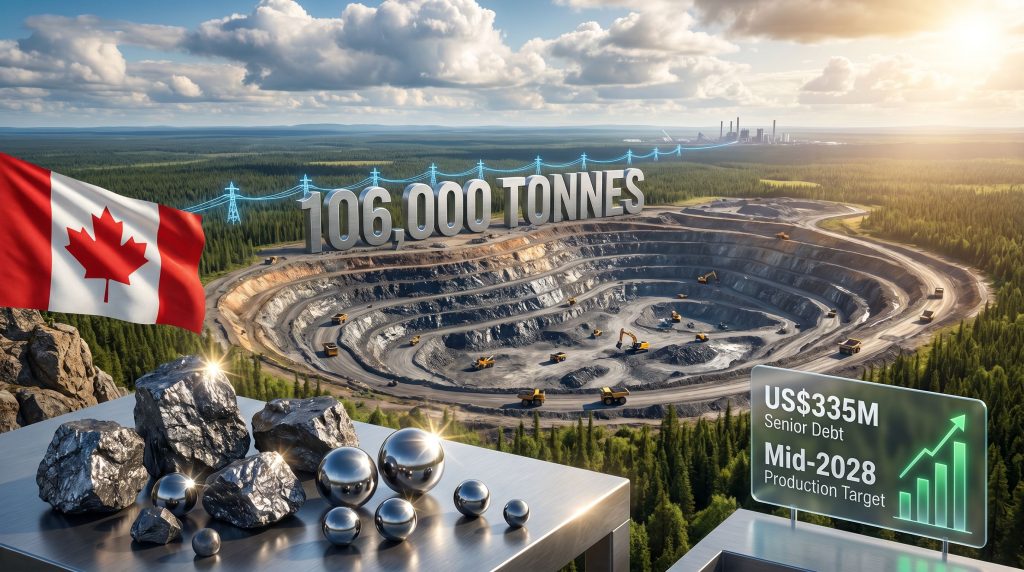
The Matawinie graphite mine construction commencement marks a concrete transition from development-stage planning to active capital deployment. Located approximately 120 kilometres north of Montréal in Québec, the project has been progressing through an extended period of feasibility, permitting, and financing work that culminated in the May 2026 announcement by Canadian Prime Minister Mark Carney.
The scale of the project is what elevates it above the dozens of battery raw materials market development stories that circulate through capital markets without ever reaching construction. Key project parameters include:
| Parameter | Detail |
|---|---|
| Annual graphite concentrate output | Up to 106,000 tonnes |
| G7 ranking upon completion | Largest graphite mine in any G7 nation |
| Location | 120 km north of Montréal, Québec |
| Total investment expected | Exceeds $2 billion CAD |
| Senior project debt commitment | US$335 million |
| Escrow funds released | US$96.5 million |
| Jobs to be created | More than 1,000 |
| Target production commencement | Mid-2028 |
| Major Projects Office referral | Approximately six months before construction start |
The release of US$96.5 million from escrow served as the practical financial trigger for construction commencement, converting committed financing into deployable capital. This sequencing reflects a deliberate project finance structure where construction authorisation is tied to defined funding milestones rather than discretionary management decisions.
The US$335 million senior debt commitment is a particularly significant data point for anyone evaluating the project's risk profile. Senior project debt of this magnitude in the battery materials sector requires lenders to have conducted extensive technical, environmental, and commercial due diligence. The presence of that commitment signals institutional confidence in the project's technical feasibility and economic viability that verbal endorsements cannot replicate.
Construction Contract Strategy: Locking In Execution Before Full FID
One aspect of the Matawinie construction approach that deserves more attention than it typically receives is NMG's decision to award major construction packages covering more than half of total project capital expenditure ahead of achieving full financial close. This covers civil works, structural steel fabrication, construction management, and processing equipment procurement.
This front-loaded contracting model carries a specific strategic logic that is worth unpacking:
-
Contractor capacity reservation: In a market where skilled engineering and construction resources for mineral processing facilities are heavily contested, early awards secure the teams and equipment needed for on-schedule execution.
-
Critical path compression: Processing equipment and structural steel are typically the longest lead-time items in a mine construction programme. Ordering them before formal FID reduces the elapsed time between financial close and first ore through the plant.
-
Cost certainty improvement: Fixed-price or target-price contracts executed before inflationary pressure peaks provide better capital cost predictability than contracts awarded late in a commodity construction cycle.
-
Financing condition satisfaction: Lenders and equity providers often require evidence of contractor commitments as a condition for releasing funds, meaning early awards can accelerate rather than precede financing.
The practical implication of this approach is that the mid-2028 production target is more than an aspirational date. It reflects a construction sequence that has been engineered backward from a commissioning deadline, with contractor appointments and material procurement aligned to support it.
The Bécancour Integration: Why Location Multiplies Strategic Value
The Bécancour industrial complex on the south bank of the St. Lawrence River is already home to several battery materials producers and chemical processors. NMG's decision to locate its downstream graphite processing facility there was not incidental. Bécancour offers direct access to Québec's hydroelectric power grid, port infrastructure, and an existing workforce with relevant industrial skills.
The hydropower dimension deserves particular emphasis. The carbon intensity of graphite anode production is heavily influenced by the electricity source used in the purification and thermal treatment stages. Coal-powered processing facilities in China produce anode material with a substantially higher embodied carbon footprint than the same process running on hydroelectricity. As battery manufacturers face growing pressure to demonstrate Scope 3 emissions accountability across their supply chains, the ability to specify hydropower-certified, low-carbon anode material becomes a procurement differentiator, not just an ESG talking point.
For North American battery cell manufacturers evaluating sourcing decisions for gigafactories opening in the 2028 to 2030 window, the comparison between Asian-sourced and Bécancour-processed anode material involves multiple dimensions beyond unit price:
- Supply chain lead times of 4 to 6 weeks domestically versus 12 to 16 weeks from Asia
- Tariff exposure under evolving U.S. and Canadian trade frameworks
- Scope 3 emissions certification requirements under customer and regulatory pressure
- Supply chain provenance documentation for IRA-related eligibility purposes
- Geopolitical concentration risk under stress scenarios
Canada's Critical Minerals Framework and the Major Projects Office
The referral of Matawinie to Canada's Major Projects Office approximately six months before construction commencement is an indicator of how the federal government has internally classified this project. The MPO exists to coordinate cross-departmental engagement for projects deemed nationally significant, facilitating inter-agency alignment and reducing the administrative friction that can create timing risk in complex mine development programmes.
Three federal cabinet ministers publicly endorsed the construction announcement, including the Environment Minister, reflecting the breadth of government alignment behind the project. Canada's NMG CEO Eric Desaulniers emphasised that the construction milestone reflects the collaboration of partners, the trust of local and Indigenous communities, and a shared commitment to sustainable development, while acknowledging the continued federal financial investment in support of the broader electrification strategy.
This whole-of-government alignment matters for project risk assessment. It reduces the probability of regulatory interruptions and signals that the project has cleared internal policy review processes at the federal level. Furthermore, it does not guarantee project outcomes or eliminate execution risk, but it substantially narrows the range of administrative obstacles that have historically delayed comparable projects. The growing critical minerals demand across Western economies has accelerated this kind of governmental prioritisation.
The next major ASX story will hit our subscribers first
The Manawan First Nation IBA: Social Licence as a Structural Asset
Nouveau Monde Graphite's Impact and Benefit Agreement with the Manawan First Nation, whose traditional territory encompasses the Matawinie project area, is more than a compliance checkbox. For institutional investors applying ESG screening criteria and for battery manufacturers evaluating supply chain provenance, a formalised and negotiated IBA with the relevant Indigenous community represents a meaningful risk mitigation factor.
Projects in Québec and across Canada that have proceeded without adequate Indigenous consultation have faced injunctions, project delays, and in some cases regulatory rejection. The existence of a negotiated IBA reduces this risk category substantially and demonstrates that the project's social licence has been built through structured engagement rather than assumed through permitting alone.
The combination of hydropower processing credentials and a negotiated Indigenous partnership agreement positions Matawinie's future anode output as premium-provenance graphite in a market that is becoming increasingly sensitive to supply chain ESG verification. This distinction may carry tangible commercial value as battery manufacturer procurement specifications evolve.
Competitive Context: Where Matawinie Stands Among Non-Chinese Graphite Projects
To appreciate the significance of Matawinie graphite mine construction reaching this stage, it helps to understand how sparse the global pipeline of credible, non-Chinese, battery-grade graphite projects actually is.
| Project Attribute | Matawinie (NMG) | Typical Non-Chinese Competitors |
|---|---|---|
| Annual production target | 106,000 tonnes concentrate | 20,000 to 50,000 tonnes (typical range) |
| Downstream anode integration | Yes, via Bécancour plant | Rarely at construction-ready stage |
| Construction status (mid-2026) | Underway | Most remain pre-FID |
| Senior debt commitment | US$335 million | Typically smaller or absent |
| Power source for processing | Québec hydroelectricity | Frequently fossil fuel dependent |
| Indigenous partnership agreement | Yes, Manawan First Nation IBA | Inconsistent across peer group |
| Jurisdiction stability | G7 Canada | Varies significantly |
Mozambique has produced natural graphite in commercially meaningful volumes, but its downstream processing infrastructure is limited and its geopolitical stability profile does not match that of a G7 jurisdiction. The Australian graphite industry has attracted interest from battery materials investors, but none of its projects have reached the construction-ready status or integrated processing capability that Matawinie now represents.
The honest assessment is that the Western world has a very short list of projects capable of actually delivering battery-grade graphite at commercial scale within this decade, and Matawinie is near the top of that list. Indeed, recycled graphite supply initiatives are emerging as a complementary strategy, however primary production at Matawinie's scale remains indispensable for meeting projected demand.
Forward Scenarios: What Determines Whether the Mid-2028 Target Holds
Construction commencement is a milestone, not an outcome. The factors that will determine whether Matawinie delivers on its mid-2028 production target and its longer-term strategic promise are worth mapping explicitly.
Execution Variables Within NMG's Control
- Construction programme management and contractor performance against the critical path
- Commissioning of the Bécancour Battery Material Plant in parallel with mine development
- Securing offtake agreements with battery cell manufacturers to validate commercial demand
- Finalising remaining financing tranches against construction progress milestones
External Variables That Could Accelerate or Create Headwinds
- Graphite spot and contract price movements, which influence both project economics and lender confidence
- Evolution of U.S. and Canadian policy frameworks affecting IRA-adjacent procurement eligibility
- Pace of North American gigafactory construction and resultant anode material demand pull
- Broader commodity construction cost inflation affecting capital expenditure estimates
Disclaimer: The scenario analysis and forward projections in this article are based on publicly available information and industry analysis. They do not constitute financial advice. Investors should conduct their own due diligence and consider their personal circumstances before making investment decisions related to any company or project discussed.
Key Takeaways for Investors and Industry Observers
The Matawinie graphite mine construction commencement is not simply a Québec mining story. It is, consequently, a data point in a much larger industrial transition that will determine whether Western economies can build credible battery materials supply chains or remain structurally dependent on Asian processing intermediaries.
The most important observations for those tracking this space:
- Scale matters: At 106,000 tonnes annually, Matawinie produces at a volume that can meaningfully serve multiple major battery manufacturers, not just serve as a demonstration project
- Integration is the differentiator: The mine-to-anode model connecting Matawinie to Bécancour is what separates NMG's approach from concentrate-only projects that still require Asian processing
- The financing structure signals institutional confidence: A US$335 million senior debt commitment reflects lender due diligence that carries more weight than political endorsements alone
- Hydropower plus IBA equals premium provenance: The combination of low-carbon processing credentials and a negotiated Indigenous partnership creates a supply chain provenance profile that is commercially valuable in an evolving procurement environment
- Execution discipline is everything from here: The construction contracts are placed, the financing triggers have been met, and the timeline is set. What follows is a test of project management under real-world conditions
For the North American battery supply chain, the question of whether Matawinie delivers on schedule may matter more than many participants currently appreciate.
Want to Know When the Next Major Mineral Discovery Hits the ASX?
Discovery Alert's proprietary Discovery IQ model scans ASX announcements in real time, instantly identifying high-potential mineral discoveries across more than 30 commodities — converting complex geological data into clear, actionable investment insights for both short-term traders and long-term investors. Explore Discovery Alert's dedicated discoveries page to see how historic finds have generated extraordinary returns, and begin your 14-day free trial today to position yourself ahead of the broader market.