
May 16, 2026
Understanding China's Graphite Flake Market Dynamics in Global Industrial Supply Chains
Industrial mineral markets operate through complex pricing mechanisms that often remain invisible to end users, yet these foundational cost structures determine everything from battery production economics to steel manufacturing competitiveness. China's position as the world's dominant graphite producer creates unique market dynamics where domestic graphite flake ex works china pricing serves as the primary reference point for global supply chains. Understanding these pricing mechanisms requires examining the technical specifications, processing economics, and regulatory environment that shape how Chinese producers price their graphite flake products at the factory gate.
Furthermore, the emergence of formalised price assessment methodologies in 2026 reflects growing market sophistication as international buyers seek transparent reference points for procurement decisions. This transparency becomes particularly critical when export control regulations create information asymmetries between domestic and international market participants.
When big ASX news breaks, our subscribers know first
Ex-Works Pricing Structure and Commercial Framework
Ex-works (EXW) pricing represents a fundamental delivery term where Chinese graphite producers place finished products at buyers' disposal at their processing facilities, with purchasers assuming complete responsibility for transportation, insurance, and logistics coordination from that point forward. This commercial structure differs significantly from international FOB or CIF arrangements where freight and insurance costs are pre-negotiated into quoted prices.
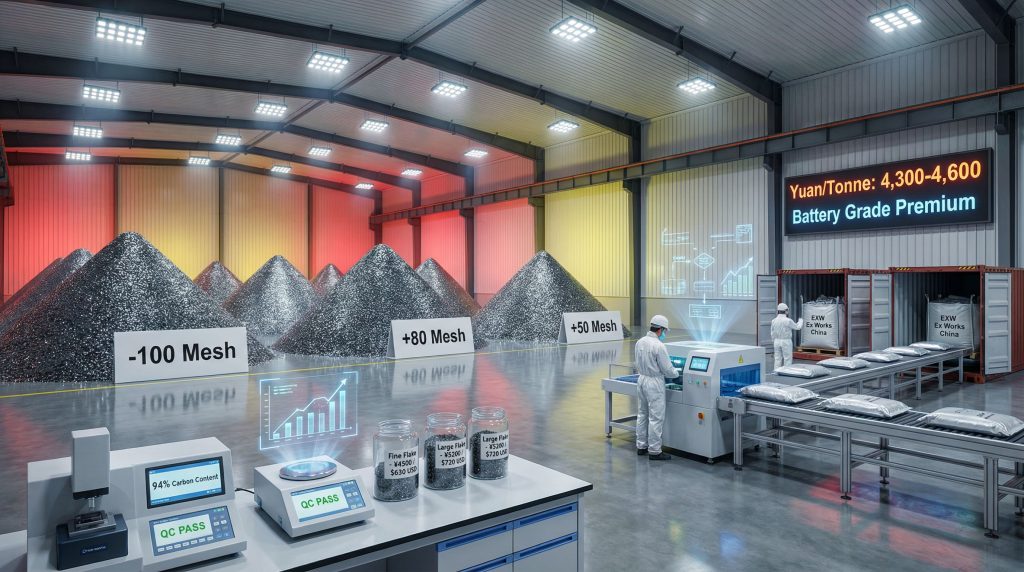
The implementation of standardised price assessments in April 2026 established critical market parameters that define commercial transactions. Minimum order quantities of 20 tonnes serve as the baseline threshold for both -100 mesh and +80 mesh grades, reflecting the operational efficiency requirements of Chinese producers and logistics optimisation for domestic transportation networks. These volume thresholds balance producer operational costs with buyer purchasing flexibility, though smaller quantities between 5-20 tonnes typically command premium pricing above standard assessments.
Currency and Settlement Mechanisms
Pricing denomination in Chinese Yuan (CNY) per tonne reflects the domestic nature of ex-works transactions, with cash settlement terms normalised for standard commercial arrangements. Weekly price publication on Thursdays between 5-6 PM Shanghai time provides regular market reference points, though actual transaction prices may vary based on specific quality specifications, delivery timing, and commercial relationships.
Exchange rate fluctuations significantly impact international buyers converting Yuan-denominated prices to their operating currencies. At current rates, the conversion of 4,300-4,600 Yuan per tonne to approximately $675-722 USD reflects an exchange rate of 6.32-6.37 CNY per USD, though these conversions require verification against real-time foreign exchange markets during actual transaction execution.
Quality Specifications and Grade Classifications
The 94% carbon content threshold represents a critical quality specification dividing premium-grade from standard industrial-grade graphite flake. Achieving this purity level through multi-stage flotation and purification processes involves significant processing costs relative to lower purity alternatives ranging from 80-90% carbon content.
In addition, mesh size classifications create distinct market segments with different valuation structures:
- -100 mesh (less than 149 microns): Preferred for battery anode applications requiring increased surface area per unit volume
- +80 mesh (177-250 microns): Suitable for steel production and foundry applications
- +50 mesh (larger particles): Used in specialty applications where coarser particle distribution provides performance advantages
China's Strategic Position in Global Graphite Markets
China's dominance in natural graphite production stems from geological advantages concentrated in Heilongjiang and Inner Mongolia provinces, combined with integrated processing infrastructure that extends from mining operations through refined flake production. This vertical integration provides cost structure advantages over international competitors managing geographically dispersed mining and processing operations, driving industry innovation trends across the sector.
The integrated supply chain encompasses underground and surface mining operations extracting raw flake graphite ore, beneficiation facilities using flotation processes to concentrate graphite content, purification stages achieving target carbon percentages, and sizing equipment producing specific mesh distributions. Chinese producers benefit from shorter inter-facility transportation distances compared to international operations, reducing logistics costs that ultimately influence ex-works pricing competitiveness.
However, navigating green transition challenges requires sophisticated understanding of how these supply chains adapt to evolving environmental regulations and market demands.
Export Control Impact on Domestic Market Structure
The implementation of graphite export controls created sufficient market disruption to necessitate domestic price transparency initiatives, as evidenced by price discovery mechanisms specifically designed to capture unique dynamics within the Chinese market. These regulatory changes fundamentally altered supply allocation decisions between domestic and international customers.
Export restrictions influence producer behaviour in several critical ways:
- Domestic inventory accumulation: Chinese industrial consumers facing potential supply constraints increase inventory holdings when ex-works prices remain stable
- Supply allocation prioritisation: Producers must balance domestic customer relationships against international market opportunities
- Price discovery complications: Information asymmetries emerge between domestic and international pricing mechanisms
Current Market Pricing Analysis and Grade Differentiation
Market pricing for premium-grade graphite flake reflects the technical complexity and processing costs required to achieve target specifications. The formal launch of price assessments in April 2026 established standardised reference points for the two most commercially significant grades in Chinese domestic markets.
| Specification | Mesh Size | Carbon Content | Market Applications |
|---|---|---|---|
| Premium Grade -100 | Less than 149 microns | 94% minimum | Battery anodes, advanced lubricants |
| Premium Grade +80 | 177-250 microns | 94% minimum | Steel production, foundry operations |
Processing Economics and Cost Structure
Multi-stage flotation processing required to achieve 94% carbon content involves primary flotation concentrating raw ore graphite content from 5-30% to 85-92% carbon, followed by rougher flotation removing first-pass non-graphite minerals, cleaner flotation further concentrating graphite, and scavenger flotation recovering fine particles from tailing streams. Each additional processing stage increases both capital equipment costs and operating expenses through flotation reagents, energy for agitation and separation equipment.
Consequently, effective waste management solutions become essential for managing by-products from these complex processing stages. Grinding and classification equipment specifications directly influence yield rates for target mesh distributions. Producers targeting -100 mesh material must grind finer than +80 mesh producers, consuming more electrical energy and accepting higher equipment wear.
Yield rates typically decline as target particle sizes decrease, with -100 mesh production potentially achieving 75% yields while +80 mesh reaches 82% yields from identical starting material.
Quality Control Protocols and Testing Requirements
Standard quality assurance for 94% carbon graphite flake includes comprehensive testing protocols that add both time and cost to production cycles:
- Carbon content verification via loss-on-ignition testing or instrumental analysis
- Ash composition analysis identifying mineral contaminants
- Particle size distribution measurement via laser diffraction or sieving
- Sulfur content testing (battery applications typically require less than 100 ppm sulfur)
- Moisture content verification for storage and handling specifications
These testing requirements typically add 1-3 days to production cycles and involve laboratory equipment and technician labour, with aggregate testing costs representing 2-5% of production expenses for premium grades.
Technology Integration and Processing Innovation
Chinese graphite processing facilities invest continuously in flotation equipment, particle classification systems, and quality control instrumentation to maintain competitive positioning in global markets. These technology upgrade investments affect production economics by requiring capital cost recovery through pricing mechanisms while potentially improving processing efficiency and product quality consistency.
For instance, the integration of data driven operations enables producers to optimise processing parameters and reduce operational variability. Energy consumption patterns in Chinese graphite facilities represent a significant component of graphite flake ex works china pricing, particularly for facilities utilising multi-stage flotation processes.
Environmental Compliance and Regulatory Costs
Chinese environmental standards covering wastewater treatment requirements, air emission controls, and tailings management add processing expenses that producers must integrate into pricing models. These compliance costs reflect both current operating requirements and ongoing investments in environmental infrastructure to meet evolving regulatory standards.
Processing facility locations in Heilongjiang and Inner Mongolia provinces benefit from established industrial infrastructure and regulatory frameworks. However, environmental compliance requirements continue evolving as national environmental policies become more stringent, driving comprehensive sustainability transformation initiatives across the industry.
Market Forces Driving Price Volatility
Demand-side pressure points influencing ex-works China pricing include battery manufacturing capacity expansion within China, cyclical steel industry consumption patterns, emerging applications in thermal management systems, and export demand fluctuations amid regulatory uncertainty. These diverse end-use markets create complex demand dynamics that can shift rapidly based on macroeconomic conditions and technological developments.
Supply-side constraints affecting pricing stability include mining permit limitations in key production regions, environmental regulations affecting processing operations, energy cost fluctuations impacting production economics, and transportation infrastructure bottlenecks during peak seasonal demand periods.
Seasonal Pricing Patterns
Chinese graphite producers typically conduct facility maintenance during lower-demand periods, often in late Q4 or early Q1, which can create seasonal price variations. Production shutdowns for equipment maintenance may result in temporary supply constraints that influence graphite flake ex works china pricing by 5-10% during affected periods.
Furthermore, volume discount structures for orders exceeding minimum thresholds reflect economies of scale in production and logistics operations. Orders of 50+ tonnes may command 2-4% discounts versus 20-49 tonne quantities, while 100+ tonne orders may achieve additional 2-3% price reductions, though specific discount schedules vary among producers.
The next major ASX story will hit our subscribers first
Strategic Procurement Framework for Industrial Buyers
Industrial buyers navigating ex-works China procurement require comprehensive due diligence encompassing supplier verification and production capacity assessment, quality certification and testing protocol validation, financial stability evaluation of Chinese graphite producers, and logistics capability assessment for ex-works arrangements.
Contract negotiation strategies must address minimum order quantities and their impact on unit pricing, payment term negotiations in yuan-denominated transactions, quality specification agreements and testing protocols, and delivery scheduling to optimise logistics costs.
Risk Management Considerations
Currency hedging for yuan-denominated purchases becomes critical for international buyers managing foreign exchange exposure over multi-month contract periods. Supply chain diversification beyond single-source suppliers provides protection against production disruptions or regulatory changes affecting specific facilities.
Inventory management strategies for price-volatile commodities require balancing carrying costs against price protection, particularly when export control uncertainties create supply risk premiums. Alternative grade specifications for cost optimisation may provide procurement flexibility when premium grades command significant price premiums over standard industrial grades.
Future Market Development and Regulatory Evolution
The regulatory environment surrounding Chinese graphite exports continues evolving as policymakers balance domestic industrial needs against international trade relationships. Potential expansion of export control measures could further influence domestic market dynamics and graphite flake ex works china pricing structures.
Environmental standards in production regions may tighten further, affecting processing operations and cost structures. Quality certification requirements for international markets could create additional compliance costs that influence ex-works pricing, particularly for battery-grade applications with stringent purity specifications.
Technology and Application Development
Battery technology shifts affecting graphite specifications may alter demand patterns for specific mesh sizes and purity levels. Supply diversification initiatives could impact natural flake pricing as production costs for artificial alternatives continue declining through manufacturing scale and process improvements.
Processing technology improvements enabling cost reductions may influence competitive dynamics among Chinese producers, while new application development driving premium grade demand could support pricing for high-specification products.
Investment and Procurement Considerations: Industrial buyers should monitor regulatory developments affecting Chinese graphite exports while maintaining supplier diversification strategies. Currency hedging and contract timing optimisation based on market cycles can provide cost advantages in volatile commodity markets. Quality specification requirements should balance technical performance needs against cost optimisation opportunities in rapidly evolving technology applications.
Looking to Invest in the Next Major Graphite Discovery?
Discovery Alert instantly alerts investors to significant ASX mineral discoveries using its proprietary Discovery IQ model, turning complex mineral data into actionable insights. Understand why historic discoveries can generate substantial returns by visiting Discovery Alert's dedicated discoveries page and begin your 14-day free trial today to position yourself ahead of the market.