June 25, 2026
The Processing Chokepoint: Why Graphite Refining Capacity Matters More Than Mining Rights
The global race to secure battery supply chains has revealed an uncomfortable truth: owning a graphite deposit is far less strategically valuable than being able to process it. Across the critical minerals sector, the pattern repeats itself with striking consistency. Nations with abundant raw material reserves have watched downstream processing advantages accumulate elsewhere, particularly in Asia. The global graphite shortage has made this structural vulnerability impossible to ignore for Western industrial policymakers.
Understanding why this matters requires a basic grasp of what battery-grade graphite actually demands. Raw graphite ore, even from high-grade deposits, is of little direct use to a lithium-ion cell manufacturer. It must be crushed, concentrated, purified to extreme levels of carbon purity, and in many cases spheroidised or coated before it qualifies for anode applications. Each of these processing steps requires specialised equipment, controlled chemical environments, and years of technical refinement. It is in this processing chain, not in the ground, where most of the commercial value and strategic leverage resides.
This is the context in which the International Graphite (ASX: IG6) and Alkeemia S.p.A. joint venture carries significance well beyond a single corporate milestone. The formation of a graphite processing hub in Europe, anchored at Alkeemia's Porto Marghera chemical site near Venice, represents a deliberate attempt to insert Western-aligned processing capacity into a supply chain that has been structurally dominated by a single geography for the better part of two decades.
This article is for informational purposes only and does not constitute financial advice. Investors should conduct their own due diligence before making investment decisions.
When big ASX news breaks, our subscribers know first
Why Europe's Graphite Supply Chain Is Structurally Exposed
The Processing Concentration Problem
According to the United States Geological Survey (USGS), China accounts for the overwhelming majority of global natural graphite production and an even larger share of processed graphite output suitable for battery and industrial applications. When synthetic graphite is included, the concentration of anode-ready material production in Chinese facilities is estimated to exceed 80 to 90 percent of total global supply by most industry assessments.
This concentration is not accidental. It reflects decades of integrated industrial development, where mining, beneficiation, chemical purification, and downstream shaping operations were co-located and optimised together. Replicating that integration elsewhere requires not just capital, but access to industrial-scale chemical infrastructure, experienced workforces, established reagent supply chains, and, crucially, permitted facilities capable of handling the chemical processes involved.
For European battery manufacturers and industrial graphite users, this creates a sourcing vulnerability that has become increasingly difficult to ignore. Multiple active and planned battery cell gigafactories across Germany, France, Sweden, and Hungary depend on graphite anode material. Without Western-aligned processing capacity, that material must either be sourced from Chinese processors or shipped via lengthy supply chains that add cost, lead time, and geopolitical risk.
What Supply Chain Sovereignty Actually Requires
The concept of supply chain sovereignty is frequently discussed at the policy level but rarely translated into operational terms. In practice, achieving meaningful independence in graphite supply requires:
- Mining rights or feedstock access to reliable graphite concentrate sources
- Chemical processing infrastructure capable of purifying concentrate to battery-grade purity
- Product qualification pathways accepted by downstream cell manufacturers
- Logistics and distribution networks to deliver material efficiently to industrial end users
Policies such as the EU Critical Raw Materials Act have formally designated graphite as a strategic mineral, establishing regulatory frameworks intended to encourage domestic processing development. However, policy designation alone does not create processing capacity. The gap between regulatory intent and operational reality remains wide, which is precisely why the International Graphite and Alkeemia graphite processing hub in Europe represents a meaningful attempt to close that gap through industrial action rather than policy ambition alone. Furthermore, the broader battery raw materials market continues to evolve rapidly, reinforcing the urgency of building domestic European capacity.
Porto Marghera: Why Infrastructure Inheritance Changes the Economics
The Strategic Value of a Pre-Permitted Chemical Site
Porto Marghera, situated on the Venice Lagoon in northeastern Italy, has operated as a major chemical and advanced materials industrial complex for the better part of a century. The site hosts substantial existing infrastructure, including operational chemical processing facilities, an established industrial workforce, and crucially, integrated hydrofluoric acid (HF) production capability. These are not trivial advantages.
Greenfield chemical processing facilities in Europe routinely face permitting timelines measured in years rather than months, environmental impact assessments of considerable complexity, and capital requirements for basic infrastructure that can dwarf the cost of the processing equipment itself. By anchoring the joint venture at Alkeemia's existing permitted Porto Marghera site, International Graphite effectively bypasses the most time-consuming and capital-intensive phases of new facility development.
The site also benefits from established port access and proximity to European distribution infrastructure, factors that matter considerably when the business model depends on supplying industrial customers across multiple national markets with consistent, on-time delivery.
The HF Purification Advantage: A Technical Deep Dive
Not all graphite purification technologies are equal, and the choice of purification method has significant implications for both the purity achievable and the cost structure involved. There are broadly three approaches used commercially:
- Thermal purification: heating graphite to temperatures above 2,500 degrees Celsius to volatilise impurities; achieves very high purity but is energy-intensive and costly at scale
- Caustic roasting (alkaline leaching): uses sodium hydroxide or other alkalis to remove silicate impurities; effective but typically limited in the purity ceiling achievable
- Hydrofluoric acid (HF) purification: uses HF's exceptional ability to dissolve silicate minerals and metallic impurities to achieve high-purity carbon; well-established in industrial chemistry and capable of reaching extreme purity levels efficiently
Alkeemia's approach employs proprietary HF-based purification, leveraging the company's existing integrated HF production infrastructure at Porto Marghera. This is a genuinely differentiated capability. Facilities that must source HF as a purchased reagent face both cost exposure and supply chain dependencies. A site with in-house HF production has material cost and logistics advantages that translate directly into processing economics.
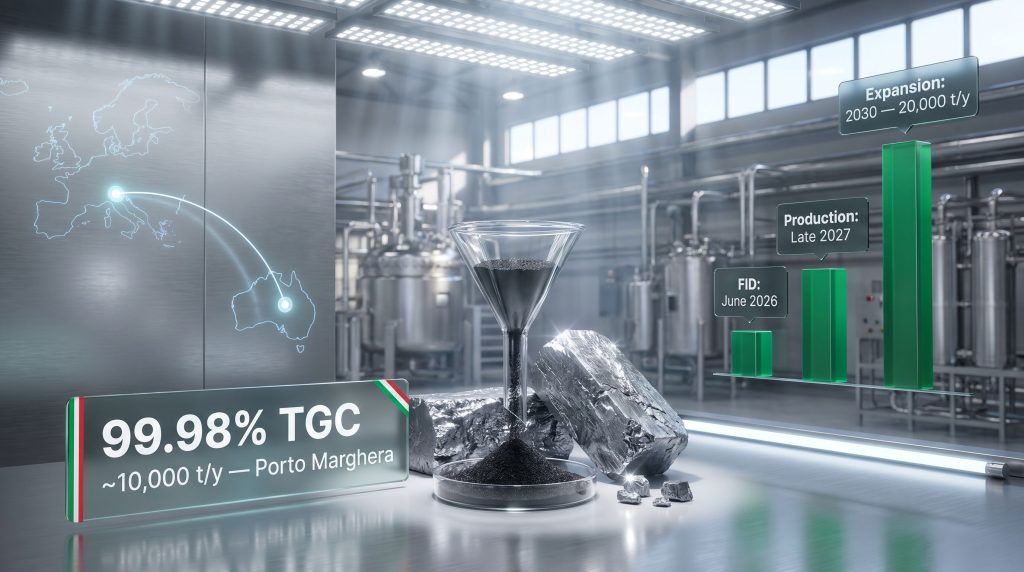
The technical results from pilot testwork validate this approach with specificity. Seven graphite concentrate samples were processed through Alkeemia's purification circuit, including material sourced from International Graphite's Springdale project in Western Australia. Every sample achieved above 99.9% total graphitic carbon (TGC), with peak results reaching 99.98% TGC. Detailed reporting on the joint venture announcement confirms the technical rigour behind these results.
Why 99.9% TGC Matters: Battery-grade graphite for lithium-ion anode qualification requires a minimum carbon purity threshold that the industry broadly places at 99.9% TGC. Below this threshold, residual impurities can interfere with electrochemical cycling performance, degrade first-cycle efficiency, and accelerate capacity fade. Results at 99.98% TGC place the Porto Marghera hub well above the minimum threshold, positioning it to serve premium-tier industrial and energy storage customers who demand the tightest specifications.
Joint Venture Architecture: How the Structure Aligns Incentives
Ownership, Contribution, and Profit Allocation
The International Graphite and Alkeemia joint venture is structured as a complementary asset-contribution model, where each party brings distinct and non-overlapping capabilities to the partnership. The proposed terms reflect a 51% equity stake for Alkeemia against 49% for International Graphite (ASX: IG6), with profits shared equally at 50/50 between the parties.
| Parameter | Alkeemia S.p.A. | International Graphite (ASX: IG6) |
|---|---|---|
| Equity Stake | 51% | 49% |
| Profit Share | 50% | 50% |
| Site and Permits | Provided | Not required |
| Workforce and Infrastructure | Provided | Not required |
| HF Reagents and Purification Technology | Provided | Not required |
| Plant and Equipment Funding | Not required | Funded |
| Graphite Feedstock and IP | Not required | Supplied |
| Construction and Operations Management | Managed | Not required |
The logic of a 50/50 profit split despite asymmetric equity ownership is deliberate. It aligns commercial incentives tightly between both parties, ensuring that neither partner benefits at the expense of the other once the facility reaches production. For International Graphite, the structure significantly reduces upfront capital requirements by avoiding the need to purchase or develop land, obtain permits, or build out chemical infrastructure. For Alkeemia, the arrangement monetises existing assets and expertise that would otherwise require substantial marketing effort to deploy commercially.
The Path From MoU to Production: Key Decision Gates
| Milestone | Target Date |
|---|---|
| Binding JV Agreements Executed | End of May 2026 |
| Final Investment Decision (FID) | June 2026 |
| Initial Production Commences | Late 2027 |
| Expansion Phase (up to 20,000 t/y) | Target 2030 |
The June 2026 Final Investment Decision is the near-term inflection point that investors and industry observers should watch most closely. A positive FID triggers construction planning, equipment procurement, and the formal commencement of the project execution phase. Delays to FID would push the late 2027 production start target, while an accelerated decision could compress the timeline if equipment lead times and construction scheduling allow.
The expansion pathway from approximately 10,000 tonnes per annum at initial production to ~20,000 tonnes per annum by 2030 represents a doubling of throughput over roughly three years. This trajectory is meaningful in the context of European graphite demand, which is expected to grow substantially as gigafactory construction and broader industrial activity continue expanding. Indeed, Europe's critical minerals supply chain is under increasing pressure to diversify away from single-source dependencies, making this expansion timeline commercially significant.
Commercial Positioning: Who Buys European Processed Graphite?
Three Distinct End Markets
High-purity graphite processed at the Porto Marghera hub would serve three primary demand categories, each with distinct specifications and commercial dynamics:
1. Battery Anode Material
Lithium-ion battery manufacturers require graphite that meets or exceeds the 99.9% TGC threshold. The European gigafactory pipeline represents substantial forward demand for qualified anode material, and procurement teams at major cell manufacturers are actively seeking non-Chinese-origin sources to reduce concentration risk and meet emerging supply chain transparency requirements.
2. Expandable Graphite
Expandable graphite is produced through the intercalation of graphite with acidic compounds, typically using sulphuric acid or similar reagents, causing the material to dramatically increase in volume when exposed to heat. This property makes it invaluable in fire retardant systems, flexible graphite foils for sealing applications, and thermal management components. Expandable graphite is a distinct product category from battery anode material, often commanding premium pricing for specific industrial grades and offering diversified revenue streams that reduce dependence on battery sector demand cycles.
3. Micronised Graphite
Micronised graphite, produced through controlled milling to precise particle size distributions, serves lubricant formulations, specialty coatings, polymer composites, and refractory materials. The particle size consistency and purity level achieved in micronisation are critical quality parameters for these applications.
A Speculative But Credible Scenario: As EU battery regulation supply chain transparency requirements tighten through 2027 and 2028, Western-origin processed graphite may shift from an optional premium to a compliance necessity for European battery manufacturers. If traceability and origin requirements become enforceable at the procurement level, facilities like Porto Marghera would transition from competing on price alone to competing on origin qualification, fundamentally reshaping demand dynamics for non-Chinese processed graphite. This remains a speculative outcome dependent on regulatory enforcement timelines, but directionally it aligns with the trajectory of EU industrial policy.
The European Distribution Question
International Graphite has disclosed that it is in advanced discussions for a European sales and distribution partner. Securing this relationship before production commences is a critical de-risking step. A qualified distribution partner with established customer relationships across European industrial and battery sectors can compress the time to first commercial revenue, reduce the marketing burden on International Graphite's management team, and provide market validation that strengthens the commercial case for the hub's full expansion phase.
The Dual-Hub Strategy: Australia and Europe Together
Collie, Western Australia: Australia's First Commercial Micronised Graphite Plant
While the International Graphite Alkeemia graphite processing hub in Europe captures significant strategic attention, the Collie micronising facility in Western Australia represents the company's near-term production anchor. As Australia's first planned commercial-scale micronised graphite facility, Collie holds considerable symbolic and practical importance.
Progress through the March 2026 quarter was tangible across multiple workstreams:
- Facility designs completed in full
- Building permit applications progressed with the local shire authority
- Micronising equipment formally ordered
- Vendor testwork for jet milling equipment selection underway
- Qualification plant continuing to supply product samples for customer testing and validation
The initial production target of 4,000 tonnes per annum from Collie, with a defined expansion pathway to approximately 7,500 tonnes per annum, positions the facility as a meaningful contributor to Asia-Pacific market demand while Porto Marghera serves European customers. This geographic separation of processing capacity is not coincidental. It reflects a deliberate strategy to serve distinct regional demand pools rather than concentrating all processing risk in a single location.
Springdale: Long-Term Feedstock Optionality
The Springdale Graphite Project in Western Australia holds a significant resource position, described as one of Australia's largest graphite deposits by resource scale. Its role within the International Graphite portfolio has been deliberately repositioned. Rather than driving the capital allocation cycle as the primary development focus, Springdale now functions as long-term feedstock optionality for both the Collie and Porto Marghera processing facilities.
Exploration and hydrological drilling at Springdale has been deferred to allow management bandwidth and capital to concentrate on Collie and Porto Marghera. This is a strategically coherent prioritisation. Processing infrastructure that lacks feedstock is commercially useless, but processing infrastructure with demonstrable market access and customer qualification progress is far more valuable than a deposit without a processing outlet. The testwork confirmation that Springdale concentrate achieves above 99.9% TGC through Alkeemia's purification circuit means feedstock compatibility has already been technically validated, reducing the risk associated with eventually integrating mine production into the processing chain.
Processing-First Versus Mining-First: A Framework Comparison
| Strategic Approach | Processing-First (IG6 Model) | Mining-First (Conventional) |
|---|---|---|
| Capital Priority | Downstream processing hubs | Upstream resource development |
| Time to Revenue | Accelerated via JV and tolling | Extended mine development cycle |
| Supply Chain Risk | Initially feedstock-dependent | Integrated but capital-intensive |
| Market Entry Timing | Aligned with demand growth phase | Risk of lagging demand cycle |
| Strategic Flexibility | High; multiple feedstock sources | Lower; tied to single deposit |
The processing-first approach carries its own risks, primarily around securing reliable feedstock during initial years of operation before owned mine production can supplement third-party supply. However, in the current critical minerals market environment, where downstream demand is building faster than new mine supply can qualify into customer supply chains, the processing-first model offers a faster path to revenue and market credibility. In addition, critical minerals energy security concerns are accelerating the appetite for exactly this kind of Western-aligned processing investment.
The next major ASX story will hit our subscribers first
Key Project Metrics at a Glance
| Metric | Detail |
|---|---|
| Porto Marghera Initial Capacity | ~10,000 tonnes per annum |
| Expansion Target (2030) | ~20,000 tonnes per annum |
| Purification Purity Achieved | Above 99.9% TGC (peak: 99.98% TGC) |
| Concentrate Samples Tested | 7 (including Springdale material) |
| JV Ownership Split | 51% Alkeemia / 49% IG6 |
| Profit Share | 50/50 |
| FID Target | June 2026 |
| Production Start Target | Late 2027 |
| Collie Facility Initial Capacity | 4,000 tpa |
| Collie Expansion Pathway | ~7,500 tpa |
| IG6 Cash Position (Quarter End) | A$1.1 million |
The Collaboration Timeline: From Initial Agreement to Joint Venture
December 2025: A Low-Risk Entry Point
The partnership's foundations were laid in December 2025 with a Letter of Intent that allocated International Graphite up to 50% of Alkeemia's 200 tonne per year startup plant capacity on a tolling basis. This arrangement served as a low-cost mechanism for validating processing economics and establishing a working relationship between the two companies before committing to the larger joint venture structure.
February 2026: Technical Validation Through Testwork
The February 2026 completion of pilot purification testwork converted commercial intent into technical evidence. Seven concentrate samples processed through Alkeemia's HF purification circuit, all achieving above 99.9% TGC, provided the independent technical credibility needed to underpin downstream customer discussions and justify the investment case for a full-scale facility. For industrial customers evaluating a new graphite supplier, independently verifiable purity results are an essential prerequisite before any commercial engagement can progress.
March 2026: MoU Execution and Binding Timeline Commitment
The March 2026 MoU signing marked the transition from exploratory collaboration to structured joint venture planning. With binding JV documentation targeted for completion by end of May 2026 and FID scheduled for June 2026, the partnership entered a defined execution phase with specific deliverable deadlines rather than open-ended development timelines. Consequently, battery recycling expansion activity across Europe is further reinforcing downstream demand signals that support the commercial case for the Porto Marghera hub. Furthermore, broader critical mineral processing partnerships are reshaping how Western companies approach value chain integration, providing useful context for the IG6-Alkeemia model.
Frequently Asked Questions
What is the International Graphite Alkeemia graphite processing hub in Europe?
The International Graphite Alkeemia graphite processing hub in Europe is a proposed joint venture facility to be established at Alkeemia S.p.A.'s existing chemical industrial site at Porto Marghera, near Venice, Italy. The hub targets initial production of approximately 10,000 tonnes per annum of processed graphite products including battery-grade, expandable, and micronised graphite from late 2027, with an expansion pathway to approximately 20,000 tonnes per annum by 2030. International Graphite (ASX: IG6) holds a 49% equity stake and 50% profit share in the venture.
Why was Porto Marghera selected for the graphite processing facility?
Porto Marghera was selected primarily because Alkeemia S.p.A. already operates a permitted chemical industrial complex at the site with integrated hydrofluoric acid production capability, an existing qualified workforce, and established reagent supply chains. These attributes allow the joint venture to bypass the multi-year permitting and infrastructure development timelines that greenfield chemical processing facilities typically face in Europe. The site also benefits from strategic logistics connectivity and port access for European distribution.
What purity levels has the Alkeemia purification process achieved?
Alkeemia's HF-based purification process has achieved above 99.9% total graphitic carbon (TGC) across all seven concentrate samples tested, including material from International Graphite's Springdale project. Peak results reached 99.98% TGC, exceeding the minimum purity threshold required for battery-grade graphite qualification by most major lithium-ion cell manufacturers.
What is expandable graphite and why does it matter for the Porto Marghera hub?
Expandable graphite is produced by intercalating graphite crystals with acidic compounds, creating a material that expands dramatically in volume when exposed to heat. Key commercial applications include fire retardant building materials, flexible graphite foils for industrial sealing, thermal insulation components, and specialty industrial materials. For the Porto Marghera hub, expandable graphite production capability represents a distinct revenue stream separate from battery anode material, potentially offering higher margins for specific premium grades and reducing the hub's dependence on battery sector demand cycles alone. Process development and cost estimation studies for expandable graphite were due for completion by June 2026.
How does Collie complement the Porto Marghera processing hub?
The Collie micronising facility in Western Australia and the Porto Marghera hub in Italy function as geographically complementary processing nodes targeting distinct regional markets. Collie, planned as Australia's first commercial-scale micronised graphite plant with initial capacity of 4,000 tonnes per annum and expansion to approximately 7,500 tonnes per annum, is positioned to serve Asia-Pacific industrial demand. Porto Marghera is positioned to serve European battery and industrial graphite demand. Together, they form the operational backbone of International Graphite's mine-to-market strategy, with the Springdale deposit providing long-term feedstock optionality for both facilities.
Near-Term Catalysts: What to Watch in the Second Half of 2026
The next six months represent the most consequential period in International Graphite's development trajectory to date. Several specific outcomes will define the pace and scale of progress:
Binding JV Documentation (End of May 2026): The formal agreement will define the precise capital contribution schedules, governance arrangements, technology access terms, and operational management protocols. The detail within these agreements will signal how well-aligned the two parties are on the commercial and operational parameters that matter most.
Final Investment Decision (June 2026): A positive FID triggers construction planning and equipment procurement for Porto Marghera, converting the joint venture from a planning exercise into an active construction project. Any delay to FID would have cascading implications for the late 2027 production start target.
Expandable Graphite Studies Completion (June 2026): The cost estimation and process development outputs for expandable graphite production will determine whether this product category is incorporated into the initial Porto Marghera scope or pursued in a subsequent phase. A positive economic result would materially strengthen the business case for the hub.
European Distribution Partner Announcement: Securing a qualified distribution partner with established European industrial and battery sector customer relationships is a critical commercial de-risking step. An announcement in this area would validate the hub's market access strategy and provide a clearer pathway to first revenue post-production commencement.
Collie Construction Readiness Progression: Equipment delivery timelines, installation scheduling, and outcomes from ongoing customer qualification trials will determine how closely the Collie facility tracks its planned production start and what level of committed commercial interest has been developed ahead of first output. Further detail on quarterly progress is available via Proactive Investors, where International Graphite has outlined its Australia-Europe processing strategy in detail.
Processing Sovereignty as an Industrial Endgame
The International Graphite Alkeemia graphite processing hub in Europe is best understood not as an isolated corporate announcement but as one deliberate contribution to a broader structural shift in how Western nations approach critical mineral supply chain architecture. The question Western industry and policymakers are now grappling with is not whether processing sovereignty matters, but how quickly it can be practically achieved.
Building competitive processing capacity outside existing dominant supply chains requires exactly the kind of asset-efficient, infrastructure-leveraging approach that the Porto Marghera joint venture embodies. It also requires patient capital, technical credibility, and the willingness to pursue a processing-first strategy at a time when graphite market conditions remain complex and mine-to-market timelines are long.
What the collaboration timeline from December 2025 through to the March 2026 MoU demonstrates is that technical validation and commercial structure can move quickly when the right industrial partners and asset bases are aligned. Whether the June 2026 FID and late 2027 production targets are met will depend on execution discipline across both the Italian and Australian operational fronts. The foundation, at least, has been built on testable evidence rather than aspiration alone.
For ongoing coverage of International Graphite's corporate developments and strategic updates, readers can explore reporting available via Proactive Investors Australia at proactiveinvestors.com.au.
Want to Track the Next Major ASX Mineral Discovery as It Happens?
Discovery Alert's proprietary Discovery IQ model delivers real-time alerts on significant ASX mineral discoveries across graphite, battery materials, and more than 30 other commodities, instantly translating complex geological data into actionable investment insights. Explore Discovery Alert's dedicated discoveries page to understand how historic mineral discoveries have generated substantial market returns, and begin your 14-day free trial to position yourself ahead of the broader market.