May 21, 2026
Understanding Modern Graphite Processing Partnerships
The global transition toward sustainable energy has fundamentally reshaped mineral supply chain dynamics, particularly within battery metals sectors where processing capabilities determine market access. Advanced economies are increasingly prioritising supply chain resilience through strategic partnerships that combine resource endowments with technological expertise, creating new paradigms for mineral processing collaboration.
Technology transfer agreements represent sophisticated frameworks for distributing processing capabilities across geographic boundaries while maintaining quality standards and operational efficiency. These arrangements have become particularly relevant in graphite markets, where purification requirements for battery applications demand specialised technological capabilities that extend beyond traditional mining operations.
When big ASX news breaks, our subscribers know first
What Are Technology Transfer Agreements in the Graphite Industry?
Defining Modern Graphite Purification Partnerships
Technology transfer agreements in the graphite sector encompass various collaborative models designed to bridge the gap between raw material extraction and high-specification end products. These partnerships typically involve the sharing of proprietary processing technologies, operational expertise, and market access networks between companies with complementary capabilities.
The global graphite market, valued at approximately USD 13.9 billion in 2023, is projected to expand at a compound annual growth rate of 6.2% through 2030, driven primarily by battery manufacturing demand. This growth trajectory has intensified focus on processing partnerships as companies seek to capture value across the supply chain without assuming full capital exposure.
Tolling service arrangements represent one primary mechanism for technology transfer, where raw material owners deliver unprocessed ore or concentrate to processing facilities operated by third parties. The processing facility applies its proprietary technology to upgrade the material while charging a per-tonne fee, allowing material owners to retain custody and quality control while accessing advanced purification capabilities.
Furthermore, International Graphite signs Alkeemia LOI arrangements represent a significant development in this space. Non-binding letters of intent serve as preliminary frameworks for establishing mutual interest before formal agreements. In the graphite sector, these documents typically outline processing volumes, quality targets, duration parameters, and fee structures.
Strategic Importance of Graphite Purification Technology
Battery-grade graphite typically requires carbon content exceeding 99.95% for lithium-ion battery applications, while natural graphite mining produces material at approximately 60-90% carbon content before processing. This purification gap necessitates sophisticated thermal and chemical processing technologies that few companies possess independently.
Demand for battery-grade graphite is expected to reach approximately 1.4 million tonnes annually by 2030, up from approximately 200,000-250,000 tonnes in 2024, representing a compound annual growth rate of approximately 25-30%. This demand trajectory has created significant value for companies controlling advanced purification technologies.
Supply chain security considerations have become increasingly prominent following geopolitical tensions and supply disruptions observed during 2021-2022. In addition, Western governments are actively promoting alternative processing routes outside traditional suppliers as risk mitigation strategies, creating opportunities for technology transfer partnerships between resource-rich jurisdictions and processing-capable regions.
Why Are Australian Companies Seeking European Processing Partners?
Geopolitical Drivers in Critical Minerals Supply Chains
China controls approximately 70% of global graphite purification capacity and approximately 60% of synthetic graphite production capacity globally, creating concentration risks that Western governments are actively addressing through policy initiatives and investment programs.
The European Union designated graphite as a critical raw material under the Critical Raw Materials Act (2024), with targets to source 25% of refined critical materials from within the EU by 2030. This regulatory framework has stimulated investment in European processing infrastructure while creating preferential market access for companies establishing EU critical raw materials supply chains.
The U.S. Department of Energy allocated USD 3.1 billion in Bipartisan Infrastructure Law funding specifically to critical minerals supply chain development, excluding China-dependent processing. Similar initiatives across allied nations have created a coordinated approach to supply chain diversification that favours technology transfer partnerships with European processing capabilities.
However, Australia released its Critical Minerals Strategy in October 2023, identifying graphite as a priority mineral with government support for downstream processing development to increase value retention domestically. This strategic alignment has created frameworks for international partnerships that combine Australian resource endowments with European processing expertise.
Technical Advantages of Italian Purification Technology
Europe has announced approximately EUR 1.2 billion in public and private investment in graphite purification and processing infrastructure across 2024-2028, reflecting the region's commitment to establishing advanced processing capabilities.
European graphite processing facilities increasingly utilise advanced thermal and chemical purification methods with lower environmental footprints compared to historical processing standards. These facilities typically adhere to:
- Water discharge standards under the Water Framework Directive (2000/60/EC)
- Hazardous waste management per the Basel Convention
- Carbon intensity reporting under EU Taxonomy Regulation
Italy has historically been a centre for advanced mineral processing due to established chemical and refining industries, providing technological foundations that can be adapted for graphite purification applications. Consequently, the country's proximity to automotive manufacturing centres also creates logistical advantages for battery-grade graphite supply chains.
Quality control systems in European facilities typically incorporate real-time monitoring technologies and automated quality assurance protocols that ensure consistent product specifications across production runs. These capabilities are particularly valuable for battery manufacturers requiring precise material specifications.
How Do Tolling Arrangements Support Vertical Integration Strategies?
Understanding Tolling Services in Mineral Processing
| Service Type | Capital Requirements | Control Level | Revenue Recognition | Typical Duration |
|---|---|---|---|---|
| Tolling Services | Low (0-10% of processing facility cost) | Limited operational control; quality spec control retained | Per-tonne processing fee | 3-7 years |
| Technology Licensing | Moderate (20-40% of facility cost) | Direct operational control; licensing compliance | Upfront fees + royalties/milestone payments | 10-20 years |
| Joint Venture | High (shared facility investment) | Shared governance; proportional operational control | Revenue sharing based on ownership % | Long-term (15-25+ years) |
| Full Vertical Integration | Very High (100% facility cost) | Complete operational control; full integration | Gross margin on entire value chain | Indefinite |
Tolling arrangements typically reduce upfront capital requirements by 60-80% compared to building dedicated processing facilities, based on industry benchmarks for mineral processing infrastructure. This capital efficiency enables emerging producers to generate revenue while preserving financial resources for core mining operations and future expansion.
Capital Efficiency Benefits for Emerging Producers
Establishing a new graphite purification facility with 10,000-15,000 tonnes annual capacity typically requires capital expenditure of USD 50-120 million, depending on technology and environmental controls. Tolling arrangements eliminate this capital requirement while providing immediate access to processing capabilities.
Companies utilising tolling arrangements typically achieve commercial-scale graphite supply 18-24 months faster than building proprietary processing facilities, which require 36-48 months from planning to commissioning. This time advantage allows companies to capture market opportunities and generate cash flow during critical development phases.
Approximately 35-45% of emerging critical minerals producers are adopting hybrid vertical integration models combining tolling with planned future ownership of processing infrastructure. For instance, this staged approach allows companies to prove commercial viability and processing volumes before committing to capital-intensive facility ownership.
Industry tolling arrangements typically operate under service contracts ranging from 3-7 years, with renewal options based on performance metrics and market conditions. These durations provide sufficient time for technology transfer and market development while maintaining flexibility for evolving business strategies.
What Role Does Western Australia Play in Global Graphite Supply?
Regional Advantages for Graphite Development
Western Australia hosts significant graphite resources, with the International Graphite Moolyella deposit containing a JORC 2012 Mineral Resource of approximately 107 million tonnes at 5.9% total graphite content, representing one of the largest known deposits globally by resource size.
Western Australia's graphite production capacity is projected to reach approximately 150,000-200,000 tonnes annually by 2027-2028 from current minimal commercial production levels, assuming current project development timelines materialise. If these projects reach full capacity, Australia could capture approximately 10-15% of projected 2030 battery-grade graphite demand.
WA graphite deposits occur primarily in metamorphic host rocks within the Yilgarn Craton, characterised by high-grade, crystalline graphite amenable to conventional gravity and flotation processing methods. Natural flake graphite from WA deposits typically grades 5-8% total graphite content, requiring moderate purification to achieve battery-grade specifications.
Integration with Downstream Processing Facilities
Western Australia is positioned approximately 2,000-4,000 km from major Asian battery manufacturing hubs in South Korea, China, and Japan, providing significant shipping cost advantages compared to African or North American graphite suppliers with approximately 40-50% shorter shipping distances.
The state has established port infrastructure, skilled mining workforce, and regulatory frameworks already supporting approximately 250+ operating mines and processing facilities, providing operational ecosystem advantages for new graphite developments. Moreover, Australian green metals leadership initiatives have created additional support for downstream processing capabilities.
International Graphite signs Alkeemia LOI represents this strategic integration model, as the company has received Development Approval for its proposed downstream graphite processing facility in Collie, Western Australia, while simultaneously pursuing technology transfer agreements with European partners. This dual strategy enables immediate processing capability while building toward full vertical integration.
Transportation cost optimisation becomes significant when processing plants are located near mining operations, as bulk mineral movements can represent substantial portions of total production costs. WA's integrated mining infrastructure supports this optimisation through established logistics networks.
How Do These Partnerships Impact Investment Considerations?
Risk Mitigation Through Strategic Alliances
Key Investment Insight: Technology transfer agreements can significantly reduce technical and commercial risks for emerging graphite producers by providing access to proven processing methods and established market relationships.
Strategic partnerships enable companies to diversify operational risks across multiple jurisdictions while accessing specialised capabilities without full capital exposure. This risk distribution is particularly valuable in emerging sectors where technology validation and market development occur simultaneously.
Regulatory compliance becomes simplified when companies partner with established processors operating under proven environmental and quality frameworks. European processing partners typically maintain certifications and compliance systems that facilitate market access across multiple jurisdictions. The focus on critical minerals energy security has made these partnerships increasingly attractive to investors.
Market Positioning and Competitive Advantages
Access to premium pricing for battery-grade materials represents a key value driver for technology transfer partnerships. Companies achieving consistent quality specifications through proven processing technologies can command premium pricing compared to standard graphite products.
Long-term supply contract opportunities with battery manufacturers become accessible when companies can demonstrate reliable processing capabilities and quality consistency. These relationships often require multi-year commitments that favour producers with established processing partnerships.
Differentiation through product quality and consistency becomes increasingly important as battery manufacturers implement stricter material specifications. However, technology transfer partnerships provide access to proven quality control systems and processing optimisation capabilities.
The next major ASX story will hit our subscribers first
What Are the Technical Requirements for Battery-Grade Graphite?
Purity Standards and Specifications
Battery-grade graphite applications demand carbon content typically exceeding 99.95% with strict limitations on chemical impurities that can affect battery performance. Key specifications include:
- Moisture content typically below 0.5%
- Ash content typically below 0.05%
- Sulphur content typically below 0.05%
- Iron content typically below 300 ppm
Particle size distribution parameters are critical for battery applications, with most specifications requiring D50 values between 15-25 micrometers and narrow distribution curves to ensure consistent electrochemical performance.
Surface area measurements, typically ranging from 3-8 m²/g, directly impact battery capacity and charging characteristics, requiring precise control during processing operations.
Processing Technology Considerations
Thermal purification involves heating graphite to temperatures exceeding 2,500°C in controlled atmospheres to remove impurities through volatilisation. This method achieves high purity levels but requires significant energy inputs and specialised equipment.
Chemical purification utilises acid leaching and alkaline treatments to remove specific impurities while preserving graphite structure. This approach offers lower energy requirements but generates chemical waste requiring specialised treatment.
Environmental impact assessment becomes critical when selecting processing technologies, as different methods generate varying waste streams and energy requirements. European facilities increasingly favour integrated approaches combining multiple purification methods to optimise environmental performance.
Energy efficiency metrics for large-scale operations typically range from 8-15 MWh per tonne of battery-grade graphite produced, depending on processing technology and environmental controls. These energy requirements represent significant portions of total production costs.
How Do These Agreements Fit Into Broader Industry Trends?
Global Shift Toward Supply Chain Localisation
Government incentives for domestic processing capabilities include tax credits, subsidies, and streamlined permitting processes across multiple jurisdictions. These incentives often favour technology transfer partnerships that combine international expertise with local resource development.
Strategic stockpiling initiatives in Western economies have created additional demand for diversified graphite supply chains. Government procurement programmes increasingly specify supply chain requirements that favour non-concentrated processing capabilities. Events like the WA mining conference 2025 highlight these evolving strategic priorities.
Investment in alternative supply chain routes has accelerated following supply disruptions observed during 2021-2022. Private and public sector funding for processing infrastructure has increased substantially, creating opportunities for technology transfer partnerships.
Technology Innovation in Graphite Processing
Emerging purification technologies focus on reducing energy consumption while maintaining quality standards. Innovation areas include microwave-assisted purification, plasma processing, and hybrid thermal-chemical methods.
Automation and digitalisation in mineral processing enable real-time quality control and process optimisation. These technological advances are typically accessible through partnerships with established processing facilities rather than independent development. Furthermore, mining industry innovation trends continue driving these advancements.
Sustainability considerations in processing operations increasingly influence technology selection and partnership decisions. Life cycle assessments and carbon footprint evaluations are becoming standard requirements for market access.
What Should Investors Monitor in This Sector?
Key Performance Indicators for Graphite Companies
| Metric | Significance | Industry Benchmark |
|---|---|---|
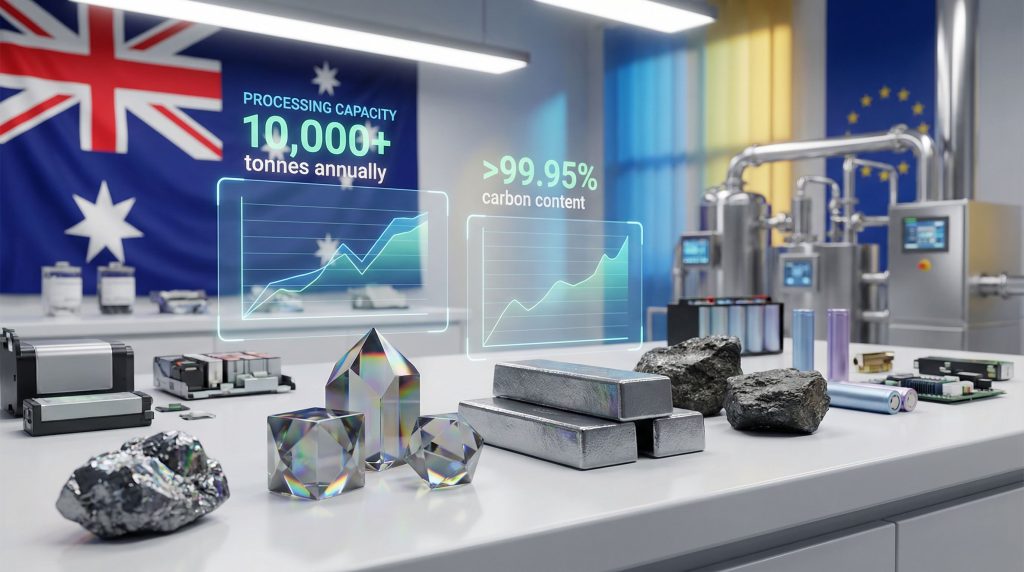
| Processing capacity | Scale of operations | 10,000+ tonnes annually |
| Product purity levels | Market access capability | >99.95% carbon content |
| Customer diversification | Revenue stability | 3+ major customers |
| Technology partnerships | Competitive positioning | Established processing agreements |
Processing facility utilisation rates indicate operational efficiency and market demand conditions. Companies maintaining high utilisation rates typically demonstrate strong market positions and effective technology deployment.
Contract duration and renewal rates for tolling agreements provide insights into partnership stability and technology effectiveness. Longer contract terms and high renewal rates suggest successful technology transfer implementation.
Regulatory and Market Risk Factors
Changes in government critical minerals policies can significantly impact project economics and market access. Investors should monitor policy developments across key jurisdictions including Australia, Europe, and North America.
Fluctuations in battery market demand directly affect graphite pricing and processing economics. Electric vehicle adoption rates, energy storage deployments, and consumer electronics demand influence graphite market dynamics.
Environmental compliance requirements continue evolving across jurisdictions, potentially affecting processing costs and technology selection. Companies with established European partnerships may benefit from proven compliance frameworks.
Currency exposure in international partnerships creates additional risk considerations. Processing fees, technology licensing payments, and revenue recognition may involve multiple currencies requiring hedging strategies.
Strategic Implications for Market Participants
Long-term Value Creation Through Partnership Models
Building sustainable competitive advantages through technology access requires careful partner selection and contract structuring. Successful partnerships typically combine complementary capabilities while preserving strategic flexibility for future development.
Positioning for growth in the expanding battery materials market involves balancing immediate processing needs with long-term integration strategies. Companies achieving optimal positioning typically utilise tolling arrangements as stepping stones to broader vertical integration.
Creating optionality for future vertical integration opportunities enables companies to adapt strategies based on market evolution and capital availability. Successful partnerships often include buyout mechanisms and technology transfer provisions that preserve strategic flexibility.
Investment Thesis Considerations
Evaluation criteria for technology partnership announcements should focus on partner capabilities, contract terms, processing capacity, and market positioning. Investors should assess both immediate processing access and long-term strategic implications.
Timeline expectations for commercial production milestones typically range from 18-36 months for tolling arrangements compared to 48-72 months for integrated facility development. These timelines influence investment returns and risk profiles significantly.
Risk-adjusted return profiles vary considerably across different development strategies. Tolling arrangements typically offer lower risk and faster returns but potentially limit long-term value capture compared to full vertical integration models.
Consequently, companies announcing arrangements where International Graphite signs Alkeemia LOI demonstrate strategic positioning for both immediate market access and future vertical integration opportunities. These partnerships enable risk-adjusted exposure to the growing battery materials sector while preserving financial flexibility for future expansion.
Monitoring industry developments becomes essential for understanding competitive positioning and market opportunities. Technology transfer partnerships represent significant strategic developments that can materially impact company valuations and market positions.
Disclaimer: This analysis contains forward-looking statements and projections based on current market conditions and industry trends. Actual results may vary significantly from projections due to market volatility, regulatory changes, technological developments, and other factors. Investors should conduct independent research and consult qualified advisors before making investment decisions. No recommendation is provided regarding specific securities or investment strategies.
Seeking Opportunities in Battery Minerals Supply Chains?
Discovery Alert's proprietary Discovery IQ model delivers real-time notifications on significant ASX mineral discoveries, instantly empowering subscribers to identify actionable opportunities ahead of the broader market. Understand why historic discoveries can generate substantial returns by exploring Discovery Alert's dedicated discoveries page, showcasing exceptional examples, and begin your 30-day free trial today to position yourself ahead of evolving supply chain dynamics.