June 11, 2026
Why Europe's Graphite Problem Is Much Harder to Solve Than Most Investors Realise
Battery metals conversations in Europe rarely open with graphite. Lithium captures the headlines, cobalt draws the ethical scrutiny, and nickel commands the trading floor attention. Yet graphite is quietly the single largest material input by weight in a standard lithium-ion battery cell, and its supply chain is arguably the most geographically concentrated of any critical battery material. The global graphite shortage creates a structural vulnerability for industrial economies like Germany that no amount of recycling policy or synthetic substitution can fully resolve in the near term.
Understanding why Germany's engagement with the NextSource Molo Graphite Mine Germany critical mineral security agenda has attracted serious institutional attention requires stepping back from the project itself and examining the policy architecture that has made natural graphite a genuine sovereign priority across the European Union.
When big ASX news breaks, our subscribers know first
The EU's Binding Graphite Targets and What They Actually Mean
Natural graphite's inclusion on the European Union's Critical Raw Materials List is not a symbolic classification. The EU Critical Raw Materials Act (CRMA), which entered into force in 2024, established legally binding benchmarks requiring that by 2030, at least 10% of the EU's annual consumption of listed materials be sourced from domestic extraction, at least 40% processed domestically, and at least 25% recovered from recycled sources.
For graphite, these targets present an exceptionally steep challenge. Unlike lithium, where new projects in Portugal, Spain, and the Czech Republic offer some genuine domestic extraction potential, Europe has very limited natural graphite geology. Furthermore, the processing dimension is equally difficult: the overwhelming majority of global graphite processing capacity currently sits within a single dominant geography, creating a chokepoint that cannot be regulated away by Brussels alone.
What makes graphite's position uniquely exposed within the CRMA framework is a combination of factors that few outside the battery supply chain community fully appreciate:
- Natural graphite accounts for roughly 50–55% of all anode material used globally in lithium-ion batteries, with the balance made up by synthetic graphite derived from petroleum coke
- The flake size and purity characteristics of natural graphite deposits vary enormously, and not all deposits are suitable for battery-grade applications without sophisticated processing
- Spherical purified graphite, the form used in battery anodes, requires a high-purity feedstock and a complex multi-stage processing workflow that has historically been dominated by Chinese facilities
- Synthetic graphite can substitute for natural graphite in some battery chemistries, but it carries a significantly larger carbon footprint and typically costs more to produce, creating both sustainability and economic constraints for European manufacturers under tightening EU Battery Regulation requirements
Europe's critical minerals supply chain therefore faces compounding pressures that make diversification not merely desirable, but legally mandated.
Germany's Industrial Exposure and the Manufacturing Dependency Beneath the Surface
Germany's economy is structurally more exposed to critical mineral supply shocks than most of its EU peers. Manufacturing contributes approximately 22% of German GDP, a share considerably higher than the EU average, and the automotive sector sits at the core of that industrial base. With Germany's major automakers committed to large-scale electric vehicle production transitions, the downstream demand for battery-grade graphite is set to compound significantly over the coming decade.
"A supply disruption scenario for natural graphite would not be confined to battery production lines. It would cascade through German automotive assembly, industrial output, and export revenue in ways that dwarf the commodity's relatively modest market profile."
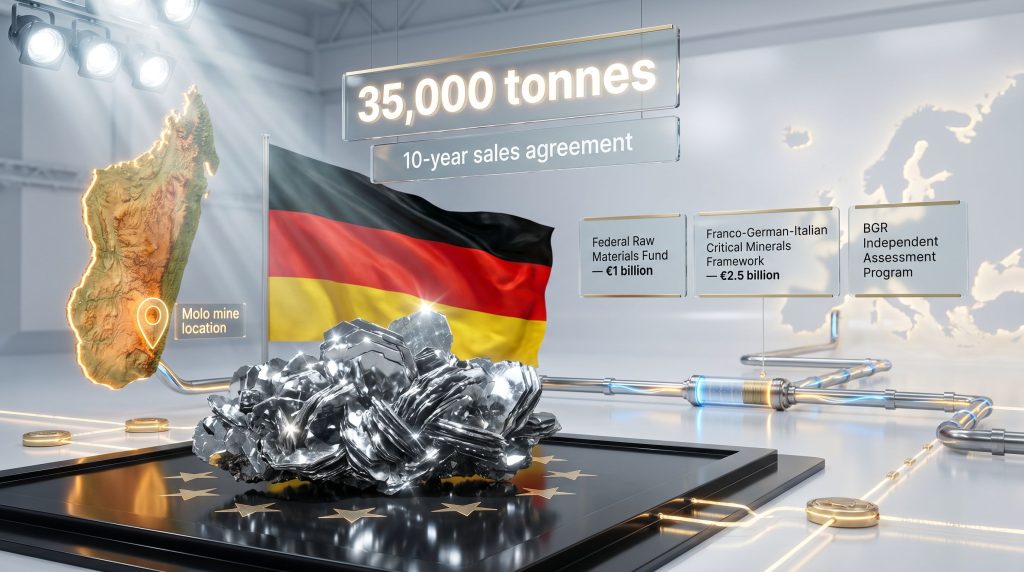
This asymmetry between graphite's low public profile and its high strategic leverage is precisely why Germany's federal government has assembled a multi-tier investment architecture to pursue supply diversification. The framework currently includes:
| Funding Mechanism | Capital Scale | Instrument Type |
|---|---|---|
| Federal Raw Materials Fund | €1 billion | Minority equity stakes up to €150M per project |
| Franco-German-Italian Critical Minerals Framework | €2.5 billion | Multilateral supply chain investment vehicle |
| BGR Assessment Program | Ongoing | Independent geoscientific evaluation informing federal decisions |
The European raw materials strategy underpinning these mechanisms reflects a deliberate shift from reactive procurement toward proactive supply chain architecture.
What the BGR Does and Why a Site Visit to Molo Is Not a Routine Exercise
Understanding the BGR's Role
The Bundesanstalt für Geowissenschaften und Rohstoffe, universally known as the BGR, functions as Germany's independent federal geoscience authority. It is not a commercial entity and does not make investment decisions. What it does is provide rigorous geoscientific evaluation that feeds directly into Germany's sovereign supply chain planning and federal investment policy.
A BGR site assessment funded through the Federal Ministry for Economic Cooperation and Development (BMZ) carries specific policy weight for a straightforward reason: it places a project formally within Germany's critical minerals intelligence architecture. The findings from such a study are reported back to the German government and inform decisions about where federal capital from mechanisms like the Raw Materials Fund is ultimately directed.
Madagascar's Strategic Position
The BGR's recent visit to the Molo graphite mine in southern Madagascar was conducted as part of a broader independent study examining Madagascar's graphite production sector, with Molo evaluated alongside other conventional operations in the country. The fact that Molo was identified as a benchmark asset within that assessment framework is analytically significant. It means the project was not merely included as a comparison point, but positioned as a reference case against which other operations were measured.
Madagascar has consequently emerged as a strategic graphite supplier for Germany and the EU battery industry, with the country's Ministry of Mines serving as a co-facilitator of the BGR study. This signals bilateral engagement between the German and Malagasy governments on the minerals cooperation dimension, and while not constituting formal investment commitment, it creates a diplomatic scaffolding that can support more structured arrangements over time.
Molo's Technical Profile: Why SuperFlake Matters in a Battery-Grade World
Not all graphite is created equal, and this is a point that even reasonably informed investors tend to underestimate. The critical distinction in natural graphite is between large flake, high-purity graphite and smaller, lower-purity material that requires significantly more chemical processing to reach battery-grade specification.
The Molo deposit in southern Madagascar is notable within the global graphite landscape for several intersecting reasons:
- The deposit is characterised by coarse, large-flake graphite, which is the most commercially valuable natural graphite morphology and the most suitable feedstock for battery anode applications
- NextSource produces what it terms SuperFlake graphite concentrate, a product specification that emphasises the outsized flake fractions that command premium pricing in battery and industrial markets
- Large-flake graphite from Molo is well suited to downstream processing into spherical purified graphite for battery anodes, with the flake size enabling more efficient processing yields compared to fine-flake feedstocks
- The deposit's scale places it among the world's larger known natural graphite resources, providing the resource base necessary to underpin meaningful long-duration offtake commitments
Molo's phased production structure is, furthermore, directly relevant to Germany's supply security calculus:
| Production Phase | Annual Output Capacity | Strategic Relevance |
|---|---|---|
| Phase 1 | ~7,300 tonnes minimum contracted | Establishes commercial supply baseline |
| Phase 2 | Up to ~35,000 tonnes | Capable of contributing meaningfully to EU diversification targets |
The step-change between Phase 1 and Phase 2 output is not trivial. At 35,000 tonnes annually, Molo's potential Phase 2 production would represent a material contribution to Europe's non-Chinese natural graphite supply, particularly as the EU Battery Regulation begins imposing stricter supply chain traceability requirements on battery manufacturers selling into the European market. These dynamics are closely tracked within the broader battery raw materials market as European procurement strategies evolve.
The Thyssenkrupp Offtake: What It Tells German Policymakers Before They Even Visit
Commercial Validation from Germany's Industrial Core
One dimension of Molo's strategic position that fundamentally alters how German government evaluators approach the asset is the 10-year sales agreement signed in May 2021 between NextSource Materials and Thyssenkrupp Materials Trading GmbH. Thyssenkrupp AG is not a peripheral industrial player. It is a cornerstone of Germany's industrial establishment, and its materials trading division has a sophisticated procurement function with deep expertise in evaluating upstream resource quality.
The agreement guarantees a minimum of 7,300 tonnes per year of SuperFlake graphite concentrate from Molo's Phase 1 operations, with volumes potentially rising to 35,000 tonnes annually at Phase 2 scale.
"For a German government body conducting supply chain due diligence, the pre-existence of a long-duration Thyssenkrupp offtake transforms the risk profile of the assessment. The question is no longer whether the project can attract commercial validation from German industry. That question has already been answered."
This distinction matters enormously in the context of critical minerals investment. Federal capital from Germany's Raw Materials Fund is designed to flow toward projects that meet qualifying criteria, not to take speculative positions in unproven assets. However, a project that already holds contractual ties to a flagship German industrial group enters that evaluation process from a structurally stronger position. The graphite supply challenges experienced elsewhere further reinforce why established, commercially validated projects like Molo are attracting disproportionate sovereign interest.
The next major ASX story will hit our subscribers first
The UAE Processing Node: Closing the Supply Chain Loop
Why Processing Location Determines Supply Chain Value
A crucial and sometimes overlooked dimension of NextSource's broader strategy is its development of a battery anode processing facility in Abu Dhabi. This downstream capability addresses what is arguably the most critical vulnerability in any mine-to-battery supply chain: the processing stage.
European battery manufacturers face a specific problem under the EU Battery Regulation's incoming supply chain due diligence and carbon footprint disclosure requirements. Sourcing natural graphite from a geographically diversified mine is valuable, but if that material is then routed through Chinese processing facilities before reaching Europe, much of the supply chain risk reduction is negated.
Processing graphite in the UAE through a dedicated facility creates a fully traceable, non-Chinese-processed anode material supply pathway that aligns with the regulatory trajectory European manufacturers must navigate. The UAE's stable political environment, established trade relationships with both European and Asian markets, and business-friendly industrial policy make it a logistically credible node for this function.
Key Decision Points and the Road Ahead
The pathway from a BGR site assessment to formal German government engagement in NextSource Molo Graphite Mine Germany critical mineral security involves several distinct milestones:
- BGR study completion and reporting to the German federal government, establishing Molo's geoscientific credentials within the official record
- Federal Raw Materials Fund eligibility review, assessing whether Molo meets qualifying thresholds for minority equity investment up to €150 million
- Bilateral investment treaty framework assessment, examining the German-Madagascar diplomatic and trade relationship as a vehicle for enabling structured government investment
- EU Battery Regulation compliance pathway alignment, verifying that Molo's supply chain documentation meets incoming traceability requirements
- Phase 2 financing decision, the capital threshold that unlocks the expanded production capacity most relevant to meaningful EU supply contributions
It is important to note that a BGR assessment does not guarantee any specific investment outcome, and investors should not interpret technical evaluation activity as a commitment of German government capital to the project. The study findings represent one input among several that inform federal decision-making.
This article is for informational purposes only and does not constitute financial or investment advice. Readers should conduct their own independent research and seek professional advice before making any investment decisions. Forward-looking statements and scenario analyses involve inherent uncertainty and actual outcomes may differ materially from those described.
FAQ: Germany, Critical Minerals, and the Molo Assessment
What is the EU Critical Raw Materials Act and why does it matter for graphite?
The CRMA establishes binding targets for domestic sourcing, processing, and recycling of strategic materials by 2030. For graphite, achieving these targets requires active diversification of supply chains currently concentrated in a small number of geographies.
Why is Germany particularly exposed to graphite supply risk?
Germany's large manufacturing base, centred heavily on automotive production, creates compounding downstream demand for battery-grade graphite as the sector transitions toward electric vehicle output. This makes supply disruption risk disproportionately consequential for the German economy.
What does the BGR do and why does its assessment matter?
The BGR is Germany's independent federal geosciences authority. Its evaluations of international mining projects inform federal investment decisions and supply chain policy, giving a site assessment meaningful policy weight beyond its technical content.
What is SuperFlake graphite and why is it relevant to battery manufacturers?
SuperFlake refers to large-flake, high-purity natural graphite concentrate. Large flake size is the most valuable natural graphite morphology for battery anode applications because it enables more efficient downstream processing into spherical purified graphite, the form used in lithium-ion battery cells.
What is the significance of the Thyssenkrupp offtake agreement?
The ten-year agreement with Thyssenkrupp Materials Trading GmbH provides commercial validation from within Germany's industrial establishment that Molo's product meets the specifications required by sophisticated end users, reducing the due diligence burden for any subsequent government-level evaluation. Consequently, this positions the NextSource Molo Graphite Mine Germany critical mineral security framework as one of the more structurally advanced supply diversification opportunities currently under federal review.
Want to Track the Next Major Mineral Discovery Before the Broader Market Does?
Discovery Alert's proprietary Discovery IQ model delivers real-time alerts on significant ASX mineral discoveries — turning complex resource data into actionable investment insights for traders and long-term investors alike. Explore historic discoveries and the extraordinary returns they've generated, then begin your 14-day free trial at Discovery Alert to position yourself ahead of the market.