August 26, 2026
The Supply Crisis Hiding in Plain Sight: Why Grade Is Everything in Modern Copper Development
Copper exploration has entered a paradox. The world needs more of it than ever, yet the average grade of newly discovered copper deposits has been falling for decades. According to S&P Global Market Intelligence data, the average copper grade of major discoveries has declined from above 1.5% in the 1990s to closer to 0.5% today. Against this backdrop, a project sitting above 2.4% copper equivalent is not just attractive, it is increasingly rare. This geological reality is reshaping where institutional capital flows and which development-stage assets command serious attention.
The FireFly Metals Green Bay copper project funding story must be understood through this lens first. The numbers being raised are large, the timelines are ambitious, and the asset itself sits in a jurisdiction that has quietly become one of the more credible addresses in Atlantic Canadian mining.
When big ASX news breaks, our subscribers know first
What Green Bay Is and Why the Geology Commands Attention
The Green Bay copper-gold project is located in Newfoundland, Canada, within a geological setting that has produced economically significant base metal deposits historically. The project sits within the Notre Dame Bay region, an area with well-documented volcanic-hosted massive sulphide mineralisation. Furthermore, VHMS ore deposits are a deposit type known for producing high-grade, compact ore bodies that lend themselves to selective underground mining methods.
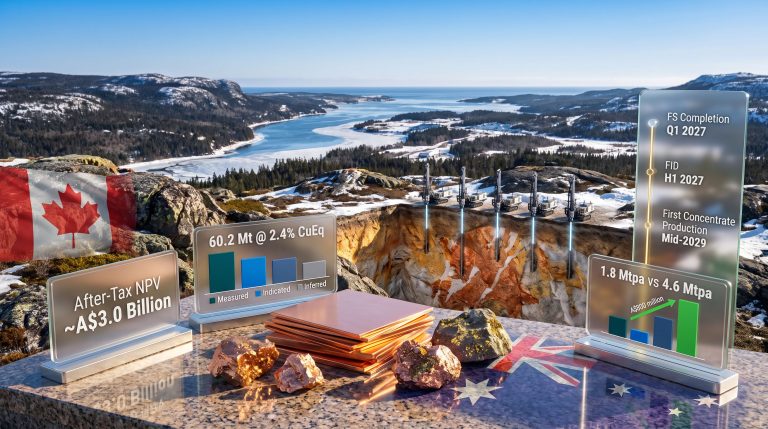
What distinguishes Green Bay from many development-stage copper projects is the combination of grade, scale, and metallurgical characteristics. The total mineral resource stands at 83.7 million tonnes, with the following breakdown:
| Resource Category | Tonnes (Mt) | Grade (% CuEq) | Contained CuEq (kt) |
|---|---|---|---|
| Measured and Indicated | 60.2 | 2.43% | 1,460 |
| Inferred | 23.5 | 2.51% | 592 |
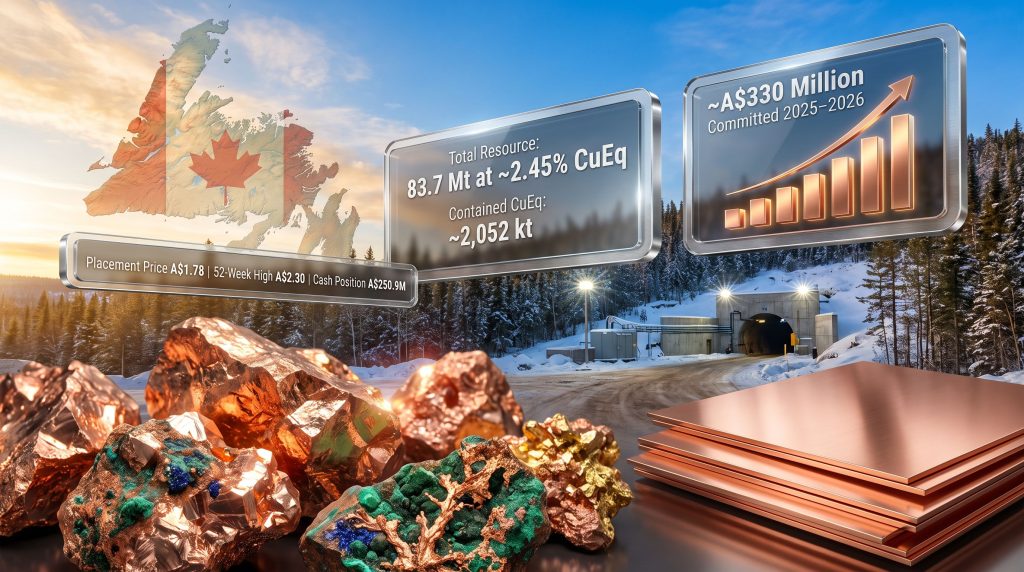
| Total Resource | 83.7 | ~2.45% | ~2,052 |
A grade of 2.43% copper equivalent for the measured and indicated component is particularly significant. Most large-scale copper mines operating globally today work with head grades of 0.4% to 0.7%. High-grade underground operations routinely target 1.5% to 2.5%, but assembling more than 60 million tonnes at this grade threshold is genuinely unusual.
The ore body also carries a polymetallic profile, incorporating gold credits that contribute meaningfully to the copper equivalent calculation and provide a degree of revenue diversification embedded in the mineralogy itself.
Does Grade Alone Justify the Capital Commitment?
VHMS deposits of this kind tend to be geologically predictable along strike and at depth, which creates a compelling exploration upside narrative alongside the core development story. The inferred resource grade of 2.51% CuEq actually exceeds the measured and indicated grade, suggesting that deeper or peripheral portions of the system may carry higher concentrations. This characteristic supports continued drilling ahead of a final investment decision, and understanding cut-off grade economics becomes particularly relevant when evaluating where boundaries are drawn within a deposit of this complexity.
A Chronological Look at Capital Raised for the Green Bay Project
The FireFly Metals Green Bay copper project funding programme has been built in deliberate stages, with each raise structured to fund a defined set of workstreams rather than simply accumulate cash.
| Raise | Period | Amount (A$) | Primary Purpose |
|---|---|---|---|
| Institutional Placement + Flow-Through | June 2025 | A$135 million | Underground development, drilling, studies |
| Share Purchase Plan | Mid-2025 | Up to A$5 million | Retail investor participation |
| Institutional Placement + Bought Deal | 2026 | A$180 million | Early works, long-lead procurement, feasibility |
| Share Purchase Plan (2026) | 2026 | Up to A$10 million | Broader shareholder access |
| Cumulative Capital Deployed / Committed | 2025-2026 | ~A$330 million | Full development acceleration |
The most recent raise targets A$190 million in total, comprising an A$180 million Australian institutional placement of 101.1 million ordinary shares at A$1.78 per share, plus a Canadian bought deal of approximately C$29.6 million at C$1.76 per share involving roughly 16.8 million new shares. A non-underwritten share purchase plan will seek up to an additional A$10 million at the same A$1.78 offer price.
Understanding the Bought Deal Mechanism
A bought deal is a financing structure where an investment bank commits to purchasing the full share allotment at a fixed price before those shares are redistributed to institutional investors. This means the issuing company faces no execution risk once the deal is struck; the capital is contractually secured regardless of subsequent market movements. For development-stage resource companies, this structure provides certainty at a critical juncture when capital timing directly affects project momentum.
A bought deal eliminates the gap between capital commitment and capital receipt, giving development teams the operational confidence to proceed with procurement and contractor engagement before funds actually clear. This distinction matters enormously when ordering long-lead equipment with six-to-eighteen-month delivery windows.
The Listed Issuer Financing Exemption and Its Role in Canadian Capital Access
The Canadian portion of the raise is being conducted under the Listed Issuer Financing Exemption (LIFE), a regulatory framework available across Canadian provinces excluding Quebec. LIFE allows listed companies to raise capital from retail investors in Canada without the full prospectus requirements that would otherwise apply, streamlining the process while maintaining disclosure standards. For a dual-listed company operating across both the ASX and TSX, this mechanism provides access to a broader investor base across two capital markets simultaneously, widening the potential demand pool for each raise.
What the A$190 Million Package Is Actually Buying
The allocation of capital across four parallel workstreams reflects a deliberate compression of the traditional sequential development model.
1. Early Project Works and Site Preparation
Physical groundwork at Green Bay, including site clearing, access infrastructure, and initial underground development activity, begins the transition from a paper project to an operational footprint. Early works commitments also signal seriousness to regulators, contractors, and offtake counterparties.
2. Long-Lead Capital Item Procurement
This is one of the least understood but most commercially important components of any large mining development programme. Processing equipment, hoisting systems, paste fill plants, and ventilation infrastructure often carry manufacturer lead times of 12 to 24 months. Ordering these items early, before feasibility studies are finalised, carries some technical risk but can shorten the overall construction timeline by a similar margin. For a project targeting a mid-2027 final investment decision (FID), compressing the post-FID construction timeline is as strategically valuable as the FID itself.
3. Feasibility Study for the 1.8 Mtpa Base Case
The base case scenario targets a throughput rate of 1.8 million tonnes per annum, which already has conditional environmental approval from the Province of Newfoundland. A definitive feasibility study at this scale provides the technical foundation required to secure project financing, whether through debt facilities, streaming agreements, or offtake-linked prepayments.
4. Pre-Feasibility Study for the 4.6 Mtpa Alternative Scenario
Running a pre-feasibility study on the larger 4.6 Mtpa scenario simultaneously maintains optionality. If copper prices remain elevated and capital markets remain receptive, the upscaled scenario could dramatically increase net present value at the cost of higher initial capital intensity.
| Development Scenario | Throughput (Mtpa) | Study Stage | Strategic Purpose |
|---|---|---|---|
| Base Case | 1.8 | Feasibility Study | Lower capex, faster to production |
| Upscaled Alternative | 4.6 | Pre-Feasibility Study | Maximises long-term extraction value |
Running exploration, feasibility studies, and early procurement simultaneously rather than sequentially is a capital-intensive but time-efficient strategy that can compress the overall development timeline by 12 to 24 months. For a project targeting a final investment decision by mid-2027, this parallel-track approach is not a luxury; it is a necessity.
What the Preliminary Economic Assessment Revealed
The PEA, released ahead of the current capital raise, demonstrated that Green Bay carries the technical and economic characteristics of a high-grade, low-cost, long-life operation. The pathway to 100,000 tonnes of copper production annually is one of the more meaningful production targets attached to a pre-feasibility asset in the Canadian copper space.
To contextualise that figure: Canada currently produces approximately 480,000 to 520,000 tonnes of refined copper per year across all operations. A single project targeting 100,000 tonnes per annum would represent a meaningful increment to national output, particularly as older operations in Ontario and British Columbia continue to deplete their reserves.
The low-cost descriptor in PEA language typically refers to cash costs or all-in sustaining costs per pound of copper produced. High-grade underground mines with polymetallic by-product credits can achieve cost structures that position them in the lowest quartile globally, even with the higher per-tonne underground mining costs relative to open-pit operations. Green Bay's gold content functions as a cost offset, with gold revenues effectively subsidising the copper production cost in the by-product accounting framework most commonly used in feasibility economics.
Permitting Progress: Where Green Bay Stands
The regulatory pathway for Green Bay is further advanced than many peers at a comparable development stage. Consequently, the project has accumulated a meaningful set of approvals:
- Environmental approval secured for the processing plant
- Conditional release from further detailed environmental and socio-economic assessment received from the Province of Newfoundland for the 1.8 Mtpa restart scenario
- Construction permitting process commenced
- Metallurgical test programme completed with strong recovery outcomes
- Feasibility study (1.8 Mtpa) in progress
- Pre-feasibility study (4.6 Mtpa) in progress
- Final investment decision targeted for mid-2027
The metallurgical test results deserve particular attention. Strong recoveries in copper-gold systems are not guaranteed. VHMS deposits can carry mineralogical complexity, including fine-grained sulphides and penalty elements, that creates processing challenges. Confirmatory metallurgical test work at this stage significantly reduces a key category of technical risk ahead of the feasibility study and eventual project financing discussions.
The next major ASX story will hit our subscribers first
Share Price Context and the Placement Discount
| Metric | Value |
|---|---|
| Placement Price (2026) | A$1.78 / C$1.76 per share |
| Market Price at Time of Raise | A$1.87 |
| 52-Week High | A$2.30 |
| 52-Week Low | A$1.04 |
| Implied Discount to Last Trade | ~4.8% |
A placement discount of approximately 4.8% to the prevailing market price is relatively tight by resource sector standards, where discounts of 8% to 15% are common for development-stage companies. A narrow discount signals strong institutional demand, suggesting bookrunners were confident of full placement without needing to offer a steeper incentive.
The 52-week trading range from A$1.04 to A$2.30 reflects the volatility inherent in pre-production copper stories but also illustrates that shares at the placement price remain well above the cycle low, indicating the market has meaningfully re-rated the asset since the resource update and PEA release.
Balance Sheet Position After Successive Raises
| Item | Value |
|---|---|
| Cash and Liquid Investments (Dec 2025) | A$250.9 million |
| 2026 Raise (Placement + SPP) | Up to A$190 million |
| Estimated Combined Liquidity (Post-Raise) | ~A$440 million+ |
A post-raise liquidity position approaching A$440 million is substantial for a development-stage company and provides a multi-year operational runway without an immediate requirement to return to equity markets. This matters because successive dilutive raises are one of the primary concerns institutional investors attach to pre-production miners. A well-capitalised balance sheet reduces this overhang, potentially supporting valuation re-rating as project milestones are achieved.
Key Risks Investors Should Weigh Before the Final Investment Decision
The following section involves forward-looking considerations and is not financial advice. Investors should conduct their own due diligence and consult qualified advisors.
- Development-stage gap: A PEA is a conceptual study with wider cost and schedule tolerances than a bankable feasibility study. Capex estimates can shift materially between PEA and feasibility stage.
- Copper price sensitivity: Project economics are inherently tied to copper price assumptions. A sustained price decline would affect both the economic case and the availability of debt financing.
- Permitting execution risk: While key provincial approvals are in place, federal environmental assessment requirements and construction permitting processes carry timeline uncertainty.
- Dilution risk: Cumulative share issuance across multiple raises has a compounding effect on per-share value for existing shareholders. The A$330 million raised across 2025 and 2026 represents significant dilution relative to earlier capitalisation levels.
- Timeline risk: The mid-2027 FID target depends on feasibility studies completing on schedule, equipment delivery meeting planned timelines, and no material regulatory delays emerging.
Frequently Asked Questions About FireFly Metals and the Green Bay Copper Project
What is the Green Bay copper-gold project?
Green Bay is a copper-gold development asset located in Newfoundland, Canada, being advanced by FireFly Metals (ASX/TSX: FFM). It hosts a total mineral resource of 83.7 million tonnes at approximately 2.45% copper equivalent, including a preliminary economic assessment outlining a pathway to 100,000 tonnes of annual copper production.
How much money has FireFly Metals raised in total for Green Bay?
Across the 2025 and 2026 capital raising rounds, FireFly Metals has raised or committed to raise approximately A$330 million in cumulative equity, comprising two institutional placements, two share purchase plans, and a Canadian bought deal.
What is the production target for the Green Bay project?
The PEA outlines a pathway to producing 100,000 tonnes of copper per annum, which would make Green Bay one of the more significant copper operations in Canada if constructed at that scale.
What is the difference between the 1.8 Mtpa and 4.6 Mtpa development scenarios?
The 1.8 Mtpa base case prioritises lower capital intensity and faster production timelines, with a feasibility study currently underway. The 4.6 Mtpa alternative targets maximum resource extraction and long-term production scale, with a pre-feasibility study running in parallel.
When is the final investment decision expected for Green Bay?
FireFly Metals has indicated a target of mid-2027 for the final investment decision.
Is FireFly Metals listed on both the ASX and TSX?
Yes. FireFly Metals holds a dual listing on the Australian Securities Exchange (ASX) and the Toronto Stock Exchange (TSX), enabling the company to access institutional and retail capital pools in both Australia and Canada.
What is a Listed Issuer Financing Exemption (LIFE) in Canada?
LIFE is a regulatory framework that allows companies already listed on a recognised Canadian exchange to raise capital from investors across most Canadian provinces without filing a full prospectus, streamlining the retail participation component of a capital raise.
What environmental approvals has the Green Bay project already received?
The project has received environmental approval for the processing plant and a conditional release from further detailed environmental and socio-economic assessment from the Province of Newfoundland, specifically for the 1.8 Mtpa initial restart configuration.
The Broader Investment Thesis: Green Bay as a Benchmark Canadian Copper Development Asset
Within the universe of advanced copper development projects in Atlantic Canada, Green Bay stands apart primarily on grade. Most comparable assets in the region operate or are being planned at grades well below 1.5% copper equivalent, making the 2.43% measured and indicated grade a genuine differentiator rather than a marginal improvement.
The institutional appetite for high-grade copper in stable jurisdictions has intensified as supply chains for the metal face structural pressure. The ongoing copper supply crunch, combined with declining ore grades at existing mines, permitting timelines stretching to a decade or more in many jurisdictions, and accelerating copper demand from electrification and infrastructure investment, has created a premium for projects that are high-grade, advanced in permitting, and located in geopolitically reliable territories. Newfoundland's established mining regulatory framework, clear provincial permitting pathways, and existing infrastructure connections position it favourably within this context.
The mid-2027 FID, if achieved on schedule, would represent a valuation inflection point for the project. Development-stage mining companies typically experience their most significant re-ratings when a project transitions from study-phase to committed construction, as the risk profile contracts sharply at that moment. Whether the market has already priced in this expectation, or whether a successful FID would still drive meaningful upside, depends heavily on copper price trajectory and the final capital cost estimates that emerge from the feasibility study. Furthermore, Mining Weekly's coverage of the A$135 million raise underscores the broader industry recognition that FireFly Metals Green Bay copper project funding has attracted across specialist financial media.
This article is prepared for general informational purposes only and does not constitute financial or investment advice. Readers should conduct independent due diligence and seek professional guidance before making investment decisions. Forward-looking statements involve risks and uncertainties, and actual outcomes may differ materially from those projected.
Readers seeking broader context on copper project development economics and Canadian mining capital markets may find value in additional editorial coverage available through Resource World Magazine at resourceworld.com.
Want to Capitalise on High-Grade Copper Discoveries Before the Broader Market?
Discovery Alert's proprietary Discovery IQ model delivers real-time alerts the moment significant ASX mineral discoveries are announced, transforming complex geological and commodity data into actionable investment insights for both short-term traders and long-term investors — explore Discovery Alert's dedicated discoveries page to see how historic high-grade finds have generated exceptional returns, and begin your 14-day free trial today to position yourself ahead of the market.