August 25, 2026
Underground Copper Mining at Scale: Why Equipment Strategy Defines Operational Success
In the world of large-scale underground mining, the machinery that moves ore from the rock face to the surface is not simply a capital expenditure line item. It is the central nervous system of the entire operation. At depths where ventilation, heat, humidity, and geological complexity converge, the reliability of a haul truck or load-haul-dump unit can mean the difference between hitting quarterly production targets and falling short by thousands of tonnes of copper. Equipment selection at high-throughput operations is therefore a deeply strategic act, one that extends far beyond the specifications listed in a procurement brochure.
This context is essential for understanding why Kamoa Copper orders more Sandvik trucks for DRC project work has become a recurring headline, and why the latest 19-unit fleet expansion carries significance well beyond its surface-level procurement narrative. Furthermore, underground copper mining technology continues to evolve rapidly, making equipment decisions even more consequential for long-term operational success.
When big ASX news breaks, our subscribers know first
Inside the Kamoa-Kakula Copper Complex
One of Africa's Most Consequential Copper Assets
Located in the Lualaba Province of the Democratic Republic of the Congo, the Kamoa-Kakula Copper Complex has rapidly established itself as one of the highest-grade large-scale copper deposits anywhere on earth. The complex hosts resources of extraordinary scale, with copper grades that consistently outperform global averages for the largest copper mines worldwide. The orebody's thickness, continuity, and grade profile have made it a benchmark asset in conversations about where future copper supply will originate.
The Kamoa-Kakula joint venture is structured across three primary partners:
- Ivanhoe Mines (TSX: IVN) holds a 39.6% interest and serves as the project's technical operator.
- Zijin Mining Group (SHA: 601899), a partially state-owned Chinese mining company headquartered in Fujian Province, also holds 39.6%.
- The DRC government, through its state mining company, retains a 20% carried interest in the project.
This joint venture structure combines Ivanhoe's underground mining expertise with Zijin's capital strength and the DRC government's sovereign participation, creating a partnership dynamic that influences procurement decisions, operational philosophy, and long-term production planning.
Why Equipment Selection Is a Strategic Decision at This Scale
Underground mining at Kamoa-Kakula is conducted using a room-and-pillar method, adapted to take advantage of the orebody's relatively flat-lying, tabular geometry. This configuration allows for high extraction ratios but demands equipment that can operate reliably in confined, high-humidity underground environments over extended shift cycles.
At production rates measured in millions of tonnes of ore per year, even a small percentage reduction in fleet availability translates directly into lost revenue. A 2% drop in truck availability across a fleet of 100+ units can represent tens of thousands of lost tonne-kilometres of haulage per month. This arithmetic is why mine operators at this scale do not change equipment suppliers casually.
What the New Sandvik Order Includes
Fleet Composition and Autonomous Capability
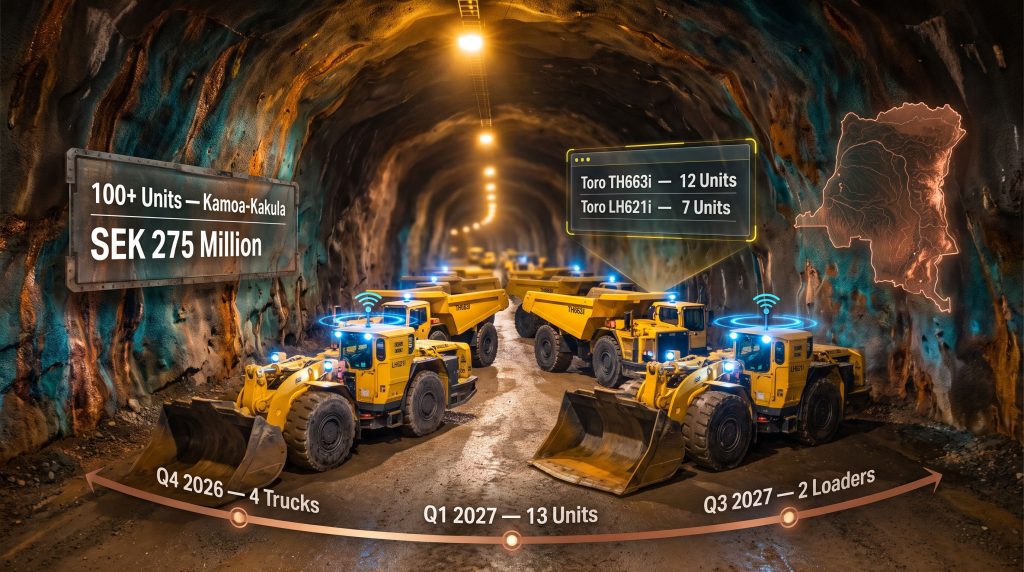
The latest procurement by Kamoa Copper from Sandvik (STO: SAND), booked in Q3 2026, adds 19 units to an already substantial existing fleet. The breakdown of the order is as follows:
| Equipment Type | Model | Units Ordered | Autonomous Capability |
|---|---|---|---|
| Underground Haul Trucks | Toro TH663i | 12 | Standard |
| Underground Loaders (LHDs) | Toro LH621i | 7 | 2 units fitted with AutoMine |
| Total Units | 19 |
The Toro TH663i is a 63-tonne payload underground haul truck engineered for high-cycle haulage in large underground mines. Its intelligent onboard systems manage load, speed, tyre pressure, and engine diagnostics in real time, feeding data to surface operators and maintenance teams. The Toro LH621i is a 21-tonne load-haul-dump unit designed for high-capacity ore loading at the draw points.
What Sandvik's AutoMine System Actually Does
Two of the seven LH621i loaders in this order will be equipped with Sandvik's AutoMine system, and this detail deserves specific attention. AutoMine is not simply a remote-control capability. It is a fully integrated autonomous operating platform that enables loaders to conduct repetitive tramming cycles between the draw point and a loading station without a human operator in the cab.
The system uses a combination of laser scanning, inertial navigation, and pre-mapped underground route data to navigate confined headings autonomously. Critically, it is designed to operate continuously across multiple shifts, including during shift changes when manually operated equipment sits idle. In underground mining, shift-change downtime is one of the most persistent and underappreciated drains on productive hours, and autonomous systems directly attack this inefficiency.
AutoMine-enabled loaders can continue operating during shift handovers, blasting re-entry periods, and other intervals when human operators would conventionally be absent from the face area. This continuous operation capability can meaningfully improve effective utilisation rates without increasing labour inputs.
The introduction of AutoMine-equipped units at Kamoa-Kakula, even if initially limited to two loaders, signals an operational appetite for expanded automation as the technology proves itself in the specific geological and infrastructure context of the DRC complex.
Delivery Timeline and Financial Scale
Phased Equipment Delivery Through 2027
The procurement is structured across three delivery phases, which aligns with how underground mines manage equipment integration. Introducing large numbers of new units simultaneously creates maintenance scheduling conflicts and operator training bottlenecks. Phased delivery allows the mine to absorb new equipment progressively.
| Delivery Phase | Units | Timing |
|---|---|---|
| Phase 1 | 4 trucks | Q4 2026 |
| Phase 2 | 13 units (trucks + loaders) | Q1 2027 |
| Phase 3 | 2 loaders (AutoMine-equipped) | Q3 2027 |
The SEK 275 Million Order Value
Sandvik confirmed the order was booked at a value of approximately SEK 275 million in its Q3 2026 financial reporting. While Kamoa Copper did not publish detailed financial terms, the Sandvik disclosure provides a clear reference point. At prevailing exchange rates, this figure places the per-unit cost in a range consistent with heavy underground equipment pricing at this specification level, reinforcing the materiality of the DRC as a revenue contributor within Sandvik's Mining and Rock Solutions division.
For context, Sandvik's Mining and Rock Solutions segment is the company's largest revenue generator, and major single-site orders of this scale contribute meaningfully to order intake reporting in quarterly results.
Sandvik's Growing Footprint at Kamoa-Kakula
From First Deployment to 100+ Units
Sandvik's operational presence at the Kamoa-Kakula complex dates to 2019, coinciding with the project's early underground development phase. Over the seven years since initial deployment, the relationship has deepened from a supplier arrangement into something closer to an embedded operational partnership.
With this latest order confirmed, Sandvik's combined fleet of trucks, loaders, and drills operating at the complex will exceed 100 units, a threshold that represents a significant concentration of equipment from a single original equipment manufacturer at one underground site in sub-Saharan Africa.
This scale of single-OEM penetration is relatively uncommon in African underground mining, where operations frequently run mixed fleets from multiple suppliers to maintain competitive tension in parts pricing and to hedge against supply chain disruptions from any one manufacturer.
The Strategic Value of a Dedicated On-Site Expert
One of the less-discussed but commercially important elements of Sandvik's arrangement at Kamoa-Kakula is the presence of a dedicated on-site technical expert. In remote underground mining environments, particularly in jurisdictions like the DRC where specialist technical personnel are difficult to mobilise quickly, embedded OEM support significantly reduces mean time to repair for complex mechanical or software-related failures.
This on-site presence effectively converts reactive maintenance events into proactively managed interventions, reducing unplanned downtime. For a mine running over 100 units across multiple underground panels, this translates into measurable fleet availability improvements that compound over time.
Repeat Procurement as a Performance Signal
Kamoa Copper's managing director has publicly attributed the continued investment in Sandvik equipment to years of demonstrated operational performance at the site. Specifically, the consistency with which the Toro fleet has delivered required availability rates, productivity benchmarks, and reliability metrics across the harsh underground environment of Kamoa-Kakula has been identified as the primary driver of the repeat procurement decision.
This is an important signal for industry observers. In underground mining, availability refers to the percentage of scheduled operating time during which equipment is mechanically fit for use. Productivity measures actual tonnes moved per operating hour. Reliability captures the consistency of that output over time. All three metrics must be sustained simultaneously, and doing so in the high-humidity, high-dust, and thermally challenging environment of a deep Central African copper mine is operationally demanding.
Competitive Dynamics and OEM Loyalty in Underground Mining
Why Mines Consolidate Around Single OEM Suppliers
The question of whether to maintain a single-OEM underground fleet or diversify across multiple equipment suppliers is one that mine planners debate actively. The arguments for diversification centre on price competition, supply security, and avoiding over-dependence. However, the arguments for consolidation are rooted in operational pragmatics:
- Parts inventory simplification – A single OEM fleet reduces the number of line items in the underground parts store, lowering working capital tied up in consumables and reducing the risk of stockouts for critical components.
- Operator and technician training efficiency – Training programmes covering one equipment family are more cost-effective and produce higher competency levels than cross-training across multiple platforms.
- Telemetry and data integration – Modern intelligent underground fleets generate enormous volumes of operational data. Single-platform fleets allow this data to feed into unified management systems rather than requiring integration across incompatible architectures.
- OEM accountability – When a single supplier is responsible for the entire production fleet, the accountability relationship is cleaner and response obligations are more clearly defined in service agreements.
In remote jurisdictions with constrained logistics infrastructure, parts availability and OEM responsiveness are frequently more decisive in procurement outcomes than unit purchase price. A cheaper truck that takes three weeks longer to repair ultimately costs more in lost production.
The Toro Product Line in High-Tonnage Underground Copper Contexts
The Toro product family occupies the upper end of Sandvik's underground fleet offering, designed specifically for high-volume production environments where continuous multi-shift operation is required. The TH663i's 63-tonne payload class positions it as one of the larger underground haul trucks available from any OEM, suited to the wide-entry, high-production drift profiles that characterise the Kamoa-Kakula room-and-pillar workings.
The LH621i's 21-tonne bucket capacity similarly targets high-cycle loading applications at large draw points, where cycle time reduction at the loading face directly multiplies through the entire haulage chain.
The next major ASX story will hit our subscribers first
Kamoa-Kakula's Position in the Global Copper Supply Landscape
Production Ambition and Equipment Expansion as Correlated Signals
Kamoa-Kakula has outlined multi-phase expansion targets that are expected to place it among the top three copper mines globally by annual output when fully ramped. The connection between fleet expansion and production ambition is direct: additional haulage and loading capacity at the underground level is a prerequisite for lifting ore throughput to surface processing facilities.
The addition of 12 haul trucks and seven loaders, even phased across 12 months, materially increases the underground haulage fleet's theoretical capacity. Combined with ongoing phase expansions of the processing plant, these equipment investments are consistent with an operation building toward significantly higher throughput rates. Consequently, understanding broader copper investment strategies becomes increasingly relevant for those tracking Kamoa-Kakula's trajectory.
The Copper Supply Context
Global copper demand trajectories remain structurally elevated across forecasting periods, driven by electrification, grid infrastructure build-out, and industrial transition needs. The copper supply crunch facing global markets further amplifies the strategic importance of high-grade producing assets like Kamoa-Kakula. The DRC's Copper Belt contains some of the highest-grade undeveloped and producing copper resources remaining in the world.
For equipment manufacturers with established footholds in this region, the long-term revenue opportunity is substantial. Sandvik's investment in local technical expertise and embedded site support at Kamoa-Kakula should be understood partly as a market-positioning strategy for the African critical minerals equipment market, not merely as after-sales service delivery.
Frequently Asked Questions
How many Sandvik units are now operating at the Kamoa-Kakula complex?
With the addition of this 19-unit order, Sandvik's combined fleet of trucks, loaders, and drills at the Kamoa-Kakula complex will surpass 100 units in total.
What is the Sandvik AutoMine system used for in underground mining?
AutoMine is an autonomous operating platform that enables underground loaders to conduct tramming cycles without a human operator in the cab, using laser scanning and pre-mapped navigation to move ore between the draw point and loading station continuously across shift cycles.
Who owns the Kamoa-Kakula Copper Complex?
The complex is a joint venture between Ivanhoe Mines and Zijin Mining Group, each holding approximately 39.6%, with the DRC government retaining a 20% carried interest through its state mining entity. Arrangements like these reflect broader trends in mining joint ventures that have become increasingly common across the sector.
When will the new Sandvik equipment be delivered to the DRC?
Delivery is structured in three phases: four trucks in Q4 2026, thirteen units in Q1 2027, and two AutoMine-equipped loaders in Q3 2027.
Why do major mines prefer repeat procurement from the same OEM supplier?
Consolidating around a single OEM simplifies parts inventory, training programmes, telemetry integration, and OEM accountability structures, particularly valuable in remote jurisdictions where logistics complexity amplifies the cost of downtime.
What is the value of the latest Sandvik equipment order placed by Kamoa Copper?
Sandvik reported the order was booked at approximately SEK 275 million in Q3 2026, as disclosed in the company's quarterly financial results.
Key Takeaways for Industry Observers
Equipment Investment as an Operational Confidence Indicator
Large-scale underground fleet procurement decisions require multi-year financial commitment and logistical planning. When a major copper producer commits to expanding its equipment fleet at this level, it signals internal confidence in the mine's production trajectory and financial viability. This type of capital allocation is not made in an environment of operational uncertainty.
Automation Adoption at Scale
The inclusion of AutoMine-equipped loaders in this order, even as a small proportion of total units, marks a meaningful step toward autonomous fleet operation at one of Africa's largest underground copper mines. As familiarity with the technology builds and performance data accumulates in the Kamoa-Kakula environment, the proportion of autonomous-capable units in future orders may expand considerably.
Sandvik's African Revenue Pipeline
With a fleet now exceeding 100 units at a single site, and phased deliveries extending well into 2027, Sandvik has secured a durable revenue stream from the DRC through equipment sales, parts supply, and embedded technical services. For investors tracking Sandvik's Mining and Rock Solutions segment performance, the Kamoa-Kakula relationship represents a strategically anchored position in one of the world's most important emerging copper provinces.
Disclaimer: This article is intended for informational purposes only and does not constitute financial advice. Statements relating to future production targets, equipment delivery timelines, and market projections involve forward-looking elements that carry inherent uncertainty. Readers should conduct independent research before making any investment decisions.
Want to Capitalise on the Next Major Copper Discovery Before the Market Moves?
Discovery Alert's proprietary Discovery IQ model delivers real-time alerts on significant ASX copper and mineral discoveries, turning complex geological data into actionable investment insights the moment they're announced — explore historic discoveries and their returns to understand the scale of opportunity, then begin your 14-day free trial at Discovery Alert to position yourself ahead of the broader market.