May 22, 2026
The Materials Beneath the Movement: Why Green Hydrogen's Revival Starts in the Ground
Few conversations about the global energy transition begin where they arguably should: with the mines. Before a single kilogram of green hydrogen flows through a pipeline, before an electrolyser hums to life at an industrial facility, and before a fuel cell powers a heavy freight vehicle across a continent, specific metals must be extracted, refined, and delivered to manufacturers. That materials dependency is not a footnote in the green hydrogen story. It is the story. And in 2026, as the green hydrogen revival and Sibanye-Stillwater reports dominate mining sector discourse simultaneously, the intersection of critical minerals and energy security has never been more consequential for investors, policymakers, and producers alike.
When big ASX news breaks, our subscribers know first
Green Hydrogen's Second Wind: Geopolitics Over Technology
The narrative around green hydrogen's earlier struggles focused heavily on cost. Levelised cost of hydrogen (LCOH) was elevated, electrolyser manufacturing was expensive, and institutional capital retreated sharply during the 2022 to 2024 cost-of-capital cycle. However, the revival now underway is not primarily being driven by a technology breakthrough. It is being driven by something considerably more urgent: national energy security anxiety.
Sustained disruptions to critical energy supply corridors have forced governments to reassess their strategic vulnerability to fossil fuel market volatility. Countries that previously treated green hydrogen as a long-horizon aspirational target have accelerated their deployment timelines under direct pressure from geopolitical instability. The economic calculus has also shifted materially. As natural gas and oil price floors have risen, green hydrogen's cost-competitiveness versus fossil-derived alternatives has improved meaningfully.
The numbers reflect this shift. According to the International Renewable Energy Agency, electrolyser capital costs fell approximately 40% between 2020 and 2024, from a range of $1,500 to $2,000 per kilowatt down to approximately $800 to $1,200 per kilowatt for PEM systems. Current LCOH ranges now vary between $2 to $3 per kilogram in best-case renewable-abundant regions, rising to $6 to $9 per kilogram in higher-cost environments. The gap versus grey hydrogen narrows further as natural gas price floors rise. (IRENA, Green Hydrogen Cost Reduction, 2024)
Institutional capital is reassessing hydrogen project pipelines that were shelved during the 2023 to 2024 period. The revival is structural, not cyclical, reflecting a permanent recalibration of how nations weigh energy independence against fossil fuel dependency.
What Green Hydrogen Actually Is: The Production Hierarchy Explained
Understanding the green hydrogen revival requires clarity on what distinguishes green hydrogen from its less discussed relatives. The hydrogen production landscape is stratified by emissions profile:
- Grey hydrogen is produced from natural gas through steam methane reforming, generating significant CO₂ emissions. It accounts for the majority of the approximately 120 million tonnes of hydrogen currently produced globally each year.
- Blue hydrogen uses the same natural gas process but attempts to capture the resulting carbon emissions, a method that faces ongoing scrutiny regarding actual lifecycle emissions performance.
- Green hydrogen is produced exclusively through water electrolysis powered by renewable energy, generating zero direct carbon emissions across its production process.
Three electrolyser technologies dominate the production landscape, each with distinct technical and economic characteristics:
| Technology | Efficiency | Purity Level | Capital Cost (2024) | Deployment Status |
|---|---|---|---|---|
| PEM (Proton Exchange Membrane) | 50 to 60% | >99.999% | $800 to $1,200/kW | Commercial scale |
| Alkaline | 62 to 82% | 99.8% | $600 to $900/kW | Commercial scale |
| SOEC (Solid Oxide Electrolysis Cell) | >80% | High | Variable | Demonstration phase |
(Sources: U.S. Department of Energy Hydrogen Program, 2023; Nel Hydrogen Global Electrolyser Market Overview, 2024; Sunfire GmbH, 2024)
PEM electrolysers are widely regarded as the preferred technology for utility-scale deployment due to their dynamic response capability and exceptional purity output. Critically, PEM technology relies on platinum and iridium as catalysts, creating a direct materials dependency on platinum and palladium markets. This is not an incidental relationship. It is a structural one with compounding implications as electrolyser deployment scales globally.
The Scale Gap Between Ambition and Reality
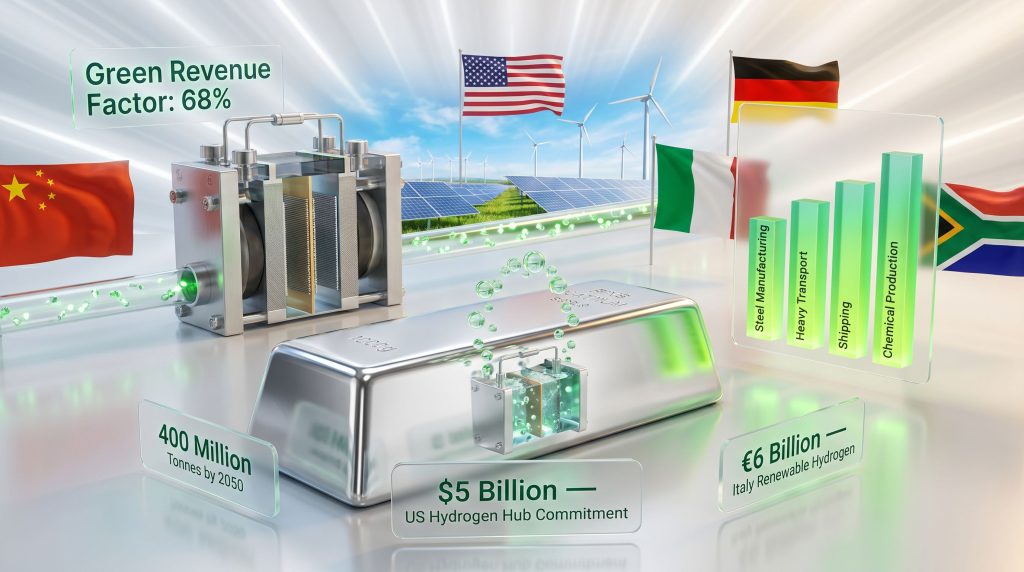
The net-zero trajectory requires approximately 400 million tonnes of hydrogen annually by 2050, according to the IEA's landmark Net Zero by 2050 roadmap. Current global production sits at roughly 120 million tonnes per year, with less than 5% produced via electrolysis. The remaining 95-plus percent derives from natural gas or coal. The deployment gap is measured not in increments but in orders of magnitude. (IEA, Global Hydrogen Review 2024)
The primary demand drivers pulling that gap closed are the hard-to-abate sectors that cannot decarbonise through electrification alone:
| Sector | Primary Hydrogen Application | Estimated Emissions Reduction |
|---|---|---|
| Steel Manufacturing | Direct Reduction of Iron (DRI) | 60 to 70% vs. conventional production |
| Chemical Production | Ammonia and Methanol Feedstock | 90%+ vs. gas-based production |
| Shipping | Green Ammonia Fuel | 60 to 80% vs. heavy fuel oil |
| Heavy Transport | Fuel Cell Propulsion | High |
| Energy Storage | Grid-Scale Balancing | Medium to High |
(Source: IRENA, Hydrogen for Hard-to-Abate Sectors, 2023)
ArcelorMittal's pilot hydrogen-based DRI facility in Hamburg has already demonstrated 95% emissions reduction versus conventional blast furnace methods at commercial scale. (ArcelorMittal Sustainability Report, 2024) This is no longer theoretical. It is operational.
The Government Commitments Driving 2026 Momentum
The depth of national policy commitment to green hydrogen has widened considerably in the past 24 months. Three major blocs are now leading the acceleration with quantified financial commitments.
China remains the world's largest hydrogen producer by volume at approximately 34 million tonnes annually, though nearly all of it is grey or brown. Beijing has now formally designated hydrogen as a strategic lever for national energy autonomy. The National Energy Administration is fast-tracking 41 pilot hydrogen projects into full industrial-scale deployment as part of the 15th Five-Year Plan, with announced electrolyser manufacturing capacity targets exceeding 200 GW by 2030.
A critical and often underappreciated element of China's strategy is its deliberate geographic pairing of hydrogen production with provinces experiencing renewable overcapacity: Inner Mongolia for wind, Xinjiang for solar, and Sichuan for hydroelectric. Approximately 30 to 35% of Chinese renewable energy generation currently experiences curtailment, and green hydrogen production offers a high-volume consumption mechanism for this stranded capacity. Furthermore, renewable energy in mining operations is increasingly following a similar logic, pairing excess renewable capacity with energy-intensive industrial processes. (IEA, China's Renewable Energy Development, 2024)
Europe presents a more complex picture. Energy ministers from Austria, Germany, the Netherlands, Poland, and Spain have collectively petitioned the European Commission to ease regulatory barriers constraining hydrogen project timelines. The tension between the EU's rigorous sustainability certification frameworks, including additionality and temporal matching requirements introduced in the 2024 Delegated Act, and the commercial urgency demanded by the energy crisis is real and unresolved.
Italy has moved unilaterally, approving €6 billion in state aid for renewable hydrogen infrastructure through its National Recovery and Resilience Plan. Germany's own National Hydrogen Strategy allocates €9 billion through 2030, with an additional €3 billion earmarked for international hydrogen import infrastructure. (European Commission Delegated Regulation, 2024; German Federal Ministry for Economic Affairs, 2023)
The United States has demonstrated something politically rare in energy policy: bipartisan continuity. The Trump administration committed $5 billion to preserve hydrogen hub infrastructure originally established under Biden-era legislation. Seven regional hubs spanning Appalachia, the Gulf Coast, California, the Midwest, New York, the Pacific Northwest, and the South-Central corridor remain in active development. The cross-partisan preservation of this commitment signals that hydrogen infrastructure has acquired the status of strategic industrial policy rather than partisan energy ideology. (U.S. Department of Energy, Hydrogen Hub Awards, 2023)
| Country or Region | Core Policy Action | Financial Commitment |
|---|---|---|
| China | 41 NEA pilot projects fast-tracked under 15th Five-Year Plan | National budget allocation |
| Italy | State aid approval for renewable hydrogen infrastructure | €6 billion |
| Germany | National Hydrogen Strategy with import infrastructure funding | €9 billion + €3 billion |
| United States | Hydrogen hub preservation across seven regional facilities | $5 billion |
| EU Multi-nation | Regulatory reform petition to European Commission | Policy-level (TBD) |
The Persistent Structural Barriers Green Hydrogen Must Overcome
Momentum and commitment are not the same as commercial viability. Several structural challenges continue to constrain the green hydrogen economy's maturation, and investors should understand them with precision rather than optimism.
Infrastructure bottlenecks remain the most immediate constraint. Hydrogen's low volumetric energy density demands either high-pressure compression or cryogenic liquefaction for transport, both of which are capital-intensive. Pipeline distribution networks capable of handling hydrogen at scale do not exist in most markets. This creates a documented investment coordination problem: demand cannot scale without infrastructure in place, yet infrastructure investment requires confirmed downstream demand to justify capital deployment.
Electrolyser supply chain constraints represent a second layer of risk. The PEM electrolyser manufacturing chain is dependent on platinum group metals, particularly platinum and iridium, as catalysts. Supply chain disruptions, limited mining output growth, and R&D investment slowdowns during the 2022 to 2024 period have created capability gaps that will require years to close. The relationship between electrolyser scale-up and critical minerals demand remains difficult to model with precision, a point of significant speculative interest for PGM investors.
Policy consistency risk deserves particular attention from institutional investors. Hydrogen projects operate on 15 to 25-year return horizons. Single-term regulatory reversals can destroy capital allocation decisions made over decade-long timeframes. The U.S. bipartisan preservation precedent provides a partial framework for addressing this risk, but it remains an outlier rather than a global standard.
The absence of a mature hydrogen distribution network in most markets creates a structural coordination failure that neither private capital nor policy mandates can solve in isolation. Resolving this requires simultaneous investment on both the supply and demand sides, a challenge that has historically paralysed energy transition infrastructure deployment.
Sibanye-Stillwater's 2025 Annual Reporting: What the Numbers Reveal
Against the backdrop of the green hydrogen revival and Sibanye-Stillwater reports, the company's 2025 Annual Reporting Suite carries layered significance. Published on 20 February 2026 and covering the full year ending 31 December 2025, the suite encompasses financial results, operational performance metrics, and comprehensive sustainability disclosures across the company's diversified metals portfolio.
Sibanye-Stillwater's operational footprint spans platinum group metals, gold, zinc, and nickel, with assets in South Africa, the United States, and Europe. PGMs remain the dominant revenue contributor, with operations including some of the world's most significant palladium and platinum-producing mines. The company's exposure to battery metals through zinc and nickel positions it at the intersection of traditional mining and the critical minerals supply chain underpinning the energy transition.
The 2023 financial baseline provides essential context for assessing trajectory. Revenue was benchmarked at R113.7 billion, while a R37 billion loss was recorded amid suppressed PGM pricing. The company also disclosed a "green revenue factor" of 68% in 2023, reflecting the proportion of revenue attributable to metals with demonstrated clean energy transition applications. This figure positions Sibanye-Stillwater not merely as a traditional miner but as a materials supplier to the energy transition itself.
Sustainability Architecture Across Multiple Frameworks
The 2025 reporting suite reflects the increasing sophistication that institutional ESG investors and international regulatory frameworks now require. Key metrics from recent disclosures include:
- A 22 million tonne CO₂e reduction in 2023, demonstrating measurable progress against decarbonisation commitments.
- 267 megawatts of renewable energy capacity developed within South Africa, providing partial operational insulation from the country's persistent electricity supply instability.
- Dedicated reporting supplements covering biodiversity management and tailings storage facility governance, two areas now subject to intensified scrutiny from investors and regulators globally.
- Injury frequency rate trajectories disclosed as a primary safety performance indicator across all operational jurisdictions.
The multi-document reporting structure, spanning climate, biodiversity, tailings, social performance, and workforce development metrics, reflects a deliberate strategy to meet the expectations of a sophisticated, internationally diverse investor base with differing but overlapping ESG requirements.
The next major ASX story will hit our subscribers first
The PGM-Hydrogen Nexus: A Structural Demand Tailwind Building Beneath the Surface
The connection between Sibanye-Stillwater's core business and the green hydrogen revival is materials-based rather than operational, but it is no less significant for that. Platinum and iridium, both platinum group metals, are essential catalysts in PEM electrolysers. They are not optional additives or substitutable components in current commercial technology. They are functional prerequisites.
South Africa holds the world's largest known platinum reserves. This geological reality positions South African PGM producers, including Sibanye-Stillwater, as structurally critical suppliers to the emerging global electrolyser manufacturing chain. As utility-scale electrolyser deployment accelerates to meet the demand projections outlined above, the long-term demand trajectory for platinum from this single application alone warrants serious attention.
The net demand picture for platinum is admittedly complex. Traditional automotive catalytic converter demand is declining as internal combustion engine vehicle production phases down over a 15 to 20-year horizon. Electrolyser and fuel cell applications are growing but from a very low base. The crossover point, where hydrogen economy demand sufficiently offsets automotive demand decline, is one of the most analytically contested projections in the PGM investment universe.
Exploration Silence: The Policy Gap Threatening Long-Term Supply Security
One of the most underappreciated risks in the critical minerals debate is not a mining risk. It is a government inaction risk. The absence of proactive exploration licensing frameworks and geological survey investment in key jurisdictions creates a compounding supply gap for the very critical minerals, including PGMs, that the hydrogen economy depends upon.
Exploration decisions made today translate into mine production capacity 10 to 20 years from now. Government silence on exploration systems is not a neutral administrative posture. It is a decision with consequences that accumulate across decades. Countries that proactively develop exploration frameworks, fund geological surveys, and streamline licensing processes today will be structurally advantaged as the hydrogen economy's materials requirements intensify through the 2030s and 2040s.
Consequently, those that do not will face import dependency on critical minerals at precisely the moment national energy security demands domestic production. The green hydrogen revival and Sibanye-Stillwater reports both point, from different angles, toward the same foundational truth: the energy transition is a materials problem first, a technology problem second, and a policy problem throughout.
Disclaimer: This article contains forward-looking statements, projections, and analytical commentary that involve assumptions and uncertainties. Commodity prices, government policy commitments, and technology development timelines are subject to change. Nothing in this article constitutes financial advice. Readers should conduct independent research and consult qualified financial advisers before making investment decisions.
Want to Position Yourself Ahead of the Next Major Mineral Discovery?
Discovery Alert's proprietary Discovery IQ model delivers real-time alerts the moment significant ASX mineral discoveries are announced, turning complex critical minerals data — including platinum group metals central to the green hydrogen supply chain — into actionable investment insights for both short-term traders and long-term investors. Explore historic discoveries and their exceptional market returns, then begin your 14-day free trial to ensure you never miss the next major opportunity.