June 27, 2026
The global steel industry faces an unprecedented transformation as carbon reduction imperatives reshape fundamental production methodologies. Traditional steelmaking processes, responsible for nearly 8% of worldwide CO₂ emissions, are encountering technological disruption through hydrogen-based reduction chemistry. This shift represents more than incremental improvement, it constitutes a complete reimagining of metallurgical processes that have remained largely unchanged for over a century.
Furthermore, green hydrogen steel production emerges as the most viable pathway for achieving deep decarbonisation while maintaining production scale and quality standards. The technology substitutes renewable electricity-derived hydrogen for coal and coke in iron ore reduction, fundamentally altering the chemical equations governing steel manufacturing.
Understanding the Fundamental Process Shift
The conventional blast furnace route produces approximately 1.8 to 2.3 tonnes of CO₂ per tonne of crude steel, with coal dependency averaging 450-500 kg of coke per tonne of hot metal. This carbon intensity stems from iron ore reduction chemistry, where carbon monoxide serves as the reducing agent through the reaction Fe₂O₃ + 3CO → 2Fe + 3CO₂.
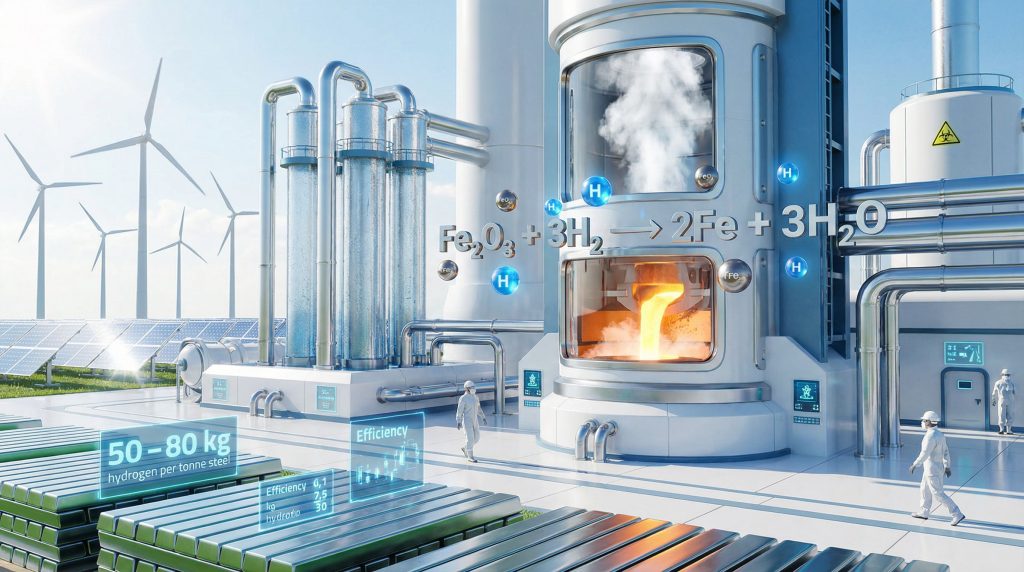
However, green hydrogen steel production transforms this equation entirely. Hydrogen molecules replace carbon monoxide as the reducing agent, following the reaction Fe₂O₃ + 3H₂ → 2Fe + 3H₂O. This fundamental chemistry change eliminates carbon emissions at the molecular level, producing only water vapour as a byproduct.
The transition extends beyond chemical substitution to encompass energy system integration. Conventional integrated steel mills consume 18-21 GJ of energy per tonne, with 90% derived from fossil fuels. Hydrogen-based systems redistribute this energy profile toward renewable electricity for both hydrogen production and steel melting operations.
Temperature and pressure optimisation requires careful calibration for hydrogen reduction kinetics. Hydrogen operates effectively at reduction temperatures of 800-900°C, compared to 1,500-1,600°C in blast furnaces. This lower temperature operation, while requiring longer residence times, enables more precise process control and reduced thermal energy consumption.
Consequently, process residence time adjustments become critical as hydrogen reduction typically requires 4-8 hours in shaft furnaces compared to the continuous operation of blast furnaces. However, this extended processing time allows for higher metallisation rates, often achieving 92-96% iron recovery compared to 85-90% in conventional routes.
When big ASX news breaks, our subscribers know first
Green Hydrogen Direct Reduced Iron Technology Architecture
Hydrogen-based direct reduced iron (H₂-DRI) technology represents the cornerstone of green steel production, requiring comprehensive equipment modifications and infrastructure development. Current pilot projects demonstrate hydrogen consumption ranging from 53-67 kg per tonne of DRI produced, varying based on ore quality and reduction conditions.
Core Infrastructure Requirements and Modifications
Shaft furnace conversions for 100% hydrogen operation demand extensive modifications to existing natural gas DRI facilities. Gas distribution systems require redesign to accommodate hydrogen's unique flow characteristics and wider flammability range of 4-75% in air. Refractory materials must resist hydrogen embrittlement while maintaining thermal efficiency at operating temperatures.
Capital investment for retrofitting a 2 million tonne per year DRI plant ranges from €200-300 million, representing a significant but manageable conversion cost compared to greenfield construction. These modifications include upgraded sealing systems, explosion-proof electrical equipment, and enhanced ventilation infrastructure.
In addition, safety protocol enhancements address hydrogen's distinct handling requirements. Unlike natural gas with its 5-15% flammability range, hydrogen demands more sophisticated leak detection systems and emergency response procedures. Safety system upgrades typically add 12-18% to baseline conversion costs but ensure operational reliability and regulatory compliance.
Storage and handling infrastructure must accommodate compressed or liquefied hydrogen supply systems. Large-scale facilities prefer on-site electrolysis for plants consuming over 50 tonnes of hydrogen daily, eliminating transportation costs that can add €1.50-2.50 per kg to delivered hydrogen prices.
Operational Parameters and Process Control Systems
Green hydrogen steel production requires precise control of multiple operational variables to achieve consistent quality and efficiency. For instance, hydrogen purity specifications typically exceed 99.9% to prevent catalyst poisoning and ensure optimal reduction kinetics.
Metallisation rate optimisation through advanced process control achieves iron recovery rates comparable to conventional DRI operations. Automated systems monitor gas composition, temperature profiles, and pressure differentials to maintain steady-state conditions throughout the reduction process.
Furthermore, quality control measures for sponge iron include real-time analysis of metallisation percentages, residual oxygen content, and trace element concentrations. These parameters directly influence downstream electric arc furnace performance and final steel quality characteristics.
| Operational Parameter | Hydrogen DRI | Natural Gas DRI | Blast Furnace |
|---|---|---|---|
| Reduction Temperature | 800-900°C | 850-1,050°C | 1,500-1,600°C |
| Residence Time | 4-8 hours | 3-6 hours | Continuous |
| Metallisation Rate | 92-96% | 90-94% | 85-90% |
| CO₂ Emissions | 0.1-0.4 t/t steel | 1.1-1.3 t/t steel | 1.8-2.3 t/t steel |
Electric Arc Furnace Integration with Renewable Power Systems
Electric arc furnace (EAF) operations using hydrogen-reduced DRI feedstock consume 400-500 kWh per tonne of liquid steel, representing a 15-20% increase compared to scrap-based operations due to higher melting energy requirements. This increased power demand necessitates sophisticated grid integration strategies and renewable energy sourcing, reflecting the broader mining industry evolution towards sustainable practices.
Power Requirements and Grid Stability Considerations
A 1 million tonne per year green steel facility requires approximately 1,500-2,000 GWh of renewable electricity annually, encompassing both hydrogen production and steel melting operations. High-power EAF operations create demand spikes of 100-200 MW during melting cycles, requiring dynamic reactive power compensation systems.
Grid stability management involves implementing short-term energy storage systems, typically 20-50 MWh capacity, to buffer intermittent renewable supply against continuous steel production demands. Advanced facilities employ sophisticated demand-side management, shifting up to 40% of melting operations to periods of high renewable generation.
Moreover, time-of-use electricity pricing impacts production scheduling strategies significantly. Operators increasingly align melting cycles with low-cost renewable generation periods, particularly during midday solar peaks or overnight wind generation maxima. This operational flexibility can reduce electricity costs by 15-25% compared to constant production schedules.
Furnace Operation Optimisation for DRI Feedstock
Electrode consumption patterns increase by 10-15% with DRI feedstock compared to scrap operations due to higher carbon requirements for carburisation and extended melting times. This consumption increase translates to additional operating costs of €8-12 per tonne of steel production.
Slag chemistry adjustments become necessary when processing hydrogen-reduced iron with lower gangue content. The reduced impurity levels in H₂-DRI require modified flux additions and adjusted tapping procedures to maintain optimal metallurgical conditions.
Alloy addition strategies must account for the different chemistry profile of hydrogen-reduced feedstock. The absence of carbon pickup from reduction gases necessitates precise carbon addition during melting to achieve target steel grade specifications.
Green Hydrogen Production and Supply Chain Architecture
The economics and logistics of green hydrogen supply fundamentally determine the viability of hydrogen-based steelmaking. Electrolyser technology selection, renewable energy integration, and distribution infrastructure collectively influence production costs and operational reliability.
Electrolyser Technology Comparison and Selection Criteria
Alkaline electrolysers operate at 63-70% efficiency with capital costs of €500-1,000 per kW, representing the most commercially mature technology for large-scale hydrogen production. These systems demonstrate proven reliability in industrial applications but offer limited operational flexibility for variable renewable inputs.
PEM electrolysers achieve 65-75% efficiency at costs of €900-1,500 per kW, providing superior dynamic response capabilities for renewable energy integration. Their ability to operate efficiently at partial loads makes them particularly suitable for wind-powered hydrogen for iron making with inherent variability.
Solid oxide electrolysers represent emerging technology with efficiency potential of 80-85% but current capital costs of €2,000-4,000 per kW. Operating at 700-900°C, these systems can utilise waste heat from steel production processes, improving overall energy integration efficiency.
Supply Chain Logistics and Distribution Infrastructure
Pipeline infrastructure development requires specialised materials resistant to hydrogen embrittlement. Dedicated hydrogen pipelines use X52-X70 grade steel with modified wall thickness specifications, necessitating compression stations every 150-200 km for long-distance transport.
In addition, on-site versus centralised production strategies depend on facility scale and renewable energy access. Steel plants consuming over 50 tonnes of hydrogen daily typically favour on-site electrolysis to eliminate transportation costs and ensure supply security.
Large-scale storage solutions employ salt caverns or depleted natural gas fields for facilities requiring 100,000+ kg hydrogen capacity. Above-ground pressurised storage at 350-700 bar remains limited to 5,000-10,000 kg due to capital costs of €500-800 per kg of storage capacity.
Strategic Insight: Water consumption for electrolysis requires 9-10 kg of water per kg of hydrogen produced, making water resource availability a critical site selection factor for large-scale green hydrogen steel facilities.
Economic Analysis and Cost Structure Transformation
Current green hydrogen steel production costs range from €600-900 per tonne compared to €400-550 for conventional blast furnace steel, representing a 20-40% premium. However, declining renewable electricity prices and increasing carbon costs are rapidly narrowing this economic gap, aligned with emerging energy transition strategies.
Capital Expenditure and Investment Requirements
A greenfield 2 million tonne per year green steel facility requires approximately €3-4 billion in capital investment, distributed across multiple technology components:
- H₂-DRI plant construction: 30-35% of total investment
- Electric arc furnace facilities: 15-20% of total investment
- Electrolyser and renewable power: 35-40% of total investment
- Balance of plant and infrastructure: 15-20% of total investment
Furthermore, retrofit versus greenfield economics favour conversion of existing DRI facilities where technically feasible. Conversion costs typically range from €200-300 million for a 2 million tonne facility compared to €1.5-2.0 billion for equivalent greenfield construction.
Operating Cost Structure and Competitiveness Factors
Green hydrogen costs dominate operating expenses at €2-4 per kg, depending on renewable electricity prices of €30-60 per MWh. This translates to €150-300 per tonne of steel production, representing 60-80% of the cost premium compared to conventional routes.
Electricity costs for EAF melting add €40-80 per tonne based on regional power prices and consumption efficiency. Combined with hydrogen costs, energy represents 70-85% of the operating cost differential versus traditional steelmaking.
Carbon pricing mechanisms increasingly favour green steel economics. European Union Emissions Trading System prices exceeding €90 per tonne CO₂ in late 2024, combined with carbon border adjustment mechanisms, create economic incentives for low-carbon steel production.
Revenue Enhancement and Market Premiums
Green steel premiums from automotive and construction sectors range from €50-150 per tonne for verified low-carbon products. Major automotive manufacturers have secured advance purchase agreements at premium prices to meet their scope 3 emission reduction targets.
Carbon credit monetisation provides additional revenue streams through various mechanisms. The EU Innovation Fund offers up to €60 million per project for first-of-a-kind green steel facilities, while voluntary carbon markets value avoided emissions at €20-40 per tonne.
Export market advantages emerge in regions implementing carbon border adjustments. Low-carbon steel producers gain competitive advantages in international markets as carbon-intensive imports face tariffs and restrictions.
Regional Implementation Strategies and Technology Deployment
Global green hydrogen steel deployment demonstrates varied approaches based on regional resource availability, policy frameworks, and industrial infrastructure. Leading projects provide insights into commercial viability and scaling strategies, particularly as companies pursue BHP strategic pivot approaches to sustainable operations.
European Pioneer Projects and Lessons Learned
H2 Green Steel Sweden represents the most ambitious integrated green steel project, targeting 5 million tonnes per year production by 2030. The €5.5 billion facility leverages northern Sweden's abundant hydropower and iron ore resources, reducing logistics costs by €40-60 per tonne compared to import-dependent locations.
ArcelorMittal Hamburg demonstrates pragmatic retrofit strategies, beginning with 30% hydrogen blending in natural gas DRI operations from 2025, scaling to 100% hydrogen by 2027-2028. This phased approach minimises operational disruption while testing hydrogen integration at commercial scale.
Thyssenkrupp Duisburg employs a comprehensive blast furnace conversion strategy with pilot hydrogen injection starting in 2025, partial conversion through 2027-2029, and full hydrogen operation by 2032. The €2 billion transformation illustrates large-scale industrial transition complexity.
Skills Development and Workforce Transition Requirements
Training programme specifications indicate that hydrogen-based steelmaking requires retraining 60-70% of existing workforce in new competencies. These include hydrogen safety protocols, electrochemical process control, and digital monitoring systems management.
Competency development timelines average 200-400 hours per employee for comprehensive retraining programmes. Specialised roles such as hydrogen system operators require additional certification and ongoing safety training to maintain operational proficiency.
Consequently, regional skills partnerships between steel companies, educational institutions, and government agencies facilitate workforce transition. These collaborations ensure training programmes align with industry requirements and regional employment objectives.
The next major ASX story will hit our subscribers first
Performance Metrics and Environmental Impact Assessment
Green hydrogen steel achieves 85-95% reduction in direct CO₂ emissions compared to blast furnace routes, with typical facilities producing 2 million tonnes annually avoiding 3.5-4.0 million tonnes of CO₂ emissions. Life cycle assessments demonstrate carbon intensities of 0.1-0.4 tonnes CO₂-equivalent per tonne steel when including upstream hydrogen production.
Quality Assurance and Steel Grade Compliance
Mechanical property verification confirms that hydrogen-reduced steel meets ASTM and EN standards across all grades, including high-strength automotive applications and construction reinforcement requirements. Testing protocols demonstrate equivalent performance characteristics to conventional steel products.
Metallurgical consistency through advanced process control maintains uniform chemical composition and mechanical properties. Automated quality systems monitor trace element concentrations and ensure compliance with customer specifications throughout production.
Furthermore, certification and traceability systems employ blockchain technology to document carbon footprint verification through the supply chain. These systems track renewable energy sources, hydrogen production methods, and emission factors at each production stage.
Environmental Benefits and Resource Utilisation
Water consumption analysis indicates hydrogen production requires 9-10 kg of water per kg of hydrogen, translating to approximately 600-800 kg of water per tonne of green steel. This consumption level remains comparable to conventional steelmaking water requirements for cooling and processing.
Air quality improvements result from eliminated coal combustion and reduced particulate matter emissions. Green steel facilities demonstrate significant reductions in NOx emissions and virtually eliminate SOx emissions associated with coke production.
Waste stream modifications shift from carbon-containing blast furnace slag to water vapour as the primary byproduct. This elimination of carbon-bearing waste streams simplifies environmental management and reduces long-term disposal requirements.
Innovation Roadmap and Emerging Technologies
Next-generation steelmaking technologies under development promise further efficiency improvements and cost reductions beyond current hydrogen DRI processes. These innovations target direct electricity-to-steel conversion and advanced process integration, supporting comprehensive sustainability transformation across the sector.
Molten Oxide Electrolysis and Direct Steel Production
Boston Metal's molten oxide electrolysis operates at 1,600°C to convert iron ore directly to steel using electricity, bypassing hydrogen production entirely. Pilot operations demonstrate energy consumption of 3.5-4.0 MWh per tonne with 98%+ purity iron production and commercial deployment targeted for 2026-2027.
Process efficiency advantages include elimination of reduction gas production and handling, direct electricity-to-metal conversion, and simplified process control systems. Energy efficiency targets of 2.5-3.0 MWh per tonne of steel potentially exceed hydrogen route efficiency.
Plasma-Based Reduction Technologies
Plasma reduction research in Europe and Japan targets reduction temperatures of 1,400-1,600°C with residence times under 30 minutes compared to 4-8 hours in shaft furnaces. This acceleration of reduction kinetics could dramatically reduce facility size requirements and capital costs.
Energy integration opportunities allow plasma systems to utilise high-temperature waste heat from other industrial processes, improving overall energy efficiency and reducing electricity consumption per tonne of steel produced.
Implementation Timeline and Strategic Considerations
Commercial green hydrogen steel deployment follows a phased approach balancing technological maturation, economic viability, and market development. Understanding these implementation phases guides investment decisions and policy development.
Technology Deployment Phases and Market Evolution
Phase 1 (2024-2027) focuses on natural gas-hydrogen blending in existing DRI facilities, typically 20-30% hydrogen content. This approach minimises capital investment while testing hydrogen integration and building operational experience.
Phase 2 (2027-2030) involves dedicated green hydrogen DRI construction with 100% hydrogen operation capability. These facilities require full infrastructure development but demonstrate commercial viability at scale.
Phase 3 (2030-2035) emphasises full integration with renewable energy systems and advanced process optimisation. AI-driven control systems optimise hydrogen consumption patterns and production scheduling for maximum efficiency.
Phase 4 (2035-2040) incorporates next-generation technologies including molten oxide electrolysis and plasma reduction, potentially achieving further cost reductions and efficiency improvements.
Critical Success Factors and Risk Management
Renewable energy cost trajectories represent the primary economic driver for green steel competitiveness. Continued declining costs for solar and wind power, projected at 5-10% annually, directly improve green hydrogen economics.
Hydrogen supply chain reliability requires redundant production and storage capabilities to ensure continuous steel production. Most facilities incorporate 3-7 days of hydrogen storage capacity to manage renewable energy intermittency.
Moreover, market acceptance of premium pricing depends on corporate sustainability commitments and regulatory frameworks. Growing demand for verified low-carbon steel in construction markets increased 180% from 2022 to 2024, indicating strong market trajectory.
Policy stability and carbon pricing provide investment certainty for multi-billion dollar green steel projects. Long-term carbon price signals and consistent renewable energy policies enable project financing and development.
Disclaimer: This analysis contains forward-looking information about emerging technologies and market developments. Steel production cost estimates and technology deployment timelines are subject to significant uncertainty based on renewable energy prices, policy changes, and technological advancement rates. Investment decisions should consider these risk factors and conduct independent technical and financial analysis.
Ready to Discover the Next Big Green Technology Investment?
Discovery Alert's proprietary Discovery IQ model delivers real-time alerts on significant ASX mineral discoveries, including emerging opportunities in green hydrogen, renewable energy infrastructure, and critical minerals essential for steel decarbonisation. Explore why major mineral discoveries can lead to substantial market returns by visiting Discovery Alert's dedicated discoveries page, and begin your 30-day free trial today to position yourself ahead of the market in the rapidly evolving green technology sector.