August 23, 2026
What Makes Greenland a Critical Player in the Global Rare Earth Market?
The global economy's dependency on critical minerals has reached a strategic inflection point, with supply chain vulnerabilities exposing the fragility of modern technological infrastructure. As nations grapple with critical minerals energy transition demands and defence technology requirements, the Arctic region emerges as a potential game-changer in mineral resource geopolitics. Understanding these macro-economic forces requires examining how geological wealth translates into strategic power, particularly when vast Greenland rare earth mineral reserves remain locked beneath ice sheets in one of Earth's most challenging operating environments.
Understanding Greenland's Geological Advantage in Critical Minerals
Greenland's positioning within the Arctic Circle creates unique geological conditions that have concentrated exceptional mineral wealth over millions of years. The territory's foundation lies within the Precambrian shield, where ancient geological processes have created some of the world's most significant rare earth element concentrations. This geological positioning differs fundamentally from established mining jurisdictions, as Greenland's mineral formations developed through distinct tectonic and magmatic processes that occurred during Earth's early formation periods.
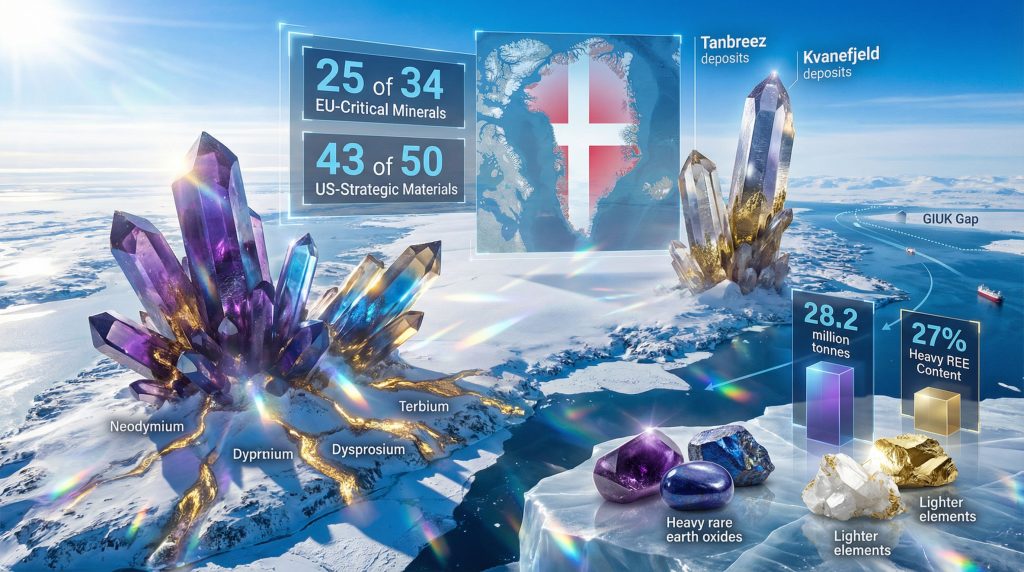
The strategic significance extends beyond simple resource quantity. Greenland hosts 25 of the European Union's 34 critical minerals alongside 43 of the 50 minerals classified as strategically important by United States national security assessments. This diversity creates potential for multi-element extraction operations, where mining companies could theoretically extract multiple strategic materials from single operational sites.
Climate change dynamics further enhance Greenland's accessibility advantages. As Arctic ice coverage diminishes, previously inaccessible mineral zones become economically viable for exploration and development. However, this accessibility remains constrained by seasonal variations, with optimal operating windows limited to specific months annually, creating unique logistical challenges not present in temperate mining jurisdictions.
Quantifying Greenland's Rare Earth Potential Through Economic Lens
The scale of Greenland rare earth mineral reserves challenges conventional understanding of global supply dynamics. The United States Geological Survey has documented 1.5 million tonnes of proven rare earth reserves, positioning Greenland eighth globally in confirmed reserves. However, this ranking understates the territory's true potential when considering resource estimates beyond proven categories.
Greenland's Major REE Deposits – Economic Impact Assessment
| Deposit | Estimated Resources | Heavy REE Content | Economic Significance |
|---|---|---|---|
| Tanbreez | 28.2 million tonnes | 27% (vs 5-10% global avg) | World's largest potential REE resource |
| Kvanefjeld | 11+ million tonnes | 370,000 tonnes heavy REE | Third-largest known land-based deposit |
| Combined Portfolio | 36+ million tonnes | Exceptionally high heavy REE ratio | Strategic counter to Chinese dominance |
The Tanbreez deposit represents a paradigm shift in rare earth economics due to its extraordinary heavy rare earth concentration. Traditional global deposits typically contain 5-10% heavy rare earth elements, whilst Tanbreez maintains concentrations exceeding 27%. This composition directly addresses the most critical supply chain vulnerabilities, as heavy rare earth elements including dysprosium, terbium, and gadolinium command premium pricing due to their essential roles in permanent magnet technologies.
Kvanefjeld's significance lies not only in its 11+ million tonne resource base but also in its advanced exploration status. The deposit contains approximately 370,000 tonnes of heavy rare earth elements, representing a substantial portion of global known reserves in this category. The project's extensive geological database, developed through decades of exploration, provides detailed understanding of ore characteristics and processing requirements.
When big ASX news breaks, our subscribers know first
Why Haven't These Massive Reserves Translated Into Production?
Infrastructure Economics – The Arctic Development Challenge
The fundamental challenge facing Greenland's mineral development centres on infrastructure economics rather than geological uncertainty. Unlike established mining jurisdictions with existing transportation networks, power grids, and processing facilities, Greenland operates from a near-zero infrastructure baseline. This reality transforms typical mining project economics, requiring massive upfront capital expenditures before any revenue generation becomes possible.
Arctic operating conditions multiply standard construction and operational costs through multiple mechanisms:
- Extreme weather constraints limiting construction seasons to 3-4 months annually
- Permafrost engineering requirements demanding specialised foundation and infrastructure designs
- Remote logistics costs for transporting equipment and materials via air or seasonal shipping
- Specialised workforce housing and life support systems for year-round operations
- Environmental protection systems designed for pristine Arctic ecosystems
Capital expenditure requirements for establishing Arctic mining operations often exceed traditional mining projects by 300-500%. These costs stem from infrastructure development needs including port facilities, power generation systems, transportation networks, and processing plants designed for extreme climate resilience. The economic threshold for project viability consequently rises dramatically compared to temperate mining ventures.
Timeline analysis reveals additional complexity when comparing Greenland projects against established mining jurisdictions. Whilst conventional mining projects typically require 7-15 years from discovery to production, Greenland's infrastructure constraints extend development timelines significantly. Current project assessments suggest 10+ year development horizons for meaningful production capacity, creating strategic planning challenges for companies and governments seeking supply chain diversification.
Regulatory and Environmental Economic Factors
The regulatory environment surrounding Greenland's mineral development reflects the territory's autonomous status within Denmark and its commitment to environmental stewardship. The 2021 uranium mining ban exemplifies how environmental policies directly impact project economics, particularly for multi-element deposits where uranium occurs alongside rare earth elements and other strategic minerals.
This regulatory shift eliminated several advanced mining projects overnight, including the extensively studied Kvanefjeld deposit. Despite 14+ years of exploration and environmental assessment, regulatory changes rendered these investments economically stranded. The uranium ban affects approximately dozen potential mining projects across Greenland, demonstrating how environmental policies can supersede economic considerations in resource development decisions.
Environmental compliance costs in pristine Arctic ecosystems exceed those in industrial regions due to heightened environmental monitoring requirements and restoration obligations. Mining companies must demonstrate:
- Baseline environmental data collection across multiple seasonal cycles
- Advanced waste management systems preventing any environmental discharge
- Comprehensive wildlife protection protocols during sensitive migration periods
- Long-term site restoration planning with financial guarantees
- Community impact mitigation for indigenous populations
Risk assessment frameworks for investors must account for regulatory uncertainty alongside technical and market risks. Furthermore, Greenland's democratic governance structure means mining policies can evolve through electoral processes, creating additional investment risk premiums compared to jurisdictions with established mining regulatory frameworks.
How Do Greenland's Reserves Compare to Current Global Supply Dynamics?
China's Market Position and Greenland's Potential Impact
China's dominance across critical mineral processing chains represents one of the most significant strategic vulnerabilities facing Western economies. This control extends far beyond rare earth mining into processing and refining operations that transform raw materials into technology-ready forms. Understanding these supply chain chokepoints illuminates why Greenland rare earth mineral reserves carry such strategic significance despite their development challenges.
Comparative Analysis Table:
| Supply Chain Element | Current Chinese Control | Greenland's Potential Contribution |
|---|---|---|
| Manganese Processing | 95% | Diversification opportunity |
| Cobalt Processing | 65% | Strategic alternative source |
| Heavy REE Production | 85%+ | Exceptional heavy REE concentration |
| Rare Earth Refining | 90%+ | Potential processing hub development |
China's processing dominance creates multiple vulnerability points even when raw materials originate from diverse geographical sources. Most non-Chinese rare earth concentrates require shipment to China for processing into usable forms, creating dependency relationships that transcend mining geography. This processing bottleneck means that developing Greenland's reserves without corresponding processing infrastructure would merely shift rather than eliminate strategic vulnerabilities.
The heavy rare earth element concentration in Greenland's deposits directly addresses the most critical supply chain gaps. Heavy rare earth elements trade at premium pricing ranging from $50-500 per kilogram compared to light rare earth elements at $5-20 per kilogram. This pricing differential reflects both scarcity and essential technological applications in defence systems, renewable energy infrastructure, and advanced manufacturing.
Consequently, Greenland's potential contribution extends beyond simple supply diversification. The territory's geological characteristics could support integrated processing operations, potentially creating Western-controlled supply chains from mining through refined product delivery. This vertical integration possibility distinguishes Greenland from other non-Chinese rare earth deposits that lack processing infrastructure development potential.
Strategic Value Assessment for Western Supply Chains
Economic modelling of supply chain diversification reveals substantial risk premium benefits from Greenland development. Current supply chain vulnerabilities create estimated economic risks of $200-400 billion annually across Western economies through potential supply disruptions. These risk calculations include direct industrial impacts alongside secondary effects through technology sector dependencies.
Risk premium analysis for single-source dependency scenarios demonstrates how concentrated supply chains amplify price volatility and availability uncertainty. Historical analysis of Chinese rare earth export restrictions during 2010-2011 resulted in price increases of 300-2000% across different rare earth elements, illustrating the economic consequences of supply concentration.
Long-term price stability implications of Greenland development extend beyond immediate supply diversification. Credible alternative supply sources tend to moderate pricing even before production begins, as market participants adjust pricing expectations based on future supply potential. This psychological effect could provide economic benefits during the extended development phase preceding actual production.
However, strategic value assessments must also consider opportunity costs of delayed development. Each year of development delay extends the period of supply chain vulnerability whilst potentially allowing competing nations to establish alternative supply arrangements. The strategic window for Greenland development may narrow if other jurisdictions successfully develop competing rare earth projects or if technological substitution reduces rare earth demand.
What Are the Economic Pathways to Greenland Resource Development?
Investment Framework Requirements
Developing Greenland's mineral wealth requires unprecedented coordination between public and private sector resources, given the scale of infrastructure requirements and strategic importance of supply chain security. Traditional mining investment models prove inadequate for Arctic development, necessitating innovative financing structures that blend commercial returns with strategic objectives.
Public-private partnership models for Arctic infrastructure development must address several unique challenges:
- Infrastructure cost sharing between strategic and commercial benefits
- Risk allocation frameworks balancing government strategic interests with private sector returns
- Technology transfer agreements ensuring knowledge development benefits multiple stakeholders
- Environmental stewardship protocols meeting both regulatory requirements and corporate sustainability goals
International cooperation mechanisms between the United States, Denmark, and Greenland become essential for successful development. The 1951 US-Danish Defence Agreement, amended in 2004, provides legal framework for American strategic involvement, whilst Greenland's autonomous status since 2009 grants substantial decision-making authority over natural resources. This three-way governance structure requires carefully negotiated agreements balancing sovereignty concerns with strategic cooperation benefits.
Staged development approaches offer the most realistic pathway for managing massive capital requirements whilst demonstrating project viability. This methodology involves:
- Advanced exploration and infrastructure assessment with shared international funding
- Pilot project development proving technical and economic feasibility
- Phased infrastructure construction aligned with production capacity increases
- Commercial scale operations with established supply chain integration
Timeline and Capital Allocation Strategy
Realistic timeline projections for Greenland mineral development must account for Arctic operating constraints alongside conventional mining project requirements. Industry analysis suggests a three-phase development approach spanning multiple decades:
Development Phase Analysis:
-
Phase 1 (2026-2030): Infrastructure foundation and advanced exploration
- Port facility construction and power system development
- Comprehensive resource assessment and processing technology optimisation
- Environmental baseline establishment and regulatory framework completion
- Estimated investment requirement: $2-4 billion
-
Phase 2 (2030-2035): Pilot production and processing facility development
- Small-scale mining operations proving technical feasibility
- Processing plant construction and workforce development
- Transportation and logistics system integration
- Estimated investment requirement: $4-8 billion
-
Phase 3 (2035+): Commercial-scale operations and supply chain integration
- Full production capacity across multiple deposits
- Integrated supply chain delivering refined products to end markets
- Regional processing hub serving broader Arctic mineral resources
- Estimated investment requirement: $10-20 billion
Capital allocation strategy must prioritise infrastructure development that serves multiple projects simultaneously. Rather than developing individual mine sites, the optimal approach involves creating regional infrastructure platforms supporting multiple mineral extraction operations. This strategy maximises capital efficiency whilst creating economic foundations for sustained Arctic development.
How Should Investors Approach Near-Term vs. Long-Term Critical Mineral Strategies?
Immediate Supply Security Through Domestic and Allied Projects
The strategic imperative for supply chain diversification demands parallel investment approaches addressing both immediate vulnerabilities and long-term security requirements. Furthermore, this pivot in critical minerals strategy recognises that whilst Greenland rare earth mineral reserves represent transformational potential, current supply chain risks require more immediate solutions through advanced-stage projects in established jurisdictions.
Analysis of advanced-stage critical mineral projects reveals several opportunities for near-term production capacity:
- Domestic rare earth projects with existing infrastructure access and established regulatory frameworks
- Allied jurisdiction developments in Australia, Canada, and other strategic partner nations
- Recycling and processing capacity expansion reducing dependency on primary production
- Strategic stockpile utilisation providing buffer capacity during supply chain transitions
Capital efficiency comparisons between near-production assets and greenfield Arctic development demonstrate stark differences in risk-adjusted returns. Near-production projects typically require $100-500 million investment for meaningful output within 2-5 years. Greenfield Arctic development demands $2-20 billion investment with 10+ year timelines, creating fundamentally different investment profiles.
Portfolio diversification strategy combining immediate and strategic long-term positions offers optimal risk management for critical mineral exposure. This approach involves:
- 60-70% allocation to near-term production assets providing immediate supply chain benefits
- 20-30% allocation to strategic long-term developments including Greenland projects
- 10% allocation to processing and recycling infrastructure supporting supply chain resilience
Building Complementary Investment Approaches
National security and supply chain resilience require parallel investment streams – accelerated domestic production for immediate needs and sustained Greenland development for long-term strategic positioning.
Complementary investment approaches must recognise the distinct risk-return profiles between immediate security solutions and strategic positioning investments. Immediate security investments prioritise cash flow generation and supply chain contribution within compressed timelines. Strategic positioning investments emphasise long-term value creation and geopolitical advantage with extended investment horizons.
The technological landscape evolution also influences optimal investment allocation strategies. Advancing battery technologies, permanent magnet alternatives, and recycling capabilities could alter rare earth demand profiles over the extended timelines required for Greenland development. Investment strategies must maintain flexibility to adapt to technological change whilst securing strategic resource access.
In addition, the broader mining industry evolution demonstrates how technological advancement and sustainable mining practices create new opportunities for efficient resource extraction. Risk management across complementary approaches involves geographic diversification, development stage diversification, and end-market diversification. This multi-dimensional diversification protects against regulatory changes, technical setbacks, and market evolution whilst maintaining strategic mineral supply chain exposure.
What Are the Geopolitical Economics of Greenland's Mineral Wealth?
Arctic Geopolitics and Resource Control
Greenland's strategic positioning within the GIUK Gap (Greenland-Iceland-United Kingdom) creates unique geopolitical dynamics that extend far beyond mineral economics. This maritime chokepoint historically served as a critical NATO monitoring zone for Soviet naval activity and continues serving similar functions for Russian and Chinese maritime movements between Arctic and Atlantic waters.
The economic implications of this positioning multiply as Arctic ice recedes and new shipping routes emerge. Potential Trans-Arctic corridors could significantly reduce transit times between major markets, with economic benefits measured in hundreds of billions of dollars through reduced shipping costs and time savings. Control over Greenland's territory and resources consequently provides influence over these emerging trade routes.
Analysis of competing international interests reveals multiple nations recognising Greenland's strategic value:
- China's Belt and Road Initiative includes Arctic development components with potential Greenland involvement
- Russia's Arctic strategy emphasises resource control and shipping route influence
- European Union critical minerals strategy identifies Greenland as essential for supply chain security
- United States Arctic strategy combines defence considerations with resource security objectives
Trade route economics calculations suggest that Arctic shipping routes could reduce Asia-Europe transit times by 30-50% compared to current Suez Canal routing. These time savings translate to substantial economic advantages for nations controlling Arctic infrastructure and resources, creating additional strategic value beyond direct mineral wealth.
US-Denmark-Greenland Economic Relationships
The trilateral relationship between the United States, Denmark, and Greenland creates complex economic and political dynamics surrounding resource development. The 1951 US-Danish Defence Agreement established American strategic presence through Pituffik Space Base (formerly Thule Air Base), providing legal precedent for continued American involvement in Greenland's security and potentially its resource development.
Greenland's autonomous status since 2009 grants substantial authority over natural resource decisions whilst maintaining political association with Denmark. This governance structure requires careful diplomatic navigation to align American strategic interests with Danish sovereignty concerns and Greenlandic self-determination aspirations.
Framework analysis reveals several potential cooperation mechanisms:
- Strategic partnership agreements covering resource development and infrastructure investment
- Technology transfer programmes supporting Greenlandic capacity development
- Environmental protection collaborations ensuring sustainable development practices
- Economic development initiatives providing broad-based benefits to Greenlandic communities
Economic diplomacy requirements for successful resource development extend beyond simple commercial negotiations. Success depends on demonstrating that mineral development provides meaningful benefits to Greenlandic society whilst respecting environmental values and cultural preferences. This requirement differentiates Greenland development from traditional mining investment approaches focused primarily on commercial returns.
However, the broader context of global economic tensions and US-China trade impact adds complexity to these trilateral relationships. Economic partnerships must therefore navigate not only local concerns but also broader geopolitical dynamics affecting Arctic development priorities.
The next major ASX story will hit our subscribers first
Frequently Asked Questions About Greenland's Rare Earth Economics
When Will Greenland Rare Earth Production Begin?
Economic feasibility timelines based on current infrastructure development rates suggest meaningful commercial production beginning in the mid-to-late 2030s under optimistic scenarios. This timeline assumes successful resolution of regulatory frameworks, infrastructure development funding, and technology optimisation for Arctic operating conditions.
Comparison with similar Arctic mining project development cycles provides historical context for timeline expectations. The Baffinland Iron Ore Mine in Canada required over 15 years from initial development to meaningful production, despite less challenging logistics than Greenland operations. The Raglan Mine in Quebec took 12+ years for development, again with more favourable infrastructure access than Greenland provides.
Key milestone dependencies for commercial production include:
- Regulatory framework completion for uranium-free rare earth extraction
- Infrastructure investment commitments from international partnerships
- Technology demonstration for Arctic processing operations
- Market development for Greenlandic rare earth products
- Workforce development programmes for specialised Arctic mining operations
How Will Greenland's Production Affect Global Rare Earth Prices?
Market impact modelling for heavy rare earth pricing suggests significant price moderation once Greenland production reaches commercial scale. The territory's exceptional heavy rare earth concentration could increase global supply by 25-40% in some elements, potentially reducing price premiums that currently range from 300-1000% above light rare earth pricing.
Supply elasticity analysis for critical mineral markets indicates that credible alternative supply sources tend to moderate pricing volatility even before production begins. Market participants adjust pricing strategies based on future supply expectations, potentially providing immediate economic benefits from Greenland development commitments.
Long-term price stability implications extend beyond direct supply effects. Diversified supply chains typically exhibit lower price volatility due to reduced geopolitical risk premiums. Historical analysis suggests that supply source diversification can reduce price volatility by 30-50% compared to concentrated supply scenarios.
Nevertheless, price impact timing remains uncertain due to extended development timelines. Market conditions in the 2030s and beyond may differ substantially from current dynamics due to technological evolution, demand growth from energy transition requirements, and potential supply responses from other jurisdictions.
Investment Implications and Strategic Recommendations
Portfolio Construction for Critical Mineral Exposure
Optimal portfolio construction for critical mineral exposure requires balancing immediate supply chain needs with strategic long-term positioning opportunities. Diversification across development stages provides protection against regulatory changes, technical setbacks, and market evolution whilst maintaining exposure to transformational value creation potential.
Balanced approach recommendations include:
- Advanced-stage domestic projects (40-50% allocation) providing near-term production and cash flow
- International allied projects (20-30% allocation) in established mining jurisdictions
- Strategic long-term developments (15-20% allocation) including Greenland and similar transformational opportunities
- Processing and infrastructure (5-10% allocation) supporting supply chain integration
Risk-adjusted return expectations for Arctic resource development reflect both high potential rewards and substantial execution risks. Successful Greenland development could generate returns exceeding 300-500% over 15-20 year investment horizons, whilst unsuccessful development could result in total capital loss. This risk-return profile suggests position sizing appropriate for speculative high-conviction investments rather than core portfolio holdings.
Diversification benefits across geographical and developmental stages protect against concentrated risks whilst maintaining upside exposure. Geographic diversification reduces regulatory and political risks, development stage diversification provides varying timeline exposures, and commodity diversification protects against specific mineral demand evolution.
Policy and Regulatory Considerations for Investors
Monitoring frameworks for Greenland's evolving mining regulations require attention to multiple governmental layers including Greenlandic autonomous authorities, Danish national policies, and international agreements affecting resource development. Regulatory evolution remains a primary investment risk requiring continuous assessment and stakeholder engagement.
United States strategic mineral policy implications create potential investment incentives through various mechanisms:
- Defense Production Act authority supporting critical mineral development
- Strategic National Stockpile providing potential off-take agreements
- Export-Import Bank financing for overseas strategic mineral projects
- Tax incentive programmes supporting domestic critical mineral production
International cooperation requirements necessitate diplomatic engagement alongside commercial development activities. Successful Greenland development depends on sustained trilateral cooperation between US strategic interests, Danish sovereignty concerns, and Greenlandic development aspirations. Investment strategies must account for diplomatic relationship evolution alongside commercial project development.
Greenland represents a transformational long-term strategic asset requiring sustained diplomatic engagement and infrastructure investment. However, immediate supply chain security demands parallel acceleration of domestic and allied critical mineral projects through streamlined permitting and targeted capital support.
Investment Disclaimer: This analysis contains forward-looking statements and speculative assessments regarding Greenland's mineral development potential. Actual development timelines, production costs, regulatory outcomes, and market conditions may differ materially from projections presented. Critical mineral investments carry substantial risks including regulatory changes, technical challenges, market volatility, and geopolitical developments. Investors should conduct independent due diligence and consider their risk tolerance before making investment decisions in Arctic resource development or critical mineral sectors.
Ready to Invest in the Next Major Mineral Discovery?
Discovery Alert instantly alerts investors to significant ASX mineral discoveries using its proprietary Discovery IQ model, turning complex mineral data into actionable insights. Understand why historic discoveries can generate substantial returns by visiting Discovery Alert's dedicated discoveries page and begin your 14-day free trial today to position yourself ahead of the market.