
August 25, 2026
When Environmental Law and Strategic Resources Collide
The global race to secure rare earth element supply outside of Chinese-controlled channels has exposed a fundamental tension in democratic governance: what happens when a nation's environmental legislation structurally prevents development of one of the most strategically significant mineral deposits on Earth? This is not a hypothetical scenario. It is precisely the situation unfolding in southern Greenland, where Greenland rejects Kvanefjeld exploration license applications, sending measurable shockwaves through Western critical mineral policy circles.
Understanding why this rejection has occurred requires stepping beyond the immediate administrative decision and examining the deeper legislative architecture that makes any alternative outcome legally impossible without parliamentary reform. Furthermore, the implications for rare earth supply chains extend well beyond Greenland's borders.
When big ASX news breaks, our subscribers know first
The Legislation Behind the Decision: Greenland's Uranium Act Explained
How Act 20 Creates a Structural Dead End for Co-Located Mineral Deposits
Greenland's Uranium Act, formally enacted in 2021 as Act 20, is widely understood as a ban on uranium mining. What is less commonly appreciated is its secondary effect on mineral deposits where uranium occurs as a chemically inseparable companion mineral rather than a primary target commodity.
At Kvanefjeld, rare earth elements and uranium are mineralogically interlocked within the same lujavrite-hosted rock units of the Ilímaussaq alkaline complex. This is not a situation where uranium can simply be left in the ground while REEs are extracted. The processing of REE-bearing ore from this deposit would inherently involve handling material with elevated uranium concentrations, bringing any such operation into direct conflict with Act 20 regardless of whether uranium is the intended product.
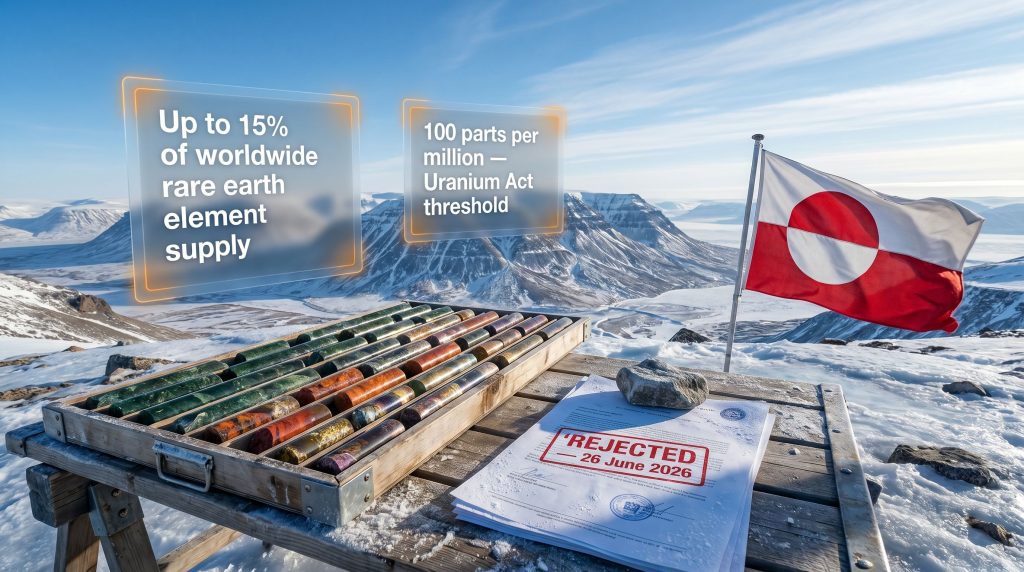
The Act establishes a threshold of 100 parts per million (ppm) uranium concentration as the operative legal boundary. This figure is critically important in practice:
- Uranium concentrations in the primary mineralised zones at Kvanefjeld have historically exceeded this threshold in large portions of the resource.
- Energy Transition Minerals (ETM) conducted new exploration in 2025 that identified mineralised zones across the licence area where uranium concentrations fall below the 100-ppm limit.
- The company argues this data materially changes the regulatory calculus, but contends it was not meaningfully evaluated before the rejection was issued.
Technical Note: The Ilímaussaq alkaline complex is one of the world's most geochemically unusual mineral systems. Its lujavrite rock units host exceptionally high concentrations of rare earth elements, niobium, and uranium within the same mineral phases, principally steenstrupine and naujakasite. This co-location is not incidental contamination but a fundamental product of the magmatic differentiation processes that formed the complex. Separation at the mineralogical level is technically complex and expensive, which is why the 100-ppm threshold is not merely a regulatory line but a geological challenge.
The 2026 Parliamentary Vote: Signal Without Substance
Greenland's parliament, the Inatsisartut, voted 15 to 14 in 2026 to revisit uranium policy, indicating a narrow but real appetite for reconsideration. However, this vote did not amend Act 20, did not suspend its provisions, and did not create any carve-out for the Kvanefjeld project. The Ministry's rejection proceeded under the existing legal framework, meaning that political willingness to debate the issue did not translate into regulatory relief for the licence holder.
Kvanefjeld's Strategic Scale in the Global REE Landscape
A Deposit Unlike Almost Any Other Outside China
The Kvanefjeld project sits within the broader Kringlerne-Kvanefjeld REE district in southern Greenland and is regarded by analysts as one of the largest undeveloped rare earth deposits identified outside Chinese-controlled jurisdictions. The project's potential to supply up to 15% of global rare earth element demand if brought into production is a figure that commands serious attention when viewed against the backdrop of current supply concentration.
| Strategic Metric | Detail |
|---|---|
| Potential REE supply contribution | Up to 15% of global rare earth element supply |
| Project location | Southern Greenland, Ilímaussaq alkaline complex |
| Original exploration licence issued | 2007 |
| Licence under review | Exploration Licence 2010/02 |
| Uranium concentration legal threshold | 100 ppm under Greenland's Uranium Act (Act 20) |
| Formal rejection date | 26 June 2026 |
| Licence extension request submitted | September 2025 |
China's rare earth strategy currently sees it controlling an estimated 60% to 70% of global rare earth mining output and an even higher share of downstream processing and separation capacity. For Western economies seeking to build resilient supply chains for electric vehicles, defence systems, wind turbines, and advanced electronics, a deposit capable of supplying 15% of global REE demand is not a marginal opportunity. It represents one of the few near-term pathways capable of making a structural difference to supply concentration.
Why REE Projects of This Scale Are Exceptionally Rare
Developing a world-class REE deposit requires an intersection of factors that rarely occur together:
- Sufficient grade and tonnage to support economically viable processing at scale.
- Mineralogical amenability to separation using commercially proven methods.
- A balanced basket of light and heavy rare earth elements, since not all REEs carry equal market value.
- Accessible geography and existing or buildable infrastructure.
- A stable regulatory environment capable of supporting decade-long investment horizons.
Kvanefjeld satisfies most of these criteria at an exceptional level. The deposit's REE basket includes meaningful concentrations of neodymium and praseodymium, the magnet metals that sit at the heart of EV motor and wind turbine demand growth. Consequently, the project's failure to proceed is not simply a Greenlandic domestic matter. It represents a tangible reduction in the optionality available to allied nations working to diversify away from Chinese REE dependency.
The Administrative Rejection: A Timeline of Compressed Decision-Making
September 2025 to June 2026: How the Process Unfolded
The sequence of events leading to the formal rejection raises procedural questions that are now at the centre of legal proceedings. According to reporting from Mining Journal, the timeline unfolded as follows:
- September 2025: Greenland Minerals submits the formal application to extend Exploration Licence 2010/02.
- April 2026: Greenland's Ministry of Business and Mineral Resources initiates a party consultation process.
- 15 June 2026: The company delivers a detailed written response to the Ministry's consultation, incorporating its 2025 exploration findings.
- 22 June 2026: The Ministry introduces two additional geological memoranda and demands a company response within 48 hours.
- Late June 2026: ETM requests a one-week extension to allow considered technical analysis of the new documents. The Ministry declines.
- 26 June 2026: The Ministry formally rejects the exploration licence extension.
Procedural Concern: The Ministry's refusal to grant a one-week extension after introducing entirely new geological documents raises substantive questions about whether the consultation process met the standards of procedural fairness expected under Greenlandic administrative law. A 48-hour window to respond to complex technical geological memoranda is, by any reasonable measure, an insufficient timeframe for considered scientific analysis.
The Ministry's Official Position
Greenland's Ministry of Business and Mineral Resources concluded that continued exploration in the Kvanefjeld area would not produce mineral deposits capable of commercial development within the constraints of the existing Uranium Act. This is a legal finding, not a geological one. The Ministry did not determine that no mineral resources exist. It determined that the legal framework prevents exploitation of whatever resources are found, which is a fundamentally different conclusion with different implications for any legal challenge.
Jurisdictional Risk and Investor Confidence
What Investment-Grade Jurisdictions Actually Require
Critical mineral investment operates on decade-long time horizons. A mining project from initial exploration to first production typically requires ten to twenty years of sustained capital commitment, regulatory engagement, and technical development. The fundamental prerequisite for attracting this scale of long-term capital is jurisdictional predictability, meaning investors must be able to rely on a consistent and coherent regulatory framework that does not shift materially between the time capital is committed and the time returns are expected.
ETM's Managing Director Daniel Mamadou described the rejection as the latest in a pattern of shifting policy positions on a project of clear strategic significance, arguing that the decision materially undermines the predictability of Greenland's investment environment at precisely the moment when stable regulatory jurisdictions are a central requirement for Western critical mineral supply chain development. (Engineering and Mining Journal, June 2026)
This assessment carries weight beyond the immediate project. When regulatory frameworks change faster than project timelines, the entire risk calculus for exploration investment in that jurisdiction shifts. Capital becomes more expensive, partners become more cautious, and marginal projects simply do not attract funding.
The Complicating Layer: Community Opposition and Indigenous Rights
The political context surrounding Kvanefjeld extends beyond regulatory architecture. The nearby town of Narsaq, with a population of roughly 1,500, has been the focal point of sustained community opposition to the project. Concerns are centred on potential radioactive contamination of local water sources and the impact on Greenland's sheep farming and fishing industries.
The Inuit Circumpolar Council and other indigenous advocacy bodies have also raised objections grounded in self-determination and environmental stewardship principles. This layered opposition helps explain why Greenland's political environment has produced the narrow parliamentary votes and shifting policy positions that have characterised the project's recent history. The 15-14 vote in favour of reconsidering uranium policy reflects a genuinely divided society navigating competing visions of economic development and environmental identity.
Legal Options and What Victory Would Look Like
The Two Pillars of ETM's Legal Challenge
ETM and Greenland Minerals have confirmed they are pursuing all available legal remedies. The company's challenge rests on two interconnected arguments:
- Procedural deficiency: The compressed 48-hour consultation window, combined with the Ministry's refusal to grant a reasonable extension, constitutes a failure to meet the procedural standards required under Greenlandic administrative law.
- Applicability of Act 20 to pre-existing licences: The exploration licence was originally granted in 2007, fourteen years before the Uranium Act was enacted in 2021. The question of whether retroactive application of Act 20 to a longstanding licence holder is legally valid remains, in the company's view, a live and unresolved question before Greenland's High Court.
A successful challenge would most likely result in the rejection decision being set aside and the Ministry being required to conduct a procedurally adequate consultation process. It would not automatically result in licence approval, but it would reopen the assessment process and potentially require the Ministry to genuinely evaluate the 2025 exploration data showing below-threshold uranium concentrations in new mineralised zones.
The next major ASX story will hit our subscribers first
The Wider Supply Chain Consequences
Quantifying What the Western Alliance Has Lost, For Now
| Stakeholder Group | Impact of the Rejection |
|---|---|
| USA critical mineral policy | Loss of potential non-Chinese REE source contributing up to 15% of global supply |
| European Union supply chain resilience | Reduced diversification optionality away from Chinese-dominated processing |
| Allied governments broadly | Demonstration that geopolitical intent alone cannot override domestic regulatory barriers |
| Global mining investors | Heightened jurisdictional risk perception for Arctic and politically sensitive mineral projects |
| Greenland's investment attractiveness | Potential deterrent effect on future exploration capital directed to the territory |
The situation highlights a structural vulnerability that goes beyond any single deposit. Indeed, the Greenland minerals race depends not only on identifying large deposits outside China, but on those deposits being located in jurisdictions that can translate geological endowment into production reality. When regulatory frameworks create irresolvable conflicts between environmental law and mineral development, even the most strategically important deposits become stranded assets.
Alternative Non-Chinese REE Projects: A Thin Pipeline
The loss of Kvanefjeld's near-term development potential leaves a relatively thin pipeline of large-scale non-Chinese REE projects at advanced stages. Projects in Australia, Canada, and the United States are progressing, but none individually approaches the scale of Kvanefjeld's potential global supply contribution.
Furthermore, as analysed in a cautionary assessment from EJIL Talk, this makes the legal proceedings currently before Greenland's High Court consequential not just for ETM shareholders, but for the broader trajectory of Western critical mineral supply security.
Investor Disclaimer: This article contains forward-looking analysis regarding the potential supply contribution of the Kvanefjeld project and the outcomes of legal proceedings. Such statements involve inherent uncertainty. Readers should not rely on this analysis as the basis for investment decisions. The outcome of legal proceedings before Greenland's High Court is not predictable, and no assumption should be made about the likelihood of licence reinstatement.
The Governance Question No One Is Asking Loudly Enough
How Should Governments Align Environmental Law With Critical Mineral Strategy?
The Kvanefjeld rejection is ultimately a governance problem as much as a legal or geological one. Greenland's Uranium Act was enacted in response to legitimate environmental and community concerns. It reflects a democratic choice. However, the Act was designed without adequate consideration of its secondary effects on co-located REE development, and without any framework for evaluating deposits where uranium occurs incidentally below commercially significant concentrations.
Several other jurisdictions have grappled with analogous challenges and developed tiered frameworks that distinguish between uranium as a primary extraction target and uranium as an incidental mineral present at subcritical concentrations in primarily non-uranium deposits. Greenland has not yet built this nuance into its legislative architecture, and that gap is now costing the territory one of the world's most significant rare earth development opportunities.
The broader context matters here. Greenland's critical minerals have attracted intense geopolitical interest, and the narrow 15-14 parliamentary vote to reconsider uranium policy suggests the political will to address this legislative gap may exist. Whether that will translates into amendment before ETM exhausts its legal options remains one of the most consequential open questions in the global critical minerals sector. The outcome of the Greenland election guide findings further illustrates just how divided public sentiment remains on this defining issue.
Want to Stay Ahead of the Next Major Mineral Discovery Before the Market Moves?
While Kvanefjeld's fate remains entangled in Greenland's legislative architecture, significant ASX mineral discoveries are being made right now — and Discovery Alert's proprietary Discovery IQ model delivers real-time alerts the moment they hit the exchange, turning complex geological data into actionable insights for both short-term traders and long-term investors. Explore historic discoveries and their extraordinary returns, then begin your 14-day free trial to ensure you're positioned at the front of the market, not the back.