June 29, 2026
The Scarcity Equation: Why Heavy Rare Earths Are the Minerals That Industrial Economies Cannot Afford to Ignore
Not all rare earths are created equal. The 17 elements that make up the rare earth group vary enormously in abundance, extractability, and strategic value. At one end of the spectrum sit the light rare earths, neodymium and praseodymium among them, which are geologically more distributed and produced from a broader range of deposit types globally. At the other end sit the heavy rare earths: dysprosium, terbium, and yttrium. These elements are far scarcer in the Earth's crust, concentrated in fewer deposit types, and almost entirely sourced from a single country. That country is China, which controls an estimated 90% or more of global dysprosium and terbium supply.
This is not merely a mining statistic. It is a structural vulnerability embedded in the supply chains powering the global energy transition. Every high-performance electric vehicle motor, every direct-drive offshore wind turbine generator, and a growing array of defence systems relies on sintered neodymium-iron-boron permanent magnets. Those magnets, in turn, require dysprosium and terbium additions to maintain magnetic performance at elevated operating temperatures. No commercially viable substitute exists at scale. The dependency is real, and the geopolitical exposure it creates has pushed rare earth supply chains to the top of industrial policy agendas across Europe, North America, and allied economies.
It is within this context that the Norra Kärr heavy rare earth project in southern Sweden has emerged as one of the most closely watched critical minerals developments in Europe.
When big ASX news breaks, our subscribers know first
Understanding What Makes Norra Kärr Geologically Unusual
Most rare earth deposits are dominated by light rare earths. The economics of conventional rare earth mining are typically built around neodymium and praseodymium, with heavy rare earths appearing as minor by-products. Norra Kärr inverts this logic almost entirely.
The deposit is hosted within the Norra Kärr Alkaline Complex, an alkaline intrusive geological system in southern Sweden where rare earth mineralisation occurs primarily within eudialyte-group minerals. Eudialyte is a sodium-calcium-cerium-zirconium cyclosilicate that is rare by global standards and tends to concentrate heavy rare earths to a degree that conventional carbonatite or ionic clay deposits do not. This geological host is a critical differentiator.
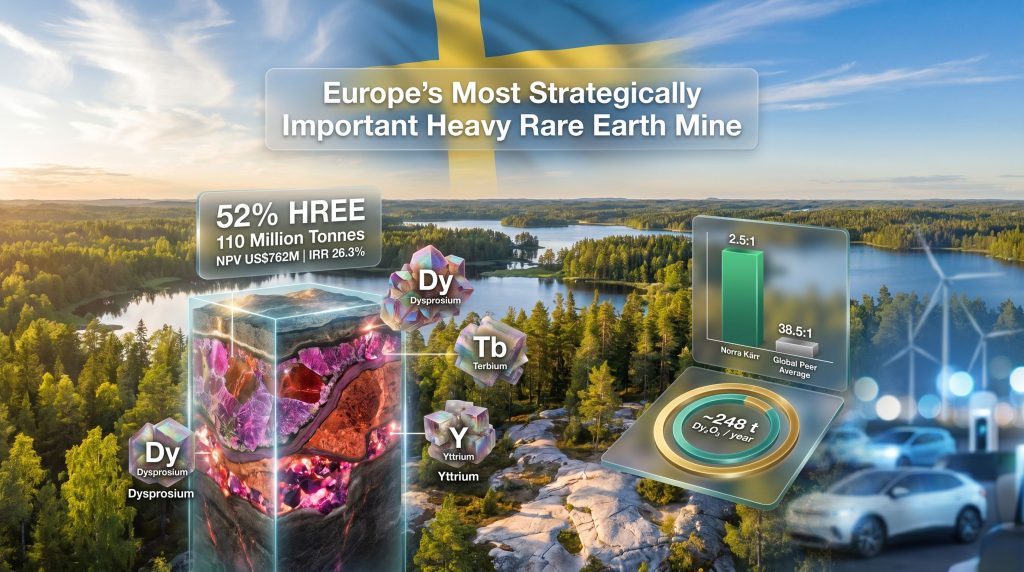
The result is a deposit in which approximately 52% of total rare earth content by value consists of heavy rare earths, primarily dysprosium, terbium, and yttrium. The NdPr-to-DyTb production ratio at Norra Kärr is estimated at 2.5:1, meaning that for every kilogram of neodymium-praseodymium produced, the deposit is projected to yield 0.4 kg of dysprosium-terbium combined. The global peer group average ratio sits at 38.5:1, implying peers generate roughly 0.026 kg of DyTb per kilogram of NdPr. Norra Kärr is therefore approximately 15 times more HREE-enriched than comparable rare earth projects worldwide.
This ratio is not a marginal advantage. It reflects a fundamentally different deposit type that produces the most economically valuable and geopolitically sensitive rare earth elements as primary outputs rather than incidental by-products.
The deposit's overall resource stands at 110 million tonnes grading 0.5% total rare earth oxides (TREO), classified as an inferred resource. By-products including zirconium, niobium, hafnium, and nepheline syenite are expected to contribute meaningfully to project economics, providing revenue diversification that insulates the project from single-commodity price exposure.
Eudialyte Metallurgy: A Double-Edged Sword
One aspect of the Norra Kärr heavy rare earth project that receives insufficient attention in mainstream coverage is the metallurgical complexity of eudialyte-hosted rare earth deposits. Eudialyte is not a simple mineral to process. It is reactive, and standard acid-leach approaches can trigger the precipitation of silica gels that complicate solid-liquid separation and dramatically reduce processing efficiency.
Leading Edge Materials and its predecessors have invested years in developing a flowsheet capable of handling these characteristics. The upside of solving the eudialyte processing challenge is that the approach can, in principle, involve lower overall acid consumption than conventional rare earth refining routes, potentially offering environmental process advantages. However, the metallurgical pathway remains a key technical risk that the upcoming pre-feasibility study will need to address with updated data and engineering rigour.
Resource Scale, Economics, and What the Numbers Actually Mean
The 2021 preliminary economic assessment (PEA) for Norra Kärr, conducted prior to the significant price appreciation seen in dysprosium and terbium markets through 2023 to 2025, established the following baseline economics:
| Financial Metric | PEA Value (2021 Basis) |
|---|---|
| Post-Tax NPV (10% Discount Rate) | US$762 million |
| Internal Rate of Return (IRR) | 26.3% |
| Average Annual EBITDA | US$206 million |
| Modelled Mine Life | 26 years |
| Annual MREO Production | 5,340 tonnes |
| Resource Utilised in PEA | ~30% of 110 Mt inferred |
| Estimated Annual Dysprosium Output | ~248 tonnes of oxide |
| Estimated Annual Terbium Output | ~36 tonnes of oxide |
A critical point rarely emphasised in headline reporting is that these figures were modelled against older and materially lower dysprosium and terbium price assumptions. Dysprosium oxide prices have historically commanded a premium of roughly five to ten times the price of NdPr oxide on a per-kilogram basis, and terbium commands an even greater premium. Furthermore, given that Norra Kärr's revenue architecture is driven primarily by DyTb rather than NdPr, any upward revision to HREE prices flows disproportionately to the project's bottom line.
An updated pre-feasibility study incorporating current market pricing could therefore produce a materially higher NPV figure. Investors and analysts treating the US$762 million figure as a ceiling rather than a floor may be significantly underestimating the project's economic potential.
The PEA's resource utilisation of only 30% of the total inferred resource to support a 26-year mine life is equally significant. It implies substantial long-term optionality: if additional resource is converted to measured and indicated categories through further drilling, the project's mine life could be extended well beyond the modelled 26 years, adding value that does not yet appear in any formal economic study.
The 25-Year Concession: A Decade-Long Regulatory Journey Concludes
The regulatory history of Norra Kärr is a case study in the complexity of balancing critical mineral development against environmental protection in a mature democratic jurisdiction.
An initial mining concession was granted and then revoked in 2016, three years after issuance, following environmental objections relating to water management, land use, and ecological impact concerns. Rather than pursuing an accelerated political workaround, Leading Edge Materials undertook a substantive project redesign that reduced the physical footprint of the operation by 65%. This approach, which prioritised genuine engagement with the underlying concerns rather than procedural responses, ultimately formed a significant part of the case presented to Swedish authorities in the reapplication process.
In June 2026, the Swedish government granted a 25-year exploitation concession following a formal recommendation from Sweden's mining inspectorate. The Swedish Geological Survey's independent assessment, confirming the Norra Kärr heavy rare earth project as one of Europe's richest rare earth deposits, was cited as a decisive factor. The government's decision explicitly concluded that supplying Sweden and the broader European Union with these critical raw materials constitutes a public interest that outweighs competing land-use claims. This legal framing carries implications well beyond Norra Kärr, potentially establishing a precedent for how European jurisdictions resolve such trade-offs as the Critical Raw Materials Act framework is implemented across member states.
The concession term of 25 years aligns closely with the project's modelled 26-year mine life, eliminating the risk of a mid-project regulatory cliff that would otherwise deter long-dated institutional capital. This alignment was not accidental and reflects a level of regulatory sophistication that distinguishes Sweden as a jurisdiction for critical minerals investment.
How Norra Kärr Positions Within Europe's Critical Minerals Landscape
The European Union currently produces zero rare earth elements domestically. Its dependency on Chinese heavy rare earth supply for permanent magnet production sits above 90% for both dysprosium and terbium. The EU's Critical Raw Materials Act has classified both elements as critical and strategic, establishing binding domestic sourcing targets for member states and large industrial users by 2030.
Against this backdrop, the supply potential of Norra Kärr is striking. The project's projected annual output of approximately 248 tonnes of dysprosium oxide has been described by the company's CEO Kurt Budge as sufficient to cover Europe's full annual dysprosium requirements at current consumption levels, alongside meaningful contributions to terbium and yttrium supply. In addition, the broader landscape of Europe's strategic metals projects underscores just how rare it is to find a deposit of this HREE intensity within a stable, tier-one European jurisdiction.
Benchmarking Against European Rare Earth Alternatives
| Project | Location | HREE Intensity | Stage | Scale Potential |
|---|---|---|---|---|
| Norra Kärr | Sweden | Very High (52% HREE) | Pre-Feasibility (2026) | ~5,340 t MREO/yr |
| Kiruna LKAB REE | Sweden | Moderate | Early R&D | Undefined |
| Tanbreez | Greenland | High | Exploration/PEA | Early-stage |
| Gakara | Burundi | LREE-dominant | Small-scale production | Limited |
No other project in Europe combines Norra Kärr's HREE enrichment profile, inferred resource scale, and jurisdictional quality. Furthermore, the Tanbreez REE project in Greenland, whilst promising, remains at a considerably earlier development stage and lacks the jurisdictional certainty that Sweden's regulatory framework now provides. The European Rare Earths Competency Network previously identified Norra Kärr as one of only two advanced-stage REE projects in Europe capable of delivering meaningful multi-decade supply.
The Processing Gap That Mining Cannot Solve Alone
A dimension of the rare earth challenge that is often underappreciated in project-level analysis is that mining approval addresses only the first stage of the supply chain problem. Europe currently possesses almost no rare earth separation and refining capacity. Even if Norra Kärr reaches production on schedule, the concentrate it produces will require downstream processing infrastructure that does not yet exist at scale within the EU or in closely allied jurisdictions.
This processing gap means that the full realisation of Norra Kärr's strategic value depends on parallel investment in European critical raw materials supply infrastructure, whether through dedicated facilities linked to the project, multi-project separation hubs, or partnerships with allied processing nations. It is a systemic challenge that no single project can resolve independently, and it represents a significant capital and policy coordination task for European industrial stakeholders.
Development Pathway: What Comes Next
With the concession secured, Leading Edge Materials has outlined the following development sequence:
- Updated Pre-Feasibility Study (PFS): Incorporating revised HREE pricing assumptions, updated metallurgical test data, and the redesigned reduced-footprint mine plan. This will be the first formal economic study to reflect current market conditions.
- Environmental Permitting: Conducted under Swedish environmental law, with a community engagement process that explicitly includes stakeholders who remain sceptical of the project.
- Offtake Discussions: Targeting European manufacturers in the EV, wind energy, and defence sectors seeking to diversify away from Chinese HREE sourcing.
- Project Financing: Expected to involve a combination of strategic equity, debt facilities, and potentially EU-level critical minerals financing instruments, though no specific arrangements have been confirmed.
- Definitive Feasibility Study (DFS): Definitive feasibility studies represent the final engineering and costing required before a construction decision can be made.
- Construction and Commissioning: Timeline dependent on permitting duration and financing close; European critical minerals projects with strong fundamentals have historically moved from PFS to construction decision in four to seven years.
The next major ASX story will hit our subscribers first
Environmental and Community Dimensions
The 2016 concession revocation was a costly lesson, but it produced a better project. The 65% reduction in surface footprint reflects a genuine rethinking of mine design rather than cosmetic adjustment. Smaller-footprint approaches in hard rock mining typically involve greater selectivity in ore extraction, optimised waste management, and reduced hydrological disruption, all of which address the specific concerns that led to the original revocation.
Eudialyte processing, when optimised correctly, can offer environmental process advantages over conventional rare earth refining methods, particularly in terms of acid reagent consumption. These characteristics, combined with Sweden's world-class environmental regulatory framework, position Norra Kärr to be developed to standards that are credibly among the highest in the global rare earth industry. Whether that credibility translates into community acceptance in the project's immediate locale remains an open question and a genuine execution risk.
Key Risk Factors Investors Should Weigh
- Metallurgical complexity: Eudialyte processing remains technically demanding and the updated PFS must demonstrate a commercially robust flowsheet.
- Environmental permitting timeline: Community opposition, if sustained, could extend permitting beyond modelled timelines.
- Processing infrastructure gap: Norra Kärr's value is only fully realised when downstream separation capacity exists in Europe or an allied jurisdiction.
- Pricing assumptions: The 2021 PEA economics are based on outdated HREE prices; an updated PFS will either confirm or challenge the economic case under current conditions.
- Capital requirements: Bringing a project of this scale to production will require significant capital that a company with a market capitalisation of approximately C$85 million cannot fund independently.
- Resource conversion: The inferred classification of the 110 Mt resource requires upgrade through additional drilling before bankable financing can be secured.
This article is intended for informational purposes only and does not constitute financial or investment advice. All forward-looking statements regarding project economics, timelines, and resource estimates carry inherent uncertainty and should not be relied upon as guarantees of future outcomes. Investors should conduct independent due diligence before making any investment decisions.
Want to Stay Ahead of the Next Major Critical Minerals Discovery?
Discovery Alert's proprietary Discovery IQ model delivers real-time alerts on significant ASX mineral discoveries — instantly translating complex geological data into actionable investment insights for both short-term traders and long-term investors. Explore how historic discoveries have generated substantial returns on Discovery Alert's dedicated discoveries page, and begin your 14-day free trial today to position yourself ahead of the broader market.