
May 17, 2026
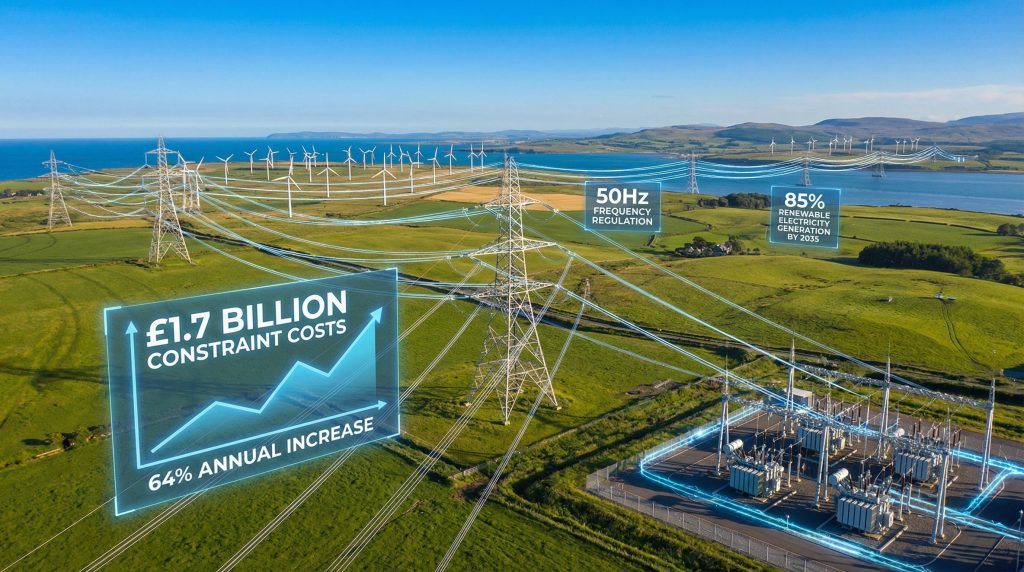
Grid Infrastructure Engineering: The Foundation of Energy Security
Grid stability in Britain's energy transition requires unprecedented coordination between renewable generation and traditional infrastructure systems. Power system engineering traditionally relied on the predictable behavior of synchronous generators, where massive rotating machines naturally maintained frequency stability through mechanical inertia. Modern electrical grids face unprecedented challenges as renewable energy sources fundamentally alter these established dynamics.
Unlike conventional power plants that provide inherent system stability, wind and solar installations require sophisticated electronic control systems to maintain grid frequency within operational tolerances. The transition to renewable-dominant electricity systems demands comprehensive understanding of frequency regulation mechanisms, voltage stability requirements, and power quality management across transmission networks.
Furthermore, these technical parameters determine whether Britain's clean energy ambitions translate into reliable electricity supply or costly system instability. The integration of electric vehicles in mining and other industrial applications creates additional complexity for grid operators managing variable demand patterns.
When big ASX news breaks, our subscribers know first
Technical Requirements for System Stability
Electrical grid stability operates on precise technical specifications that govern power system reliability. Frequency regulation must maintain the standard 50Hz within ±0.5Hz tolerance under normal operating conditions, while voltage levels require continuous management across transmission networks.
System operators monitor power factor balance, reactive power flows, and maintain adequate system inertia during periods of reduced conventional generation. Traditional power systems derived stability from synchronous generators whose rotating masses naturally resisted frequency changes.
However, renewable energy sources connect through power electronics that can provide faster response times but lack mechanical inertia. This fundamental shift requires grid operators to procure additional frequency response services, increasing operational costs while maintaining system reliability.
Critical Grid Parameters:
- Primary frequency response: 1-2 second automatic control
- Secondary response: 3-30 second manual adjustment
- Tertiary response: 30+ second system restoration
- Reactive power requirements: 100-150 MVAr across transmission networks
- Rate of Change of Frequency (RoCoF) limits: Enhanced protection settings
Advanced Static Var Compensators and Static Synchronous Compensators increasingly provide voltage support as inverter-based renewables proliferate. These technologies compensate for the reactive power characteristics of current-source renewable generators, ensuring voltage stability across distribution networks.
Consequently, the August 2019 frequency event demonstrated system vulnerabilities when frequency dropped to 48.8Hz following unexpected generation losses. This incident triggered automatic demand disconnection procedures, highlighting critical infrastructure dependencies during periods when synchronous generation margins compress.
Infrastructure Bottlenecks: Geographic Constraints and Transmission Limitations
Britain's electricity system confronts severe transmission capacity constraints between renewable-rich generation regions and major demand centers. Scotland and offshore areas generate substantial wind capacity during favorable weather conditions, but existing AC transmission corridors lack adequate capacity to transfer this power to population centers in southern England and the Midlands.
The National Electricity System Operator reports thermal constraint costs reaching £1.7 billion in 2024/25, representing a 64% annual increase. These costs arise when transmission networks operate at capacity limits, forcing operators to pay generators to reduce output in constrained areas.
In addition, operators must simultaneously activate expensive backup generation in demand regions. This creates significant economic pressures that affect both system costs and consumer bills.
Regional Infrastructure Analysis:
| Generation Zone | Installed Capacity | Local Demand | Infrastructure Gap |
|---|---|---|---|
| Scottish Highlands | 12.8 GW wind | 3.2 GW average | 9.6 GW export requirement |
| North Sea Offshore | 8.7 GW operational | Minimal onshore load | Full transmission dependency |
| Southern England | 4.3 GW renewables | 32.1 GW peak winter | 27.8 GW import requirement |
| Welsh Coast | 2.9 GW wind | 4.7 GW demand | Bidirectional flows |
Connection queue backlogs extend beyond 2035 for major infrastructure projects, with over 700 GW of generation and storage capacity seeking grid access. This represents more than ten times current system capacity, indicating fundamental inadequacy of transmission planning processes and infrastructure delivery timelines.
Economic Impact of Grid Constraints
Constraint payment mechanisms create economic inefficiencies where wind farms receive £500-800/MWh curtailment payments during high-generation periods, compared to typical wholesale prices of £60-90/MWh. These costs embed directly in consumer bills through system balancing charges, creating political vulnerabilities for renewable energy policies.
Multiple winter constraint events during 2023/24 demonstrated the escalating costs of geographic generation-demand mismatches. Constraint payment hours increased 156% compared to 2019/20 baseline levels, with total addressable constraint costs approaching critical thresholds for public acceptance of transition costs.
System Balancing Economics: The Hidden Costs of Renewable Integration
Electricity system balancing costs represent the operational friction of integrating variable renewable generation with inflexible demand patterns. The UK's Balancing Services Use of System charges totaled £2.7 billion in 2024/25, with specific cost components revealing the technical challenges of renewable integration.
Detailed Cost Structure Breakdown:
- Frequency response services: £450 million annually
- Voltage support mechanisms: £280 million for reactive power compensation
- Reserve capacity payments: £340 million for backup generation availability
- Constraint management: £1.7 billion for thermal limit violations
- Emergency response: £180 million for system restoration capabilities
Consumer bill impacts from balancing costs contribute approximately £30 annually to average household electricity expenses, representing 3.5% of total energy costs. While individually manageable, these costs create cumulative political pressure as renewable penetration increases without corresponding infrastructure investments.
Furthermore, the trajectory of balancing costs shows concerning acceleration: from £1.8 billion in 2019/20 to £2.7 billion in 2024/25, representing a 50% increase over five years. This growth rate significantly exceeds renewable capacity additions, indicating structural inefficiencies in grid integration approaches.
Balancing Service Categories
System operators require continuous frequency response services to manage moment-to-moment variations in supply and demand. Traditional generators provided these services automatically through governor response and mechanical inertia. Modern systems increasingly rely on battery energy storage, demand response programs, and synthetic inertia from renewable generators.
Voltage support services maintain power quality across transmission networks as solar and wind installations alter reactive power flows. These services previously came from synchronous generators operating in voltage regulation mode, but now require dedicated Static Var Compensators and power electronics-based solutions.
Constraint payments represent the most visible and controversial balancing cost category. When transmission capacity limits prevent power flow from generation to demand areas, system operators must manage these constraints through economic dispatch, paying generators to reduce or increase output regardless of merit order efficiency.
Advanced Grid Technologies: Engineering Solutions for System Integration
High-Voltage Direct Current transmission technology offers superior performance characteristics for long-distance power transfer compared to conventional AC systems. HVDC infrastructure demonstrates 30% lower transmission losses over distances exceeding 600 kilometres, enhanced grid stability through independent frequency control, and reduced electromagnetic interference in populated areas.
The evolution of mining industry technology provides valuable insights for grid modernisation approaches. Similarly, developments in critical minerals and energy security demonstrate how strategic resource management affects infrastructure reliability.
Strategic HVDC Development Projects:
The Shetland HVDC Link represents a critical test case for UK offshore wind integration, with 600-800 MW capacity planned for completion by 2031-32. Investment costs of £1.8-2.2 billion demonstrate the capital intensity required for grid modernisation, but the project enables direct export of North Sea wind generation to Scotland's Central Belt demand centres.
The North Sea Grid Initiative involves ten European countries coordinating development of 100 GW offshore wind capacity with integrated HVDC transmission infrastructure by 2040. This multinational approach addresses geographic generation-demand mismatches through shared transmission rather than duplicated national infrastructure investments.
HVDC Performance Specifications:
| Technical Parameter | AC Transmission | HVDC Technology |
|---|---|---|
| Distance efficiency threshold | Economic <300km | Economic >600km |
| Power transfer capacity | 1-3 GW per circuit | 1-2 GW per bipole |
| Transmission losses | 3-5% per 100km | 2-3% per 100km |
| Right-of-way requirements | 60-80m corridor width | 30-40m corridor width |
| Converter station costs | Minimal | £200-400M per terminal |
Smart Grid Technologies and AI Integration
Smart grid technologies enable real-time optimisation of power flows and demand response coordination across distribution networks. Advanced metering infrastructure provides five to fifteen minute demand forecasting accuracy versus traditional thirty-minute settlement periods, enabling more responsive system operation.
Artificial intelligence applications in grid management demonstrate measurable performance improvements: load forecasting root mean square error reductions of 12-18% compared to traditional ARIMA statistical models. In addition, predictive maintenance programs achieve 30-40% reductions in transformer failures, whilst optimal power flow algorithms reduce transmission losses by 2-4% through intelligent routing.
Vehicle-to-Grid Integration Potential:
The UK's expanding electric vehicle fleet presents opportunities for grid support services through bidirectional charging technology. With 4.8 million EVs currently deployed and projections reaching 10 million vehicles with V2G capability, potential flexible load capacity could reach 25-50 GW during peak demand periods.
Technical barriers limit current V2G deployment to less than 5% of public charging infrastructure, requiring enhanced interoperability standards, cybersecurity protocols, and market mechanisms for compensating grid services from distributed vehicle batteries.
Critical Materials and Supply Chain Dependencies
Grid infrastructure deployment requires substantial steel inputs across multiple technology categories, creating supply chain bottlenecks that constrain transition timelines. World Steel Association data quantifies material intensity requirements: onshore wind turbines average 180 tonnes of steel per MW, while offshore installations require 450 tonnes per MW installed capacity.
The relationship between iron ore market trends and energy infrastructure development demonstrates how commodity markets influence transition timelines. Consequently, strategic planning must account for material availability alongside technical capabilities.
Infrastructure Steel Requirements Analysis:
| Technology Category | Steel Intensity | UK Deployment Target | Total Material Demand |
|---|---|---|---|
| Onshore wind farms | 180 tonnes/MW | 35 GW additional | 6.3 million tonnes |
| Offshore wind installations | 450 tonnes/MW | 60 GW total | 27 million tonnes |
| Transmission line construction | 85 tonnes/km | 5,000 km new lines | 425,000 tonnes |
| Substation infrastructure | 1,200 tonnes/facility | 200 new substations | 240,000 tonnes |
| HVDC converter stations | 5,000 tonnes/station | 20 terminals | 100,000 tonnes |
Specialised steel grades present additional supply chain vulnerabilities: high-strength weathering steel for transmission towers, electrical steel for transformer cores, corrosion-resistant alloys for offshore applications, and advanced materials for high-temperature superconducting cables.
Manufacturing Capacity Constraints
Limited UK production capacity for electrical steel creates dependencies on European suppliers, extending lead times for critical grid components. Transformer manufacturing requires specialised facilities with quality assurance capabilities appropriate for grid-critical applications, while offshore applications demand materials with enhanced fatigue resistance and corrosion performance.
Steel stockholding strategies, precision machining capabilities, non-destructive testing protocols, and quality assurance regimes determine whether policy targets translate into functioning infrastructure. These industrial capabilities represent bottlenecks that constrain deployment timelines regardless of policy ambition or financial resources.
The next major ASX story will hit our subscribers first
Electric Vehicle Infrastructure Integration
Electric vehicle charging infrastructure creates new demand patterns that fundamentally challenge grid stability assumptions. Rapid charging installations require 50-350 kW power draws per vehicle, with ultra-rapid charging exceeding 350 kW capacity. Multiple simultaneous charging events during peak demand periods create concentrated load spikes in distribution networks designed for residential demand patterns.
The UK currently operates approximately 88,000 public charging points, while government estimates suggest requirements for 250,000 to 550,000 installations by 2030. This deployment rate implies sustained infrastructure development far exceeding historical precedents, with corresponding grid reinforcement needs.
Geographic Clustering Challenges:
EV charging infrastructure concentrates at motorway service stations, urban commercial centres, and residential areas with high EV adoption rates. This clustering creates localised grid stress during peak charging periods, particularly when combined with heating electrification and industrial demand growth.
Distribution network operators must upgrade transformer capacity, cable ratings, and protection systems to accommodate charging load profiles that differ significantly from traditional residential consumption patterns. These upgrades require coordination with transmission system reinforcements to ensure adequate power supply during simultaneous charging events.
Vehicle-to-Grid Service Provision
Bidirectional charging technology enables electric vehicles to provide grid support services during periods when batteries are not required for transport. Technical implementation requires smart charging infrastructure deployment, grid code modifications for distributed resource operation, cybersecurity protocols for networked charging systems, and market mechanisms compensating vehicle owners for grid service provision.
Grid support services from EVs include frequency regulation during low-demand periods, peak demand shaving through distributed storage, emergency backup power for critical loads, and voltage support in distribution networks. These services can offset some system balancing costs while providing revenue streams for EV owners.
Current V2G deployment remains limited by interoperability standards, with IEEE 1547 compliance testing required for distributed energy resources. Cybersecurity considerations increase complexity as thousands of mobile storage units require authentication and control protocols suitable for grid-critical applications.
Regulatory Framework Evolution and Investment Strategies
Ofgem's Connections Reform programme implements strategic project prioritisation through "First Ready, First Needed" assessment criteria, replacing chronological queue management with technical and economic evaluation. This regulatory evolution aims to accelerate connection timelines for projects that enhance system stability and security of supply.
The approved £28 billion network investment programme through 2031 focuses on strategic transmission reinforcements, offshore wind connection infrastructure, distribution network flexibility upgrades, and energy storage integration capabilities. Investment priorities reflect technical requirements for managing increased renewable penetration whilst maintaining system reliability.
For investors seeking broader market opportunities, understanding these infrastructure requirements provides valuable context for developing a comprehensive investing guide that accounts for energy transition impacts across multiple sectors.
Priority Investment Categories:
- Strategic transmission corridors: Scotland-England reinforcement, offshore collection networks
- Distribution network modernisation: Smart grid deployment, automated switching systems
- Grid-scale storage integration: Battery connections, pumped hydro development
- System stability services: Synchronous compensators, inertia provision
International Cooperation Frameworks
International cooperation frameworks address cross-border transmission development through coordinated planning and shared investment structures. The North Sea Wind Power Hub initiative demonstrates how multinational infrastructure development can optimise resource utilisation whilst reducing individual country investment requirements.
Enhanced grid capacity release mechanisms enable unused transmission rights to be reallocated to projects capable of earlier commissioning. Improved coordination between transmission and distribution operators reduces planning delays and infrastructure conflicts. Streamlined consent processes for strategic projects balance environmental protection with infrastructure deployment urgency.
Grid code modifications accommodate new technology characteristics whilst maintaining system security standards. These technical regulations evolve continuously as renewable penetration increases and new grid support technologies demonstrate operational capability.
Long-Term Energy Security and Strategic Dependencies
Britain's energy security increasingly depends on supply chain resilience for critical infrastructure components rather than fuel supply diversification. Grid-scale battery manufacturing, HVDC equipment production, smart grid technology innovation, and skilled workforce development represent strategic capabilities that determine transition success.
System Resilience Requirements:
Future grid architecture must accommodate 85% renewable electricity generation by 2035 whilst supporting complete electrification of transport and heating sectors. Industrial decarbonisation through electrification adds additional load growth that compounds grid stability challenges during the transition period.
Extreme weather resilience becomes increasingly critical as climate change intensifies storm events that stress transmission infrastructure. Design standards, maintenance procedures, and emergency response capabilities require enhancement to maintain reliability during severe weather periods that may coincide with high electricity demand.
International Supply Chain Analysis
Critical technology components increasingly depend on international supply chains: rare earth elements for wind turbine permanent magnet generators, lithium and cobalt for battery energy storage systems, advanced semiconductors for power electronics, and specialised manufacturing capabilities for HVDC equipment.
The geopolitical dimension of energy transition materials creates strategic vulnerabilities that complement traditional energy security concerns. Furthermore, grid investment requirements demonstrate how European coordination affects national energy security strategies.
Domestic Capability Development:
Strategic technology independence requires domestic manufacturing capabilities for grid-critical components. Battery gigafactory development, power electronics manufacturing, specialised steel production, and advanced materials research represent industrial policy priorities that support energy security objectives.
Workforce development programmes must expand technical education in power system engineering, renewable energy integration, and advanced manufacturing processes. These human capital investments determine whether transition policies translate into operational infrastructure capability.
Strategic Integration: From Fragmented Policies to System Solutions
Grid stability in Britain's energy transition represents the convergence of multiple technical, economic, and strategic challenges that require integrated solutions rather than sector-specific policies. The interconnections between EV infrastructure deployment, renewable energy integration, critical materials supply chains, and international cooperation frameworks demand coordinated planning approaches.
System-wide optimisation requires simultaneous investment in generation capacity, transmission infrastructure, storage systems, and demand flexibility mechanisms. Fragmented approaches that address individual components without considering system interactions risk creating new bottlenecks whilst solving localised problems.
Performance Measurement Framework:
Success metrics must encompass system reliability, cost effectiveness, security of supply, and public acceptability rather than focusing solely on renewable capacity additions. Grid stability metrics, constraint cost trends, consumer bill impacts, and infrastructure resilience indicators provide comprehensive assessment of transition progress.
However, the next decade of Britain's energy transition will be determined by infrastructure delivery capability rather than policy ambition. Countries that successfully coordinate grid modernisation, supply chain development, and international cooperation will achieve clean energy objectives whilst maintaining economic competitiveness and energy security.
In conclusion, grid stability in Britain's energy transition requires unprecedented coordination across technical, regulatory, and industrial domains to deliver reliable, affordable, and secure electricity supply in a renewable-dominant system. The technical, economic, and strategic challenges outlined demonstrate that successful energy transition depends on integrated infrastructure solutions rather than isolated policy interventions.
Seeking Opportunities in Britain's Energy Infrastructure Transition?
Discovery Alert's proprietary Discovery IQ model delivers real-time alerts on significant mineral discoveries essential to grid modernisation, from critical minerals powering renewable energy systems to steel-intensive infrastructure projects. With Britain's energy transition requiring unprecedented material inputs and strategic resource coordination, subscribers gain immediate insights into actionable opportunities that support this massive infrastructure transformation. Begin your 14-day free trial today to secure your market-leading advantage in the commodities driving energy security.