May 15, 2026
Understanding Grid-Scale Battery Storage Development Within Britain's Complex Planning Framework
The acceleration of battery energy storage deployments across Britain represents a fundamental shift in how energy infrastructure intersects with local planning authority decision-making processes. As renewable energy targets intensify and grid modernisation demands escalate, battery storage planning approvals UK have emerged as a critical bottleneck determining project viability and connection timeline success.
Britain's devolved administrative structure creates a multi-layered approval pathway where developers must navigate distinct regulatory environments across England, Wales, Scotland, and Northern Ireland. This jurisdictional complexity, combined with evolving safety standards and environmental protection requirements, has created both opportunities and challenges for energy storage project developers seeking to capitalise on growing market demand.
The intersection of planning consent with grid connection queue positioning has fundamentally altered project development strategies, as planning approval status now directly influences connection offer timelines and commercial viability assessments.
When big ASX news breaks, our subscribers know first
The Multi-Jurisdictional Planning Framework for Battery Storage Projects
Understanding Core Regulatory Requirements
Battery storage planning approvals UK operate within a complex web of statutory requirements that vary significantly across jurisdictional boundaries. All grid-scale battery energy storage systems require formal planning permission from relevant local planning authorities, regardless of installed capacity or technology configuration.
The regulatory framework encompasses multiple compliance areas:
• Health and Safety Compliance: Projects must adhere to DSEAR (Dangerous Substances and Explosive Atmospheres Regulations) due to lithium-ion battery flammability classifications
• Electrical Safety Standards: Electricity at Work Regulations 1989 govern installation and maintenance protocols
• Fire Safety Requirements: Statutory consultation with local fire and rescue services for projects exceeding 1 MWh capacity
• Environmental Permitting: Integration with Environmental Permitting Regulations following recent Defra consultation processes
• Grid Connection Alignment: Coordination with NESO's reformed connection queue methodology prioritising planning-ready projects
Planning permission timelines typically range from 8-13 weeks for standard applications, though complex projects requiring Environmental Impact Assessment may extend significantly longer. The Development Management Procedure Order 2015 establishes the statutory framework governing formal consultation processes for projects exceeding 1 MWh capacity.
Furthermore, the permitting process insights reveal that planning approval requirements have evolved significantly following NESO's late-2025 grid connection queue reforms, with planning consent status now playing a substantially larger role in connection date assignments and project commercial viability.
Technology-Specific Considerations
Battery storage projects face unique planning considerations compared to other renewable energy technologies. Thermal runaway mitigation represents a primary design consideration, requiring comprehensive site layout planning to ensure adequate emergency access routes and containment systems.
| Planning Consideration | Standard Requirement | Enhanced Requirement |
|---|---|---|
| Fire Safety Consultation | Projects ≥1 MWh | All grid-scale installations |
| Environmental Impact Assessment | Case-by-case screening | Sensitive locations mandatory |
| Emergency Access Planning | Basic fire service access | Thermal incident containment systems |
| Site Bunding Requirements | Standard drainage | Enhanced firewater containment |
Battery Safety Management Plans now represent mandatory submission requirements at the planning application stage, incorporating detailed risk assessments and emergency response protocols tailored to specific technology configurations and site characteristics.
Regional Planning Authority Structures and Approval Pathways
England and Wales: Centralised Local Authority Model
England and Wales operate under a universal Local Planning Authority jurisdiction model, where all battery storage projects regardless of capacity require LPA approval. This centralised approach provides consistency in application procedures while maintaining local decision-making authority over land use planning considerations.
Pre-application engagement protocols have emerged as best practice, with successful developers typically conducting early consultations with:
• Local planning authorities during site selection phases
• Fire and rescue services for safety assessment preliminary reviews
• Community stakeholders through informal engagement processes
• Grid connection teams for technical feasibility confirmation
The Development Management Procedure Order 2015 establishes formal consultation requirements for projects exceeding 1 MWh, creating statutory timelines for stakeholder input and decision-making processes.
Early engagement with fire services during pre-application phases significantly reduces planning risk by identifying potential safety concerns before formal submission, allowing developers to incorporate mitigation measures into initial design phases rather than addressing concerns through costly post-application modifications.
Scotland: Specialised Energy Infrastructure Pathway
Scotland's planning system incorporates a tiered approval structure distinguishing between large-scale strategically important projects and smaller local developments. The Scottish Energy Consents Unit (SECU) provides specialised technical expertise for major energy infrastructure applications requiring ministerial approval.
Large-scale projects typically exceed specific capacity thresholds and trigger the ministerial consent pathway under Section 36 of the Electricity Act 1989. This specialised route provides:
• Technical expertise concentration for complex energy storage infrastructure
• Streamlined coordination with grid connection planning processes
• Integration with broader energy strategy and renewable energy targets
• Specialised consultation protocols for major infrastructure development
Local planning authority routes handle smaller installations through standard council-level procedures, maintaining consistency with other development applications while ensuring appropriate technical oversight for energy storage safety requirements.
Northern Ireland: Dual-Track Administrative System
Northern Ireland operates a dual-track planning system where project significance determines the appropriate approval pathway. The Department for Infrastructure (DfI) handles ministerial decisions for significant developments, while district councils maintain jurisdiction over smaller installations.
Generation licensing falls under Utility Regulator oversight, creating parallel approval processes where planning consent and generation licensing proceed independently but must coordinate for project completion and commissioning.
This administrative structure requires developers to manage multiple regulatory relationships simultaneously, coordinating timelines between planning approval and generation licensing while ensuring technical compliance across both regulatory frameworks.
Unprecedented Growth in Battery Storage Planning Approvals
Record-Breaking 2025 Development Statistics
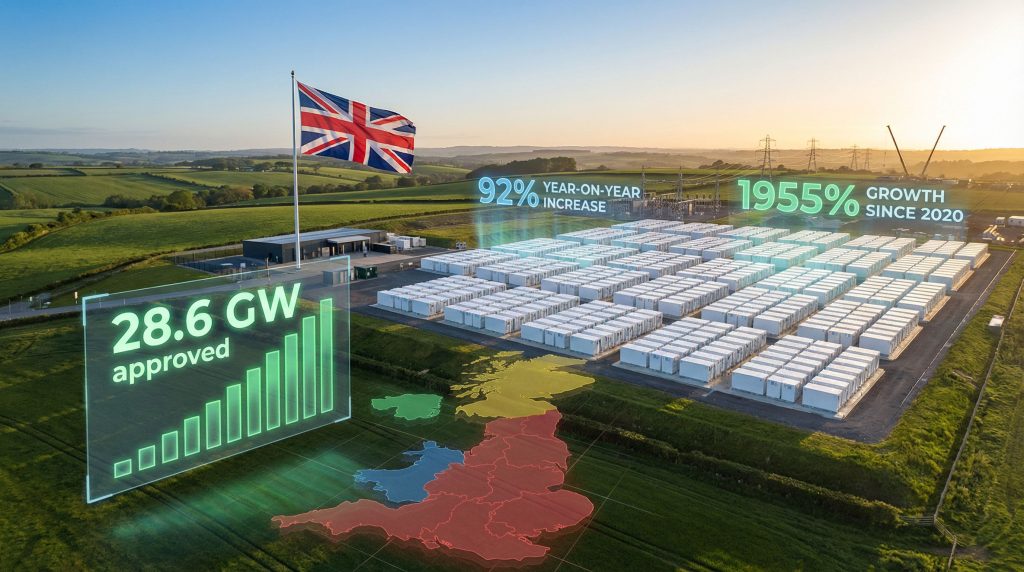
The first three quarters of 2025 witnessed unprecedented growth in battery storage planning approvals UK, with 28.6 GW of capacity securing planning permission across Great Britain. This represents a 92% increase compared to the complete 2024 approval total of 14.9 GW, demonstrating accelerating market momentum and developer confidence.
Battery storage has emerged as the dominant technology within renewable energy planning approvals, accounting for more than half of the 45 GW total renewables capacity approved in Q1-Q3 2025. This marks a fundamental shift in the composition of the UK's renewable energy development pipeline.
| Technology | Q1-Q3 2025 Approvals | Market Share | 2024 Comparison |
|---|---|---|---|
| Battery Storage | 28.6 GW | 63.6% | +92% vs 14.9 GW |
| Offshore Wind | 9.9 GW | 22.0% | Data not provided |
| Solar PV | 5.72 GW | 12.7% | Data not provided |
| Onshore Wind | 1.15 GW | 2.6% | Data not provided |
Long-term growth trajectory analysis reveals a 1,955% cumulative increase in battery storage planning approvals since 2020, when only 1.39 GW secured planning permission. This exponential growth pattern positions battery storage as the fastest-growing energy technology progressing through the UK planning system.
Strategic Market Drivers Behind Approval Acceleration
Analysis from Cornwall Insight identifies three primary factors driving the unprecedented approval surge. However, the surge in planning approvals for green energy projects highlights additional market dynamics at play.
Market Maturation Effects: The battery storage sector has demonstrated increased sophistication in project development, with developers exhibiting improved technical expertise, financial backing, and stakeholder engagement capabilities. This maturation has translated into higher-quality planning applications with reduced approval risk.
Grid Connection Queue Reform Response: NESO's implementation of new connection queue methodology in late 2025 created strong incentives for developers to secure planning consent rapidly. The reformed system prioritises project "readiness" criteria, where planning permission now plays a substantially larger role in connection date assignments.
Political Uncertainty Navigation: Local election cycles across various UK jurisdictions influenced planning application timing, with developers potentially accelerating submissions to avoid potential policy changes under new local administrations. This strategic timing consideration reflects increasing developer sophistication in navigating political risk factors.
Consequently, while planning approvals have reached record levels, infrastructure deployment challenges remain significant. Grid connection constraints and construction timelines mean approval statistics don't automatically translate into operational capacity increases.
Grid Infrastructure Integration and Connection Challenges
NESO Queue Reform Impact on Planning Strategy
The National Energy System Operator's grid connection queue reform implemented in late 2025 fundamentally altered the relationship between planning approval and project commercial viability. Under the previous first-come, first-served methodology, planning consent timing had limited impact on connection dates.
Project readiness criteria now determine connection offer priority, with planning permission status representing a critical qualification factor. This policy shift has created strong incentives for developers to secure planning approval before pursuing grid connection applications, fundamentally altering project development sequencing.
"Protected status" qualification typically requires demonstration of planning permission or confirmed land rights, providing connection offer priority over projects lacking these readiness indicators. This has created a two-tier system where planning-approved projects receive preferential treatment in connection queue positioning.
Furthermore, battery storage systems are crucial to the UK's clean power future, making these reforms particularly significant for long-term energy security planning.
Queue cleansing results demonstrate the reform's impact, with 153 GW of "zombie projects" removed from the connection queue in December 2025. These eliminations primarily affected projects lacking planning approval or other readiness criteria, concentrating connection opportunities among properly prepared developments.
Infrastructure Capacity Constraints and Investment Gaps
Despite planning approval acceleration, grid infrastructure capacity limitations represent the primary constraint preventing approved projects from achieving operational status. Current estimates suggest 33 GW of battery storage projects hold protected connection offers with pre-2030 dates, though actual construction timelines may extend beyond these projections.
Gate 2 competition dynamics involve approximately 83 GW of storage capacity competing for connection slots through 2035, creating intense competition for available grid access even among planning-approved projects. This supply-demand imbalance highlights the need for coordinated grid investment strategies alongside planning reform.
Investment coordination challenges between planning approval processes and transmission infrastructure development create systematic delays in project delivery. While planning authorities can approve projects within standard 8-13 week timelines, grid reinforcement projects often require multi-year development periods.
| Connection Timeline | Current Capacity | Status | Key Constraints |
|---|---|---|---|
| Pre-2030 | 33 GW | Protected offers | Grid reinforcement timing |
| 2030-2035 | 83 GW | Gate 2 competition | Investment coordination |
| Post-2035 | Significant backlog | Queue position uncertain | Long-term grid planning |
Fire Safety Evolution and Environmental Protection Standards
Updated Safety Framework Implementation
Health and Safety Executive guidance revision in April 2024 introduced enhanced technical standards for grid-scale battery storage installations, reflecting lessons learned from operational projects and international best practices. These updated requirements now form part of standard planning application assessment criteria.
National Fire Chiefs Council consultation protocols have evolved beyond basic statutory requirements, with many local fire services now requesting early engagement during pre-application phases rather than formal consultation only after submission. This proactive approach helps identify site-specific safety concerns before design finalisation.
Battery Safety Management Plans represent mandatory planning submission requirements, incorporating:
• Detailed thermal runaway risk assessment and mitigation strategies
• Emergency response protocols tailored to specific technology configurations
• Site access planning for emergency services intervention
• Containment system design preventing fire escalation to adjacent battery units
• Environmental protection measures for firewater and toxic gas management
Site design requirements now emphasise thermal incident containment through spacing standards, fire barriers, and emergency access route planning. These enhanced safety measures reflect growing institutional understanding of battery storage operational risks and appropriate mitigation strategies.
Environmental Permitting Integration Developments
Environmental Permitting Regulations integration following the June 2025 Defra consultation deadline has created additional compliance requirements for battery storage projects. These enhanced environmental standards reflect growing understanding of potential operational impacts and appropriate protection measures.
Firewater containment systems represent a particular focus area, with potential retrofitting obligations for existing planning approvals depending on site-specific environmental sensitivity assessments. These requirements aim to prevent contaminated firewater discharge during thermal incidents from affecting soil and groundwater quality.
In addition, the critical raw materials supply considerations increasingly influence environmental assessment requirements for battery storage projects.
Site bunding specifications have been enhanced to address environmental protection concerns, particularly regarding groundwater protection in sensitive geological areas. Modern bunding requirements consider both standard operational drainage needs and emergency containment capacity for thermal incident management.
Emissions control requirements for grid-scale battery energy storage systems now address air quality considerations during both normal operations and emergency scenarios, requiring detailed assessment of potential toxic gas release pathways and mitigation measures.
The next major ASX story will hit our subscribers first
Strategic Development Challenges and Market Barriers
Local Opposition and Community Engagement Dynamics
Sensitive location conflicts represent an increasing challenge for battery storage developers, particularly regarding projects proposed near schools, hospitals, residential areas, and water supply sources. Community concerns typically focus on fire risk, emergency response capacity, and potential environmental impacts during operational incidents.
Enhanced consultation requirements have emerged as informal best practice, with successful developers typically conducting multi-phase stakeholder engagement beginning during initial site selection and continuing through planning application submission and determination processes.
Visual impact considerations have become more prominent in planning assessments, particularly for larger installations in rural or sensitive landscape areas. While battery storage infrastructure typically presents lower visual impact than wind or solar installations, cumulative development effects require careful assessment.
Community benefit proposals increasingly feature in planning applications, with developers offering local economic value creation through construction employment, ongoing maintenance contracts, community fund contributions, or local energy supply arrangements.
Technical and Commercial Development Barriers
Site selection optimisation requires careful balance between multiple technical factors:
• Grid connection proximity and capacity availability
• Land acquisition cost and availability
• Environmental and planning constraint mapping
• Fire service emergency response capability and proximity
• Community acceptance probability assessment
• Transmission infrastructure upgrade requirements
Cumulative development assessment challenges arise in areas with multiple proposed battery storage projects, requiring planning authorities to evaluate combined impacts on local infrastructure, emergency services capacity, and community acceptance.
Financial readiness demonstration requirements have intensified, with planning authorities increasingly requiring evidence of project backing, grid connection financial commitments, and construction contract arrangements before granting approval.
Future Policy Evolution and Strategic Planning Considerations
Government Capacity Targets and Support Framework Development
The Clean Power 2030 Action Plan establishes deployment targets of 23-27 GW of battery storage capacity by 2030, representing substantial acceleration from the current operational baseline of approximately 4.5 GW as of late 2024. Achieving these targets requires sustained planning approval growth and resolution of grid connection constraints.
Revenue support mechanisms through Ofgem's cap-and-floor framework for long-duration storage provide commercial certainty for larger projects, with first approvals expected in spring 2026. This support mechanism specifically targets projects providing multi-hour storage duration, complementing shorter-duration installations focused on frequency response and arbitrage revenue streams.
Ofgem cap-and-floor methodology provides regulated revenue certainty similar to transmission asset frameworks, reducing commercial risk for developers while ensuring appropriate consumer value delivery. This mechanism particularly supports longer-duration storage technologies that may struggle to achieve commercial viability through energy market revenues alone.
Regulatory Harmonisation and Process Optimisation Initiatives
Cross-jurisdictional alignment efforts aim to reduce complexity for developers operating across England, Wales, Scotland, and Northern Ireland boundaries. These harmonisation initiatives focus on technical standards convergence while respecting devolved administration autonomy over land use planning decisions.
Digital planning system enhancements provide improved application tracking, stakeholder coordination, and decision transparency across different local planning authorities. These technological improvements aim to reduce administrative burden while maintaining thorough technical and environmental assessment standards.
Moreover, energy security strategies increasingly inform these harmonisation efforts, ensuring planning processes support broader energy transition objectives.
Stakeholder coordination protocol development focuses on improving communication between developers, planning authorities, fire services, grid operators, and community representatives throughout the application and determination process.
Technical standards unification efforts address safety requirements, environmental protection measures, and grid integration specifications to reduce regulatory uncertainty and development cost while maintaining appropriate protection standards.
Best Practices for Successful Planning Application Strategy
Pre-Application Development Optimisation
Comprehensive site suitability assessment represents the foundation of successful planning applications, requiring evaluation across multiple dimensions:
• Technical feasibility: Grid connection capacity, transmission infrastructure proximity, geological stability assessment
• Environmental compatibility: Protected habitat impact, flood risk evaluation, contaminated land assessment
• Social integration: Community acceptance probability, emergency services capacity, cumulative development impacts
• Commercial viability: Land acquisition costs, planning risk assessment, construction accessibility evaluation
Early stakeholder engagement strategy should commence during initial site evaluation, incorporating:
• Informal consultation with local planning authority officers for preliminary feedback
• Pre-application dialogue with local fire and rescue services for safety assessment
• Community engagement through public information sessions and feedback collection
• Grid operator coordination for connection feasibility and timing alignment
Grid connection strategy alignment requires careful coordination between planning application timing and NESO connection application processes, ensuring planning approval supports rather than conflicts with grid access objectives.
Application Documentation Excellence
Environmental Impact Assessment preparation where required should demonstrate comprehensive understanding of potential impacts and appropriate mitigation measures, particularly focusing on areas of community concern such as fire safety, emergency response, and environmental protection.
Fire safety and emergency planning documentation must address site-specific risks and local emergency services capacity, incorporating:
• Detailed thermal runaway risk assessment with technology-specific considerations
• Emergency access route planning accounting for local road infrastructure capacity
• Coordination protocols with local fire and rescue service operational procedures
• Environmental protection measures for emergency response scenarios
Additionally, understanding lithium refinery developments can inform supply chain considerations within planning applications.
Grid integration technical studies should demonstrate system compatibility and stability impacts, supporting both planning authority assessment and subsequent grid connection application processes.
Community benefit and economic impact analysis increasingly features in successful applications, quantifying local economic value creation through construction employment, ongoing operations, and potential community fund contributions.
Strategic Recommendations for Market Participants
Technology Selection and Project Sizing Optimisation
Alignment with local grid requirements should guide technology selection decisions, considering factors such as frequency response capability, energy arbitrage duration requirements, and grid stability service provision. Different technologies offer varying advantages for specific revenue stream optimisation.
Phased development approaches can help manage planning approval complexity for larger projects while demonstrating successful operation before subsequent capacity expansion. This strategy particularly benefits projects in areas with limited prior battery storage deployment experience.
Partnership development strategies with local authorities, community organisations, and established energy sector participants can provide valuable local knowledge, stakeholder relationships, and technical expertise that improves planning approval probability and timeline optimisation.
For instance, insights from the battery recycling breakthrough can inform sustainability credentials within planning applications.
Proactive regulatory compliance excellence requires staying ahead of evolving safety standards, environmental requirements, and grid integration specifications rather than merely meeting minimum current requirements. This forward-thinking approach reduces retrofit costs and operational complications.
Long-Term Strategic Market Positioning
Regional specialisation development allows developers to build institutional knowledge and stakeholder relationships within specific geographic areas, improving efficiency and approval success rates across multiple projects.
Technology portfolio diversification across different storage durations, chemistry types, and application focuses provides flexibility to optimise project characteristics for specific site conditions and market opportunities.
Supply chain integration strategies including relationships with equipment suppliers, construction contractors, and operational service providers support project delivery timeline optimisation and cost control.
The UK's battery storage planning approvals UK landscape continues evolving rapidly in response to unprecedented approval growth, grid connection reforms, and enhanced safety requirements. Success requires comprehensive understanding of multi-jurisdictional regulatory frameworks, proactive stakeholder engagement strategies, and strategic alignment with evolving grid infrastructure development priorities.
This analysis incorporates data and insights available as of January 2026. Planning requirements, grid connection procedures, and safety standards continue evolving. Developers should verify current requirements with relevant authorities and seek professional advice for specific project applications.
Looking to Invest in the UK's Battery Storage Revolution?
As Britain's battery storage sector experiences unprecedented growth with 28.6 GW of capacity securing planning approvals in 2025, savvy investors are seeking opportunities in the companies driving this transformation. Discovery Alert's proprietary Discovery IQ model delivers instant notifications on significant ASX mineral discoveries, including critical battery materials like lithium, cobalt, and rare earths essential for energy storage infrastructure. Start your 30-day free trial today to gain immediate insights into emerging battery supply chain opportunities and position yourself ahead of the renewable energy transition.