May 20, 2026
Fundamentals of Ground Support Automation in Underground Mining
The evolution of underground mining operations increasingly depends on technological precision rather than manual intervention. As mining depths extend and geological complexities intensify, the fundamental challenge of maintaining structural integrity in underground environments has driven innovation toward automated solutions. The sandvik next-gen automatic resin injection pump represents a significant advancement in this technological evolution, addressing traditional ground support methods that, while effective for decades, now face scrutiny regarding consistency, safety, and operational efficiency in modern high-pressure mining environments.
The integration of automated systems represents a paradigm shift from operator-dependent processes to data-driven precision engineering. This transformation addresses not merely efficiency concerns but fundamental safety imperatives that define contemporary underground operations. Understanding these automated ground support technologies requires examining their technical architecture, operational frameworks, and the specific engineering challenges they resolve.
When big ASX news breaks, our subscribers know first
Core Components of Automated Resin Delivery Systems
Technical Architecture and Control Platforms
Modern automated injection systems operate through sophisticated control platforms that eliminate traditional sources of operator variability. The sandvik next-gen automatic resin injection pump exemplifies this evolution, featuring self-calibrating mechanisms that maintain precise mixing ratios while continuously monitoring operational parameters.
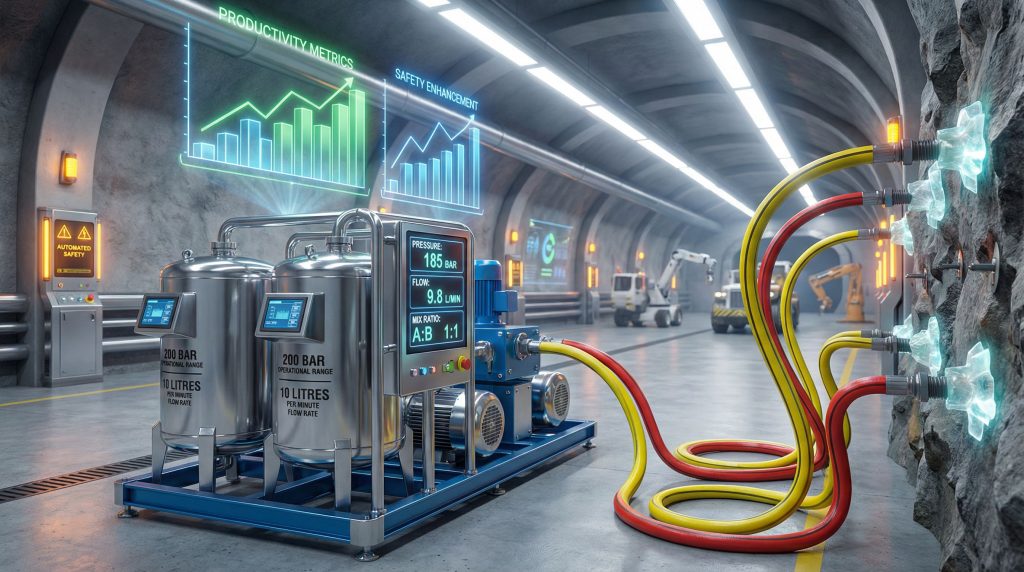
These systems integrate multiple technological components into unified operational platforms. Real-time monitoring capabilities track pressure, flow, and volume metrics during each injection cycle. Additionally, dual-component resin delivery systems accommodate both silicate and polyurethane formulations.
Self-calibrating control interfaces adjust parameters automatically based on material characteristics. Furthermore, data logging and export functions enable integration with site quality assurance protocols, supporting comprehensive documentation requirements.
The technical specifications demonstrate substantial operational capacity. Systems like the HPA20 deliver up to 200 bar operational pressure with flow rates reaching 10 litres per minute per component. This capacity enables consistent injection performance across varying geological conditions and resin formulations.
Performance Specifications and Capacity Analysis
| Technical Parameter | Specification Range | Operational Impact |
|---|---|---|
| Pressure Delivery | Up to 200 bar | High-pressure applications in challenging geological formations |
| Flow Rate Capacity | 10 litres/minute per component | Rapid injection cycles reducing equipment downtime |
| Container Capacity | Dual 300-litre sealed systems | Extended operational periods with minimal refilling |
| Automation Modes | Manual override and fully automated | Operational flexibility for varying site requirements |
The sealed container architecture represents a significant advancement in operator safety. Traditional open-container systems exposed personnel to resin vapours and handling hazards. Conversely, modern sealed dual 300-litre systems minimise direct operator contact during material handling and setup procedures.
Operational Transformation Through Injection Automation
Efficiency Enhancement Mechanisms
Automated injection systems fundamentally alter underground ground support workflows by eliminating multiple sources of operational variability. The transition from manual mixing protocols to automated ratio control removes human error variables that historically compromised injection quality and consistency.
Key operational improvements include elimination of mixing inconsistencies through automated ratio maintenance. Moreover, reduced injection cycle times occur via optimised flow control algorithms, while enhanced quality documentation provides comprehensive data logging.
Predictive maintenance capabilities reduce unexpected equipment failures, contributing to overall operational efficiency. The integration of automated flushing protocols addresses a critical operational challenge in resin injection systems.
Both automated and manual flushing functions prevent system blockages that would otherwise require equipment shutdown and manual intervention. Consequently, this significantly reduces operational downtime while maintaining system performance.
Safety Protocol Integration
"Modern automated systems incorporate sealed container designs, remote operation capabilities, and emergency shutdown procedures that collectively minimise personnel exposure to injection hazards while maintaining operational flexibility."
Safety improvements extend beyond simple exposure reduction. The implementation of remote operation capabilities allows personnel to maintain safe distances from active injection sites. Simultaneously, automated monitoring systems provide real-time alerts for pressure anomalies or system malfunctions.
Emergency shutdown procedures integrated into modern systems enable rapid response to unexpected conditions. Additionally, fail-safe mechanisms ensure system stability even during power interruptions or component failures.
Application Domains Driving Technology Adoption
Primary Ground Support Applications
Automated resin injection technology addresses multiple ground support requirements across underground mining operations. The versatility of systems like the sandvik next-gen automatic resin injection pump enables deployment across diverse geological conditions and support requirements.
Principal applications include rock bolt installation and anchoring systems requiring precise resin placement. Furthermore, cable bolt reinforcement operates effectively in high-stress geological environments, while ground consolidation supports unstable formations during development activities.
Structural reinforcement applications extend to critical development headings and production areas. The flexibility of automated systems accommodates operations using drill rigs that cannot support onboard bulk resin systems.
This addresses a specific market segment requiring portable, standalone solutions rather than integrated rig-mounted configurations. The versatility supports operations where traditional systems prove inadequate or impractical.
Equipment Integration Strategies
Deployment Configuration Options:
• Stand-alone deployment for maximum positioning flexibility
• Drill rig mounting for integrated operational workflows
• Hydraulic power pack configurations addressing varying site infrastructure requirements
• Mobile unit setups enabling multi-site deployment efficiency
The availability of optional hydraulic power pack configurations acknowledges the reality that mining operations possess varying electrical infrastructure capabilities. This adaptability ensures system deployment feasibility across diverse operational environments.
However, the integration of AI in mining operations continues to influence equipment design and deployment strategies. These technological advances support the development of more sophisticated automation systems.
Technical Innovation Drivers in Modern Systems
Control System Evolution
The advancement from manual control interfaces to self-calibrating platforms represents a fundamental shift in injection technology architecture. Modern systems eliminate the skill-dependent variability inherent in manual ratio setting, ensuring consistent performance regardless of operator experience levels.
Advanced Control Features:
• Self-calibrating mixing ratio maintenance eliminating manual intervention requirements
• Pressure regulation algorithms optimising flow characteristics for varying resin formulations
• Data export capabilities enabling integration with broader site quality assurance systems
• Remote diagnostic monitoring supporting predictive maintenance protocols
The emphasis on data export functionality indicates that regulatory compliance and performance traceability now constitute core system requirements rather than optional enhancements. Each injection cycle records mixing ratios, pressures, and pumped volumes for integration into site documentation systems.
Furthermore, the development of data-driven mining operations increasingly demands systems capable of comprehensive performance monitoring and documentation.
Material Compatibility Matrix
| Resin Type | Setting Characteristics | Application Suitability |
|---|---|---|
| Two-component silicate | Standard cure rates | General rock anchoring applications |
| Polyurethane formulations | Variable setting times | High-stress environments |
| Fast-setting compounds | Rapid cure cycles | Emergency stabilisation |
| Temperature-resistant formulations | Extreme condition stability | Deep mining applications |
The compatibility with multiple resin chemistries within the same platform eliminates the need for dedicated systems for different material types. Consequently, this reduces equipment inventory requirements and operator training complexity.
Resolution of Traditional Injection Challenges
Quality Control Standardisation
Automated systems address fundamental quality control limitations inherent in manual injection methods. The comprehensive documentation of injection parameters enables performance verification and regulatory compliance that manual methods cannot consistently provide.
Quality Assurance Improvements:
• Consistent mixing ratios eliminating operator-dependent variations
• Documented injection parameters supporting regulatory compliance requirements
• Performance traceability enabling cross-cycle and cross-site comparisons
• Standardised procedures reducing training requirements and operational complexity
The integration of real-time monitoring capabilities provides immediate feedback on injection quality. This enables corrective actions during the injection process rather than post-completion assessment.
Moreover, the implementation of quality control systems aligns with broader mining industry evolution trends emphasising precision and documentation in underground operations.
Economic Impact Analysis
Cost-Benefit Considerations:
-
Reduced labour requirements through automated operation cycles
-
Minimised material waste via precise dosing control
-
Decreased maintenance costs through automated flushing protocols
-
Enhanced productivity from faster cycle times
-
Improved safety compliance reducing incident-related costs
The economic justification for automated systems extends beyond immediate operational savings. The ability to generate comprehensive documentation supports insurance and regulatory compliance. Additionally, this reduces liability exposure associated with ground support failures.
The next major ASX story will hit our subscribers first
Deployment Optimisation Strategies
Site Assessment Requirements
Successful implementation of automated injection systems requires comprehensive pre-deployment evaluation addressing geological, infrastructure, and operational factors. The complexity of underground environments demands systematic assessment protocols ensuring optimal system configuration.
Critical Assessment Parameters:
• Geological condition evaluation determining appropriate resin chemistry selection
• Equipment compatibility analysis with existing underground fleet components
• Power supply infrastructure assessment ensuring adequate energy delivery capacity
• Maintenance access planning supporting regular service requirements
The availability of multiple deployment configurations (stand-alone, rig-mounted, hydraulic-powered, mobile) addresses the reality that mining operations possess fundamentally different infrastructure constraints and operational requirements.
Implementation Protocol Framework
"Successful automated system implementation requires phased deployment protocols incorporating operator training, performance monitoring, and continuous improvement feedback loops to optimise operational integration."
Implementation phases typically encompass operator certification programs covering system operation, safety protocols, and troubleshooting procedures. The complexity of automated systems requires comprehensive training ensuring personnel can effectively utilise advanced features while maintaining safety standards.
Performance monitoring during initial deployment phases enables optimisation of system parameters based on site-specific conditions and operational requirements. This data-driven approach ensures maximum operational efficiency while identifying potential improvement opportunities.
The emphasis on comprehensive implementation aligns with trends highlighted at the global resources innovation expo, where industry leaders discuss best practices for technology adoption.
Cross-Industry Application Potential
Civil Engineering Integration
The technology underlying automated resin injection systems transfers effectively beyond mining applications into civil engineering domains. The fundamental requirements for precise ground support exist across multiple construction and infrastructure contexts.
Civil Engineering Applications:
• Tunnel construction and reinforcement requiring reliable ground stabilisation
• Foundation stabilisation in challenging soil conditions
• Infrastructure repair and strengthening for ageing structural systems
• Emergency ground support in construction and disaster response scenarios
Specialised Construction Scenarios
The versatility of automated injection systems enables deployment in specialised construction environments where traditional ground support methods prove inadequate or unsafe. These applications demonstrate the broader utility of automation technology beyond traditional mining contexts.
Extended Application Domains:
• Underground utility installation requiring temporary ground stabilisation
• Slope stabilisation and erosion control for infrastructure protection
• Bridge foundation reinforcement in challenging geological conditions
• Emergency response ground stabilisation for disaster recovery operations
Future Technology Evolution Pathways
Industry Trend Integration
The development of automated ground support systems reflects broader industry trends toward digitalisation and data-driven decision making. The integration requirements for modern mining operations increasingly demand systems capable of communicating with broader operational management platforms.
Technology Development Drivers:
• Increasing automation requirements across all underground operations
• Enhanced safety regulations driving technology adoption
• Data-driven decision making in ground support planning
• Integration demands with mine digitalisation initiatives
The emphasis on data export capabilities and remote monitoring indicates that standalone systems will increasingly require integration with broader mine management platforms. This enables holistic operational optimisation through comprehensive system connectivity.
Furthermore, developments in AI-powered efficiency boost technologies will likely influence future automated injection system designs.
Advanced Technology Integration Potential
| Technology Area | Development Focus | Operational Impact |
|---|---|---|
| Artificial Intelligence | Predictive optimisation algorithms | Automated parameter adjustment based on geological conditions |
| IoT Connectivity | Fleet-wide monitoring systems | Real-time performance tracking across multiple units |
| Advanced Materials | Extreme condition formulations | Extended operational range in challenging environments |
| Robotics Integration | Fully autonomous operations | Elimination of personnel exposure in high-risk environments |
The convergence of artificial intelligence with automated injection systems presents opportunities for predictive optimisation based on geological condition recognition and historical performance data. This evolution would enable systems to automatically adjust parameters based on real-time assessment of underground conditions.
System Selection and Configuration Framework
Technical Specification Evaluation
The selection of appropriate automated injection systems requires systematic evaluation of technical specifications against operational requirements. The diversity of underground environments demands flexible systems capable of adapting to varying conditions while maintaining consistent performance standards.
Specification Assessment Criteria:
• Pressure and flow requirements matching specific geological applications
• Container capacity alignment with operational demand cycles
• Power supply compatibility with existing site infrastructure
• Environmental operating ranges addressing site-specific conditions
The sandvik next-gen automatic resin injection pump demonstrates the integration of these considerations into practical system design, offering operational flexibility while maintaining technical performance standards.
Economic Justification Methodology
Investment Analysis Framework:
-
Capital investment assessment against operational savings projections
-
Productivity improvement quantification through cycle time reductions
-
Safety cost reduction calculations from incident prevention
-
Long-term maintenance considerations supporting lifecycle cost analysis
The economic justification for automated systems extends beyond immediate operational improvements to encompass long-term strategic advantages. These include regulatory compliance, insurance optimisation, and operational risk reduction.
What Are the Key Operational Questions and Technical Considerations?
System Operation and Maintenance
What training requirements exist for automated system operators?
Comprehensive certification programs cover system operation, safety protocols, troubleshooting procedures, and data management requirements. Training duration typically ranges from initial certification through ongoing competency maintenance.
How do maintenance requirements compare with manual systems?
Automated systems require scheduled maintenance based on usage hours and injection cycles. However, automated flushing protocols and diagnostic monitoring reduce unexpected failures compared to manual systems.
Can automated systems operate effectively in extreme underground conditions?
Modern systems incorporate environmental protection ratings designed for harsh mining environments. Temperature-resistant formulations and sealed container systems address extreme condition requirements effectively.
Performance and Compatibility Assessment
The integration of automated injection systems with existing underground equipment requires careful compatibility assessment ensuring operational synergy rather than operational disruption. The flexibility of modern systems accommodates diverse integration scenarios while maintaining performance standards.
Integration Considerations:
• Equipment compatibility with existing underground fleet components
• Resin compatibility and storage addressing multiple formulation requirements
• Data export and quality assurance integration with site management systems
• Remote monitoring and diagnostic capabilities supporting fleet management
The evolution of automated ground support technology represents a fundamental shift toward precision engineering in underground mining operations. As systems continue to demonstrate increasing sophistication and operational capability, automation technology integration will expand across underground mining applications.
This expansion is driven by safety requirements, operational efficiency demands, and regulatory compliance necessities. The development of the sandvik next-gen automatic resin injection pump and similar advanced systems indicates the continued evolution toward fully automated ground support solutions in underground mining environments.
This analysis is based on publicly available technical information and industry developments from industry news sources and manufacturer announcements. Readers should consult with equipment manufacturers and technical specialists for specific application guidance and system selection decisions.
Looking to Capitalise on Mining Technology Innovation?
Discovery Alert's proprietary Discovery IQ model delivers real-time notifications on significant ASX mineral discoveries, instantly empowering subscribers to identify actionable opportunities ahead of the broader market. Understand why historic discoveries can generate substantial returns by exploring major mining breakthroughs, then begin your 14-day free trial to position yourself ahead of the next technological advancement in mining.