July 14, 2026
When Energy Becomes a Strategic Weapon: Inside the Grupo México BlackRock Saavi Energía Deal
The relationship between heavy industry and electricity has always been transactional. Miners plug into grids, pay whatever rate prevails, and absorb the cost as a line item. That logic held for decades across Latin America's resource sector. But something is shifting. The world's most capital-intensive industrial operators are no longer content to sit at the mercy of utility pricing cycles. They are moving upstream, acquiring generation capacity, and converting energy from an uncontrollable expense into a managed strategic asset. The Grupo México BlackRock Saavi Energía deal, formalised on April 27, 2026, is one of the clearest expressions of this industrial evolution seen anywhere in the Americas.
When big ASX news breaks, our subscribers know first
Mexico's Electricity System Under Pressure From Every Direction
To understand why this transaction carries such strategic weight, it is necessary to first appreciate the structural tension building inside Mexico's power system. The country's dominant public utility, the Comisión Federal de Electricidad (CFE), has faced persistent capacity constraints even as industrial electricity demand accelerates across multiple fronts simultaneously.
The forces driving that demand growth are converging rather than sequential:
- Manufacturing expansion driven by nearshoring activity, as multinational firms relocate production from Asia to take advantage of Mexico's proximity to the United States market
- Logistics infrastructure buildout along major industrial corridors connecting northern border zones to interior production hubs
- Data centre proliferation, with hyperscale operators selecting Mexican markets for latency, land cost, and connectivity advantages
- Automotive and electronics manufacturing clustering in the Bajío corridor, creating dense pockets of industrial electricity consumption that grow with each new facility commissioned
The geographic concentration of this demand is particularly relevant. Northern states including Sonora, Chihuahua, and Nuevo León, along with the Bajío region encompassing Guanajuato and Querétaro, absorb a disproportionate share of new foreign direct investment. These are precisely the corridors where reliable, competitively priced electricity is becoming a decisive factor in site selection decisions.
The gap between what Mexico's public utility can reliably deliver and what an increasingly sophisticated industrial base actually requires has created both a problem and a commercial opportunity of considerable scale.
What the Grupo México BlackRock Saavi Energía Deal Actually Involves
Breaking Down the Transaction Structure
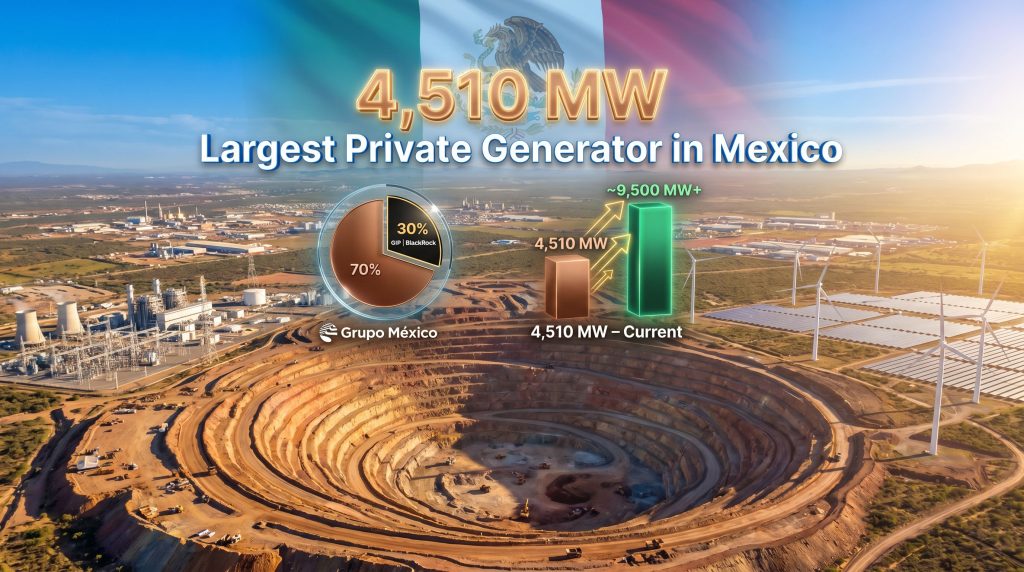
The agreement involves Grupo México's infrastructure division combining its power generation asset portfolio with Saavi Energía, a private generation platform controlled by Global Infrastructure Partners (GIP), which operates within the BlackRock ecosystem following BlackRock's acquisition of GIP. The resulting entity will be majority-owned by Grupo México at 70%, with GIP retaining a 30% stake.
| Deal Parameter | Detail |
|---|---|
| Transaction Type | Asset combination and joint platform creation |
| Grupo México Ownership | 70% |
| GIP (BlackRock) Ownership | 30% |
| Operating Plants Combined | 14 facilities |
| Combined Installed Capacity | 4,510 MW |
| Development Pipeline | ~5,000 MW |
| Transaction Announced | April 27, 2026 |
| Expected Closing | Q3 2026 (subject to regulatory approval) |
The transaction creates a private electricity generation platform operating across 14 facilities with a combined installed capacity of 4,510 MW. Alongside those operating assets sits a forward-looking development pipeline of approximately 5,000 MW in additional capacity, meaning the combined entity has ambitions well beyond its current footprint. According to reporting from BNamericas, this alliance with BlackRock is a decisive driver of Grupo México's broader energy shift.
Understanding the Principal Parties
Each participant in this transaction brings a distinct strategic rationale:
- Grupo México is one of Latin America's largest diversified conglomerates, with core operations centred on copper mining. Its flagship Buenavista del Cobre operation in Sonora ranks among the largest open-pit mines by output and reserve base
- Saavi Energía is an established private power generation platform with assets concentrated in high-demand Mexican industrial regions, building a commercial track record in private electricity supply ahead of this combination
- Global Infrastructure Partners (GIP) is a leading global infrastructure investor with a multi-decade track record across energy, transport, and digital infrastructure assets. GIP's integration into the BlackRock platform gives it access to the world's largest asset manager's capital raising and distribution capabilities
- Germán Larrea, Grupo México's controlling shareholder and Mexico's second-wealthiest individual, is understood to be the principal strategic architect behind this repositioning
The Vertical Integration Logic: Why Copper Miners Must Control Their Own Power
The Cost Case for Captive Generation
The financial arithmetic behind this transaction is grounded in a rarely publicised reality of the mining industry. Electricity accounts for between 20% and 35% of total operating costs in open-pit copper mining operations. That is not a peripheral cost centre. It is one of the single largest variable inputs in the entire production chain, sitting alongside labour and reagents as a primary driver of cash operating costs per tonne.
Furthermore, the ongoing copper supply crunch makes it even more critical for producers to contain operating costs wherever possible. For an operation the scale of Buenavista del Cobre, even a modest reduction in the per-unit electricity cost translates into hundreds of millions of dollars in cumulative operating savings across a multi-decade mine life.
The strategic implication is direct. A mining conglomerate that secures captive generation capacity effectively locks in a structural cost advantage that competitors dependent on grid pricing cannot easily replicate. Grid-dependent operators face price volatility, dispatch uncertainty, and the risk of supply interruptions during peak demand periods. A vertically integrated operator with captive generation hedges all three exposures simultaneously.
This vertical integration logic is amplified further by the commercial opportunity it creates. The same generation platform that serves Grupo México's internal demand can also supply electricity to third-party industrial customers operating within the same regional corridors. The company moves from being a passive price-taker in the electricity market to a dual-role participant: both a major consumer and a merchant generator capable of monetising surplus capacity through commercial offtake agreements.
Scenario Comparison: Before and After the Transaction
| Dimension | Pre-Deal Position | Post-Deal Position |
|---|---|---|
| Energy Cost Exposure | High, market-dependent | Reduced via captive generation |
| Third-Party Revenue | Negligible | Commercially enabled |
| Market Role | Energy consumer only | Consumer plus merchant generator |
| Competitive Moat | Copper production scale | Copper scale plus energy cost advantage |
| Growth Verticals | Mining operations | Mining plus energy generation |
What GIP and BlackRock Bring Beyond Capital
A 30% stake from an institutional infrastructure investor of GIP's calibre is not simply a financial contribution. It carries operational, structural, and strategic dimensions that are easy to underestimate when viewed through a purely transactional lens.
GIP brings institutional-grade infrastructure asset management capabilities, including dispatch optimisation, commercial structuring of long-term power purchase agreements, and the financial engineering expertise required to fund large-scale development pipelines at competitive cost of capital. These are specialised competencies that differ meaningfully from mining operations management.
For BlackRock and GIP, the Mexican private power market represents a high-conviction infrastructure thesis. The combination of nearshoring-driven demand growth, an undersupplied industrial electricity market, and a credible local partner in Grupo México creates a risk-adjusted return profile consistent with institutional infrastructure allocation mandates. GIP's involvement in Saavi Energía preceded this transaction, meaning the Grupo México combination represents a deepening of an existing market relationship rather than a first-time market entry.
Morningstar's coverage of the deal confirms that Grupo México will combine its power generation assets with Saavi Energía in a structure that reflects the long-term confidence both parties have in Mexico's private energy market. Grupo México has been explicit that this transaction is intended to lay the foundation for a continuing partnership with GIP, with potential to extend into joint infrastructure development opportunities beyond Mexico's national market.
Scale, Pipeline, and What 5,000 MW of Development Capacity Actually Means
The Renewable Dimension of the Pipeline
The development pipeline of approximately 5,000 MW is perhaps the most underappreciated element of this transaction. It represents a volume of potential new capacity roughly equivalent to the entire existing installed base being combined through the deal. If that pipeline reaches full realisation, the platform's total footprint could approach or exceed 9,500 MW of installed capacity.
| Metric | Current (Post-Merger) | Potential (Pipeline Realised) |
|---|---|---|
| Installed Capacity | 4,510 MW | ~9,500 MW+ |
| Market Position | Largest private generator in Mexico | Dominant private generation platform |
| Revenue Streams | Mining plus energy generation | Mining, generation, and merchant sales |
This pipeline also carries important implications for the energy transition dimension of the platform. Industrial offtakers, particularly multinational manufacturers operating under sustainability commitments, increasingly require that their electricity supply carry a credible renewable content. In this context, renewable energy in mining operations has become a genuine competitive differentiator rather than simply a compliance exercise.
A development pipeline of this scale, if structured to incorporate solar, wind, and other renewable technologies, would allow the platform to serve that demand while simultaneously diversifying its generation mix away from fossil fuel exposure. The asset concentration in northern Mexico and the Bajío places the pipeline squarely within the geographic corridors experiencing the highest rates of industrial electricity demand growth, driven by nearshoring and manufacturing investment inflows.
Energy Transition Implications
Consequently, the Grupo México BlackRock Saavi Energía deal carries significance well beyond a single corporate transaction. It reflects the broader convergence of energy transition and critical minerals strategy, where the producers of materials essential to electrification are themselves transforming how they power their operations. In addition, the mining decarbonisation benefits available to a platform of this scale are substantial, spanning reduced carbon liability, improved ESG positioning, and enhanced attractiveness to sustainability-focused capital allocators.
The next major ASX story will hit our subscribers first
Regulatory Pathway and Approval Considerations
The transaction is subject to standard regulatory review processes within Mexico. Two institutions are particularly relevant to the approval timeline. COFECE, Mexico's federal competition authority, will assess whether the combined platform creates market concentration issues in private electricity generation. CRE, the energy regulatory commission, will evaluate the transaction from a sector-specific licensing and compliance perspective.
The deal's structural characteristics may work in its favour from a timing standpoint. Because it combines existing operating assets rather than proposing new greenfield capacity additions, the regulatory review process may proceed on a more predictable timeline than a construction-stage project would face. The Q3 2026 closing target reflects this expectation, though investors and analysts should monitor review progress carefully as that window approaches.
Mexico's electricity regulatory environment has shifted considerably over the preceding years. The procedural and policy-level dimensions of this review will be watched closely by other private infrastructure investors considering exposure to the Mexican market.
Frequently Asked Questions
What is the Grupo México BlackRock Saavi Energía deal?
A definitive agreement signed on April 27, 2026, in which Grupo México's infrastructure division combines its power generation assets with Saavi Energía, controlled by BlackRock's Global Infrastructure Partners. The combined platform will operate 14 generation facilities with 4,510 MW of installed capacity, plus a development pipeline of approximately 5,000 MW, structured as a 70/30 ownership split favouring Grupo México.
When is the deal expected to close?
Closing is targeted for Q3 2026, contingent on regulatory approvals from relevant Mexican authorities including COFECE and CRE.
Why does electricity cost matter so much for copper mining?
Electricity represents between 20% and 35% of total operating costs in open-pit copper mining. For a large-scale operation like Buenavista del Cobre, securing captive generation capacity at controlled cost provides a durable competitive advantage over grid-dependent mining operators.
What is GIP's role in the combined platform?
GIP, a major infrastructure investment manager now part of the BlackRock group, will hold a 30% stake in the combined entity and contribute institutional infrastructure management capabilities, commercial structuring expertise, and long-term co-investment ambitions alongside Grupo México.
Will this make Grupo México the largest private power generator in Mexico?
Based on the combined installed capacity of 4,510 MW across 14 operating facilities, the platform is expected to hold the largest private electricity generation capacity in Mexico upon completion of the transaction.
Key Takeaways: What This Transaction Signals for Mexico's Private Energy Market
- Vertical integration is accelerating: Resource-intensive industrial conglomerates are increasingly moving upstream into power generation to control a critical and volatile input cost
- 4,510 MW changes the competitive landscape: No other private generator in Mexico will operate at this scale upon deal completion, reshaping commercial dynamics across industrial supply corridors
- The development pipeline is the real story: Approximately 5,000 MW of forward capacity signals this is a platform-building exercise with a decade-long horizon, not a simple asset consolidation
- Institutional capital is validating the thesis: GIP's participation reflects conviction in Mexico's private energy infrastructure market at a moment when public utility constraints and nearshoring-driven demand are both intensifying
- The partnership has a longer arc: Both parties have framed this as the beginning of a sustained relationship that extends beyond the initial transaction into future joint infrastructure development across Mexico and internationally
This article is intended for informational purposes only and does not constitute financial or investment advice. Forward-looking statements, projections, and scenario analyses involve inherent uncertainty and should not be relied upon as predictions of actual outcomes. Regulatory approval timelines and transaction completion remain subject to change. Readers should conduct their own due diligence before making any investment decisions related to companies or markets discussed herein.
Want to Capitalise on Major Resource and Energy Discoveries Before the Broader Market?
Discovery Alert's proprietary Discovery IQ model delivers real-time alerts on significant ASX mineral discoveries — instantly converting complex data across 30+ commodities into clear, actionable insights for both traders and long-term investors. Explore how historic discoveries have generated extraordinary returns and begin your 14-day free trial today to secure a genuine market-leading advantage.