July 14, 2026
When Coal Country Reimagines Itself: The Hunter Valley's Post-Mine Transformation
Regional economic identities rarely change by choice. More often, they change because the commodity or industry that built them reaches an inflection point, forcing communities, governments, and corporations to confront what comes next. The Hunter Valley is now at precisely that crossroads.
For generations, coal has been the structural backbone of the Upper Hunter, shaping its towns, its infrastructure, its workforce culture, and its relationship with the rest of New South Wales. But as individual mines approach confirmed closure timelines and state governments legislate toward net-zero emissions targets, the question of what the post-mine plan for Hunter coal mines looks like is no longer theoretical. It is a live planning challenge with real deadlines, real funding commitments, and real consequences for tens of thousands of people.
Understanding the framework being built, its strengths, and the gaps that remain requires moving beyond the headline figures and into the mechanics of how post-mining land transitions actually work.
When big ASX news breaks, our subscribers know first
No Single Blueprint: Why the Hunter Needs a Coordinated Regional Approach
One of the most important things to understand about post-mine planning in the Hunter is that there is no single unified document or agency that governs every site. Each mine operates under its own rehabilitation conditions, its own financial assurance arrangements, and its own closure timeline. Left entirely to individual operators, this fragmented approach has historically produced patchy outcomes, with some sites rehabilitated to high standards while others languish in prolonged care-and-maintenance limbo.
The NSW Government's response to this challenge has been to layer a coordinated regional framework over the top of existing individual obligations. Rather than replacing what mining companies are legally required to do, the framework creates institutional capacity to plan across multiple sites simultaneously, address legislative barriers that slow down land repurposing, and attract new investment to fill the economic space coal leaves behind.
Furthermore, the approach to mine reclamation embedded within this framework is meaningfully different from the approach taken in previous Australian coal transitions, which tended to be reactive rather than anticipatory.
The Institutional Architecture: The Future Jobs and Investment Authority
The centrepiece of the NSW Government's coordination effort is the Future Jobs and Investment Authority, a statutory body with a specific mandate to lead post-mine land reuse planning across the state. For the Hunter Valley, a dedicated regional division was targeted for establishment by June 2026, reflecting the urgency of the transition timeline.
The Authority's functions span several interconnected workstreams:
- Conducting comprehensive land audits of transitioning and former mine sites to assess rehabilitation status, infrastructure assets, and economic potential
- Facilitating planning approvals for new uses on former mine land, reducing the bureaucratic friction that has historically delayed repurposing
- Coordinating economic development by connecting investors, developers, and government agencies with viable sites and opportunities
- Liaising with workforce transition programs to ensure new industries being established on former mine sites can draw from a retrained local labour pool
This multi-function mandate is important because post-mine land repurposing is not a linear process. It requires simultaneous progress on environmental, planning, economic, and social fronts, and a body with authority across all of them is better positioned to achieve this than a series of siloed agencies working in parallel.
Legislative Reform: Removing the Invisible Barriers
Even the best-funded post-mine planning effort will stall if the underlying legal framework was designed for a different era. In NSW, three key pieces of legislation present structural obstacles to repurposing former mine land:
- The Mining Act
- The Environmental Planning and Assessment Act
- The Protection of the Environment Operations Act
All three were written primarily with active mining operations in mind. They create compliance pathways, assessment processes, and consent frameworks oriented toward extraction, not toward converting a former open-cut mine into a renewable energy precinct or an advanced manufacturing hub. Reviews of all three were scheduled for completion by June 2026.
The significance of this legislative reform process is often underestimated. In comparable international coal transitions, planning approval delays have added years to the timeline between mine closure and new land use activation, extending the period of community economic disruption far beyond what the raw closure timeline suggests.
Getting the legislative settings right before major closures occur, rather than scrambling to fix them afterward, is one of the more strategically sound elements of the current NSW approach. The NSW Government's vision for post-mining land use reflects a broader commitment to ensuring that former mine sites become productive assets rather than stranded liabilities.
The Two Pilot Sites: Mt Arthur and Macquarie Coal
The most tangible, funded component of the post-mine planning framework centres on two pilot sites selected for master plan development. The NSW and Commonwealth governments have jointly committed $5 million to develop detailed master plans for these locations, providing a replicable methodology for future sites.
| Pilot Site | Operator | Closure Timeline | Primary Repurposing Focus |
|---|---|---|---|
| Mt Arthur Coal | BHP (ASX: BHP) | 2030 | Renewable energy, pumped hydro, solar |
| Macquarie Coal | Glencore | TBC | Economic diversification, infrastructure reuse |
The selection of these two sites as pilots is strategically logical. Mt Arthur is the Hunter's largest and most publicly visible coal operation approaching a confirmed closure date, making it both the highest-stakes and highest-profile test case. Macquarie Coal, located near Lake Macquarie, represents a different geographic and infrastructure context, allowing the master plan methodology to be stress-tested across varying site conditions.
BHP's Mt Arthur: The Transition's Most Advanced Case Study
Closure Timeline and Community Investment
BHP has confirmed coal production at Mt Arthur will cease by 2030, making it the Hunter's most time-constrained major transition. In parallel with the government-funded master plan process, BHP has established a $30 million Upper Hunter Community Fund directed toward supporting the surrounding communities through the adjustment period.
The fund's scope encompasses three priority areas:
- Job creation initiatives targeting industries compatible with the skills base of the existing mining workforce
- Education and skills programs delivered through regional institutions to prepare workers for post-coal employment pathways
- Heritage protection and cultural preservation recognising that the Hunter's identity extends beyond its economic function
The Renewable Energy Infrastructure Advantage
One of the less widely understood aspects of the Mt Arthur transition opportunity is the significant infrastructure advantage the site carries into its post-coal life. Large-scale mining operations require substantial electrical infrastructure, including high-voltage transmission connections that in many cases are already integrated into the regional grid.
For renewable energy developers, this existing connectivity is genuinely valuable. Building new grid connections for a greenfield renewable energy project in a comparable location could cost tens of millions of dollars and take years to approve and construct. At Mt Arthur, that infrastructure already exists.
This is why pumped hydro energy storage and large-scale solar are among the leading candidates for the site. Pumped hydro in particular is well-suited to former open-cut mine environments because:
- The excavated topography creates natural elevation differentials suitable for upper and lower reservoir configurations
- Existing water management infrastructure, including dams and pumping systems developed for mining operations, can potentially be adapted rather than built from scratch
- The site's power infrastructure supports the significant electrical load that pumped hydro facilities require both for pumping and for grid dispatch
If Mt Arthur's existing grid and water infrastructure can be successfully repurposed for a pumped-hydro facility, the site has a credible pathway from being one of NSW's largest carbon-emitting energy consumers to becoming an active renewable energy storage contributor, potentially within a decade of coal operations ceasing. This remains a scenario under assessment rather than a confirmed outcome, and its realisation depends on technical feasibility studies, commercial investment decisions, and planning approvals that have not yet concluded.
The next major ASX story will hit our subscribers first
Hunter Valley Operations: A Longer Runway, a Different Conversation
Not every Hunter coal mine is on a near-term closure trajectory, and this distinction matters for understanding the overall shape of the region's transition.
Hunter Valley Operations (HVO), now part of Whitehaven Coal's portfolio, has received approval for a Continuation Project that extends its operational life well into the 2040s:
| Operation | Approved Extension | Post-Mine Planning Status |
|---|---|---|
| HVO North | Operating to 2045 | Not yet initiated |
| HVO South | Operating to 2042 | Not yet initiated |
For HVO, the post-mine planning conversation is a future obligation rather than a current priority. However, the institutional frameworks and legislative reforms being developed now will directly shape the conditions under which HVO's eventual transition occurs. Getting the methodology right at Mt Arthur and Macquarie Coal creates a tested playbook that can be applied to HVO and other sites when their timelines approach.
The $3.7 Billion Opportunity: What Economic Analysis Suggests
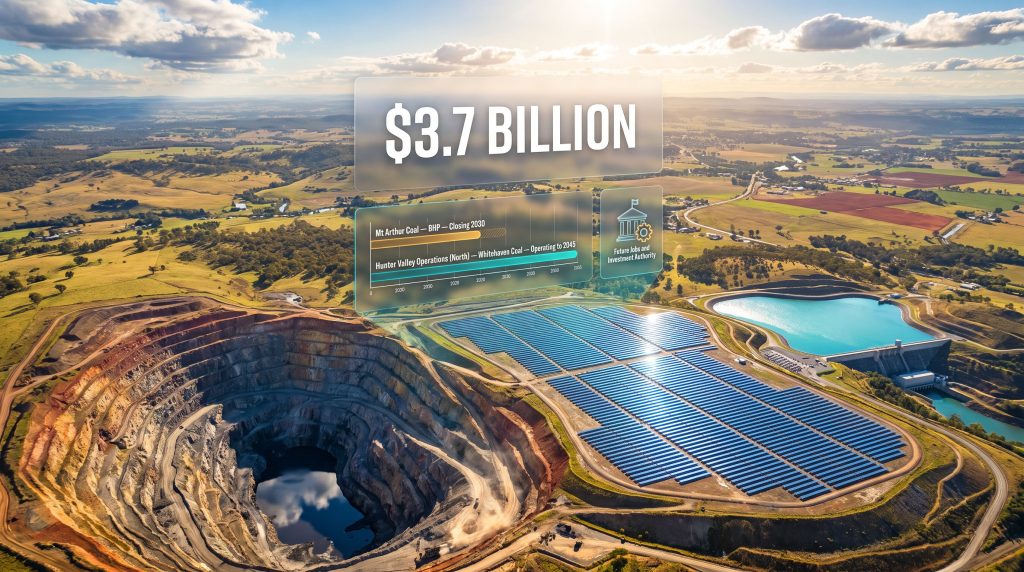
Research by EY, conducted in conjunction with environmental advocacy analysis, estimates that repurposing degraded Hunter mine sites for renewable energy and biodiversity restoration could generate up to $3.7 billion in economic output across the region.
This figure is not a guaranteed outcome, and readers should treat it as a scenario estimate rather than a forecast. It is sensitive to several variables:
- The speed of planning reform: delays in legislative change directly reduce the window for investment attraction
- The quality of site master plans: master plans that identify credible, commercially viable uses attract more investment than generic aspirational documents
- The availability of workforce skills: economic development on former mine sites only delivers regional benefit if local workers can access the jobs being created
- Commodity and energy market conditions: the viability of renewable energy projects on former mine sites depends on energy market dynamics that extend beyond the Hunter
Three Priority Economic Use Cases
The research points to three categories of land use that are most compatible with the physical characteristics of former Hunter mine sites.
Renewable Energy Precincts
Former open-cut mines offer large, contiguous land parcels with existing grid connections. Both attributes are difficult and expensive to replicate on greenfield sites. Solar farms can be deployed across rehabilitated flat surfaces with minimal land preparation, while renewable energy solutions in mining contexts exploit the topographic and water management assets described above.
Agriculture and Ecological Restoration
Buffer lands, which are unmined parcels held by mining companies adjacent to active operations, have been identified as a high-priority category for biodiversity restoration and agricultural reintegration. Advocacy groups have consistently pushed for these lands to be incorporated into regional restoration plans rather than being sold or left unmanaged after operations cease.
Light Industrial and Advanced Manufacturing
The Hunter's logistics infrastructure, including road and rail networks developed to support mining exports and the proximity of the Port of Newcastle, positions former mine sites as genuinely competitive locations for light industrial and advanced manufacturing investment. This category is particularly relevant for workforce transition, as manufacturing skills share transferable elements with mining trade skills.
Workforce Transition: The Human Dimension of Post-Mine Planning
Skills Audits and the Retraining Challenge
The NSW Government has commissioned a formal skills audit of the NSW mining workforce to map existing competencies against future employment opportunities in renewable energy, construction, and advanced manufacturing. The intent is to move beyond generic retraining programs toward targeted pathways that match workers' existing skills to specific emerging roles.
This matters because the track record of coal transition workforce programs internationally is mixed. Lessons from comparable transitions, including those seen in the Appalachian coalfields of the United States and the Ruhr Valley industrial transition in Germany, consistently point to a critical risk: the gap between job losses and meaningful new employment frequently extends five to ten years without proactive, well-resourced retraining infrastructure.
For the Hunter, with Mt Arthur closing in 2030, meaningful retraining programs need to be operational by 2027 at the latest to avoid creating a cohort of displaced workers without viable employment pathways during the transition window. Regional TAFE networks and universities are being positioned as key delivery partners, with industry partnerships sought to create direct pipelines from retraining programs into operational roles in new industries.
Environmental Obligations and the Open Void Debate
What Mining Companies Are Required to Do
Under existing NSW mining law, operators are required to progressively rehabilitate disturbed land throughout a mine's operational life, not simply at the point of closure. Financial assurance bonds held by the NSW Government provide a backstop against operator failure to meet these obligations. The legislative reforms currently underway are expected to strengthen rehabilitation standards, particularly around water management and the treatment of residual landforms. In addition, effective mining waste management practices will be central to how successfully these sites are repurposed.
The Open Void Problem
Perhaps the most contested environmental issue in Hunter post-mine planning is the fate of large open-cut voids. These excavated depressions, sometimes kilometres in scale, fill with groundwater over time to create pit lakes. The water quality characteristics of pit lakes are complex and site-specific, and can require costly ongoing management indefinitely.
Community advocates and the proposed Hunter Rehabilitation and Restoration Commission (a body recommended by both community groups and a NSW Parliamentary Inquiry, though not yet legislated) have argued strongly that operators must be legally prevented from walking away from sites with unmanaged perpetual voids.
If this position is ultimately legislated, it would have material implications for rehabilitation cost estimates across the Hunter, potentially increasing financial assurance requirements and closure cost provisions for operators with large open-cut operations.
Assessing the Framework: Strengths and Critical Gaps
What the Plan Gets Right
- The creation of a dedicated statutory authority with a Hunter-specific mandate represents a more structured institutional approach than previous Australian coal transitions have received
- The selection of two pilot sites with joint government funding creates a testable, iterative methodology for master plan development
- The legislative review process, if completed on schedule, could meaningfully reduce the time and cost barriers to activating former mine sites for productive new uses
- BHP's $30 million community fund provides a degree of community support funding that operates alongside, rather than instead of, government investment
Where the Gaps Remain
- The $5 million pilot funding for the two master plans is modest relative to the scale of the economic transformation being contemplated. Master plans are necessary but not sufficient; implementation requires substantially greater capital
- The proposed Hunter Rehabilitation and Restoration Commission remains an advocacy position rather than a legislative reality, leaving the most ambitious restoration objectives without statutory enforcement mechanisms
- The skills transition timeline is tight: Mt Arthur's 2030 closure leaves approximately four years to build effective retraining infrastructure from a standing start
- The $3.7 billion economic opportunity estimate is conditional on multiple variables aligning, and should not be treated as a baseline outcome
Consequently, the broader challenge of mining electrification and decarbonisation across the region will also shape how effectively the post-mine plan for Hunter coal mines is ultimately executed, influencing both investment appetite and the pace of energy infrastructure development on former sites.
The Hunter Valley's post-mine transition is more deliberately planned than most comparable Australian coal regions have managed. But the distance between the ambition of the framework and the resources and legislative backing committed to executing it remains a material risk. The period from now through 2028 will be decisive in determining whether the region captures its transformation opportunity or experiences a prolonged structural economic contraction.
This article contains references to economic forecasts and scenario estimates, including the $3.7 billion economic output figure attributed to EY research. Such estimates involve assumptions and are subject to significant uncertainty. They should not be interpreted as guaranteed outcomes or investment advice. Readers seeking to make investment or business decisions based on Hunter Valley transition opportunities should conduct independent due diligence.
Further reporting and analysis on NSW mining regulation, regional economic policy, and post-mine land use can be found through the Australian Mining Review at australianminingreview.com.au.
Want to Spot the Next Major Mineral Discovery Before the Broader Market Does?
While the Hunter Valley navigates its post-coal transformation, new mineral discoveries continue to reshape the ASX landscape — and Discovery Alert's proprietary Discovery IQ model delivers real-time alerts the moment significant discoveries are announced, turning complex data across 30-plus commodities into clear, actionable insights for investors at every level. Explore historic discovery returns on Discovery Alert's dedicated discoveries page and begin a 14-day free trial to position yourself ahead of the market.