July 14, 2026
The Quiet Revolution in Fertilizer Mining: Why Deep-Rock Nutrients Are Reshaping Agricultural Supply Chains
For most of recorded agricultural history, soil fertility has been managed through a narrow set of inputs: nitrogen, phosphorus, and potassium, each sourced from industrial-scale chemical processes or conventional potash mining. Yet the soil science community has long recognised that crop health depends on a far broader spectrum of nutrients, including sulfur, magnesium, and calcium, which are systematically depleted by modern intensive farming.
This gap between what crops actually need and what conventional fertilizers deliver has quietly created one of the most significant unmet demands in global agriculture. It is precisely this demand that makes a remote deposit beneath the English moors one of the most strategically consequential mining projects currently under development anywhere in the world, and Anglo American selects Stantec for Woodsmith feasibility study as the latest signal of that growing momentum.
Anglo American's decision to formally appoint Stantec as an engineering and project delivery partner is the latest indication that this project is moving from concept to credible development reality. Understanding what that appointment means requires unpacking the geology, the engineering complexity, the commercial structure, and the long-term agricultural logic that underpins the entire venture.
When big ASX news breaks, our subscribers know first
What Makes Polyhalite Different From Every Other Fertilizer Mineral
Polyhalite is a naturally occurring evaporite mineral, meaning it formed through the slow evaporation of ancient seabeds over geological timescales. Its chemical composition is what makes it remarkable from an agricultural standpoint: a single mineral that simultaneously contains potassium, sulfur, magnesium, and calcium — four macronutrients that conventional fertilizer programmes typically deliver through separate, synthetically processed products.
The commercial product derived from polyhalite, marketed as POLY4, is applied directly after processing without the energy-intensive chemical transformation required by most synthetic fertilizer alternatives. This matters for several reasons:
- The lower processing intensity reduces the carbon footprint of fertilizer production relative to conventional potash or sulfate-based products
- The slow-release characteristics of polyhalite mean nutrients become available to plants progressively, reducing leaching losses and improving uptake efficiency
- The multi-nutrient profile allows a single application to address soil deficiencies that would otherwise require multiple separate products
- Unlike chloride-based potassium fertilizers, polyhalite is chloride-free, making it suitable for a wider range of sensitive crops
From an agronomic perspective, polyhalite sits in a category of its own. It is not a replacement for nitrogen, which remains the primary driver of yield, but rather a complementary product that addresses the often-overlooked secondary nutrient deficiencies that limit the effectiveness of nitrogen application in depleted soils. Furthermore, understanding mining project economics helps contextualise why operators are investing so heavily in bringing this unique mineral to market.
The Scale and Strategic Weight of the Woodsmith Deposit
The polyhalite deposit beneath North Yorkshire is not simply large. It is, by current geological assessment, the largest known deposit of the mineral anywhere on Earth. The seam runs at significant depth beneath the North York Moors, with the ore body's scale positioning Woodsmith as a genuinely generational resource capable of supplying global agricultural markets for decades.
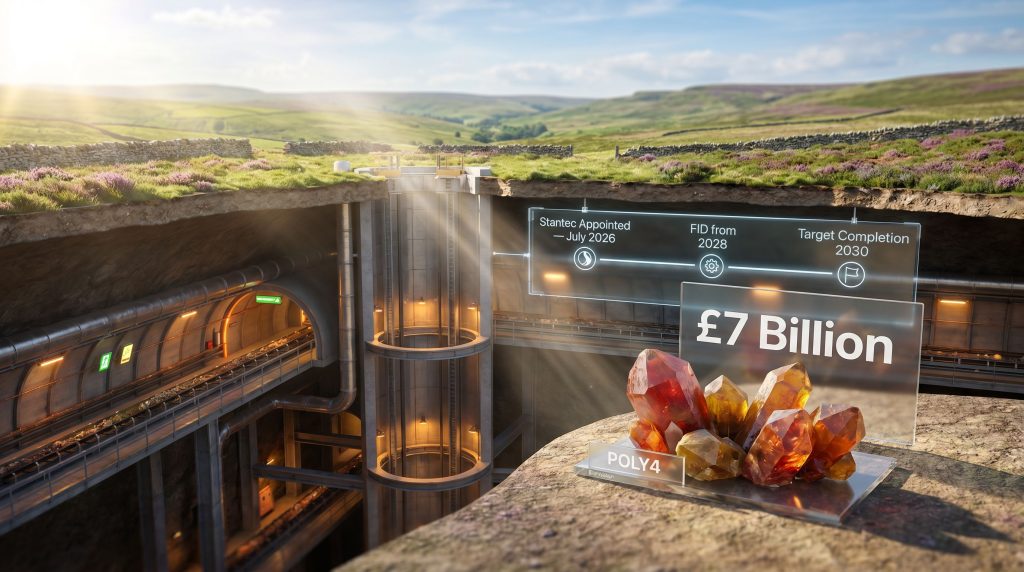
Anglo American has classified it as a Tier 1 asset — a designation reserved for deposits that combine exceptional scale, long mine life, low operating cost potential, and strategic commodity exposure. The project carries an approximate valuation of £7 billion, making it one of the most valuable single mining assets currently in development in Europe.
Tier 1 asset classification in mining is not simply a marketing label. It reflects a rigorous internal assessment framework used by major mining houses to distinguish assets capable of generating material, sustained cash flows over multi-decade operating lives from the broader project pipeline. Woodsmith meeting this threshold places it in rare company globally.
The deposit's location, however, introduces a set of engineering and regulatory constraints that have no close precedent in conventional mining practice. The ore body sits beneath the North York Moors National Park, one of England's most strictly protected natural landscapes, and the surface directly above the deposit is subject to tight controls on visual impact, noise, and light emissions. Consequently, considerations around natural capital in mining are especially pertinent here, given the project's proximity to protected landscapes.
Anglo American Selects Stantec for Woodsmith Feasibility Study: The Engineering Mandate
The appointment of Stantec to deliver feasibility study services for the Woodsmith project, confirmed in July 2026, reflects the specific technical demands that the project's underground-first design philosophy creates. Stantec's scope of work covers four interconnected engineering domains:
- Hoisting systems design, including the engineering of shaft winding equipment capable of operating at the depths required by the Woodsmith seam
- Shaft construction planning, addressing the structural and geotechnical challenges of sinking large-diameter shafts through varied rock formations to reach the ore body
- Material handling systems, encompassing the conveyance of extracted polyhalite from shaft bottom through underground corridors and ultimately to surface processing infrastructure, potentially via long-distance underground conveying
- Underground infrastructure integration, coordinating the placement and operational sequencing of all below-surface facilities
Stantec brings a dedicated centre of excellence in hoisting and shaft engineering based in the United States, a capability that directly addresses the most technically demanding elements of Woodsmith's underground architecture. The project will be managed through Stantec's UK operations, drawing on that global expertise within the local regulatory and operational context.
Why Underground Headframe Placement Is an Engineering First
In conventional hard rock mining, the headframe — the large structural tower that houses the winding equipment and sits directly above the shaft collar — is one of the most visually prominent features of any mine site. At Woodsmith, the decision to relocate headframes and associated infrastructure underground is not merely a design preference. It is a direct response to the planning constraints imposed by the National Park designation.
This decision has significant engineering consequences. Designing hoisting systems that operate within underground chambers rather than surface-mounted towers requires modifications to standard winding machine configurations, ventilation strategies for the machinery spaces, maintenance access planning, and emergency egress protocols. It also affects the structural loading transferred to the surrounding rock mass, which must be carefully managed through geotechnical design.
| Design Element | Conventional Mine | Woodsmith Underground-First Design |
|---|---|---|
| Headframe location | Surface tower | Positioned underground |
| Surface footprint | Large industrial area | Minimised by regulatory mandate |
| Noise and light impact | Standard industrial levels | Constrained by National Park rules |
| Infrastructure access | Surface roads and facilities | Underground corridors and shaft systems |
| Environmental compliance framework | Standard permitting | Elevated stewardship requirements |
The Dual-Partner Feasibility Study Structure: Stantec and Fluor
Anglo American has structured the Woodsmith feasibility study around two separately appointed engineering partners rather than a single lead consultant — an approach that reflects both the scale and the technical diversity of the work required. Fluor was announced as an FS partner in early 2026, with Stantec's appointment confirmed in July 2026. Both firms are working alongside Anglo American's internal project team.
This multi-partner model delivers several strategic advantages:
- Parallel workstreams allow different engineering disciplines to advance simultaneously rather than sequentially, compressing the overall FS timeline
- Specialisation alignment ensures that each partner is contributing within its domain of deepest expertise rather than a single generalist firm spreading capacity across all technical areas
- Risk distribution means that delays or technical challenges in one workstream do not automatically cascade across the entire study
- Competitive benchmarking creates an implicit quality control mechanism, as both firms are aware their outputs will be reviewed alongside those of a peer organisation
The multi-partner FS model is increasingly favoured by major mining houses on complex, large-scale projects where the engineering domains are sufficiently distinct to benefit from specialised input. It does, however, require careful coordination to prevent interface management becoming a bottleneck.
In addition, a well-structured definitive feasibility study at this scale is critical to establishing the bankable cost estimates that institutional co-investors require before committing capital. For comparison, phosphate project development in Australia demonstrates how multi-nutrient deposit projects require similarly rigorous FS processes to attract long-term investment partners.
Project Timeline and the Path to a Final Investment Decision
The Woodsmith project has undergone a deliberate pacing adjustment as Anglo American has worked through a broader portfolio optimisation process. Understanding where the feasibility study sits within the overall development sequence is critical for assessing the project's near-term trajectory.
| Milestone | Detail |
|---|---|
| Original completion target | 2027 |
| Revised completion target | 2030 |
| 2025 capital investment | Reduced to £160 million |
| Fluor FS appointment | Early 2026 |
| Stantec FS appointment | July 2026 |
| Mitsubishi investment agreement | February 2026 |
| Anticipated Final Investment Decision | From 2028 onwards |
The feasibility study is the critical technical and commercial gateway between project development and investment decision. A completed FS provides the bankable cost estimates, production schedules, and technical risk assessments that institutional co-investors and project financiers require before committing capital at the scale Woodsmith will eventually demand.
Anglo American's appointment of two specialised engineering firms to run parallel FS workstreams is therefore not simply a technical decision. It is a deliberate strategy to build the credible, investor-grade technical foundation needed to advance syndication discussions.
Mitsubishi Corporation's entry into a definitive investment agreement in February 2026 is particularly notable in this context. Mitsubishi's agricultural and food supply chain investment interests align directly with polyhalite's value proposition, and its willingness to commit ahead of a completed FS signals genuine institutional conviction in the project's long-term commercial case.
The next major ASX story will hit our subscribers first
Risk Factors That Investors and Industry Observers Should Understand
Woodsmith's strategic credentials are compelling, however the project carries a specific set of risks that require clear-eyed assessment:
- Timeline extension risk: The revised 2030 completion target represents a multi-year pre-revenue development period, during which capital continues to be deployed without production cash flows
- Capital discipline pressure: Anglo American's reduction of 2025 capex to £160 million reflects the ongoing tension between advancing the project and maintaining group-level financial discipline
- Engineering complexity: The underground-first design approach is, in several respects, genuinely novel, and novel engineering always carries execution risk that standard contingency frameworks may underestimate
- Regulatory continuity: Operating within a National Park introduces ongoing exposure to planning and environmental regulatory change over a multi-decade project life
- FID timing uncertainty: With the Final Investment Decision not anticipated before 2028, a meaningful period of uncertainty remains ahead of full capital commitment
- Fertilizer market dynamics: Polyhalite is a relatively new commercial product, and building a large-scale market for POLY4 requires sustained agronomic education and commercial development work in target geographies
Furthermore, thoughtful mine reclamation strategies will be essential across the project's lifecycle, particularly given the National Park context and the elevated environmental stewardship requirements built into Woodsmith's design.
Why Woodsmith's Design Philosophy Could Set a Global Precedent
Beyond the immediate commercial and technical story, Woodsmith is significant as a proof-of-concept for a specific type of resource development: large-scale extraction within environmentally protected landscapes, achieved through engineering rather than exemption.
The project demonstrates that it is technically possible to design a major mine that places virtually all operationally visible infrastructure below ground, preserving surface ecology and visual amenity while still accessing a deep, high-value ore body at commercial scale. If the Woodsmith approach succeeds, it will provide a documented engineering template for future projects facing similar constraints in protected or sensitive environments globally.
This matters because a growing proportion of the world's undeveloped mineral resources lie beneath or adjacent to protected areas. The conventional assumption that mining and environmental protection are inherently incompatible is increasingly being challenged by engineering innovation, and Woodsmith is the largest and most technically ambitious test of that proposition currently underway.
Frequently Asked Questions: Woodsmith, POLY4, and the Stantec Appointment
What is the Woodsmith project?
Woodsmith is a polyhalite fertilizer mine under development in North Yorkshire, England, sitting above the world's largest known polyhalite deposit. Anglo American owns and is developing the asset, which carries an approximate valuation of £7 billion.
What role does Stantec play in the feasibility study?
Stantec has been appointed to engineer hoisting systems, shafts, material handling infrastructure, and underground facilities as part of the mine's feasibility study, working alongside Anglo American and Fluor.
What is POLY4 and why does it matter agriculturally?
POLY4 is the commercial name for processed polyhalite, a mineral delivering potassium, sulfur, magnesium, and calcium in a single chloride-free product. Its multi-nutrient profile and lower processing intensity differentiate it from conventional synthetic fertilizer alternatives.
Why is the mine being built with underground headframes?
The mine sits beneath the North York Moors National Park, which imposes strict limitations on surface structures, noise, and light. Relocating headframes and key infrastructure underground is the primary mechanism for meeting those environmental requirements.
When is a Final Investment Decision expected?
Anglo American has indicated the FID process could begin from 2028 onwards, with project completion now targeted for 2030 following an earlier schedule revision from the original 2027 target.
What does Mitsubishi's involvement signal?
Mitsubishi Corporation's February 2026 investment agreement reflects institutional confidence in polyhalite's long-term demand trajectory and in Woodsmith's position as the dominant global source of the mineral, aligning with Mitsubishi's broader food and agricultural supply chain strategy.
Disclaimer: This article contains forward-looking statements and information derived from publicly available sources. Timelines, valuations, and project milestones are subject to change. Nothing in this article constitutes financial or investment advice. Readers should conduct independent due diligence before making any investment decisions related to companies or projects mentioned herein.
Want to Stay Ahead of Major Mineral Discoveries as They Happen?
Discovery Alert's proprietary Discovery IQ model scans ASX announcements in real time, delivering instant alerts on significant mineral discoveries — from rare fertiliser minerals to major multi-commodity finds — so subscribers can act ahead of the broader market. Explore historic discovery returns on Discovery Alert's dedicated discoveries page and begin your 14-day free trial today to secure a genuine market-leading edge.