June 7, 2026
How Guinea's Bauxite Dominance Reshapes Global Aluminum Supply Chains in 2025
Global commodity markets are witnessing an unprecedented shift in resource concentration as West African mining operations fundamentally alter aluminum production dynamics worldwide. Guinea bauxite exports to China 2025 have reached record levels, with the convergence of Chinese industrial policy, infrastructure development, and mineral resource availability creating a supply chain configuration that challenges traditional commodity trading relationships and raises critical questions about resource security in the world's second-largest economy.
This transformation reflects broader trends in critical minerals strategy, where single-source relationships increasingly define strategic industrial inputs. The implications extend far beyond aluminum markets, touching on geopolitical risk assessment, supply chain resilience, and the economic development trajectories of resource-rich nations across sub-Saharan Africa.
China's Strategic Resource Dependency Reaches Critical Mass
Beijing's aluminum sector has evolved into a highly concentrated import structure that fundamentally relies on West African bauxite supplies. China's total bauxite imports surged 26.4% in 2025 to 200.5 million tonnes, according to the General Administration of Customs of China, with Guinea providing approximately 150 million tonnes by November 2025. This represents over 80% of the feedstock required for China's 45 million-ton annual aluminum smelting capacity.
The strategic implications are profound. China's 74% import dependency on Guinea for bauxite creates the world's most concentrated mineral trade relationship outside of oil and gas sectors. This dependency structure has evolved rapidly since 2023, when Guinea overtook Australia as the world's leading bauxite exporter, fundamentally reshaping global aluminum supply chains.
Resource security experts note that China's approach reflects broader mineral acquisition strategies across multiple sectors. Chinese entities maintain controlling stakes exceeding 60% in Guinea's Simandou iron-ore project, which began production in 2024, alongside equity positions in gold and lithium developments. This multi-commodity portfolio creates an integrated supply chain that locks Guinea into China's industrial ecosystem.
The concentration risk extends beyond immediate supply concerns. China's aluminum smelting capacity has been capped by government policy, creating supply-side constraints on aluminum production despite abundant bauxite availability. This regulatory framework generates price volatility and market distortions that ripple through global aluminum markets.
West African Mining Infrastructure Transformation
Guinea's mining infrastructure has undergone rapid development to support unprecedented export volumes. Weekly bauxite export rates reached 4.9 million tonnes during January 12-18, 2026, representing a 16.7% increase from previous baselines of 4.2 million tonnes weekly. Concurrent iron ore shipments of 175,880 tonnes weekly demonstrate sophisticated multi-commodity port operations.
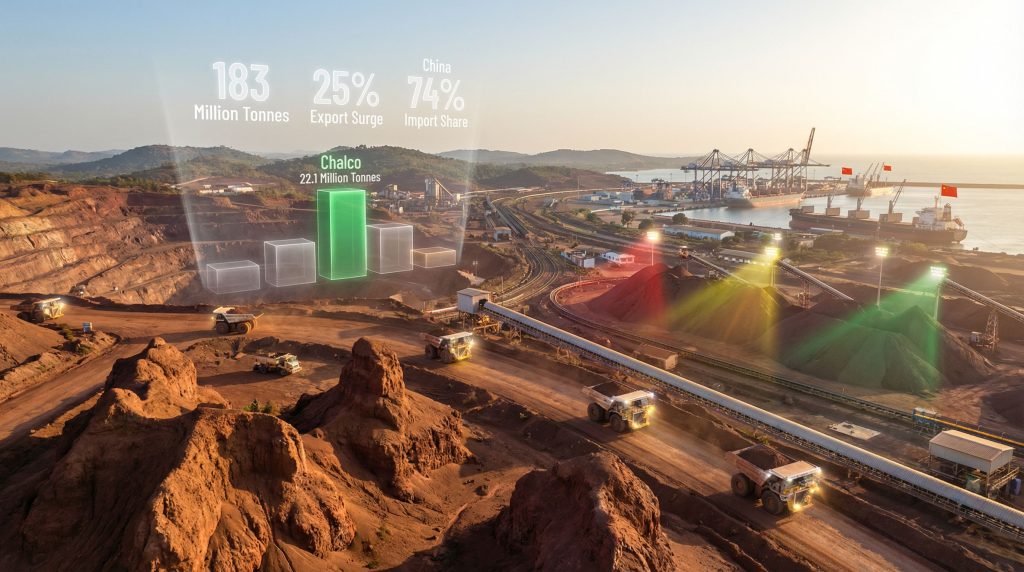
The infrastructure scaling required to achieve 25% annual export growth (from 146.2 million tonnes in 2024 to 182.8 million tonnes in 2025) represents substantial capital investment in specialized handling equipment. However, these developments showcase the mining industry evolution through advanced logistics and processing technologies.
Bauxite operations require dust suppression systems, high-capacity conveyor networks, and dedicated ship-loading facilities capable of processing abrasive, high-tonnage commodities. Current throughput capacity appears to exceed immediate demand. At January 2026 weekly rates, annualised capacity approaches 254 million tonnes, suggesting infrastructure development has created headroom for continued growth.
Port infrastructure development has been driven by both public sector initiatives and private mining consortium investments. The government's acceleration of domestic processing facility development requires concurrent logistics upgrades to handle increased throughput volumes while accommodating value-added product streams.
Vertical Integration Accelerates Across the Value Chain
Guinea's strategic pivot toward domestic processing represents a fundamental shift from raw material export dependency toward value-added manufacturing. The government announced in November 2025 plans to accelerate domestic alumina refinery and iron-ore pellet plant development, designed to reduce raw material exports while capturing downstream processing margins.
This vertical integration strategy mirrors successful resource nationalism policies implemented in other mineral-rich nations. Indonesia's nickel ore export restrictions forced downstream smelting development, creating substantial value-added processing capacity. Guinea's approach seeks similar outcomes through planned infrastructure development rather than export restrictions.
The economics of vertical integration are compelling. Raw bauxite contains 30-50% aluminum oxide content, while refining processes concentrate this to 95%+ purity alumina suitable for aluminum smelting. Furthermore, the margin differential between raw bauxite exports and processed alumina represents substantial value capture opportunities for domestic economic development.
Iron ore pelletisation offers similar value-addition potential. Converting low-grade ore fines into pellets suitable for direct reduction furnaces commands premium pricing and reduces transportation costs per unit of iron content. These processing facilities require significant capital investment but generate higher-margin revenue streams.
When big ASX news breaks, our subscribers know first
What Drove Guinea's 25% Export Surge to 183 Million Tonnes?
Multiple convergent factors created conditions for Guinea's remarkable export performance in 2025. Chinese aluminum sector expansion, mining consortium production scaling, and infrastructure development combined to generate unprecedented throughput volumes that established new benchmarks for West African mineral exports.
The surge reflects structural demand growth rather than cyclical inventory movements. Chinese industrial policy supporting aluminum production capacity, coupled with sustained infrastructure investment and electric vehicle sector expansion, created sustained import demand that Guinea's mining operations successfully captured.
Chinese Aluminum Sector Expansion Fuels Unprecedented Demand
China's aluminum smelting operations require approximately 200 million tonnes of bauxite annually to maintain 45 million-ton aluminum production capacity, accounting for beneficiation and conversion losses. This industrial demand provides stable, long-term offtake for Guinea's expanding mining operations.
The Chinese market's absorption capacity exceeds current Guinea export volumes, creating growth potential for continued expansion. Electric vehicle manufacturing, lightweight alloy applications, and construction sector aluminum consumption generate sustained demand for primary aluminum production.
Chinese smelting capacity constraints, rather than bauxite availability, represent the primary bottleneck in aluminum supply chains. Government-imposed production caps limit aluminum output despite abundant feedstock supplies, creating market dynamics where raw material availability exceeds processing capacity.
This demand structure provides Guinea with predictable export markets and stable pricing frameworks. Long-term offtake agreements between Chinese smelters and Guinea mining operations create revenue certainty that supports continued capital investment in production expansion.
Port Infrastructure Doubling Creates Logistical Breakthrough
Guinea's port infrastructure development has created the throughput capacity necessary to handle massive commodity export volumes. The transformation from constrained logistics networks to high-capacity shipping operations represents a critical enabler of export growth.
Current operational data demonstrates infrastructure effectiveness:
- Weekly bauxite handling: 4.9 million tonnes (January 2026)
- Concurrent iron ore throughput: 175,880 tonnes weekly
- Annualised capacity: ~254 million tonnes at current operational rates
This infrastructure development required sophisticated scheduling and berthing management systems to handle multiple commodity streams simultaneously. Specialised equipment for dust suppression, conveyor operations, and ship-loading systems represents substantial capital investment.
The infrastructure scaling enables Guinea to capture market share from alternative suppliers whilst maintaining operational efficiency. Port capacity exceeding current export volumes provides flexibility for seasonal variations and continued production growth.
Mining Consortium Scale-Up Operations Across Multiple Sites
Guinea's mining landscape features concentrated production among leading operators alongside a diverse ecosystem of smaller mining companies. Twenty-three companies shipped bauxite in 2025, with the top four exporters representing significant market concentration:
| Company | 2025 Exports (Million Tonnes) | Ownership Structure |
|---|---|---|
| Chalco | 22.1 | Chinese State-Owned Enterprise |
| CBG | 17.4 | Rio Tinto/Alcoa Consortium |
| SMB | 17.0 | Private Guinea Operator |
| AGB2A/SDM | 17.0 | Guinea-Majority Joint Venture |
These four entities collectively exported 73.5 million tonnes, representing approximately 40% of total Guinea bauxite exports. The remaining 17 companies managed 109.3 million tonnes (60%), indicating a diversified production base beyond major operators.
Future growth is expected from state-owned enterprises Nimba and Axis Mining, which are ramping up production capacity. These operations represent the primary engines for continued export expansion, suggesting potential market share redistribution among leading producers.
The consortium structure provides operational expertise, capital access, and international market connectivity essential for large-scale mining operations. Joint venture arrangements between international mining companies and Guinean entities create technology transfer and local capacity development.
Which Companies Control Guinea's Bauxite Export Landscape?
Guinea's bauxite export sector demonstrates a unique combination of international mining expertise and emerging domestic capacity. The market structure balances established multinational operators with growing Guinean-owned enterprises, creating competitive dynamics that drive operational efficiency and production growth.
Market leadership reflects diverse ownership models, from Chinese state-owned enterprises to international consortiums and private Guinean operators. This diversity provides supply chain resilience and competitive pricing frameworks whilst supporting local economic development objectives.
Chalco's Market Leadership with 22.1 Million Tonnes
China Aluminum Corporation (Chalco) maintains the largest individual export position with 22.1 million tonnes in 2025, representing approximately 12% of Guinea bauxite exports to China 2025. As a Chinese state-owned enterprise, Chalco's operations align with Beijing's strategic resource acquisition priorities.
Chalco's market leadership reflects substantial capital investment in mining infrastructure, processing facilities, and logistics networks. The company's integrated approach combines extraction operations with export capabilities designed to serve Chinese aluminum smelting requirements.
State-owned enterprise structure provides Chalco with access to Chinese policy bank financing and long-term strategic planning capabilities that support sustained capital investment cycles. This financial backing enables large-scale infrastructure projects that smaller operators cannot easily replicate.
CBG Consortium's Strategic Position in Global Markets
Compagnie des Bauxites de Guinée (CBG) exported 17.4 million tonnes in 2025, maintaining its position as a major international operator. The consortium structure, majority-owned by Rio Tinto and Alcoa, provides access to global aluminum markets and operational expertise.
CBG's established operations benefit from decades of operational experience in Guinea's mining sector. The company's infrastructure investments and local relationships provide competitive advantages in navigating regulatory environments and community engagement requirements.
International ownership structure connects Guinea's bauxite exports to global aluminum supply chains beyond Chinese markets. This diversification provides alternative marketing channels and pricing mechanisms that reduce single-market dependency risks.
The consortium model combines international capital, technical expertise, and local partnerships to create sustainable mining operations. Long-term concession agreements provide operational stability whilst supporting community development initiatives.
SMB and AGB2A Joint Ventures Drive Private Sector Growth
Société Minière de Boké (SMB) achieved 17.0 million tonnes of exports in 2025, establishing itself as Guinea's first major private bauxite exporter. This milestone represents successful private sector development in Guinea's mining landscape.
AGB2A/SDM joint venture similarly exported 17.0 million tonnes, demonstrating the success of Guinea-majority owned operations. These ventures showcase domestic capacity development and local ownership participation in large-scale mining operations.
Private sector success stories provide models for additional domestic mining development. Local ownership structures create direct economic benefits for Guinean stakeholders whilst building indigenous mining sector expertise.
Joint venture arrangements balance international expertise with domestic participation, creating sustainable development frameworks that support long-term economic growth. Technology transfer and capacity building associated with these partnerships develop local mining sector capabilities.
How Does China's 74% Import Share Impact Global Commodity Markets?
China's overwhelming dependence on Guinea for bauxite imports creates unprecedented concentration risk in global aluminum supply chains. This dependency structure influences commodity pricing mechanisms, trade policy decisions, and strategic resource planning across multiple economies.
The 74% import concentration represents the highest single-source dependency for any major commodity trade relationship outside of oil and gas sectors. This level of concentration creates systemic risks that extend beyond bilateral trade relationships to affect global aluminum market dynamics.
Beijing's Resource Security Strategy Reaches New Heights
China's resource security architecture increasingly relies on direct investment and long-term supply agreements with mineral-rich developing nations. The Guinea bauxite relationship exemplifies this strategic approach, combining supply chain control with infrastructure investment and political relationship building.
Resource diplomacy becomes a critical component of China's industrial policy when single suppliers provide such high percentages of critical inputs. Guinea's political stability, regulatory environment, and bilateral relationship management directly affect Chinese aluminum production capabilities.
The strategic dependency creates mutual economic interests that extend beyond commodity trading. China's 60%+ controlling stake in the Simandou iron-ore project, combined with equity positions in gold and lithium developments, demonstrates integrated resource acquisition strategies.
Multiple commodity exposure in Guinea reduces China's ability to diversify supply sources for individual minerals. This integration creates compound dependency risks where political or economic disruptions could affect multiple supply chains simultaneously.
Aluminum Smelting Capacity Constraints Create Price Volatility
China's aluminum smelting capacity caps generate market distortions that affect global aluminum pricing mechanisms. Despite abundant bauxite supplies, production constraints limit aluminum output and create price volatility independent of raw material availability.
Shanghai alumina prices fell 48% in the first ten months of 2025, reflecting oversupply conditions created by abundant bauxite imports combined with constrained smelting capacity. This price decline demonstrates how supply chain bottlenecks create market inefficiencies.
Government-imposed production limitations prevent Chinese smelters from fully utilising available bauxite feedstock. This regulatory framework prioritises environmental objectives and industrial policy goals over short-term market optimisation.
Price volatility affects upstream mining operations and downstream aluminum consumers globally. Uncertainty about Chinese production levels creates planning difficulties for international aluminum supply chain participants, which in turn relates to broader trade war impacts on global supply chains.
Geopolitical Implications of Single-Source Dependency
China's 74% import dependency on Guinea creates substantial geopolitical leverage for the West African nation. This relationship dynamic affects diplomatic relationships, development assistance programmes, and regional political alignments.
Resource dependency relationships often generate political alignment pressures as importing nations seek to ensure supply security. China's infrastructure investments and development assistance programmes in Guinea reflect these strategic considerations.
Alternative supplier development becomes a strategic priority when import concentration reaches critical thresholds. Australia, Indonesia, and other bauxite producers benefit from Chinese diversification efforts designed to reduce Guinea dependency.
International commodity markets become vulnerable to disruptions in bilateral political relationships. Trade disputes, regulatory changes, or political instability could affect global aluminum supply chains despite adequate global bauxite reserves.
What Are the Broader Economic Implications for West Africa?
Guinea's bauxite export boom generates substantial economic development opportunities that extend beyond mining sector employment and government revenue collection. The multiplier effects of large-scale mineral extraction create infrastructure development, service sector growth, and regional economic integration opportunities.
Resource-driven economic development requires careful management to ensure sustainable benefits and avoid dependency relationships that limit long-term growth potential. Guinea's strategic approach to domestic processing development demonstrates awareness of these challenges.
Guinea Government Revenue Projections Jump 40% in 2025
Guinea's budget ministry projects 40% revenue growth in 2025, driven primarily by expanded mining sector contributions. This substantial increase provides fiscal resources for infrastructure investment, social programme expansion, and economic diversification initiatives.
Revenue growth translates directly into government capacity for public investment and service delivery improvements. Mining sector contributions provide stable funding sources that support long-term development planning and capital project implementation. These bauxite project economic benefits demonstrate the transformative potential of well-managed mineral resources.
According to Bernabe Sanchez, principal mineral economist at CPCS, the country is finally seeing production growth translate meaningfully into state finances. This observation highlights successful revenue capture mechanisms that ensure mining activities generate broad economic benefits.
Tax revenue optimisation from mining operations requires sophisticated administrative capacity and transparent governance frameworks. Guinea's ability to effectively collect and utilise mining revenues determines the long-term development impact of resource extraction activities.
Regional Mining Hub Development Accelerates
Guinea's mining sector success creates opportunities for regional economic integration and service sector development. Specialised mining services, equipment supply networks, and logistics infrastructure benefit neighbouring West African economies.
Regional mining hub development requires coordination across multiple countries and economic sectors. Transportation infrastructure, financial services, and technical expertise sharing create network effects that amplify individual country mining sector development.
Cross-border infrastructure projects, including rail networks and port facilities, serve multiple countries' mining export requirements. Shared infrastructure reduces individual country development costs whilst creating regional economic integration opportunities.
Guinea's experience provides models and expertise for other West African countries seeking to develop mineral resources. Technology transfer, operational knowledge sharing, and investment attraction strategies can be replicated across the region.
Infrastructure Investment Creates Multiplier Effects
Mining sector infrastructure development generates economic benefits beyond direct extraction activities. Port facilities, transportation networks, and power generation systems support multiple economic sectors and create employment opportunities.
Infrastructure multiplier effects include:
- Transportation network improvements that reduce logistics costs for agriculture and manufacturing
- Power generation capacity that supports industrial development and urban economic growth
- Telecommunications infrastructure that enables digital economy development
- Financial services expansion that supports small business development and household economic participation
Capital investment in mining-related infrastructure often exceeds direct mining project costs, creating substantial economic development leverage. These investments benefit multiple generations and economic sectors beyond initial mining operations.
Social infrastructure development, including healthcare facilities, educational institutions, and housing projects, improves human capital development and community welfare outcomes. These investments create sustainable development benefits that persist beyond mining sector activity.
Why Are Global Aluminum Prices Under Pressure Despite Strong Demand?
Global aluminum markets face unique dynamics where strong downstream demand meets constrained smelting capacity and abundant raw material supplies. This unusual combination creates price pressures and market inefficiencies that challenge traditional commodity market analysis frameworks.
The disconnect between bauxite availability and aluminum pricing reflects complex supply chain bottlenecks, regulatory constraints, and industrial policy interventions that override typical supply-demand equilibrium mechanisms.
Chinese Smelting Capacity Caps Limit Price Discovery
China's aluminum smelting capacity restrictions create artificial supply constraints that prevent efficient price discovery mechanisms. Despite abundant bauxite feedstock availability, production limitations maintain market imbalances that affect global aluminum pricing.
Government-imposed capacity caps prioritise environmental objectives and industrial policy goals over market-driven production optimisation. These regulatory frameworks create predictable supply constraints that affect international aluminum market dynamics.
Capacity utilisation restrictions prevent Chinese smelters from responding to price signals through production adjustments. This regulatory framework reduces market efficiency and creates persistent price volatility independent of fundamental supply-demand factors.
International aluminum producers benefit from Chinese capacity constraints through reduced competitive pressure and market share protection. However, downstream aluminum consumers face higher prices and supply uncertainty due to artificial production limitations.
Shanghai Alumina Falls 48% in First Ten Months
Shanghai alumina prices declined 48% during the first ten months of 2025, reflecting oversupply conditions created by abundant bauxite imports combined with constrained aluminum smelting capacity. This dramatic price decline demonstrates market inefficiencies in aluminum supply chains.
The price collapse indicates alumina refinery capacity exceeds smelting capacity, creating inventory accumulation and storage constraints. Refineries continue processing bauxite into alumina despite limited downstream absorption capacity.
Alumina price volatility affects upstream bauxite mining operations through reduced profit margins and uncertain demand forecasting. Mining companies face challenges in investment planning when downstream processing markets experience extreme price fluctuations.
International alumina markets become disconnected from Chinese pricing when domestic oversupply conditions create regional market distortions. Global aluminum supply chain participants must navigate complex pricing mechanisms that don't reflect fundamental supply-demand relationships.
Supply-Demand Imbalance Creates Market Distortions
Aluminum market distortions arise from mismatched capacity across different supply chain stages. Raw material abundance, intermediate product oversupply, and final product constraints create complex market dynamics that challenge traditional commodity analysis.
Market participants face pricing signals that don't reflect underlying economic fundamentals. Investment decisions, production planning, and risk management strategies must account for regulatory interventions and policy-driven market distortions.
Supply chain optimisation becomes difficult when government policies create artificial bottlenecks at specific processing stages. Companies must balance operational efficiency with compliance requirements that may conflict with market-driven optimisation.
Global aluminum consumers experience price volatility and supply uncertainty despite adequate raw material reserves and processing capacity. These market inefficiencies create economic costs that extend beyond direct aluminum market participants.
The next major ASX story will hit our subscribers first
How Will Domestic Processing Plans Transform Guinea's Export Strategy?
Guinea's strategic pivot toward domestic processing represents a fundamental shift from raw material export dependency toward value-added manufacturing. This transformation could significantly alter global aluminum supply chains whilst generating substantial economic development benefits for Guinea.
The success of domestic processing development depends on technology transfer, capital investment, market access, and operational expertise that requires sophisticated industrial policy coordination and international partnership management.
Government Accelerates Alumina Refinery Development
Guinea's government announced in November 2025 plans to accelerate domestic alumina refinery development, designed to capture value-added processing margins whilst reducing raw bauxite export dependency. This strategic initiative represents significant industrial policy evolution.
Alumina refining transforms raw bauxite (30-50% aluminum oxide content) into high-purity alumina (95%+ aluminum oxide) suitable for aluminum smelting. This processing step captures substantial value-addition that currently benefits importing countries.
Domestic refinery development requires significant capital investment, technical expertise, and market access arrangements. International partnerships provide technology transfer and financing capabilities essential for successful implementation.
Refinery operations create employment opportunities, skill development programmes, and industrial ecosystem benefits that extend beyond direct processing activities. These multiplier effects support broader economic development objectives.
Value-Added Processing Reduces Raw Material Dependence
Value-added processing strategies reduce Guinea's vulnerability to raw material price volatility whilst capturing higher-margin revenue streams. Downstream processing creates more stable economic relationships with international markets.
Processing facilities create demand for domestic services, infrastructure development, and technical expertise that support indigenous capability building. Local content requirements generate economic benefits beyond direct processing employment.
Resource nationalism policies worldwide demonstrate successful models for value-addition mandates. Indonesia's nickel ore export restrictions forced downstream smelting development, creating substantial domestic industrial capacity. This approach aligns with broader trends in energy transition security where countries seek greater control over critical mineral supply chains.
Guinea's approach emphasises planned development rather than export restrictions, providing market certainty whilst building processing capacity. This gradual transition strategy balances immediate revenue needs with long-term development objectives.
Iron Ore Pellet Plants Diversify Revenue Streams
Iron ore pelletisation represents additional value-addition opportunities that complement bauxite processing development. Pellet plants convert low-grade ore fines into premium products suitable for direct reduction furnaces.
Multi-commodity processing strategies reduce economic dependence on single mineral exports whilst utilising shared infrastructure and expertise. Diversified processing capabilities provide revenue stability and market flexibility.
Pelletisation technology requires less complex infrastructure than full steel production, making it suitable for initial value-addition development. Success in pellet production creates foundations for further downstream processing expansion.
Iron ore pellet markets provide alternative export destinations that reduce dependency on single-country relationships. Diversified market access improves pricing power and reduces geopolitical risks.
What Does This Mean for Global Aluminum Supply Security?
Guinea's bauxite export dominance creates unprecedented concentration risks in global aluminum supply chains that require strategic response from consuming nations, alternative suppliers, and international policy organisations. The implications extend beyond aluminum markets to affect critical mineral security frameworks worldwide.
Supply security considerations must balance economic efficiency with strategic resilience, creating complex policy challenges for countries dependent on aluminum imports or seeking to maintain competitive aluminum production capabilities.
Concentration Risk Reaches Critical Threshold
China's 74% import dependency on Guinea represents the highest single-source concentration for any major commodity relationship outside of oil and gas. This level of dependency creates systemic risks that affect global aluminum market stability.
Critical threshold analysis suggests that import dependencies exceeding 70% from single sources create strategic vulnerabilities requiring policy intervention. Guinea bauxite exports to China 2025 clearly exceed this threshold, indicating urgent need for diversification strategies.
Concentration risk affects multiple supply chain participants beyond direct importers. Downstream aluminum consumers, equipment manufacturers, and construction industries face potential disruption risks from Guinea-specific supply interruptions.
Risk mitigation requires coordinated responses from multiple stakeholders, including alternative supplier development, strategic reserve management, and supply chain diversification initiatives. These responses require substantial time and capital investment.
Alternative Supply Source Development Becomes Urgent
Alternative bauxite supplier development becomes strategically essential as Guinea's market dominance creates unacceptable concentration risks. Australia, Indonesia, Brazil, and other producers must expand capacity to provide supply diversification options.
Supplier development requires substantial capital investment, regulatory approval processes, and infrastructure development that typically require 5-10 year implementation timelines. Immediate action is necessary to address medium-term supply security concerns.
International development finance institutions and strategic material security programmes should prioritise alternative supplier development. Government policy support, including loan guarantees and tax incentives, can accelerate diversification initiatives.
Technology transfer and operational expertise sharing can reduce alternative supplier development costs and timelines. International cooperation in mining sector development provides mutual supply security benefits.
Strategic Reserve Policies May Need Reassessment
Strategic aluminum and bauxite reserve policies require reassessment given Guinea's market dominance and associated concentration risks. Current reserve levels may be inadequate given potential supply disruption scenarios.
Reserve policy development must consider storage costs, inventory management requirements, and market intervention capabilities. Strategic reserves must be sufficient to manage supply disruptions whilst avoiding market distortion effects.
International coordination in reserve policy development provides enhanced security whilst reducing individual country reserve requirements. Shared reserve facilities and coordination mechanisms improve cost effectiveness.
Reserve policies should encompass both raw materials (bauxite) and processed products (alumina, aluminum) to address different supply chain disruption scenarios. Comprehensive reserve strategies provide maximum supply security benefits.
Which Market Trends Will Shape 2026 Bauxite Trade?
Several critical trends will influence bauxite trade dynamics in 2026, including production expansion at specific mining operations, continued growth in aluminum-intensive sectors, and potential regulatory changes affecting export licensing and market access.
Market participants must navigate evolving supply-demand relationships, infrastructure constraints, and policy interventions that could significantly affect trading patterns and pricing mechanisms throughout 2026.
Nimba and Axis Mining Production Ramp-Up Expected
State-owned enterprises Nimba and Axis Mining represent the primary growth engines for Guinea's bauxite export expansion in 2026. These operations are expected to drive continued strong export performance through production capacity increases.
Production ramp-up at established operations typically provides more reliable capacity additions than new project development. Existing infrastructure and operational experience reduce implementation risks associated with expansion projects.
State-owned enterprise structure provides access to government financing and policy support that facilitates rapid capacity expansion. These operations align with national economic development objectives and strategic resource management policies.
Market share redistribution may occur as Nimba and Axis Mining increase production volumes. Current leading exporters could face competitive pressure from expanded state-owned enterprise operations.
Chinese EV Sector Growth Sustains Aluminum Demand
China's electric vehicle sector expansion creates sustained demand for aluminum through battery packaging, structural components, and lightweight alloy applications. EV production growth directly translates into aluminum consumption increases.
Aluminum intensity per vehicle increases significantly in electric vehicle applications compared to internal combustion engine vehicles. Battery protection requirements and weight optimisation create new aluminum demand categories.
Chinese EV production targets and domestic market expansion create predictable aluminum demand growth that supports sustained bauxite import requirements. Long-term growth projections provide investment planning certainty for mining operations.
Export market development for Chinese EV manufacturers creates additional aluminum demand through increased production volumes. Global EV market expansion multiplies the aluminum demand effects of Chinese production capacity.
Regulatory Changes May Impact Export Licensing
Potential regulatory changes affecting export licensing, environmental requirements, or local content mandates could significantly impact Guinea's bauxite trade patterns. Government policy evolution requires careful monitoring by market participants.
Export licensing frameworks may evolve to support domestic processing development through quota systems or preferential allocation mechanisms. These changes could affect international market access and pricing relationships.
Environmental regulations affecting mining operations or export facilities could impact production capacity and operational costs. Compliance requirements may necessitate infrastructure upgrades or operational modifications.
Local content requirements for mining operations could affect ownership structures, employment practices, and operational partnerships. These policy changes influence long-term investment planning and market participation strategies.
FAQ: Understanding Guinea's Bauxite Export Boom
Why has Guinea become the world's largest bauxite exporter?
Guinea's emergence as the world's leading bauxite exporter results from several convergent factors: abundant high-quality bauxite reserves, strategic Chinese investment in mining infrastructure, rapid port capacity development, and favourable regulatory frameworks that attract international mining companies. The country overtook Australia in 2023 as the leading global exporter, achieving 182.8 million tonnes in exports during 2025.
The competitive advantages include lower transportation costs to Chinese markets, government policies supporting mining sector development, and successful public-private partnerships that combine international expertise with domestic resources. Chinese companies, particularly Chalco with 22.1 million tonnes in annual exports, have established integrated supply chains connecting Guinea's mines directly to China's aluminum smelting operations.
How does this affect global aluminum prices?
Guinea bauxite exports to China 2025 create complex effects on global aluminum prices due to supply chain bottlenecks at the smelting stage. Despite abundant bauxite availability, Shanghai alumina prices fell 48% in the first ten months of 2025 due to Chinese smelting capacity constraints that prevent efficient processing of available raw materials.
The price impact reflects regulatory limitations on Chinese aluminum production rather than raw material shortages. China's 45 million-ton annual smelting capacity faces government-imposed constraints designed to achieve environmental objectives, creating artificial supply limitations despite adequate bauxite feedstock.
This dynamic generates price volatility that doesn't reflect traditional supply-demand fundamentals, creating challenges for global aluminum market participants who must navigate regulatory interventions and policy-driven market distortions.
What are the risks of China's heavy dependence on Guinea?
China's 74% import dependency on Guinea for bauxite represents the highest single-source concentration for any major commodity relationship outside of oil and gas, creating substantial strategic vulnerabilities. This concentration level exceeds risk management thresholds typically considered acceptable for critical industrial inputs.
The risks include potential supply disruptions from political instability, regulatory changes, infrastructure failures, or international trade disputes. Guinea's political and economic conditions directly affect Chinese aluminum production capabilities, creating geopolitical leverage that extends beyond normal commercial relationships.
Additional risks arise from China's multiple commodity dependencies in Guinea, including 60%+ controlling stakes in iron-ore projects and equity positions in gold and lithium developments. This integrated dependency structure compounds risks where single-country disruptions could affect multiple critical supply chains simultaneously.
Mitigation strategies require alternative supplier development, strategic reserve management, and supply chain diversification initiatives that typically require substantial time and investment to implement effectively.
When will domestic processing facilities come online?
Guinea's government announced in November 2025 plans to accelerate domestic alumina refinery and iron-ore pellet plant development, but specific timelines for facility completion remain unclear from available public information. These processing facilities aim to reduce raw material export dependency whilst capturing value-added manufacturing margins.
Typical alumina refinery development requires 3-5 years from final investment decision to commercial production, depending on project scale, financing arrangements, and technical complexity. Iron ore pelletisation facilities generally require shorter development timelines, typically 2-3 years for construction and commissioning.
The success of domestic processing development depends on securing international partnerships for technology transfer, obtaining project financing, and establishing market access arrangements for processed products. Government policy support and regulatory frameworks will significantly influence implementation timelines and operational success.
Disclaimer: This analysis is based on publicly available information and industry research as of January 2026. Commodity markets involve substantial risks, including price volatility, regulatory changes, and geopolitical factors that can significantly affect investment outcomes. Readers should conduct independent research and consult qualified professionals before making investment decisions based on this information.
Seeking Exposure to Guinea's Bauxite Boom and ASX Mining Opportunities?
Discovery Alert's proprietary Discovery IQ model delivers real-time notifications on significant ASX mineral discoveries, instantly empowering subscribers to identify actionable trading opportunities in bauxite, aluminum feedstock companies, and related mining operations ahead of the broader market. As Guinea's export surge reshapes global supply chains, explore Discovery Alert's dedicated discoveries page to understand how historic mineral discoveries have generated substantial returns, then begin your 30-day free trial today to position yourself ahead of critical market developments.