
May 11, 2026
The Industrial Mineral That Reveals Everything About China's Economic Health
Few commodities expose the inner workings of China's industrial economy quite like zircon sand. Unlike metals traded on transparent exchanges, zircon operates in a relatively opaque market where price formation is heavily influenced by the health of a single downstream sector: ceramic tile manufacturing. When China builds, zircon moves. When construction stalls, the entire supply chain contracts in ways that ripple from Western Australian mine sites to inland Chinese beneficiation plants within a matter of quarters.
Understanding the zircon price correction in China that unfolded across 2025 requires looking beyond headline numbers. What occurred was not a sudden demand collapse but rather a methodical convergence of supply acceleration, inventory accumulation, and demand-side fragility that compressed pricing across multiple grades and origins simultaneously. Crucially, the structural forces that set the stage for eventual recovery were building in parallel throughout the same period.
When big ASX news breaks, our subscribers know first
Why China Controls the Zircon Market's Pricing Destiny
China's position as the world's dominant zircon consumer creates an unusual market dynamic where the health of one country's property sector effectively sets the global pricing tone for an industrial mineral extracted primarily in Australia and South Africa. China accounts for roughly half of all global zircon demand, with the ceramic tile sector serving as the largest single consumption pathway.
The China Building Materials Federation has documented that Chinese ceramic tile production capacity reached approximately 11 billion square metres annually as of 2023, down from a peak of 12.8 billion square metres in 2015 following environmental regulation tightening and residential construction normalisation. Each square metre of ceramic tile produced consumes a measurable quantity of zircon in glaze formulation, meaning that production volume fluctuations translate almost directly into raw material demand signals.
Beyond ceramics, China industrial demand feeds three other critical industrial pathways:
- Refractories used in steelmaking, glass furnaces, and foundry applications where heat resistance and chemical inertness are essential
- Zirconium chemicals including zirconium oxychloride, sulfate, and carbonate, which serve as inputs for catalysts, paper coatings, and textile treatments
- Nuclear-grade zirconium sponge, where extreme purity specifications are mandatory for fuel cladding applications in commercial reactors
This multi-sector dependency creates a layered demand structure where weakness in one application does not necessarily devastate overall consumption. However, when ceramics and chemicals weaken simultaneously, as occurred in 2025, the combined effect on price formation is amplified.
How Zircon Prices Are Actually Measured
Zircon pricing operates through a structured assessment methodology maintained by price reporting agencies, most notably Fastmarkets, which publishes the globally referenced benchmark for premium-grade zircon: 66.5% ZrO₂ minimum, bulk, CIF China (assessed under pricing code MB-ZIR-0014). This benchmark represents the international standard against which producers, traders, and buyers negotiate contract terms.
A secondary domestic benchmark, the 65% ZrO₂ minimum EXW China standard-grade assessment, serves as the pricing anchor for material processed within Chinese beneficiation facilities and sold through domestic distribution channels.
The precision demanded by these assessments is considerable. In May 2026, Fastmarkets issued a formal correction to its MB-ZIR-0014 assessment, adjusting the published range from an erroneously wide $1,600-$1,700 per tonne to the accurate $1,600-$1,670 per tonne. The $30 per tonne correction may appear minor in isolation, but in a market where long-term supply contracts are priced against these benchmarks, even narrow range errors carry material financial consequences for counterparties.
Price assessments for zircon undergo formal correction protocols managed by price reporting agencies. The precision of published ranges directly affects contract pricing, risk management calculations, and procurement budgeting across the global zircon supply chain.
Anatomy of the 2025 Zircon Price Correction
The price correction that defined the Chinese zircon market through the second half of 2025 had its origins in a simultaneous supply push and demand retreat that unfolded across multiple vectors.
A Supply Surge That Overwhelmed Absorption Capacity
Heavy Mineral Concentrate production expanded materially heading into 2024-2025, with multiple projects reaching commercial output simultaneously. HMC is the upstream feedstock from which zircon concentrate is recovered through beneficiation processing, and the surge in available material created a processing bottleneck at Chinese refinery facilities that were equipped to handle feedstock throughput but struggled to find downstream buyers for the resulting product.
Australian HMC exports to China increased substantially in 2025 relative to the 2022-2023 baseline, redirecting larger volumes through Chinese beneficiation circuits already operating at elevated utilisation rates. The influx concentrated disproportionately in standard 65% ZrO₂ grade material, creating a two-tier market dynamic where premium grades held relatively firm while standard grades absorbed the brunt of supply pressure.
The price differential between premium and standard grades widened from approximately $45 per tonne in Q2 2025 to $97 per tonne by Q4 2025, an important structural signal that the oversupply was grade-specific rather than uniform. This widening quality premium has significant implications for producers whose output sits near or below the premium threshold.
Simultaneously, approximately 12 secondary beneficiation plants across China closed between early 2024 and Q3 2025 in response to tightened environmental compliance requirements and deteriorating processing margins. These facilities collectively removed 75,000-85,000 tonnes of annual processing capacity from the domestic market, though this reduction was insufficient to offset incoming HMC supply volumes.
Demand Erosion From Multiple Directions
China's property sector slowdown created a cascading effect through the ceramics supply chain. Guangdong Province ceramic manufacturers, who collectively represent a significant share of national tile output, accumulated roughly six months of zircon inventory by Q4 2025, compared to approximately four months of inventory cover in Q2 2025. With warehouses full and construction activity subdued, procurement desks shifted from regular restocking cycles to extended hold strategies.
Furthermore, the China commodity outlook for zirconium chemical exporters was complicated by trade friction affecting their end-markets. Export volumes from major chemical producers declined approximately 18% year-on-year in Q4 2025, suppressing raw material purchasing activity even where domestic processing capacity remained available.
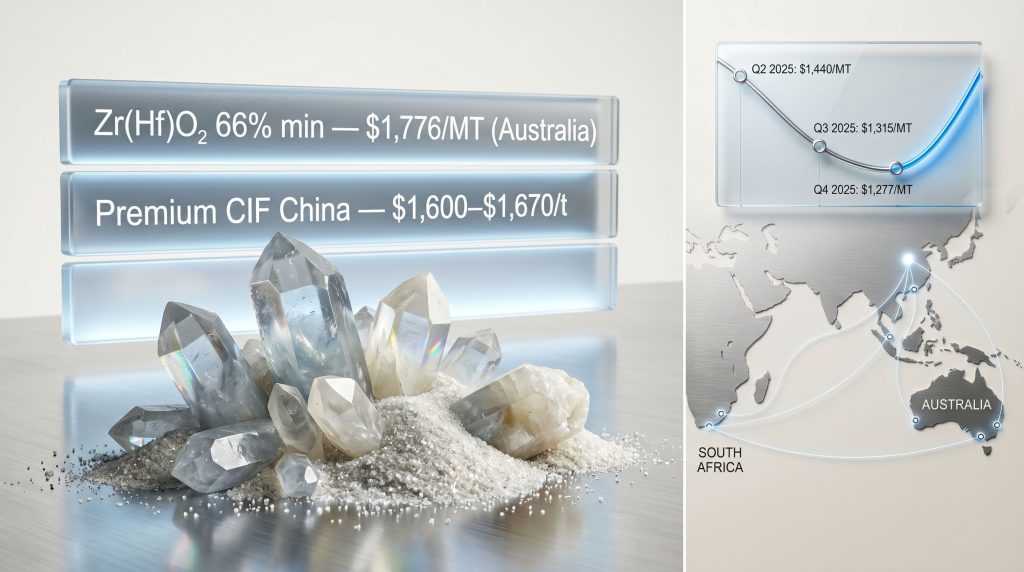
The quarterly price trajectory through 2025 illustrates the cumulative effect:
| Period | Zircon Price (USD/MT) | Quarter-on-Quarter Change |
|---|---|---|
| Q2 2025 | $1,440 | Baseline reference |
| Q3 2025 | $1,315 | -$125/MT (-8.7%) |
| Q4 2025 | $1,277 | -$38/MT (-2.9%) |
Zirconium carbonate, a key derivative chemical and a reliable indicator of downstream demand health, declined from $2,865/MT FOB Qingdao in Q3 2025 to $2,675/MT in Q4 2025, representing a quarterly decline of approximately 6.65-7.17%. Consequently, zirconium carbonate pricing data became an increasingly watched indicator for analysts tracking the pace of China's demand recovery.
The 2026 Price Recovery: Genuine Rebound or Technical Bounce?
Spot market assessments from April-May 2026 reflect a meaningful recovery from the December 2025 trough, though the nature and durability of that recovery remains subject to debate among market participants.
| Grade and Specification | Origin / Delivery Terms | May 2026 Price (USD/MT) | Change vs. Prior Period |
|---|---|---|---|
| ZrO₂ 66% minimum | Australian, Port China | $1,776 | +$76/MT |
| ZrO₂ 66% minimum | South African, Port China | $1,614-1,615 | +$85/MT |
| ZrO₂ 65% minimum | EXW China (domestic) | $1,578-1,579 | +$81-82/MT |
| Premium CIF China (corrected benchmark) | Bulk, CIF China | $1,600-1,670 | Corrected May 2026 |
The $162 per tonne discount at which South African material trades relative to Australian premium grades reflects genuine quality differentiation. South African zircon typically carries slightly higher hafnium oxide content and lower ZrO₂ purity than Australian equivalents, characteristics that matter considerably in high-specification chemical and nuclear applications but less so in standard ceramics production.
The premium-to-standard price spread is not merely an academic distinction. Producers straddling the 65-66.5% ZrO₂ boundary face dramatically different revenue outcomes depending on which side of the quality threshold their product consistently falls on.
What the 2026 recovery demonstrates is that the market did not collapse into a structural bear phase. The Q4 2025 trough represented an overshooting of fair value driven by simultaneous supply and demand pressure rather than a fundamental reassessment of zircon's industrial utility. The recovery validates the controlled rebalancing thesis rather than suggesting a speculative return to unsustainable peaks.
The Hidden Variable: Zircon's Nuclear Dimension
One of the least-discussed aspects of Chinese zircon demand is the strategic stockpiling component tied to nuclear energy expansion. China's nuclear power build-out, among the most ambitious in the world by reactor count, creates a demand pathway for high-purity zirconium sponge that operates largely independent of commercial market dynamics.
Strategic procurement of nuclear-grade zirconium sponge, estimated at 10,000 tonnes tied to national stockpiling programmes, tightens high-purity feedstock availability in ways that do not appear in conventional ceramic or chemical demand statistics. China currently imports more than 80% of its high-purity zirconia requirements, creating a structural import dependency that makes domestic production economics and supply chain security increasingly important as reactor commissioning timelines accelerate.
This nuclear demand layer is notable precisely because it is non-cyclical. Unlike ceramic tile procurement, which can be deferred when inventory is elevated, nuclear fuel cycle requirements operate on commissioning schedules that cannot be easily adjusted. The presence of this inelastic demand underpins pricing for premium-grade material even during periods of construction sector weakness.
Supply Deficit Risk: The Case for Structural Price Recovery
Perhaps the most consequential forward-looking consideration for the zircon price correction in China is the supply depletion dynamic developing at major Australian mining operations. Several legacy deposits in Western Australia face reserve exhaustion timelines extending into 2026-2027, raising the prospect of a 50,000-tonne global supply gap as economically recoverable reserves at existing operations are drawn down.
However, the broader global steel outlook and refractory demand trajectory add another dimension to supply deficit risk, given that zircon-based refractories are a key input for steelmaking furnaces worldwide. The market forces that could reverse the 2025 correction and drive prices meaningfully higher include:
- Australian mine reserve depletion at legacy operations reducing available premium-grade supply by an estimated 50,000 tonnes annually
- South African production vulnerability from persistent labour disruption risk and port logistics constraints that have historically created periodic supply shock events
- Chinese beneficiation capacity rationalisation with 75,000-85,000 tonnes of annual processing capacity already removed from the market
- Nuclear demand inelasticity supporting high-purity grade pricing independent of construction sector cycles
- New domestic Chinese supply timelines extending to 2028 or beyond before Xinjiang province HMC development reaches meaningful commercial output
Long-term consensus price forecasts position zircon sand averaging approximately $1,628/MT FOB across the 2025-2030 horizon, with upside scenarios projecting values exceeding $2,200/MT if supply disruptions materialise concurrently with construction sector recovery.
Bearish Risks That Could Extend Price Weakness
Not all market signals point to a swift recovery. In addition, several factors could sustain subdued pricing into late 2026:
- Ceramics buyers remain reluctant to rebuild inventory aggressively until residential construction starts demonstrate consistent improvement over multiple consecutive months
- Loose spot availability from discounted South African cargoes continues to provide a pricing ceiling for standard-grade material
- Export competition from lower-cost Southeast Asian ceramic producers is compressing Chinese manufacturers' margins and moderating their appetite for raw material restocking
- US-China trade tensions have created additional uncertainty for zirconium chemical exporters, further dampening raw material procurement activity
- The timeline for China's property market normalisation remains genuinely uncertain, with residential construction starts yet to show the sustained momentum that would drive tile demand recovery
The next major ASX story will hit our subscribers first
The Quality Divide That Shapes Producer Economics
The widening price spread between premium and standard grades has created a bifurcated market with meaningfully different economic implications for producers depending on their output quality profile.
| Market Participant | Near-Term Strategy | Key Long-Term Consideration |
|---|---|---|
| Chinese ceramics buyers | Extend inventory cycles; limit spot purchases | Watch for construction sector recovery signals |
| Premium-grade producers | Maintain price discipline; resist spot discounting | Positioned for supply gap upside post-2026 |
| Standard-grade producers | Compete on volume; accept margin compression | Risk structural discount if oversupply persists |
| Chemical and nuclear processors | Prioritise long-term contract coverage | Reduce import dependency through sourcing diversification |
The technical explanation for this quality divide is rooted in processing chemistry. Premium-grade material at 66.5% ZrO₂ minimum contains lower concentrations of hafnium oxide, iron oxide, and titanium-bearing impurities that must be removed during chemical processing. Lower impurity burden translates directly to higher chemical yields and reduced reagent consumption, making premium feedstock economically superior for zirconium chemical producers even when its spot price commands a substantial premium over standard grades.
For ceramic applications requiring consistent glaze opacity and colour stability at scale, premium-grade material delivers measurably better manufacturing consistency. The technical dependency on grade quality creates demand inelasticity at the premium end of the market that protects producers of high-specification material from the full force of commodity-grade oversupply pressure. Furthermore, tariff-driven supply chains are reshaping sourcing preferences in ways that may ultimately favour premium-grade Australian material over lower-specification alternatives.
Frequently Asked Questions: Zircon Prices and the China Market
What is the current zircon price in China?
As of May 2026, premium-grade zircon assessed at 66.5% ZrO₂ minimum on a bulk CIF China basis is priced at $1,600-$1,670 per tonne following Fastmarkets' formal benchmark correction. Australian-origin premium material trades at approximately $1,776/MT at port, South African origin sits near $1,614-$1,615/MT, and domestic EXW China standard-grade material is assessed at approximately $1,578-$1,579/MT.
Why did zircon prices fall sharply in late 2025?
The 2025 correction combined new HMC supply entering the market faster than Chinese beneficiation facilities could absorb, conservative procurement behaviour from ceramics and chemical sector buyers managing elevated inventories, weakening export volumes for zirconium chemical products, and persistent softness in China's residential construction activity. The combination compressed prices from a Q2 2025 baseline of $1,440/MT to approximately $1,277/MT by Q4 2025.
What is the difference between premium and standard grade zircon?
Premium grade specifies a minimum 66.5% ZrO₂ content and commands a higher price because of its suitability for chemical processing, nuclear applications, and high-specification ceramic production where purity and consistency are critical. Standard grade specifies 65% ZrO₂ minimum and is more widely available from a broader range of sources, making it more susceptible to price pressure when supply increases. The quality gap between these two classifications widened significantly during 2025, with the price differential reaching $97/MT by Q4 2025.
How are zircon price corrections issued by Fastmarkets?
Fastmarkets operates formal correction protocols for instances where reporter error affects published assessments. In May 2026, Fastmarkets corrected its MB-ZIR-0014 premium-grade CIF China assessment from an erroneously published range of $1,600-$1,700 per tonne to the accurate $1,600-$1,670 per tonne. The pricing database was updated accordingly and the correction was published with full transparency regarding the nature and cause of the error.
Navigating the Next Phase of China's Zircon Cycle
The zircon price correction in China through 2025 was a supply-demand imbalance event, not a structural breakdown. Prices fell approximately 8-11% from Q2 to Q4 2025 before finding support and beginning a recovery trajectory that has continued into 2026. The market's ability to stabilise without collapsing reflects the underlying structural demand for zircon across ceramic, chemical, and nuclear applications that cannot be easily substituted or indefinitely deferred.
The most important variables for price direction through 2026 and into 2027 are clear:
- The pace of China's construction sector normalisation and its effect on ceramic tile production volumes
- Australian mine reserve depletion timelines and any acceleration in planned capacity reductions
- South African production and logistics reliability as a swing supply source
- Strategic procurement activity in China's nuclear and high-purity chemical sectors
- Trade policy developments affecting Chinese zirconium chemical export competitiveness
What makes zircon a particularly instructive market to follow is the precision it demands from both producers and analysts. A $30 per tonne correction to a benchmark assessment, as occurred in May 2026, carries real financial consequences in a market where long-term contracts, risk management instruments, and procurement budgets are all anchored to published price ranges. That level of precision reflects both the commercial stakes involved and the sophistication of the industrial minerals pricing infrastructure that serves a commodity most consumers never see but encounter daily in the tiles beneath their feet.
This article contains forward-looking statements and price forecasts based on publicly available market data and analyst consensus. Commodity price forecasts are inherently uncertain and should not be construed as financial advice. Past price trajectories do not guarantee future outcomes. Readers should conduct independent research before making any investment or procurement decisions based on zircon market conditions.
For transparent pricing methodology documentation covering zircon and other industrial minerals benchmarks, Fastmarkets publishes full specification details at fastmarkets.com/methodology.
Want to Catch the Next Major ASX Mineral Discovery Before the Market Does?
Discovery Alert's proprietary Discovery IQ model delivers real-time alerts on significant ASX mineral discoveries — including industrial minerals tied to China's evolving commodity cycles — turning complex market data into actionable investment insights for both short-term traders and long-term investors. Explore how historic discoveries have generated substantial returns on Discovery Alert's dedicated discoveries page, and begin your 14-day free trial today to position yourself ahead of the market.