May 11, 2026
The Hidden Geography of Global Food Security
Most people understand that oil flows through the Strait of Hormuz. Far fewer appreciate that the world's ability to grow food depends on the same 21-mile-wide passage. Phosphate fertilisers, the agricultural inputs that support phosphorus nutrition in crops worldwide, move through this contested waterway in volumes large enough to meaningfully affect planting seasons across multiple continents. When that passage is compromised, the effects are not felt at the fuel pump but in farm input costs, crop planting decisions, and ultimately food prices, playing out across a timeline measured in growing seasons rather than trading days.
The events of early 2026 have exposed how fragile this arrangement truly is. Since the outbreak of US-Iran hostilities at the end of February 2026, the effective disruption of Strait of Hormuz transit has created a supply bottleneck with consequences extending far beyond the Persian Gulf. The confirmation that a second Saudi phosphates cargo transits Hormuz since hostilities began represents a data point that markets are watching closely, but interpreting correctly requires understanding what one vessel actually signals within a much larger structural problem.
When big ASX news breaks, our subscribers know first
Saudi Arabia's Phosphate Export Architecture and Its Geographic Vulnerability
Ras Al-Khair: A Single Point of Failure at Industrial Scale
Saudi Arabia's primary phosphate export infrastructure is anchored at Ras Al-Khair on the Kingdom's eastern Gulf coast, a deep-water terminal operated by the Saudi Arabian Mining Company, Ma'aden, in a long-standing partnership with Mosaic of the United States. The facility represents one of the largest integrated phosphate production and export complexes in the world, combining upstream rock mining with downstream fertiliser manufacturing and bulk vessel loading.
The critical geographic reality is inescapable: Ras Al-Khair sits inside the Persian Gulf. Every tonne of monoammonium phosphate (MAP) or diammonium phosphate (DAP) loaded at this terminal must travel the length of the Gulf before it can reach open ocean shipping lanes. There is no maritime alternative. Unlike producers in Morocco, who ship via the Atlantic, or Chinese producers with Pacific and Indian Ocean access, Saudi phosphate exports face a mandatory transit of the Strait of Hormuz with no geographic workaround.
This creates what commodity risk analysts describe as single-corridor dependency, a condition where the entire export capacity of a major producer can be effectively neutralised by disruption at one geographic point. Furthermore, these geopolitical mining risks are not new phenomena, though the 2026 scenario has crystallised them with unusual clarity.
Why Concentration Risk Matters Beyond Saudi Arabia
The Persian Gulf hosts multiple fertiliser-relevant production facilities beyond phosphates alone. Qatar exports significant ammonia and urea volumes. Kuwait produces ammonia. Saudi Arabia itself produces sulphur as a petroleum byproduct, a critical feedstock in the phosphoric acid manufacturing chain. The Hormuz disruption therefore affects multiple fertiliser input categories simultaneously, creating a broader agricultural supply cost shock than any single-commodity disruption would produce. This distinguishes the 2026 scenario from previous fertiliser supply events, where disruption tended to be narrower in its commodity coverage.
What the Mdl Toofan's Transit Actually Reveals
Parsing the Signal From the Noise
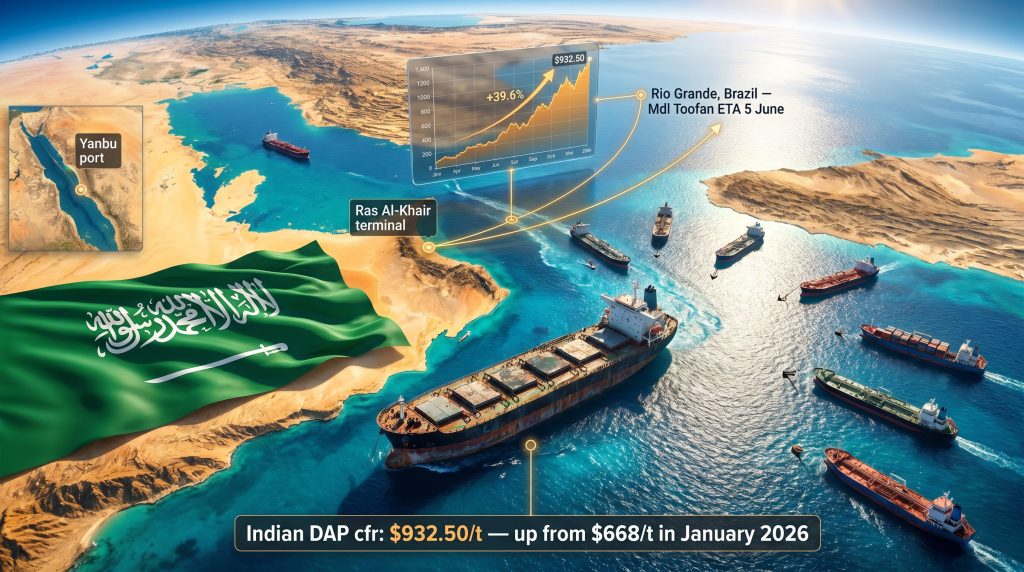
Vessel tracking data from Kpler confirmed that the Mdl Toofan, carrying 55,000 tonnes of MAP loaded at Ras Al-Khair in late April 2026, crossed the Strait of Hormuz on 9–10 May, bound for Rio Grande, Brazil, with a scheduled arrival date of 5 June 2026. This represents only the second confirmed phosphate cargo to complete the transit since US-Iran hostilities began at the end of February. The cargo is timed for delivery ahead of Brazilian planting preparation cycles.
The transit of a second cargo does not signal a reopening of the strait. It represents a narrow, potentially opportunistic window rather than a systemic restoration of normal trade flows. Markets should interpret this data point with considerable caution.
Understanding what MAP is, and why its transit matters, requires brief context. Monoammonium phosphate is a concentrated phosphorus fertiliser applied during planting to support root system development and early crop establishment. It is one of the most widely traded phosphate fertiliser products globally, and it cannot easily be substituted at the farm level without agronomic consequences. When MAP supply tightens, growers face the choice of paying elevated prices, reducing application rates, or delaying planting.
Eight Vessels Still Stranded: The Real Story
While the Mdl Toofan's transit generated market attention, the more consequential data point is what remains behind. According to Argus Media reporting, eight additional phosphate-laden vessels loaded at Ras Al-Khair are still anchored or stationary inside the Gulf as of mid-May 2026, unable to complete outbound transits. These are not empty vessels awaiting cargo. They are loaded ships with contracted buyers, carrying MAP and DAP that global agricultural markets require.
The distinction between loaded vessels awaiting transit clearance and vessels still awaiting berth assignments matters commercially. Loaded ships carry financing costs, demurrage exposure, and counterparty risk that accumulates with each passing day. Both categories create downstream price pressure because neither contributes to delivered supply, regardless of what the production numbers suggest about Saudi output capacity.
How the Hormuz Disruption Has Reshaped Global Phosphate Pricing
The Price Trajectory Since February 2026
The market response to the Strait disruption has been sharp and sustained. Price data tracked by Argus Media illustrates the scale of the move across multiple phosphate products and delivery destinations.
| Metric | January 2026 | Early May 2026 | Change |
|---|---|---|---|
| Indian DAP cfr assessment (midpoint) | $668/t | $932.50/t | +$264.50/t (+39.6%) |
| IPL tender lowest DAP offer (east coast) | — | $935/t cfr | — |
| IPL tender lowest DAP offer (west coast) | — | $930/t cfr | — |
| TSP lowest offer (east coast) | — | $775/t cfr | — |
| TSP lowest offer (west coast) | — | $770/t cfr | — |
A nearly 40% increase in DAP prices from January to early May reflects more than the mechanical effect of reduced supply. It incorporates a geopolitical risk premium, a freight uncertainty premium, and a procurement timing premium as buyers attempt to lock in supply ahead of planting windows. These layered premiums are characteristic of supply shock scenarios where the duration of disruption is genuinely unknown. In addition, this global commodity market disruption compounds pre-existing pressures that were already building before hostilities began.
India's Procurement Crisis: A Leading Indicator
India's situation functions as a real-time stress test for how import-dependent agricultural economies absorb phosphate supply shocks. The data is stark. Between January and April 2026, India received 380,000 tonnes of DAP imports, against a five-year average of 1.12 million tonnes for the same period. This shortfall was not caused by reduced demand. Indian DAP sales reached 322,000 tonnes in April alone, pushing January–April demand to 1.73 million tonnes, above the five-year average of 1.54 million tonnes.
By the end of April 2026, Argus Media estimated Indian DAP stocks at 1.93 million tonnes, compared with a five-year average of 2.46 million tonnes for the month, representing a deficit of approximately 530,000 tonnes relative to normal seasonal inventory levels.
The scale of India's procurement gap prompted importer IPL to issue a tender seeking 1.2 million tonnes of DAP in early May 2026, with a deadline of 7 May. The tender drew 2.325 million tonnes in total offers from 18 trading companies and producers, confirming that supply availability exists at the right price. IPL issued counter-bids at $935/t CFR east coast and $930/t CFR west coast, representing the lowest prices submitted by any individual bidder.
The full range of bids reveals the dispersion in global supply cost structures at this moment:
- Indagro: 40,000t at $935/t CFR (east coast), 30,000t at $930/t CFR (west coast)
- Maaden: 60,000t at $950/t CFR (east coast), 110,000t at $950/t CFR (west coast)
- Sun International: 50,000t at $955/t CFR (east coast)
- OCP: 100,000t at $990/t CFR (west coast)
- VB Venture: 85,000t at $1,100/t CFR (east coast)
The spread between the lowest offer at $930/t and the highest at $1,100/t illustrates the pricing uncertainty gripping global phosphate markets. OCP's participation from Morocco, offering 150,000 tonnes of TSP at $770/t CFR west coast, confirms that alternative non-Gulf suppliers are actively engaged, though their pricing reflects premium market conditions rather than competitive normalcy.
Saudi Arabia's Attempt to Route Around the Blockade
Yanbu as a Red Sea Bypass Channel
Facing the prospect of indefinite Gulf export disruption, Ma'aden has explored its Red Sea-facing infrastructure at Yanbu as an alternative export channel. Approximately 15,000 tonnes of MAP were reportedly sold to South American buyers for April loading via Yanbu, routing cargo through the Red Sea and Suez Canal rather than the Strait of Hormuz. Ma'aden's decision to export phosphates from Yanbu demonstrates commercial intent and operational flexibility, however the gap between Yanbu's available throughput and Ras Al-Khair's scale is substantial.
Yanbu lacks the equivalent deep-water bulk loading infrastructure that makes Ras Al-Khair an industrial-scale phosphate export hub. It cannot serve as a full replacement within any realistic near-term timeframe. The 15,000 tonnes redirected through Yanbu for April represents a fraction of what a single Ras Al-Khair loading represents, illustrating the mismatch between bypass capacity and required throughput.
Overland Corridor Proposals: Feasible in Theory, Remote in Practice
Proposals have also emerged for overland logistics corridors linking Gulf producers through Saudi Arabia, Jordan, and onward to Mediterranean or Suez-accessible ports. The concept is straightforward on a map: avoid the Strait entirely by moving cargo by rail or road to non-Gulf coastal access points. The practical barriers, however, are formidable.
Such corridors would require coordinated infrastructure investment across multiple sovereign jurisdictions, alignment on customs and transit regulatory frameworks, and significant capital expenditure on rail and road freight capacity sized for bulk commodity volumes. These are multi-year projects under the most favourable conditions. In an active conflict environment, they represent aspirational planning rather than operational solutions within the current disruption window.
Brazil: The Compounding Pressure Point
Import Dependency Meets Domestic Production Setbacks
Brazil consumed more than 49.1 million tonnes of fertiliser in 2025, with approximately 88% sourced from imports, according to national fertiliser distributor association Anda. This import dependency makes Brazil acutely sensitive to any disruption in global phosphate supply chains. The scheduled arrival of the Mdl Toofan's cargo at Rio Grande on 5 June 2026 sits directly within Brazilian planting preparation timelines, making this individual shipment commercially significant beyond its 55,000-tonne volume.
What makes Brazil's situation particularly complex in mid-2026 is the simultaneous failure of domestic fertiliser production assets intended to reduce precisely this vulnerability. Petrobras halted fertiliser production at two recently restarted units within days of each other in late April and early May 2026. These resource export challenges mirror difficulties observed in other commodity-dependent economies navigating infrastructure constraints.
The Petrobras Production Disruption in Detail
Araucaria Nitrogenados (Ansa) in Parana state has been offline since 30 April 2026 following an incident in a compressor room. The unit carries nameplate capacity of 720,000 t/yr of urea, 475,000 t/yr of ammonia, and 450,000 m³/yr of Arla 32. Critically, Ansa had only just restarted on the same day the compressor incident occurred, after being idle since 2020.
Fafen Sergipe in northeastern Brazil is offline due to a power supply failure that damaged operational systems. The facility can produce up to 650,000 t/yr of urea, 450,000 t/yr of ammonia, and 320,000 t/yr of ammonium sulphate. It had been operating at 90% of maximum capacity in early March.
Petrobras had projected that the combined return of Fafen Bahia, Fafen Sergipe, and Ansa would allow the company to supply approximately 10% of Brazil's urea market in the first quarter of 2026. Both units going offline simultaneously while the Middle East conflict disrupts phosphate imports concentrates agricultural input supply risk in Brazil at precisely the wrong moment.
Petrobras has acknowledged that all three of its reactivated fertiliser units experienced extended periods of hibernation prior to restart, leading to equipment degradation that required maintenance investment to improve reliability. This is a recognised pattern in industrial facility restarts and not specific to any single unit.
The next major ASX story will hit our subscribers first
Benchmarking the 2026 Disruption Against Historical Fertiliser Shocks
How This Event Differs From Previous Supply Crises
Context matters when assessing whether a supply disruption is transient or structurally significant. The 2026 Hormuz disruption shares some characteristics with past events but differs in important ways.
| Risk Factor | 2022 Russia-Ukraine | 2021 China Export Curbs | 2026 Hormuz Disruption |
|---|---|---|---|
| Primary commodity affected | Nitrogen, Potash | Phosphates | Phosphates, Sulphur, Ammonia |
| Trade route impacted | Black Sea | Global | Persian Gulf / Hormuz |
| Duration of disruption | Months to years | Months | Ongoing (Feb 2026 to present) |
| Alternative supply sources | Available but limited | Limited | Partially available (Morocco, China) |
| Price impact (DAP) | Significant | Significant | Approximately +40% since January 2026 |
The 2022 Russia-Ukraine conflict disrupted nitrogen exports from a country that accounted for a substantial share of global urea and ammonium nitrate trade, with secondary effects on potash from Belarus. The disruption mechanism was geopolitical, similar to 2026, but the commodity mix was different.
The 2021 Chinese phosphate export restrictions operated as a demand-side shock, where a major producer deliberately reduced outbound volumes to protect domestic agricultural supply. Prices responded sharply, but the restriction was administrative rather than geographic, meaning it could be reversed by policy decision without physical infrastructure change.
The 2026 Hormuz scenario is distinct in two critical ways. First, it affects multiple fertiliser input categories simultaneously, creating broader agricultural input cost pressure than single-commodity events. Phosphates, sulphur, and ammonia all transit the same chokepoint. Second, the geographic nature of the disruption means no policy decision can resolve it unilaterally. Reopening requires either diplomatic resolution or military de-escalation, both of which involve actors and timelines outside commercial market control.
Three Scenarios for Supply Normalisation
Mapping the Possible Paths Forward
Disclaimer: The following scenario analysis is speculative and represents possible outcomes rather than forecasts. Market participants should not rely on any single scenario for procurement or investment decisions.
Scenario A: Rapid Diplomatic Resolution (Low Probability, High Impact)
A ceasefire or rapid de-escalation restores commercial transit rights within weeks. The backlog of eight stranded vessels clears over a four-to-six week window. Spot prices correct sharply downward. Buyers who locked in high-priced forward contracts face mark-to-market losses. Supply chain inventory normalises within a single quarter.
Scenario B: Gradual Reopening with Persistent Risk Premium (Moderate Probability)
Partial resumption of commercial traffic through negotiated or informal safe passage arrangements. Price normalisation takes three to six months as supply chain confidence rebuilds incrementally. Yanbu routing and alternative supply source engagement remain active as risk hedges. The risk premium embeds itself in forward pricing curves rather than dissipating quickly.
Scenario C: Prolonged Disruption Through Planting Season (Elevated Probability)
Continued conflict or diplomatic stalemate keeps the effective closure in place through Q3 2026. Global DAP and MAP prices sustain elevated levels. Food security implications intensify for import-dependent nations. Alternative logistics infrastructure investment accelerates, but delivers benefits over a one-to-two year horizon rather than within the current agricultural year.
Strategic Considerations for Buyers, Traders, and Policymakers
Procurement Strategy in a Supply-Constrained Environment
The Hormuz disruption has exposed structural weaknesses in how fertiliser buyers approach supply chain risk. Several practical considerations emerge.
- Extend forward coverage windows: Buyers who depended on Gulf-origin spot procurement face the sharpest exposure. Extending forward coverage to six to twelve months provides buffer against single-corridor disruptions.
- Diversify supplier geography as a structural policy: Morocco's OCP and Chinese producers demonstrated their ability to supply in India's May 2026 tender. Treating these as structural alternatives rather than emergency options reduces exposure to any single production region.
- Use vessel tracking data as a real-time leading indicator: Platforms tracking Gulf port activity, including ship movements at Ras Al-Khair and the Strait transit queue, provide earlier price signals than published price assessments, which lag physical market developments by days to weeks.
- Monitor India's stock position as a global demand bellwether: India's DAP inventory trajectory reflects the most transparent real-time picture of global phosphate supply-demand balance available to market participants.
The Deeper Policy Question: Strategic Fertiliser Reserves
The 2026 disruption raises a question that few agricultural policymakers have adequately addressed: which countries maintain strategic fertiliser reserves capable of bridging a multi-month supply disruption, and which are entirely exposed to spot market dynamics? Countries with the greatest import dependency and the least domestic production capacity carry the highest food security risk in a prolonged disruption scenario.
Brazil's Petrobras experience illustrates both the strategic rationale for domestic fertiliser production and the execution complexity involved. Restarting fertiliser plants that have been dormant for years is technically demanding, and the simultaneous failure of two units at their restart demonstrates that domestic production ambitions require longer lead times and more conservative capacity assumptions than strategic plans have historically incorporated.
The 2026 Hormuz disruption may ultimately accelerate two structural changes already underway before hostilities began: the geographic diversification of phosphate supplier relationships away from Gulf concentration, and renewed investment in domestic fertiliser production capacity in large import-dependent economies. Consequently, projects such as the Ammaroo phosphate project in Australia and the European phosphate project in Estonia are drawing renewed interest as non-Gulf sources of supply. Both shifts were already economically rational. The events of early 2026 have made them strategically urgent.
This article is intended for informational purposes only and does not constitute financial, investment, or procurement advice. All price data and market statistics are sourced from Argus Media. Readers seeking ongoing price assessments and market intelligence across the phosphate and broader fertiliser sector can explore reporting from Argus Media at argusmedia.com.
Want to Stay Ahead of the Next Major Mineral Discovery Tied to the Global Fertiliser Supply Shift?
The structural push to diversify phosphate supply away from Gulf-dependent corridors is accelerating investment into non-Gulf projects worldwide, and Discovery Alert's proprietary Discovery IQ model delivers real-time alerts the moment significant ASX mineral discoveries — including phosphate and critical mineral projects — are announced, turning complex data into actionable opportunities. Explore historic examples of major discovery returns and begin your 14-day free trial today to position yourself ahead of the market.