August 24, 2026
The Quota Trap: Why OPEC's Collective Bargaining Model Was Always Vulnerable to Defection
Collective resource agreements share a fundamental tension that has defined cartel economics since the mid-twentieth century. When individual members possess the technical capability, infrastructure, and market intelligence to operate profitably outside a shared governance structure, the incentive to remain inside depends almost entirely on whether collective membership delivers more value than independence. For most of OPEC's history, the answer was yes. The UAE exit from OPEC, arriving at May 2026 with nearly six decades of membership behind it, signals the calculus had clearly shifted.
Understanding why requires looking beyond the immediate conflict dynamics in the Strait of Hormuz and examining the structural architecture of OPEC itself, the asymmetric capabilities of its most sophisticated members, and the compounding effect of a geopolitical crisis that has exposed fault lines the alliance had long managed to paper over.
When big ASX news breaks, our subscribers know first
The Architecture of OPEC Power and the UAE's Unique Position Within It
For most of OPEC's operational history, Saudi Arabia has functioned as the group's de facto policy anchor. Its role stems not just from production scale but from institutional depth: a capacity to read global crude balances, anticipate demand shifts, and deploy or withhold production volumes in ways that smaller members simply cannot replicate. OPEC's global influence has historically rested on this implicit compact, where members follow Saudi Arabia's lead on the expectation that the kingdom's decisions will ultimately serve collective interests.
The UAE occupied a genuinely unusual position within this hierarchy. According to market analysis from Argus Media (11 May 2026), the UAE was arguably unique among OPEC's membership in possessing both the technical capacity to rapidly scale production and the depth of oil market knowledge required to navigate global markets without collective support. In practical terms, this meant the UAE was never a passive participant deferring to Riyadh on questions of production strategy.
That friction had been building for years. The UAE's stated ambition to expand output capacity from approximately 3.6 million barrels per day (b/d) toward a 5 million b/d ceiling by 2027 was structurally incompatible with OPEC+ quota frameworks that constrained it to a 3.43 million b/d target. Every barrel the UAE could theoretically produce but was barred from selling represented a direct economic cost of membership. The question was never really whether the UAE would eventually reassess that cost, but when conditions would make exit viable.
Three structural forces converged to make May 2026 that moment: persistent quota misalignment with national production ambitions, a divergence in geopolitical positioning relative to Saudi Arabia on the Iran conflict, and critically, the existence of pipeline bypass infrastructure that materially reduced the strategic risk of operating outside the alliance's collective framework.
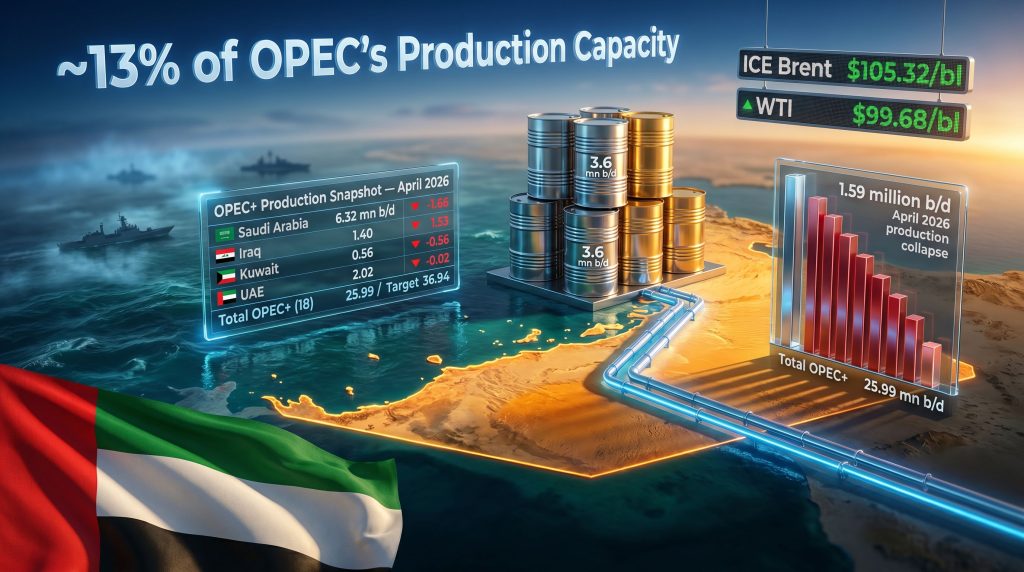
Furthermore, the Qatar precedent from 2019 is worth acknowledging here, though the comparison has limits. Qatar's departure was primarily motivated by its pivot to liquefied natural gas and involved oil production volumes that were relatively marginal to OPEC's overall balance. The UAE's exit is categorically different: it removes approximately 13% of the cartel's total production capacity from collective governance and eliminates one of only two members with genuine independent pricing and market intelligence capability.
How the Strait of Hormuz Crisis Accelerated the Break
The US-Iran conflict that effectively closed the Strait of Hormuz from late February 2026 onward did not cause the UAE exit from OPEC, but it dramatically accelerated the strategic logic behind it. The closure exposed something that had always been true but rarely visible in such stark quantitative terms: OPEC's Gulf members are not equally exposed to the waterway's disruption, and that asymmetry creates fundamentally different strategic interests within the alliance.
Argus Media reporting confirms that by April 2026, the combined effect of Hormuz disruption and conflict-related shutdowns had produced the largest single-month production collapse in the alliance's recent history, with OPEC+ output falling by 1.59 million b/d and leaving total group production approximately 11 million b/d below pre-war levels. Consequently, oil market volatility intensified sharply across global benchmarks as traders priced in prolonged supply disruption.
The production data tells the story of asymmetric exposure with unusual clarity:
OPEC+ Wellhead Production: April 2026 vs. March 2026
| Producer | April 2026 (mn b/d) | March 2026 (mn b/d) | Target (mn b/d) | Variance vs Target |
|---|---|---|---|---|
| Saudi Arabia | 6.32 | 7.00 | 10.17 | -3.85 |
| Iraq | 1.40 | 1.70 | 4.30 | -2.90 |
| Kuwait | 0.56 | 1.17 | 2.60 | -2.04 |
| UAE | 2.02 | 1.90 | 3.43 | -1.41 |
| Algeria | 1.00 | 0.98 | 0.98 | +0.02 |
| Nigeria | 1.57 | 1.45 | 1.50 | +0.07 |
| Russia | 9.00 | 9.20 | 9.64 | -0.64 |
| Kazakhstan | 1.72 | 1.80 | 1.58 | +0.14 |
| Total OPEC+ (18) | 25.99 | 27.62 | 36.94 | -10.95 |
Source: Argus Media, 11 May 2026. UAE exit effective 1 May 2026. Iran, Libya, and Venezuela exempt from production targets.
Kuwait's numbers are particularly telling. Output collapsed from 1.17 to 0.56 mn b/d between March and April, a 52% month-on-month decline driven entirely by the country's complete dependence on the Strait of Hormuz for export routes. Iraq fell from 1.70 to 1.40 mn b/d, leaving it operating at less than a third of its 4.30 mn b/d target. These are not producers with strategic options. They are structurally captive to a chokepoint they do not control.
The UAE's situation was measurably different. Its April output of 2.02 mn b/d was actually higher than its March figure of 1.90 mn b/d, reflecting the operational benefit of its 249-mile pipeline providing Gulf of Oman export access that bypasses Hormuz entirely. Saudi Arabia similarly benefited from its 7 million b/d East-West Pipeline running from the Abqaiq processing complex to the Yanbu port on the Red Sea, which Saudi Aramco CEO Amin Nasser confirmed had reached maximum operating capacity during this period. (Argus Media, 10 May 2026)
This pipeline infrastructure advantage is more than operational convenience. It is a strategic differentiator that separates producers capable of independent action from those whose economic futures depend entirely on an export corridor controlled by geopolitical forces outside their influence.
The military dimension of the conflict escalated throughout early May 2026. US and Iranian forces exchanged fire on 4 May and again on 7 May, with Iranian forces targeting three US destroyers during an attempted Hormuz transit. When US President Donald Trump subsequently rejected Iran's counter-proposal to peace negotiations as unacceptable, crude markets responded immediately: Brent and WTI futures surged, with Ice Brent July contracts rising 3.9% to $105.32/bl and WTI June contracts climbing 4.5% to $99.68/bl in Asian trading on 11 May 2026. (Argus Media, 11 May 2026)
Who Fills the Void? The Power Hierarchy After UAE's Departure
The UAE's departure from OPEC, effective 1 May 2026, leaves a structural vacancy that no single remaining member is immediately positioned to fill. The two most frequently cited candidates, Iraq and Kuwait, each face binding constraints that limit their near-term capacity to assume a more authoritative policy role.
Iraq: Ambition Without Infrastructure
Iraq holds significant theoretical weight within OPEC as the group's second-largest member, with stated plans to expand production capacity from roughly 4.5 mn b/d toward a 6 mn b/d ceiling. The reserve base to support that ambition exists. The execution infrastructure largely does not.
As Argus Media analysis notes, Iraq has struggled for years to advance long-standing capacity expansion and export infrastructure projects, primarily due to political instability and governance fragmentation. Its April 2026 output of just 1.40 mn b/d against a 4.30 mn b/d target reflects not only Hormuz disruption but also deeper structural limitations in its production and export architecture.
Compounding this is the unresolved question of the semi-autonomous Kurdish region, whose production volumes have long operated outside Baghdad's direct control, undermining Iraq's credibility within OPEC when compliance is assessed against national targets. Any meaningful shift toward greater Iraqi influence within the alliance would require not just infrastructure investment but political consolidation over producing regions that currently operate with significant autonomy.
Kuwait: Capacity Plans vs. Hormuz Reality
Kuwait presents a different version of the same fundamental problem. Before the effective Hormuz closure, Kuwait was producing approximately 2.6 mn b/d against a stated capacity of around 3 mn b/d, with longer-term ambitions to reach 4 mn b/d. The April production collapse to just 0.56 mn b/d reveals the vulnerability at the core of those expansion plans.
There is also a subtler issue within Kuwait's capacity narrative. Analysis from Argus Media indicates that recent capacity additions have largely offset natural field decline rather than generating genuine net new output. The headline expansion targets therefore obscure what is, in practice, a maintenance of existing production levels rather than a meaningful increase in the country's contribution to global supply.
Algeria and the Geographic Diversification Argument
Algeria's case for greater influence within a restructured OPEC operates on a different logic entirely. Its production volumes are smaller, but its geographic position outside the volatile Mideast Gulf corridor and its political stability relative to conflict-affected producers give it a form of strategic insulation that is genuinely valuable in the current environment.
Notably, Algeria was one of only two producers in the April 2026 data to meet or exceed its production target, coming in at 1.00 mn b/d against a 0.98 mn b/d target. That distinction, however marginal in absolute volume terms, carries symbolic weight when most of the alliance is operating at severe production shortfalls.
Scenarios for OPEC's Future Cohesion
The structural consequences of the UAE's departure are unlikely to resolve cleanly into a single institutional outcome. Three distinct scenarios deserve consideration:
-
Scenario 1: Saudi Consolidation — Saudi Arabia's production weight within OPEC increases arithmetically following the UAE's exit. However, the risk is that smaller members feel increasingly marginalised by an alliance that functions as a Saudi-directed instrument rather than a genuine multilateral body.
-
Scenario 2: A Rebalanced Non-Gulf Voice — Algeria, Nigeria, and other producers outside the immediate conflict zone may find this moment creates unusual leverage to demand more meaningful input into OPEC production decisions. Whether Saudi Arabia would genuinely accommodate this shift or manage it symbolically remains an open question.
-
Scenario 3: Membership Expansion as Stabilisation — OPEC has historically used membership expansion as a tool for broadening its geographic base and diluting internal tensions. The UAE's exit may accelerate efforts to bring new producer nations into the fold, adding both capacity and credibility to offset what has been lost.
Market Consequences: What a Structurally Weakened OPEC Means for Oil Prices
The immediate price response to compounding supply shocks confirms that markets are pricing a significant geopolitical risk premium into crude benchmarks. Brent above $105/bl and WTI approaching $100/bl in May 2026 Asian trading reflects the intersection of three simultaneous disruptions: Hormuz closure reducing Gulf export volumes, OPEC+ production collapse leaving output nearly 11 mn b/d below pre-war levels, and the collapse of UAE's production governance within the OPEC framework.
Saudi Aramco's Q1 2026 results add important nuance to this picture. Adjusted profit rose 26% year-on-year to $33.6 billion on revenues of $115 billion, with an average crude realisation price of $76.9/bl versus $76.3/bl in Q1 2025. (Argus Media, 10 May 2026) The marginal price improvement masked significant volume disruption, and the East-West Pipeline reaching maximum capacity signals that even Saudi Arabia's bypass infrastructure has limits.
Over a longer horizon, the picture bifurcates depending on how quickly the conflict resolves and how aggressively the UAE pursues production growth outside OPEC's quota framework:
- Bullish case for importers: An unconstrained UAE scaling toward 5 mn b/d by 2027 adds meaningful incremental supply to global markets, potentially moderating price levels once geopolitical risk premiums compress.
- Bearish case for price stability: Without quota discipline applied to one of the Gulf's most capable producers, the structural mechanism that prevented coordinated overproduction breaks down. The 2014-2016 price collapse provides a historical reference point for how rapidly cartel discipline can unravel once defection begins.
- Asian importer exposure: Energy-importing economies across Asia, particularly India, face a dual vulnerability: supply shortages driven by Hormuz disruption in the near term, and potential price instability if the longer-term production architecture shifts away from coordinated supply management.
The next major ASX story will hit our subscribers first
Is the UAE Exit a Symptom of a Deeper Institutional Crisis?
Comparing the UAE and Qatar departures reveals the scale of what OPEC has actually lost. As Wood Mackenzie's analysis notes, the departure fundamentally rattles OPEC's grip on the oil market in ways that Qatar's exit simply did not.
| Dimension | Qatar (2019) | UAE (2026) |
|---|---|---|
| Primary rationale | Gas-focused economy, LNG pivot | Quota misalignment, geopolitical divergence |
| Production capacity at exit | ~600,000 b/d oil equivalent | ~3.6 mn b/d |
| Share of OPEC capacity removed | Minimal | ~13% |
| Pipeline bypass availability | Limited | Yes (249-mile Gulf of Oman route) |
| Geopolitical context | Relatively stable | Active regional conflict, Hormuz closure |
| Precedent-setting impact | Symbolic | Structurally significant |
The contrast illustrates that the UAE exit from OPEC is not simply the latest iteration of a recurring pattern of minor membership attrition. It represents the departure of a producer with genuine independent capability, market intelligence, and bypass infrastructure, combined with a long-stated production growth ambition that was fundamentally incompatible with OPEC's quota architecture. Furthermore, examining OPEC and geopolitical tensions in broader context makes clear that this departure did not emerge in isolation, but as part of a prolonged realignment of Gulf strategic interests.
The deeper question this raises is whether OPEC's governance model, designed around a consensus framework that worked most effectively when Saudi Arabia's interests aligned broadly with those of its members, is structurally capable of retaining sophisticated producers whose individual capacity trajectories diverge from collective discipline. The cartel loses not just production barrels in the UAE's departure, but one of its few members with the analytical infrastructure to function as a credible independent actor in global oil markets.
Whether that loss prompts institutional reform within OPEC or simply accelerates the alliance's gradual transition toward a looser coordination mechanism rather than a binding production governance framework will define the organisation's relevance through the remainder of the decade. Indeed, OilPrice.com's assessment characterises the departure as leaving OPEC weakened and the global oil order fundamentally rewritten.
Frequently Asked Questions: UAE Exit from OPEC
Why did the UAE leave OPEC?
The departure reflected a convergence of factors: production quota allocations that constrained the UAE's capacity expansion ambitions, diverging geopolitical positioning on the Iran conflict relative to Saudi Arabia's preferred approach, and the operational availability of pipeline infrastructure providing Gulf of Oman export access that reduced the strategic cost of operating outside the alliance.
When did the UAE officially exit OPEC?
The UAE's withdrawal from both OPEC and the broader OPEC+ framework became effective on 1 May 2026, concluding a membership spanning approximately 58 to 59 years.
How significant is the UAE's production capacity?
At the time of exit, the UAE held a production capacity of approximately 3.6 mn b/d, representing roughly 13% of OPEC's total production capacity. Its stated objective is to expand that ceiling to 5 mn b/d by 2027, production that will now operate entirely outside OPEC quota constraints.
Could other OPEC members follow the UAE out of the alliance?
No members have publicly signalled imminent departure, but the structural logic that made exit rational for the UAE applies in varying degrees to other members with production growth ambitions that exceed their quota allocations. Saudi Arabia's likely response of adopting a more accommodating posture on quota negotiations is itself an acknowledgment that cohesion cannot be assumed.
What does the UAE's exit mean for oil prices?
Near-term price dynamics are dominated by Hormuz disruption and OPEC+ output collapse rather than the exit itself. Over the medium term, an unconstrained UAE scaling production toward 5 mn b/d introduces meaningful incremental supply that could moderate prices as geopolitical tensions resolve, but it also removes a source of quota discipline that historically prevented competitive overproduction among Gulf producers.
This article is intended for informational purposes only and does not constitute financial or investment advice. Forecasts, scenario projections, and price references reflect conditions as reported in May 2026 and are subject to rapid change given active geopolitical developments. Readers should seek independent financial guidance before making investment decisions based on oil market conditions.
Want to Stay Ahead of ASX Opportunities Emerging From Global Oil Market Shifts?
Discovery Alert's proprietary Discovery IQ model scans ASX announcements in real time, delivering actionable alerts on significant mineral discoveries across more than 30 commodities — ensuring subscribers are positioned ahead of the broader market. Explore historic discoveries and the substantial returns they have generated, then begin your 14-day free trial to secure your market-leading advantage.