May 11, 2026
The Geography of Vulnerability: Why 21 Miles of Water Defines India's Energy Future
Every major energy importing nation carries a version of the same hidden risk: the assumption that supply chains will function normally. For most of history, that assumption has held. But when maritime chokepoints come under pressure, India energy security and Strait of Hormuz dependencies become suddenly, painfully visible. No waterway makes that vulnerability more concrete than the Strait of Hormuz.
Understanding the architecture of that exposure, and what India is doing to reduce it, requires looking beyond the headlines of any single conflict. The real story is structural, and it has been building for decades.
When big ASX news breaks, our subscribers know first
What 21 Miles of Water Actually Controls
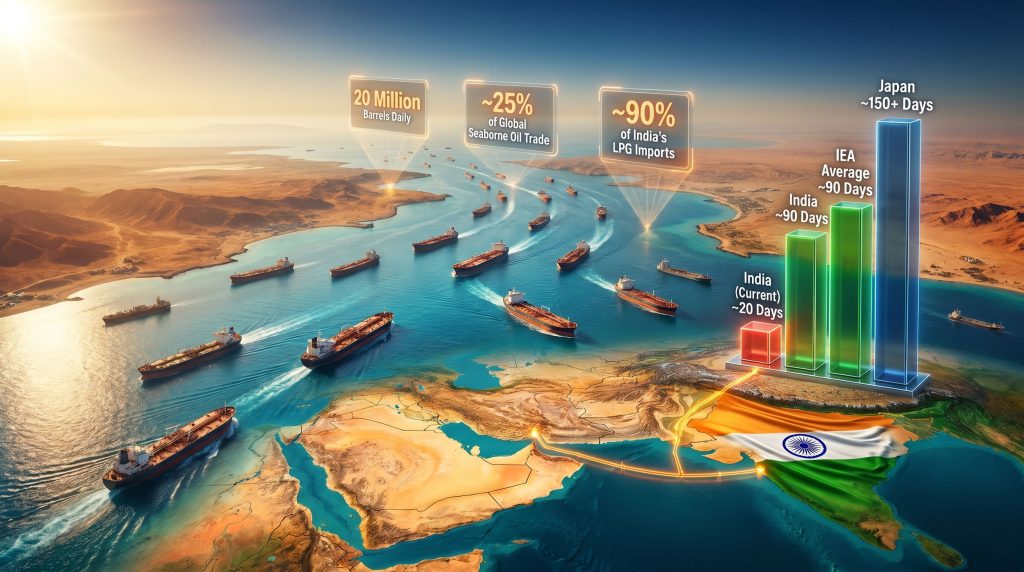
The Strait of Hormuz sits at the southern end of the Persian Gulf, separating Oman and Iran. At its narrowest navigable passage, the strait spans approximately 21 nautical miles, with internationally recognised shipping lanes running just 2 miles wide in each direction. Within those lanes, more than 20 million barrels of crude oil and petroleum products move daily, accounting for roughly 25% of the entire world's seaborne oil trade.
That concentration alone would make it significant. However, the strait's strategic weight extends well beyond crude. Qatar and the UAE together represent close to one-fifth of global LNG export volumes, with the overwhelming majority of those cargoes transiting through the same narrow corridor. The LNG supply outlook shows the Hormuz chokepoint is therefore not simply an oil infrastructure risk — it is a multi-commodity systemic vulnerability affecting crude, liquefied natural gas, and liquefied petroleum gas simultaneously.
Technical bypass alternatives do exist for some Gulf producers. Saudi Arabia's East-West Pipeline can redirect a portion of crude output toward Red Sea terminals, avoiding the strait entirely. However, these pipelines have fixed capacity ceilings and were designed to supplement, not replace, normal export flows. During a genuine disruption scenario, they cannot absorb the full volume normally transiting Hormuz, and they offer no meaningful parallel pathway for LNG or LPG cargoes.
The Four Transmission Vectors of Disruption
A critical insight often missed in mainstream analysis is that a physical blockade is not the primary risk mechanism. The modern energy market is so deeply integrated through financial instruments, insurance frameworks, and logistics networks that disruption transmits across the value chain long before a single barrel is physically withheld.
The four primary transmission vectors are:
- War-risk insurance premium escalation: Underwriters price conflict exposure into shipping insurance the moment perceived risk rises, regardless of whether incidents have occurred. These premiums are passed directly to cargo buyers.
- Shipping freight rate spikes: Tanker operators demand higher spot rates to compensate for elevated risk, longer rerouting distances, and reduced vessel availability as ships avoid conflict zones.
- Port congestion, delays, and demurrage charges: Rerouted vessels create bottlenecks at alternative discharge terminals, generating detention charges and extending cargo cycle times.
- Working capital burden: Extended voyage durations from alternative routes require cargo buyers to carry inventory costs for longer periods, tightening liquidity across the refining and distribution chain.
The Strait of Hormuz does not need to be physically closed to destabilise global energy markets. The elevation of perceived risk alone is sufficient to reprice insurance, trigger freight rate increases, and compress refinery margins across every importing economy in Asia.
India and the Strait of Hormuz: Mapping a Triple Dependency
India's exposure to Hormuz disruption is not a simple import dependency problem. It is a structurally compounded vulnerability across three distinct commodity streams, each with different substitution characteristics and different downstream consequences. Furthermore, as highlighted in India's critical oil vulnerability, the risks extend well beyond price fluctuations into genuine supply security territory.
As the world's third-largest oil consumer, India imports approximately 88% of its total crude oil consumption. Its diversified sourcing strategy, which spans close to 40 supplier countries, provides meaningful buffer against single-origin supply shocks. But that diversification has a geographic blind spot: a significant portion of those varied supply chains converge through the same maritime chokepoint.
The following table illustrates the scale of India's Hormuz exposure across all three commodity categories:
| Commodity | India's Import Dependence | Share Transiting Hormuz | Key Origin Concentration |
|---|---|---|---|
| Crude Oil | ~88% of consumption | ~50% (variable) | Multiple Gulf producers; Russian crude providing partial offset |
| LNG | ~50% of gas consumption sourced from imports | ~60% of LNG cargoes | Qatar supplies ~40% of India's total LNG |
| LPG | ~60% of consumption | ~90% of import volumes | Gulf producers dominate with limited alternatives |
The critical insight embedded in this data is that the three commodities do not carry equal substitution flexibility.
Why LNG and LPG Carry Deeper Structural Risk Than Crude
Indian refiners operate with meaningful crude grade flexibility. A refinery configured for Arab Light crude can, with operational modifications, process Brent, Russian Urals, or West African grades. This technical adaptability allows India to partially reroute its crude procurement away from Hormuz-transiting origins during disruptions, particularly given the availability of discounted Russian crude via alternative routes. For context on current pricing dynamics, the crude oil market overview illustrates how quickly these conditions can shift.
Gas and LPG, however, offer no equivalent flexibility. The structural rigidity stems from three interlocking constraints:
- Fixed regasification terminal infrastructure: India's LNG import terminals at Dahej, Hazira, and Kochi operate at defined throughput capacities. They cannot be rapidly expanded to compensate for supply shortfalls, nor can they be reconfigured within operational timeframes.
- Limited pipeline connectivity alternatives: India's domestic gas pipeline network is oriented toward distribution, not emergency inter-source switching. There is no pipeline connection to Central Asian or other non-Gulf gas supply corridors that could provide a meaningful volume substitute.
- Inflexible downstream end-uses: The most consequential downstream applications of LNG and LPG in India are structurally resistant to fuel switching. Fertiliser manufacturing requires specific feedstock composition. The Pradhan Mantri Ujjwala Yojana, which has placed LPG stoves in over 90 million low-income households, creates a population of consumers physically unable to switch cooking fuels without equipment replacement.
This asymmetry between crude substitution flexibility and gas/LPG rigidity is why a Hormuz disruption creates disproportionate economic pressure on India compared to many other importing nations.
The Macroeconomic Transmission Channels
The economic consequences of India's Hormuz exposure propagate through multiple channels simultaneously:
- Retail inflation: Transport fuel prices rise directly; freight cost increases embed indirectly into the price of food and manufactured goods across the supply chain.
- Currency pressure: A widening import bill denominated in US dollars exerts depreciation pressure on the rupee, compounding inflationary effects through imported goods pricing.
- Current account deficit deterioration: Simultaneous price spikes across crude, LNG, and LPG create a structural deterioration in India's external balance that persists for as long as the disruption continues.
- Oil marketing company balance sheet stress: India's state-owned fuel retailers operate under administrative pricing constraints. When global prices rise faster than retail prices can be adjusted, under-recovery balances accumulate on corporate balance sheets, eventually requiring either fiscal transfers or forced price normalisation.
India's Crisis Response: What Has Actually Been Done
India's response to the 2026 Hormuz disruption has been pragmatic and operationally competent, combining supply-side diversification, diplomatic engagement, demand management, and fiscal cushioning. Consequently, the pre-existing 40-country crude sourcing basket created immediate optionality that more concentrated importers lacked.
Approximately 70% of India's crude shipments are now travelling via non-Hormuz pathways, representing a meaningful structural shift from pre-crisis routing patterns. This was achieved through a combination of accelerated procurement from alternative origins, prioritisation of in-transit cargoes, and operational coordination across the refinery sector.
Diplomatic engagement ran in parallel with logistics adjustments. The Petroleum Minister's bilateral visit to Qatar in April 2026 focused on securing LNG supply continuity, while the National Security Advisor's engagement in Saudi Arabia addressed broader energy coordination alongside strategic security discussions. An inter-ministerial session in early May 2026 integrated source diversification, alternative shipping corridor planning, naval coordination, and diaspora-related considerations into a consolidated national response framework.
Domestic Supply Management and Pipeline Expansion
Within India's domestic supply architecture, the government implemented a demand-side triage framework that prioritised household cooking fuel and essential transport sectors while accepting curtailment across industrial gas users. The operational results have been notable:
- PNG and CNG domestic supply maintained at 100% of demand
- Fertiliser plant gas supply maintained at 95% of normal levels
- 424,000 new PNG connections established since March 2026
- 466,000 new CNG registrations recorded in the same period
The April 2026 Natural Gas and Petroleum Products Distribution Order streamlined regulatory approvals for last-mile gas network connectivity, accelerating private operator deployment of distribution infrastructure across urban and peri-urban areas. This represents a structural supply-side gain that will outlast the immediate crisis.
The Fiscal Intervention and Its Limits
The government deployed an excise duty reduction of approximately ₹10 per litre on petrol and diesel in March 2026 to cushion consumers from the full force of the global price spike. This instrument, while effective as a short-term stabiliser, carries an inherent fiscal cost estimated in the range of several thousand crore rupees per month in foregone revenue.
Policy analysis from PwC India's oil and gas practice, published via ETEnergyWorld in May 2026, identifies a structural incompatibility in India's crisis response framework: the dual objective of protecting household energy affordability while maintaining fiscal consolidation targets becomes increasingly difficult to sustain as disruption duration extends. The longer retail prices are held below cost-recovery levels, the larger the eventual adjustment required.
The post-state-election pricing environment suggests a gradual normalisation trajectory, with commercial LPG prices already adjusted upward and broader retail price movements expected progressively.
Scenario Analysis: What Different Disruption Timelines Actually Mean
The severity of consequences from Hormuz supply disruptions scales non-linearly with duration. A short shock can be absorbed through existing buffers. A prolonged disruption, in contrast, progressively exhausts those buffers and forces structural economic adjustment.
| Scenario | Duration | Key Risk Factors | Strategic Reserve Adequacy |
|---|---|---|---|
| Short-Duration | Under 30 days | LPG household supply; moderate inflation | Manageable with ~20-day reserves plus rerouting |
| Medium-Duration | 30-90 days | LNG spot market cost surge; fertiliser curtailment; rupee pressure | Strategic reserves insufficient; spot procurement expensive |
| Extended-Duration | Beyond 90 days | Structural rationing; subsidy unsustainability; Ujjwala household supply failure | Reserves exhausted; forced rationing and price normalisation |
The medium-duration scenario is particularly instructive because it is where India's current reserve architecture is most exposed. With approximately 20 days of strategic petroleum reserve coverage, India falls well short of the 90-day benchmark maintained by International Energy Agency member economies. According to the IEA's Strait of Hormuz analysis, Japan maintains a combined strategic and commercial reserve buffer of more than 150 days. China has built toward a 90-day equivalent. India's gap is not marginal; it is structural.
An equally important gap is the absence of any formalised national gas reserve framework. For LNG-importing economies that have established reserve buffers, the standard benchmark sits at 10 to 14 days of gas cover. India currently operates without an equivalent mechanism, meaning any LNG supply disruption must be managed entirely through demand rationing rather than inventory drawdown.
The Two-Pillar Resilience Framework India Needs to Build
Short-term crisis management cannot substitute for the structural resilience investments that would reduce India's vulnerability before the next disruption arrives. The energy security transition agenda identifies a two-pillar framework that addresses both the immediate security dimension and the long-term sustainability imperative.
Pillar One: Hardening the Energy Security Architecture
Strategic Storage Expansion
The path from 20-day reserve coverage to the 90-day IEA benchmark requires a combination of government-held strategic reserves and commercially held working stocks. Distributing the capital burden across both public and private balance sheets makes the build-out financially achievable without imposing the full cost on the fiscal position.
National Gas Reserve Framework
Establishing even a modest formalised gas buffer, equivalent to 10 to 14 days of consumption, would fundamentally change the options available during LNG supply disruptions. The difference between managed drawdown and forced industrial rationing is economically significant: rationing disrupts production chains, triggers contract penalties, and damages India's reputation as a reliable industrial partner.
Contract Portfolio Architecture
The structure of India's long-term supply contracts matters as much as their total volume. A resilient portfolio combines:
- Multiple counterparty origins spanning different geopolitical risk zones
- Flexible destination clauses enabling cargo diversion to alternative terminals if primary routes are disrupted
- Optionality for spot market supplementation without triggering penalty provisions
The complementary domestic dimension, intensifying upstream exploration and production, directly reduces the volume of hydrocarbons that must be sourced through international maritime routes. The lowest-risk barrel in any supply disruption is the one that never required a voyage through a contested strait.
Logistics and Route Hardening
Terminal infrastructure, pipeline capacity, and shipping fleet diversification are not merely commercial investments. They are national security assets that determine how quickly India can reroute supply flows when primary pathways become unavailable. Route risk deserves equivalent strategic weight to production risk in India's energy security planning framework.
Pillar Two: Structural Reduction in Oil Intensity
Long-term resilience is not built through storage and contracts alone. Every percentage point reduction in India's structural dependence on imported hydrocarbons permanently reduces the economic damage caused by any future Hormuz disruption. Furthermore, the broader clean energy transition provides a strategic pathway that simultaneously addresses climate objectives and supply security.
Transport Electrification
Accelerating electric vehicle adoption, powered by domestically generated renewable electricity, removes crude import demand at the source. Each percentage point of transport electrification translates directly into a reduction in the volume of petroleum products that must transit Hormuz. This dynamic also helps moderate the conditions that have historically driven an oil price rally during periods of geopolitical tension.
Biofuels and Gas Alternatives
Compressed bio-gas programmes targeting urban and peri-urban households provide a near-term substitution pathway for LPG that reduces Hormuz-exposed import volumes without requiring the hardware replacement that limits switching for existing PMUY beneficiaries.
Renewable Energy as Strategic Infrastructure
India has already crossed a significant threshold: approximately 50% of the country's installed electricity generation capacity now operates on non-fossil sources, combining renewables and nuclear. This is not merely an environmental achievement. It represents a platform from which oil displacement in transport, industry, and thermal applications can be systematically accelerated.
The energy transition, viewed through a security lens, is not simply an environmental objective. Every gigawatt of clean electricity capacity that displaces hydrocarbon-based generation permanently narrows the volume of oil and gas India must source through geopolitically fragile maritime corridors. Sustainability and security are, in this context, the same investment.
The next major ASX story will hit our subscribers first
Strategic Reserve Benchmarking: Where India Stands
| Country / Region | Strategic Petroleum Reserve Coverage | Gas Reserve Buffer |
|---|---|---|
| IEA Member Average | ~90 days | 10 to 14 days |
| Japan | 150+ days (strategic and commercial combined) | LNG tank buffer maintained |
| China | ~90 days (estimated) | Expanding strategic gas infrastructure |
| United States | ~25 to 30 days (post-drawdowns) | Substantial underground gas storage |
| India (Current) | ~20 days | No formalised framework |
| India (Target) | 90 days | 10 to 14 days minimum |
The gap between India's current position and the benchmarks maintained by comparable major importers is not a minor technical shortfall. It represents the difference between having weeks of decision-making time during a disruption versus having none.
The Recurring Pattern: Why This Is Not an Anomaly
The current 2026 disruption sits within a longer historical sequence that includes the Iran-Iraq War tanker conflicts of the 1980s, the 2019 Abqaiq infrastructure attack, and multiple episodes of elevated Hormuz tension between those events. This recurrence pattern is not incidental. It reflects a structural feature of the global energy system: a disproportionate share of the world's hydrocarbon production is concentrated in a single geopolitically contested region.
India's planning framework needs to internalise this pattern rather than treating each episode as an exceptional event. India energy security and Strait of Hormuz interdependencies require that policymakers ask not whether the next disruption will occur, but whether India will manage it through pre-built buffers and structural resilience, or through the more costly process of ad-hoc emergency response.
Building toward 90-day strategic reserves, establishing a national gas reserve framework, restructuring term contract portfolios toward diversified optionality, and accelerating the energy transition as a security investment are not separate policy agendas. They are interlocking components of a single national risk management strategy. India energy security and Strait of Hormuz exposure will remain structurally linked for the foreseeable future, and the cost of building resilience in advance will almost certainly be lower than the macroeconomic cost of navigating the next major disruption without it.
This article draws on analysis published by Manas Majumdar, Leader Oil and Gas, Fuels and Resources at PwC India, via ETEnergyWorld (May 2026). The views expressed in the original source represent the author's professional analysis and do not constitute investment advice. Forward-looking scenario analysis involves inherent uncertainty, and actual outcomes will depend on geopolitical developments, policy decisions, and market dynamics that cannot be predicted with precision.
Want to Stay Ahead of the Commodity Shifts Reshaping Energy Security?
As geopolitical pressures on critical supply chains intensify, the downstream effects on ASX-listed resource and energy companies can be swift and significant — Discovery Alert's proprietary Discovery IQ model scans ASX announcements in real time, delivering instant alerts on significant mineral discoveries so investors can identify actionable opportunities before the broader market reacts. Explore historic discoveries and their market returns, then begin a 14-day free trial to secure a genuine market-leading edge.