June 23, 2026
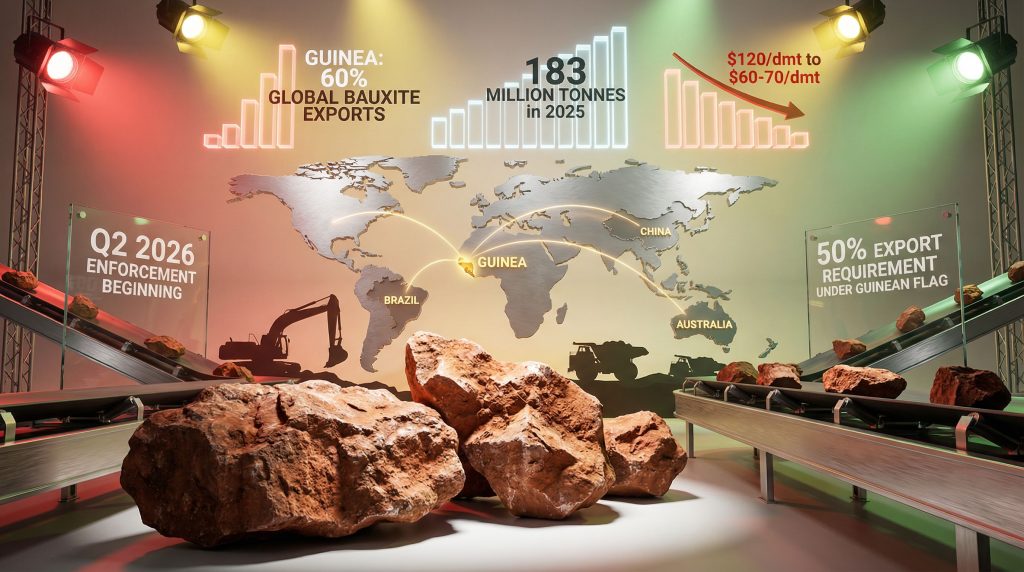
Guinea bauxite export controls represent a pivotal development in global mineral commodity markets, as the world's largest bauxite producer implements production quotas to address severe price volatility. The aluminum industry faces unprecedented supply chain disruption as Guinea, which controls 60% of global bauxite exports, introduces comprehensive regulatory measures designed to stabilise pricing and promote domestic value addition. Furthermore, these bauxite project benefits demonstrate how strategic resource management can transform regional economies beyond traditional extraction models.
Understanding Guinea's Dominant Position in Global Bauxite Markets
Guinea's extraordinary market concentration creates systemic vulnerabilities throughout the global aluminum supply chain. The country exports 183 million tonnes of bauxite annually, representing approximately 60% of global bauxite exports in 2025. This dominance dwarfs secondary producers, with Australia accounting for 22% and Brazil contributing just 8% of international supply.
The dependency relationship extends far beyond simple market share statistics. China, the world's largest aluminum producer, sources 85% of its bauxite imports from Guinea, creating a bilateral trading relationship with profound implications for global manufacturing supply chains. This concentration risk becomes particularly acute when considering that China produces nearly 60% of global aluminum, making Guinea's production decisions influential far beyond the bauxite market itself.
Market Fundamentals and Price Volatility Drivers
Bauxite pricing has experienced dramatic compression, declining from $120 per dry metric tonne to $60-70 per dry metric tonne over twelve months, representing a 50% price collapse. This decline reflects fundamental supply-demand misalignment, with Guinea's bauxite exports growing 25% year-over-year while global aluminum demand increased only 3% during the same period.
The pricing deterioration compounds challenges facing aluminum producers already contending with geopolitical disruptions affecting 9% of global aluminum production capacity due to Middle East tensions. These combined pressures create cascading effects throughout the value chain, from mining company revenues to government tax collection in resource-dependent economies. Consequently, the mining industry evolution reflects these structural challenges requiring adaptive strategies across operational dimensions.
| Global Bauxite Exporters | Annual Volume (Million Tonnes) | Market Share |
|---|---|---|
| Guinea | 183 | 60% |
| Australia | 67 | 22% |
| Brazil | 24 | 8% |
| Jamaica | 15 | 5% |
| Indonesia | 12 | 4% |
When big ASX news breaks, our subscribers know first
Guinea's Export Control Framework and Implementation Strategy
Guinea bauxite export controls operate through a sophisticated regulatory mechanism designed to align actual production with approved capacity limits. The framework centres on license-based output restrictions that enforce compliance with feasibility study specifications originally submitted during mining permit process approval procedures.
Minister Bouna Sylla's regulatory approach emphasises production alignment rather than outright export prohibition. The policy targets companies exceeding their approved production limits, with implementation beginning in Q2 2026. This enforcement timeline provides mining companies minimal adjustment period, reflecting governmental urgency to address price deterioration.
Enforcement Mechanisms and Compliance Requirements
The production quota system requires mining companies to submit operational plans demonstrating adherence to feasibility study parameters. Government oversight extends to:
- Monthly production reporting aligned with licence specifications
- Third-party auditing of production facilities and export volumes
- Port monitoring to verify reported shipment quantities
- Financial record reviews to identify production discrepancies
The precedent for enforcement severity emerged through the Emirates Global Aluminium licence revocation, where the government transferred mining assets to state control following non-compliance with alumina refinery construction commitments. Moreover, Reuters reports that industry sources expect stringent implementation of these measures amid rising freight costs.
Domestic Value Addition Mandates
Beyond production controls, Guinea implements comprehensive value-addition requirements designed to transform the country from raw material exporter to integrated aluminum producer. Key mandates include:
- Mandatory alumina refinery construction by 2027
- 50% export shipments under Guinean flag to capture freight revenues
- Local Economic Development Fund (FODEL) contributions from mining operations
- Technology transfer requirements for processing infrastructure development
The 2027 refinery deadline represents an aggressive timeline for major industrial infrastructure development, typically requiring 4-5 years for engineering, financing, construction, and commissioning phases.
African Resource Control Policies in Comparative Context
Guinea's export control strategy reflects broader continental trends toward resource nationalism and domestic value capture. Multiple African governments have implemented similar measures across various commodities, particularly in the critical minerals energy transition affecting global supply chains.
Continental Resource Management Initiatives
The Democratic Republic of Congo suspended cobalt exports and introduced production quotas to stabilise pricing in critical battery materials markets. Zimbabwe implemented lithium concentrate export halts, requiring domestic processing before international sales. Tanzania established gold export value-addition requirements, mandating local refining capacity development. However, DRC resource controls demonstrate the complexities of implementing such policies across diverse mining operations.
| Country | Commodity | Control Measure | Implementation Year |
|---|---|---|---|
| Guinea | Bauxite | Production quotas & value-addition | 2026 |
| DRC | Cobalt | Export suspensions & quotas | 2024 |
| Zimbabwe | Lithium | Processing mandates | 2025 |
| Tanzania | Gold | Refining requirements | 2023 |
| Indonesia | Nickel | Export ban (precedent) | 2020 |
These policies demonstrate coordinated efforts to capture greater value-chain integration, though effectiveness varies significantly based on alternative supplier capacity and downstream industry adaptation strategies.
Global Supply Chain Disruption Scenarios
Guinea bauxite export controls create immediate sourcing challenges for aluminum producers, particularly Chinese smelters dependent on Guinean supply. Alternative supplier analysis reveals significant capacity constraints limiting immediate substitution options.
Alternative Supplier Capacity Assessment
Australia possesses the greatest potential for production expansion, with established mining infrastructure and geological reserves supporting increased output. However, Australian operations face higher extraction costs and longer shipping distances to Asian markets, creating 15-20% cost premiums compared to Guinean supply.
Brazil offers substantial reserve potential but confronts infrastructure limitations restricting rapid capacity expansion. Port capacity constraints and inland transportation challenges limit Brazil's ability to offset significant Guinean supply reductions within 2-3 year timeframes.
India maintains considerable bauxite reserves but prioritises domestic aluminum production, limiting export availability. Indian producers typically consume 85-90% of domestic bauxite production internally, providing minimal buffer capacity for international markets.
Downstream Industry Adaptation Strategies
Chinese aluminum producers, facing the most severe supply disruption risk, are implementing multiple adaptation strategies:
- Long-term supply contracts with Australian and Brazilian producers
- Strategic inventory accumulation during policy transition periods
- Domestic bauxite exploration and production capacity development
- Alternative aluminum sourcing through increased recycling and imports
European aluminum producers benefit from greater supply diversification, though they face secondary effects through global price transmission and increased competition for alternative bauxite sources. Additionally, Mining.com analysis suggests that stricter supply rules could fundamentally reshape international trading relationships.
Mining Company Risk Assessment and Strategic Responses
Guinea bauxite export controls create differentiated impacts across mining companies based on operational scale, licence compliance status, and downstream integration capabilities.
Major Operator Impact Analysis
Chalco's Guinea operations face production adjustments to align with feasibility study baselines, potentially reducing annual output by 10-15% if current production exceeds approved limits. The company's integrated Chinese operations provide downstream demand security, supporting compliance with new regulations.
Rio Tinto's Sangaredi mine demonstrates relatively strong compliance positioning, with production levels historically maintained within feasibility study parameters. The company's global diversification provides operational flexibility to optimise Guinea production within regulatory constraints.
Rusal's integrated supply chain creates particular vulnerability, as the company's aluminum production capacity depends heavily on Guinean bauxite feedstock. Supply disruption forces either production cutbacks or expensive alternative sourcing arrangements.
| Mining Company | Guinea Production (Million Tonnes) | Compliance Risk | Strategic Response |
|---|---|---|---|
| Chalco | 45 | Moderate | Production alignment & domestic integration |
| Rio Tinto | 38 | Low | Optimised production within limits |
| Rusal | 32 | High | Alternative sourcing & legal challenge |
| CBG (Bauxite Co.) | 28 | Moderate | Value-addition investment |
Investment and Capital Allocation Implications
Mining companies face substantial capital requirements to comply with value-addition mandates. Alumina refinery construction typically requires $2-3 billion investment per facility, with 2-3 million tonne annual processing capacity.
Joint venture requirements with Guinean entities add complexity to financing arrangements, potentially requiring:
- Local partnership structures with government or private Guinean entities
- Technology transfer agreements for processing equipment and operations
- Employment and training commitments for local workforce development
- Infrastructure development obligations beyond primary processing facilities
Bauxite Market Pricing Evolution and Forecasting
Guinea bauxite export controls aim to reduce global supply from current 183 million tonnes to approximately 150-160 million tonnes annually, representing a 12-18% supply reduction. This supply constraint creates upward pressure on bauxite pricing, though effectiveness depends on demand elasticity and alternative supplier responses.
Short-term Price Stabilisation Dynamics
Chinese inventory levels become critical in determining short-term price responses. Current Chinese strategic bauxite reserves provide 3-4 months of processing capacity, offering limited buffer against supply disruption. Seasonal demand patterns typically peak during Q3-Q4, coinciding with increased aluminum production for manufacturing export seasons.
Price stabilisation scenarios suggest bauxite pricing could recover to $80-90 per dry metric tonne within 12-18 months if supply controls achieve target reduction levels without significant alternative supplier capacity additions.
Long-term Market Structure Transformation
Guinea's strategic transformation from raw material exporter to integrated processor fundamentally alters global aluminum industry structure. Regional value chain development creates new competitive dynamics, with West African aluminum production potentially competing directly with established Chinese and Middle Eastern producers.
Supply security premiums emerge as aluminum producers factor increased sourcing risk into procurement strategies. Long-term contracts increasingly incorporate force majeure clauses and alternative sourcing provisions to manage regulatory disruption risk.
The shift toward domestic processing represents more than policy adjustment – it signals fundamental restructuring of global aluminum supply chains with lasting implications for cost structures, trade flows, and competitive positioning across the industry.
The next major ASX story will hit our subscribers first
Strategic Response Framework for Industry Stakeholders
Guinea bauxite export controls require comprehensive strategic adaptations across aluminum industry participants, from raw material procurement through downstream manufacturing operations.
Procurement Strategy Evolution
Supply chain diversification becomes paramount for aluminum producers previously dependent on Guinean bauxite. Effective diversification strategies include:
- Geographic distribution across multiple supplier countries
- Contract term optimisation balancing security with flexibility
- Strategic inventory management to buffer supply disruptions
- Supplier relationship development with alternative bauxite producers
Long-term contract renegotiation priorities focus on incorporating regulatory risk provisions, alternative sourcing mechanisms, and price adjustment formulas reflecting supply security premiums.
Investment Opportunity Assessment
Guinea's domestic processing infrastructure requirements create substantial investment opportunities in:
- Alumina refinery development with 2-3 year construction timelines
- Port and transportation infrastructure supporting increased processed output
- Power generation facilities meeting energy-intensive refining requirements
- Technical services and equipment supply for processing operations
Alternative bauxite deposit development accelerates in Australia, Brazil, and other producing regions as aluminum companies seek supply security through vertical integration and long-term sourcing agreements.
Aluminum recycling capacity expansion emerges as strategic priority, reducing primary aluminum demand and bauxite dependency. Recycling operations typically achieve 90-95% energy savings compared to primary production while eliminating bauxite sourcing requirements entirely.
Risk Mitigation and Market Adaptation Strategies
The aluminum industry faces a fundamental transition requiring adaptive strategies across operational, financial, and strategic dimensions. Companies that successfully navigate these changes will likely emerge with competitive advantages through improved supply security, cost optimisation, and market positioning.
Operational adaptations include flexible production systems capable of utilising multiple bauxite sources with varying aluminum content and processing requirements. Financial hedging strategies incorporate commodity price volatility management and regulatory risk insurance products.
Strategic positioning involves developing capabilities in aluminum recycling, alternative materials research, and downstream application development to reduce dependency on primary aluminum production and associated bauxite requirements. In addition, understanding guinea bauxite export controls becomes essential for developing robust risk management frameworks across the aluminum value chain.
This analysis is provided for informational purposes and reflects current market conditions and regulatory developments. Commodity markets involve substantial risks, and investment decisions should be based on comprehensive due diligence and professional advice. Market forecasts and price projections are subject to significant uncertainty and may not reflect actual future outcomes.
Ready to Capitalise on Bauxite Market Disruptions?
Discovery Alert's proprietary Discovery IQ model delivers instant notifications on significant ASX mineral discoveries, including bauxite and aluminum sector opportunities that could benefit from Guinea's export control implementation. Begin your 14-day free trial today and position yourself ahead of market volatility with actionable insights that transform complex commodity developments into profitable trading opportunities.