June 23, 2026
When Diplomacy Reprices Energy: Understanding the Oil Market's Response to Geopolitical Shifts
Energy markets do not wait for certainty. They trade on probability, and nowhere is this dynamic more visible than in the rapid repricing that occurs when a long-running geopolitical conflict moves toward resolution. The relationship between political risk and crude oil benchmarks is not linear or predictable; it operates through layers of sentiment, algorithmic positioning, forward supply expectations, and macro overlays that interact in ways even seasoned traders find difficult to anticipate in real time.
The signing of the US Iran ceasefire deal oil prices response on June 18, 2026, delivered one of the most instructive examples of this dynamic in recent memory. It triggered an immediate and aggressive move lower across crude oil benchmarks as markets repriced the probability of Iranian barrels returning to global supply chains. Understanding why this happened, how far it may go, and what risks remain embedded in the current price environment requires moving well beyond the headline numbers.
When big ASX news breaks, our subscribers know first
Why the US-Iran Ceasefire Deal Sent Oil Prices to a 3.5-Month Low
Crude oil prices carry more than just a reflection of physical supply and demand at any given moment. During periods of active conflict involving major petroleum-producing or transit regions, benchmarks absorb what traders refer to as a geopolitical risk premium. This is additional value baked into the price to compensate for the possibility of supply disruption, route closure, or logistical breakdown. Furthermore, understanding oil trade and geopolitics helps explain why these premiums can build so rapidly.
When the US-Iran ceasefire agreement was formally signed, markets interpreted it as a signal that the risk of sustained Hormuz closure had meaningfully declined. The reaction was immediate and mechanical. Algorithmic trading systems, institutional futures desks, and macro funds that had built long positions as a conflict hedge rapidly unwound those positions, accelerating the decline in a compressed timeframe.
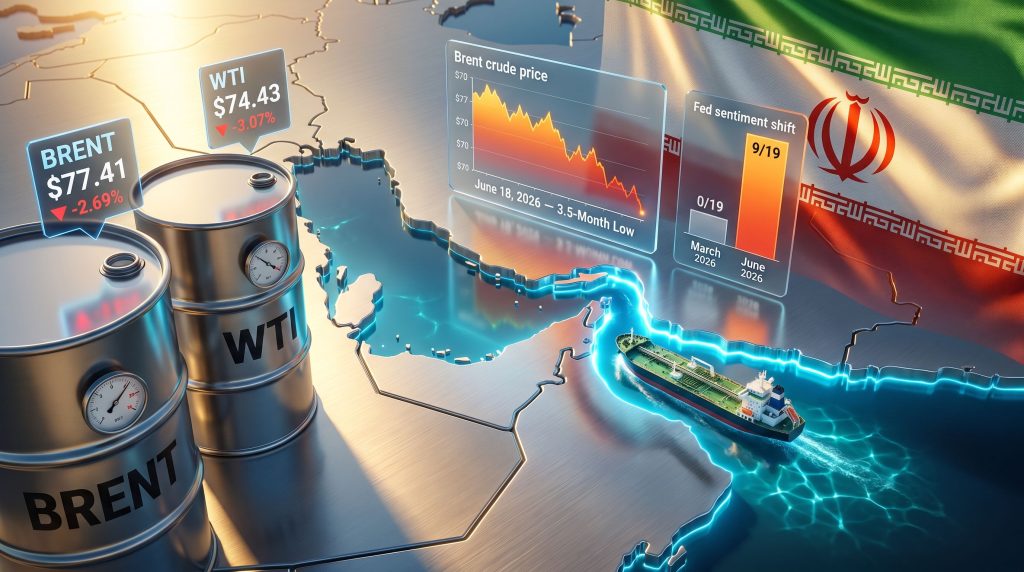
Key Price Movements on June 18, 2026
| Benchmark | Pre-Deal Level | Post-Deal Level | Change | % Move |
|---|---|---|---|---|
| Brent Crude | ~$79.55 | ~$77.41 | -$2.14 | -2.69% |
| WTI Crude | ~$76.79 | ~$74.43 | -$2.36 | -3.07% |
| Brent 3.5-Month Low | March 2 prior low | Revisited June 18 | Lowest since conflict began | Risk premium unwind |
Brent crude fell to its lowest level since March 2, 2026, which was itself the first trading session after the US and Israel began military operations against Iran. WTI reached its weakest point since March 4. These were not gradual drifts; they were concentrated repricing events driven by forward-looking supply expectations rather than any confirmed change in physical barrel availability.
It is also worth noting that the session prior had seen a brief upward jolt after comments from US President Donald Trump suggesting he retained the option to resume military operations if Iran's leadership failed to comply with the agreement. That volatility spike was itself quickly reversed once the formal agreement was signed, underscoring just how sentiment-driven the market had become in this environment.
Key insight: The price declines recorded on June 18 represent a forward-looking repricing of supply probability, not a reflection of Iranian oil physically re-entering markets. The gap between diplomatic progress and barrel flows is where the real uncertainty lives.
What the 14-Point Memorandum of Understanding Actually Contains
The agreement signed between the US and Iran is structured as an interim memorandum rather than a comprehensive treaty, and its terms reflect the complexity of reaching consensus on deeply contested issues under compressed diplomatic timelines.
The core provisions of the accord include:
- A 60-day window for negotiating a full and binding settlement
- Restoration of full commercial transit capacity through the Strait of Hormuz within 30 days
- Guaranteed toll-free passage through the strait during the negotiation period
- Explicit deferral of Iran's nuclear enrichment program to later-stage discussions
- A requirement for the US and partner nations to develop a $300 billion financing framework for Iran's economic reconstruction and recovery
- Conditional waiver of US sanctions on Iranian oil exports during the negotiation period
What the Deal Leaves Unresolved
The interim nature of the agreement means several structurally significant issues remain open. These include:
- No dismantling of the long-term sanctions architecture, only a conditional waiver
- No binding enforcement mechanism publicly disclosed that would compel compliance from either side
- Iran's nuclear capabilities remain completely untouched in the current framework
- The US administration has publicly reserved the right to resume military operations if Iran's leadership fails to comply, creating what analysts are describing as a conditional peace environment rather than a durable settlement
Analyst Watch: Energy markets are pricing in the probability of deal success, not confirmed implementation. Every milestone in the 60-day negotiation window will be closely monitored for signals about whether this interim agreement can evolve into something structurally durable, with crude prices likely to react sharply in either direction.
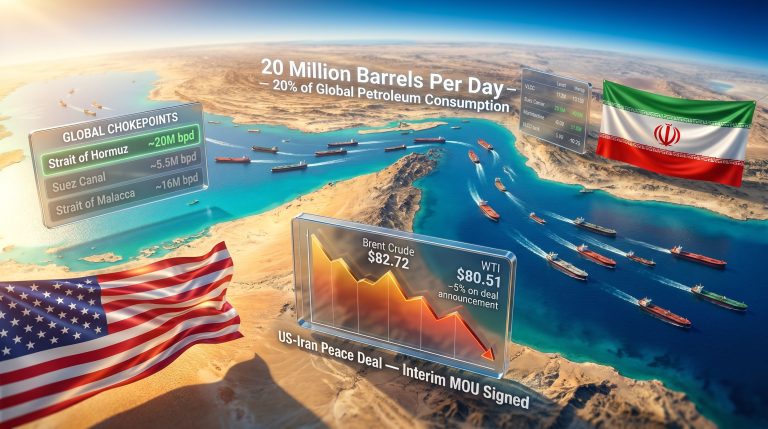
The Strait of Hormuz: Quantifying What Was at Stake
To appreciate the scale of the market response to the US Iran ceasefire deal oil prices movement, it is essential to understand exactly what the Strait of Hormuz represents in global energy infrastructure terms. Indeed, the geopolitical oil risks associated with this waterway have long been a defining feature of energy market pricing.
The strait is a narrow passage connecting the Persian Gulf to the Gulf of Oman, and from there to global maritime trade routes. Its strategic importance is almost impossible to overstate:
- Approximately 20 to 21% of global petroleum liquids transit through the strait annually
- Major exporters relying on Hormuz include Saudi Arabia, Iraq, the UAE, Kuwait, Qatar, and Iran itself
- Historical precedent shows that even credible threats to close the strait have added $5 to $15 per barrel to Brent prices in relatively short order
- The strait is narrow enough at its chokepoint that targeted disruption requires minimal military capability to execute, making it a persistent vulnerability
During the active conflict period, tanker operators rerouted vessels through alternative passages, adding significant transit costs and delivery delays. War risk insurance premiums for vessels operating in the Persian Gulf escalated sharply, and some Iranian crude volumes were redirected through pipeline workarounds that partially offset but could not fully replace Hormuz-dependent export capacity.
Will Hormuz Reopening Immediately Flood the Market With Oil?
This is where the analysis becomes more nuanced, and where several informed observers have pushed back against overly bearish crude price forecasts.
Mukesh Sahdev, CEO of energy consultancy XAnalysts, has outlined a key constraint: the volume of crude returning to market after Hormuz reopens could be meaningfully limited. Some cargoes already exited through workaround routing arrangements during the conflict, while tanker operators may remain reluctant to re-enter the region prematurely given residual concerns about agreement stability. Sahdev further noted that overall crude demand recovery may outpace supply normalization in the near term, which would place a natural floor under prices rather than allowing them to retrace to pre-conflict levels.
This dynamic reflects a well-documented phenomenon in energy markets: diplomatic announcements and physical logistics operate on entirely different timescales. Prices move at the speed of information; barrels move at the speed of ships.
Medium-Term Outlook: The IEA's Supply Glut Warning
While near-term price support may hold due to logistical constraints, the International Energy Agency issued a stark medium-term warning in its June 2026 monthly market report. If the US-Iran agreement is successfully implemented and Middle Eastern crude returns to global markets at meaningful scale, the supply crisis of 2026 could transform into a significant oversupply condition by 2027.
The IEA projected that supply could outstrip demand by 5.05 million barrels per day in 2027 under a successful implementation scenario. To contextualise that number: the 2020 COVID-era demand collapse, which was the most severe supply imbalance in modern oil market history, peaked at roughly 9 million barrels per day of surplus. A 5.05 mb/d glut would represent a substantial but not unprecedented supply overhang, though it would place severe downward pressure on all producer budgets.
Scenario Analysis: Three Pathways for Oil Markets Through 2027
| Scenario | Timeframe | Brent Price Range | Key Drivers |
|---|---|---|---|
| Full implementation, deal holds | 2027 | $70 to $75/bbl | IEA 5.05 mb/d surplus materialises |
| Partial implementation, delayed flows | Late 2026 | $75 to $82/bbl | Logistics delays, one Fed hike, moderate recovery |
| Deal collapse, hostilities resume | 2026 to 2027 | $90+/bbl | War premium rapidly repriced, insurance surge |
The asymmetric nature of this risk environment is worth highlighting for investors and energy consumers alike. The downside scenarios for crude prices are gradual and supply-driven, while the upside scenarios are fast and shock-driven. This structural asymmetry typically results in volatility remaining elevated even when prices appear stable at a mid-range level.
The Federal Reserve Overlay: A Compounding Bearish Signal
The market environment surrounding the US Iran ceasefire deal oil prices dynamic is further complicated by a significant shift in US monetary policy expectations that emerged simultaneously. Consequently, the broader oil market impact from macroeconomic forces cannot be ignored when assessing where prices are headed.
Federal Reserve projections released on June 18, 2026, revealed that 9 of 19 policymakers now believe an interest rate increase will be necessary later in 2026 to address inflationary pressures. This represents a dramatic change from the situation just three months earlier, when zero of 19 policymakers held that view.
Why Monetary Policy Matters for Crude Demand
| Fed Sentiment Shift | Timeframe | Implication for Oil Demand |
|---|---|---|
| 0 of 19 policymakers supporting hike | March 2026 | Neutral to positive demand growth outlook |
| 9 of 19 policymakers supporting hike | June 2026 | Bearish demand signal; industrial slowdown risk |
Higher interest rates operate on oil demand through several transmission channels:
- Industrial activity compression: Borrowing costs rise for manufacturers and logistics operators, slowing output and reducing fuel consumption
- Consumer credit tightening: Vehicle financing becomes more expensive, reducing mobility demand at the margin
- Currency effects: Rate hike expectations typically strengthen the US dollar, which denominates crude oil globally, making it more expensive for non-dollar buyers and suppressing import demand
- Growth slowdown feedback: If rate hikes successfully cool inflation, they may also dampen the economic growth that underpins petroleum demand forecasts
Energy traders are therefore navigating a dual-pressure environment in the second half of 2026: potential new supply volumes returning from Iran on one side, and potentially weaker demand growth on the other.
The next major ASX story will hit our subscribers first
Gulf Exporters and OPEC+: The Strategic Recalibration Challenge
One dimension of the US-Iran ceasefire deal that receives less attention in headline coverage is the structural challenge it creates for Gulf exporters and the OPEC+ production management framework. In addition, OPEC's market influence remains a critical variable in determining how producers will respond to a potential surge in Iranian supply.
Saudi Arabia and the broader Gulf Cooperation Council exporters have been investing in pipeline and export infrastructure designed to reduce dependence on Hormuz transit capacity. While the ceasefire reduces the immediate urgency of those investments, it does not eliminate the long-term strategic rationale for infrastructure diversification.
The more pressing challenge lies in production economics. Iran operates outside OPEC+ quota arrangements, meaning a full return of Iranian export volumes would effectively expand total supply from the broader grouping without requiring any formal quota agreement. This creates a structural tension:
- Iran's economic reconstruction needs create strong domestic pressure to maximise oil export revenues as quickly as possible
- Saudi Arabia and other Gulf producers face reduced pricing power if Iranian volumes ramp up without coordinated production management
- OPEC demand forecasts and internal discipline, already tested through multiple quota disagreement cycles in recent years, faces a new stress test if Iranian supply normalization proceeds faster than expected
Structural insight: The last time Iranian volumes fully re-entered global markets after a sanctions period, in 2015 to 2016 following the JCPOA agreement, the resulting supply overhang contributed significantly to the price collapse that saw Brent fall below $30 per barrel in early 2016. While circumstances differ in 2026, the structural dynamic carries notable parallels that investors should factor into longer-term positioning.
Frequently Asked Questions: US-Iran Ceasefire Deal and Oil Prices
What caused oil prices to fall after the US-Iran ceasefire deal?
The agreement reduced the immediate risk of sustained Strait of Hormuz closure and signalled a potential return of Iranian crude to global supply chains. Traders rapidly unwound the geopolitical risk premium that had been embedded in crude benchmarks since the conflict began in early March 2026, with algorithmic and institutional selling accelerating the move lower.
How much did oil prices fall on June 18, 2026?
Brent crude declined $2.14 per barrel, or 2.69%, to $77.41, while WTI fell $2.36, or 3.07%, to $74.43, marking the lowest levels for both benchmarks since the conflict's opening days. Reporting from The Hill further confirmed the scale of these moves and their connection to the Hormuz situation.
Will oil prices keep falling after the Iran deal?
Near-term declines may be constrained by logistical delays in restoring physical barrel flows and residual uncertainty about deal durability. However, the IEA has projected a 5.05 million barrel per day supply surplus in 2027 if the agreement holds and Iranian exports normalise, which would place sustained downward pressure on prices over a medium-term horizon. Forecasts carry inherent uncertainty and should not be treated as assured outcomes.
Does the ceasefire resolve Iran's nuclear programme?
No. The 14-point memorandum of understanding explicitly defers Iran's nuclear enrichment capabilities to later-stage negotiations. The interim accord focuses on ending active hostilities, restoring Hormuz transit, and establishing a reconstruction financing framework.
How does the Federal Reserve's rate outlook affect oil?
Rate hike expectations slow economic growth and compress energy demand. With 9 of 19 Fed policymakers now favouring a 2026 rate increase, markets face a compounding bearish signal combining potential supply increases from Iran with potentially weaker demand growth from monetary tightening.
Key Takeaways for Investors and Energy Market Observers
- The US Iran ceasefire deal oil prices response triggered an immediate geopolitical risk premium unwind across both Brent and WTI benchmarks on June 18, 2026
- Physical supply restoration will lag diplomatic announcements by weeks to months, providing a near-term floor under crude prices despite bearish sentiment
- The IEA's projected 5.05 mb/d surplus for 2027 represents the most significant medium-term downside risk scenario for oil prices if the agreement is fully implemented
- A dramatic shift in Federal Reserve policymaker sentiment toward rate hikes adds a macro demand headwind on top of the supply-side narrative
- Deal fragility, underscored by conditional US military posture, ensures volatility remains structurally elevated regardless of near-term price direction
- OPEC+ faces a quota discipline stress test if Iranian export volumes normalise outside the cartel's production management framework
- Historical parallels from the 2015 to 2016 post-JCPOA period offer a cautionary reference point, though current market conditions, demand profiles, and production economics differ in material ways
This article contains forward-looking analysis and scenario projections based on publicly available information as of June 18, 2026. Energy market forecasts involve significant uncertainty and should not be construed as investment advice. Readers should conduct independent research and consult qualified financial advisors before making investment decisions.
Want to Stay Ahead of the Next Major Market-Moving Discovery?
While geopolitical shifts reprice energy markets in real time, significant mineral discoveries on the ASX can generate equally dramatic opportunities — and Discovery Alert's proprietary Discovery IQ model delivers instant notifications the moment those discoveries are announced, turning complex data across more than 30 commodities into clear, actionable insights. Explore historic examples of exceptional discovery returns and begin your 14-day free trial today to position yourself ahead of the broader market.