June 19, 2026
The Hidden Architecture of Bauxite Market Power: Why Guinea Holds the Cards
Commodity markets have a way of appearing stable right up until the moment they are not. For decades, the global aluminium supply chain operated under an implicit assumption: Guinea would keep producing, and the world would keep buying. That assumption is now being formally challenged. As Guinea moves toward announcing Guinea bauxite export controls in June 2026, the industrial foundations of aluminium production from China to Europe face a structural recalibration that few market participants had fully priced into their long-cycle planning assumptions.
Understanding why this matters requires stepping back from the news cycle and examining the geological, commercial, and geopolitical architecture that makes Guinea's position so difficult to replicate or replace.
When big ASX news breaks, our subscribers know first
Why Guinea's Bauxite Is Not Interchangeable With Anyone Else's
There is a quality dimension to the Guinea bauxite story that rarely surfaces in mainstream coverage. Guinean bauxite is predominantly a gibbsite-type bauxite, which requires significantly less energy to refine into alumina compared to the boehmite and diaspore varieties found in Australian and some Asian deposits. This matters enormously for refinery economics.
Chinese alumina refineries, many of which were specifically engineered around the processing characteristics of Guinean ore, cannot simply switch feedstock sources without incurring capital expenditure on equipment modifications and accepting higher operating costs. This creates a geological lock-in effect that goes beyond simple volume considerations.
Key quality attributes of Guinean bauxite that underpin its market premium include:
- High available alumina content, typically ranging from 40% to 55% depending on the deposit and processing method
- Low reactive silica content, which reduces alumina loss during refining and improves process efficiency
- Favourable gibbsite crystallography, enabling processing at lower digestion temperatures and pressures than boehmite ores
- Relatively shallow lateritic deposit profiles, allowing lower-cost open-cut mining with minimal stripping ratios
These characteristics are not replicated at scale anywhere else in the world at comparable export volumes. Understanding global bauxite production helps contextualise just how central Guinea has become to the seaborne market. Australia produces roughly 100 million tonnes of bauxite annually, but the bulk of that output is captive to integrated producers like Rio Tinto and South32, whose refinery networks are calibrated to their specific ore chemistry.
Brazilian production sits around 45 million tonnes and is largely directed toward domestic consumption. Indonesia, once a significant seaborne exporter, now operates under its own export restriction framework, ironically reducing the market's ability to absorb a Guinean volume cut.
| Source Country | Estimated Annual Production | Key Constraint |
|---|---|---|
| Guinea | ~183 million tonnes | Proposed export controls |
| Australia | ~100 million tonnes | Captive to integrated producers |
| Brazil | ~45 million tonnes | Domestic refinery priority |
| Indonesia | ~35 million tonnes | Active export restrictions |
| India | ~25 million tonnes | Domestic consumption priority |
The Price Collapse That Made Policy Intervention Inevitable
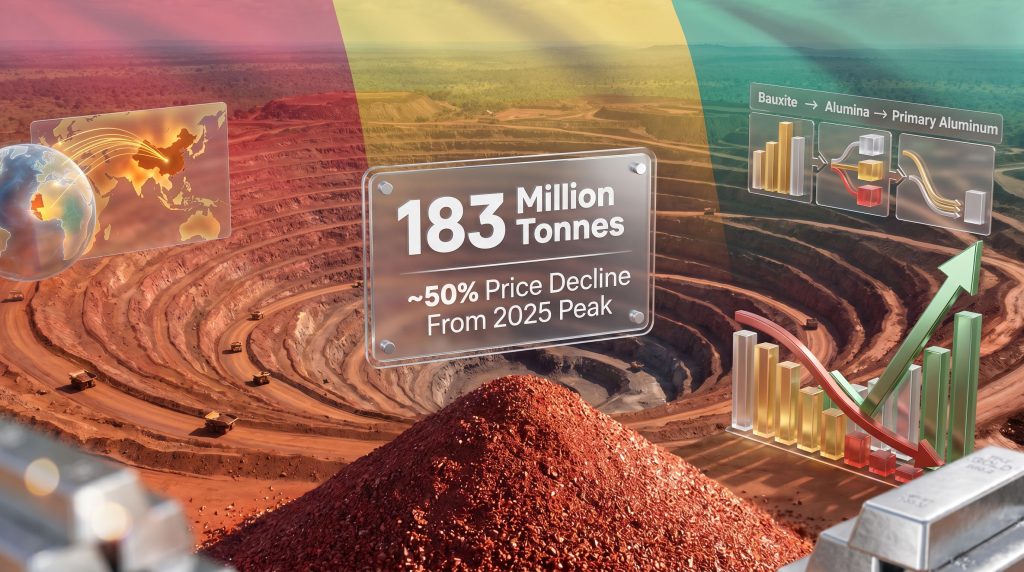
To understand the urgency behind Guinea's proposed export controls, the timeline of the supply surge is critical. Bauxite shipments from Guinea grew by approximately 25% in 2025, pushing total export volumes to 183 million tonnes, a record level that overwhelmed the market's capacity to absorb without price consequences. Growth then continued to accelerate into the first quarter of 2026, compounding the oversupply condition rather than self-correcting.
The result was a price collapse of approximately 50% from the peak reached in early 2025, one of the steepest short-cycle corrections in the bauxite market's modern history. This is not a gradual deterioration. It is the kind of price shock that threatens the fiscal sustainability of an entire national export economy. Reuters has reported that Guinea is actively weighing export quotas precisely in response to these sliding prices and rising freight costs.
The structural problem with bauxite pricing: Unlike copper or gold, bauxite does not trade on a liquid international exchange. It is primarily priced through bilateral contract negotiations between miners and refiners, with a smaller spot market. This means price discovery is slower, oversupply signals are absorbed gradually rather than instantly, and corrections require deliberate supply-side intervention rather than market-driven responses.
The fiscal transmission mechanism amplifies the sovereign pain. Most mining royalty regimes in Guinea, as in other West African resource economies, are calculated as a percentage of export value rather than export volume. When prices fall by half, government revenue can decline by a similar magnitude even if tonnage remains flat.
With volumes simultaneously elevated, the tax take per unit of ore exported falls precisely when the government needs revenue most. This convergence of private investor pain and sovereign fiscal deterioration is what creates the political economy for supply intervention. When both parties simultaneously benefit from higher prices, the traditional friction between regulatory ambition and industry resistance is significantly reduced.
Resource Nationalism as an Industrial Strategy, Not Just Protectionism
Is Guinea's Policy More Than Simple Protectionism?
A critical analytical error would be framing Guinea bauxite export controls purely as a protectionist measure. The policy architecture being constructed is more sophisticated than a simple export tax or volume cap. It reflects a three-layer industrial development strategy:
- Short-term price stabilisation through volume regulation tied to mining licences and feasibility study commitments, targeting 2026 production and export levels.
- Medium-term value capture through mandated investment in domestic alumina refining capacity, with five new refineries targeted at a combined annual production capacity of 7.2 million tonnes.
- Long-term industrial transformation through attraction of primary aluminium smelting investment, moving Guinea from raw material exporter to vertically integrated industrial producer.
The three alumina refinery projects currently at planning or construction stage represent Chinese capital allocation decisions made under a framework of close trading relationships:
- China's State Power Investment Corporation is developing one facility
- Aluminum Corporation of China (Chalco), one of China's largest state-owned aluminium producers, is developing another
- A consortium led by Winning International Group, registered in Singapore with significant Chinese operational connections, is developing the third
However, even at full capacity, these five planned refineries would process less than 15% of Guinea's current annual bauxite output. This is a figure that deserves careful consideration. It means the domestic refinery buildout, while strategically important for long-term value capture, cannot resolve the near-term oversupply problem. Price stabilisation depends on export volume regulation, not on the refinery construction timeline.
The aluminium smelter ambition is even further from commercialisation. Primary aluminium smelting is extraordinarily energy-intensive, requiring approximately 14,000 to 15,000 kilowatt-hours of electricity per tonne of aluminium produced. Guinea's current electricity infrastructure does not support smelting at industrial scale, meaning this ambition is measured in decades rather than years.
How China's Aluminum Complex Is Exposed
What Does Chinese Exposure Actually Look Like?
No analysis of Guinea bauxite export controls is complete without examining the downstream exposure on the Chinese side of the trade. China is not a passive buyer in this relationship. It has systematically built its aluminium industry around Guinean supply availability, and that dependency now creates a structural vulnerability.
Chinese domestic bauxite deposits are predominantly diasporic and boehmite-rich, requiring higher-temperature, more energy-intensive refining processes. They are also increasingly lower-grade and more expensive to access as shallow reserves are exhausted. The industry has compensated by building seaborne import capacity, with Guinean ore the cornerstone of that strategy.
Furthermore, the leading bauxite producers that might theoretically fill a supply gap are largely constrained by their own downstream integration or domestic policy priorities, which limits China's substitution options in the short term.
A sustained reduction in Guinean export volumes would force Chinese refiners to confront several difficult choices simultaneously:
- Source alternative supply from Australia, Brazil, or other West African producers, accepting higher delivered costs and potential quality penalties
- Reduce alumina output at marginal refineries that depend on Guinean feedstock economics, with downstream tightening of primary aluminium production capacity
- Renegotiate long-term offtake agreements with Guinean miners to secure priority access to a smaller available export pool, likely at higher contract prices
- Accelerate investment in Guinea's domestic refining infrastructure, accepting that the ore's value will increasingly be captured within Guinea before export
The alumina price sensitivity to even modest Guinea supply disruptions is well established. A 10 to 15% reduction in Guinean export volumes could tighten the global alumina feedstock market materially, given the absence of immediately deployable alternative supply at comparable scale and quality. The major aluminium mining companies with significant Guinea exposure are consequently among those with the most to navigate as this policy unfolds.
African Resource Sovereignty: A Pattern With Momentum
Guinea's policy direction does not exist in isolation. It is part of an accelerating pattern across Sub-Saharan Africa that market participants have been slow to fully integrate into their risk frameworks. Indeed, this resource sovereignty trend is increasingly shaping the global critical minerals landscape as producing nations seek greater value from their natural endowments.
| Country | Commodity | Policy Mechanism | Primary Market Affected |
|---|---|---|---|
| Guinea | Bauxite | Volume regulation | China |
| DRC | Cobalt | Export restrictions | China |
| Zimbabwe | Lithium | Raw ore export ban | China |
| Namibia | Lithium | Processing mandates | China |
The common thread is that China's dominant position as a downstream processor creates the leverage that makes these policies economically logical for the producing country. By targeting raw material exports destined primarily for Chinese processing, African governments force a choice: either accept higher prices for the ore, or invest in in-country processing that creates employment, tax revenue, and industrial capability within the producing nation.
Furthermore, Africa Business Insider has noted that Guinea's consideration of export controls has the potential to shake global supply chains well beyond the immediate bauxite market. Moreover, this dynamic is closely intertwined with China's industrial demand pressures, as Chinese manufacturers face rising input costs across multiple commodity categories simultaneously.
A speculative but analytically credible scenario: If Guinea's export control framework proves effective at recovering prices, it is likely to accelerate similar policy consideration in Mozambique for graphite, Zambia for copper concentrates, and other West African states where bauxite deposits are being explored. Supply management as an African policy tool is no longer a theoretical option. It is becoming demonstrated practice.
The next major ASX story will hit our subscribers first
Short-Term Market Scenarios and Investment Implications
Investors across the aluminium value chain should be stress-testing their positions against three plausible near-term scenarios:
Scenario A: Full Implementation as Announced
Export volumes decline in the second half of 2026. Bauxite spot and contract prices recover partially from their 50% drawdown. Chinese alumina refiners face input cost increases. Primary aluminium production costs rise at the margin, potentially supporting aluminium price floors.
Scenario B: Implementation Delayed by Industry Negotiation
Guinean miners, many of whom are themselves under margin pressure, negotiate a phased or diluted implementation. Oversupply conditions persist through year-end 2026. Bauxite prices remain depressed and government revenue continues to underperform.
Scenario C: Controls Trigger Accelerated Chinese Supply Diversification
Chinese state-owned enterprises fast-track investment in alternative bauxite sources across Australia, Brazil, and other West African jurisdictions. Medium-term supply diversification reduces Guinea's structural leverage, but the transition costs are borne by Chinese industrial capital in the short run.
Disclaimer: The scenarios above are analytical projections based on available information and historical precedent. They are not investment advice. Commodity markets are subject to a wide range of unpredictable variables, and actual outcomes may differ materially from any projection.
Key Market Data at a Glance
| Metric | Data Point |
|---|---|
| Guinea's share of global bauxite production | More than one-third |
| 2025 Guinean bauxite export volume | 183 million tonnes |
| Year-on-year export growth in 2025 | ~25% |
| Bauxite price decline from 2025 peak | ~50% |
| Planned alumina refinery capacity | 7.2 million tonnes/year across 5 refineries |
| Share of current output absorbed by planned refineries | Less than 15% |
| Primary export destination | China |
| Policy announcement timeline | June 2026 |
| Approximate energy requirement for aluminium smelting | 14,000 to 15,000 kWh per tonne |
Frequently Asked Questions: Guinea Bauxite Export Controls
What Exactly Are the Proposed Guinea Bauxite Export Controls?
The Guinean government is finalising a regulatory framework to cap bauxite export volumes at levels consistent with existing mining licences and feasibility study commitments. The objective is supply discipline to support price recovery, not an outright export prohibition.
Why Did Bauxite Prices Fall So Sharply?
A 25% volume surge in Guinean exports during 2025, reaching 183 million tonnes, overwhelmed market absorption capacity. Prices fell approximately 50% from their early 2025 peak. The oversupply continued to build in early 2026, making government intervention increasingly unavoidable.
Which Companies Have the Most Direct Exposure?
Chinese state-owned enterprises are the most directly exposed, particularly those operating refineries calibrated to Guinean feedstock. Chalco, State Power Investment Corporation, and Winning International Group all have operational investments in Guinea's refinery buildout.
Is Guinean Bauxite Interchangeable With Australian or Brazilian Ore?
Not without cost. Guinean gibbsite bauxite requires less energy-intensive processing than the boehmite and diaspore deposits dominant in Australia. Chinese refineries built around Guinean ore specifications face capital and operating cost penalties when switching feedstock.
Will This Cause a Spike in Aluminium Prices?
A moderate reduction in Guinean export volumes would tighten alumina feedstock markets and increase input costs for Chinese smelters. However, a full aluminium price spike would require sustained, significant volume cuts beyond current proposals. The aluminium price impact would consequently be gradual rather than immediate.
How Does This Fit the Broader African Resource Policy Picture?
Guinea's approach mirrors export restriction frameworks implemented by the DRC for cobalt and Zimbabwe for lithium. The common thread is the use of supply management to increase value capture within the producing country and redirect leverage away from Chinese processing dominance.
Want to Stay Ahead of Commodity Shifts That Move Markets?
When structural disruptions like Guinea's bauxite export controls reshape global supply chains, early intelligence is everything — and Discovery Alert's proprietary Discovery IQ model scans ASX announcements in real time, delivering actionable alerts on significant mineral discoveries the moment they emerge. Explore how major commodity discoveries have historically rewarded early investors on Discovery Alert's dedicated discoveries page, and begin your 14-day free trial today to position yourself ahead of the next market-moving event.