August 5, 2026
The Numbers That Refuse to Cooperate With Peak Oil Theory
Energy forecasting has long been shaped by a particular kind of optimism: the belief that technological progress in renewables will compress hydrocarbon consumption on a timeline determined largely by innovation speed rather than economic reality. That assumption runs headlong into a very different set of numbers when examined from the bottom up, starting not with climate targets, but with the lived energy realities of the roughly three billion people still climbing the lower rungs of the global development ladder.
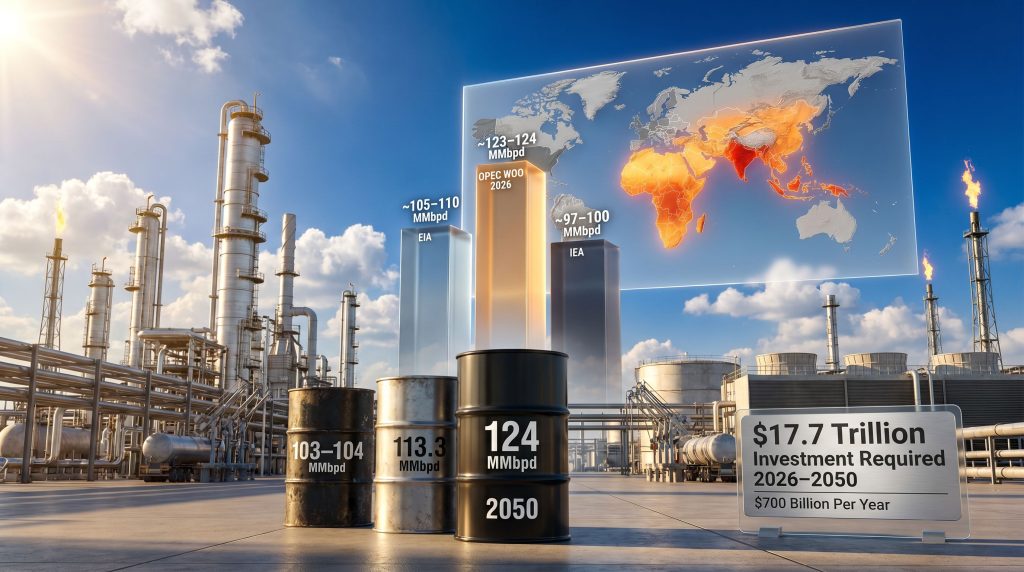
OPEC's World Oil Outlook 2026 puts a precise figure on where this demographic and economic reality leads: global oil demand reaching approximately 123-124 million barrels per day (MMbpd) by 2050, a projection that directly challenges the peak demand consensus increasingly dominating Western energy discourse. Understanding why that number is credible, contested, and consequential requires moving well beyond the headlines. Furthermore, oil's global importance to development trajectories makes this debate far more than a technical forecasting exercise.
When big ASX news breaks, our subscribers know first
The Demand Foundation: Demographics, Development, and the Energy Access Gap
Why Population and Urbanisation Drive Long-Duration Oil Demand
The structural underpinning of OPEC's long-range demand case is not speculative. Global population is on course to exceed 9 billion by mid-century, with the overwhelming share of net new energy consumers concentrated in Sub-Saharan Africa, South Asia, and Southeast Asia. These are not marginal additions to existing demand patterns; they represent economies in the early-to-middle phases of industrialisation, where energy consumption per capita tends to rise sharply and persistently.
Urbanisation amplifies this dynamic in ways that are frequently underappreciated in demand modelling. As rural populations migrate into cities, their energy consumption typically increases by a factor of three to five times, driven by motorised transport, appliance ownership, commercial activity, and industrial employment. In regions where urbanisation rates are still accelerating, this multiplier effect compounds over decades.
Crucially, hundreds of millions of people across emerging markets still lack reliable access to modern energy services. For these populations, the energy transition dynamics debate is secondary to a more immediate question: how to access affordable, dependable power and transport fuel in the first place. Hydrocarbons remain the most economically viable near-term solution at scale, particularly in regions where grid infrastructure is underdeveloped and renewable integration costs remain prohibitive.
Contextualising the 124 MMbpd Projection
To appreciate the magnitude of what OPEC is projecting, consider the baseline. Global oil consumption in 2024 hovered in the range of 103-104 MMbpd. The outlook implies a net addition of roughly 20 MMbpd over 25 years, with an intermediate milestone of 113.3 MMbpd projected by 2030 signalling that near-term demand growth is expected to be robust rather than deferred to the later forecast period.
Framed differently, this trajectory means the world would need to produce the equivalent of nearly two additional Saudi Arabias worth of oil output by mid-century compared to today's levels, just to satisfy demand growth, before accounting for the natural decline of existing fields.
The 124 MMbpd forecast is not anchored in an assumption that the energy transition fails. It is anchored in the assumption that the transition proceeds at the pace dictated by economic capacity rather than policy ambition, a materially different proposition.
Sector-by-Sector: Where the Incremental Demand Is Actually Coming From
Petrochemicals: The Demand Driver That EVs Cannot Displace
One of the most frequently overlooked structural realities in peak oil discourse is that electric vehicles address only a fraction of total oil demand. Transport fuels as a whole account for roughly half of global oil consumption, but within that share, the petrochemical feedstock category is growing fastest and is entirely insulated from electrification pressures.
Plastics, fertilisers, synthetic rubber, pharmaceutical intermediates, and hundreds of other industrial materials are derived from oil and gas feedstocks. These applications do not have near-term substitutes at commercial scale, and their demand grows in direct proportion to industrial output and population. The International Energy Agency has itself acknowledged that petrochemicals are on track to become the single largest driver of oil demand growth through mid-century.
Aviation: The Electrification Frontier That Does Not Yet Exist
Commercial aviation represents one of the most structurally durable sources of long-duration oil demand. Sustainable aviation fuel (SAF) currently accounts for less than 1% of total jet fuel consumption globally, and the production infrastructure required to change that ratio materially remains years away from the scale needed.
More importantly, the fastest-growing aviation markets are in Asia and Africa, where a rapidly expanding middle class is accessing air travel for the first time. Passenger growth in these regions is projected to compound well into the 2040s, and the aircraft that will carry those passengers run on kerosene, not electricity.
Road Transport and the EV Affordability Gap
Global EV sales exceeded 17 million units in 2024, a figure frequently cited as evidence that oil's displacement in transport is accelerating. However, what this number obscures is the geographic concentration of that adoption. The vast majority of EV penetration is occurring in China, Western Europe, and the United States, where charging infrastructure, grid reliability, and consumer purchasing power make electrification viable.
In lower-income economies, the picture is fundamentally different. Vehicle fleet electrification is constrained by:
- Inadequate grid infrastructure to support widespread charging
- Vehicle purchase price premiums that are incompatible with median incomes
- Unreliable electricity supply that makes battery-dependent transport impractical
- Limited domestic manufacturing capacity for EVs or batteries
India alone is projected to add hundreds of millions of new vehicle registrations over the coming decades as per-capita income rises, and the majority of that fleet will not be electric at the point of purchase.
How OPEC's 2050 Outlook Compares to Other Major Forecasters
The divergence between major forecasting bodies on long-term oil demand is one of the most consequential debates in global energy planning. The gap is not merely technical; it reflects deeply different assumptions about policy effectiveness, technology cost trajectories, and the development priorities of non-OECD economies. In addition, OPEC demand forecasts have themselves undergone notable revisions in recent years, reflecting the complexity of modelling a rapidly shifting global landscape.
| Forecasting Body | 2050 Oil Demand Projection | Demand Peak Assumption | Primary Growth Drivers |
|---|---|---|---|
| OPEC (WOO 2026) | ~123-124 MMbpd | No peak within forecast horizon | Developing economies, petrochemicals, aviation |
| IEA (Stated Policies Scenario) | ~97-100 MMbpd | Peak demand mid-2030s | EV adoption, efficiency gains, policy intervention |
| EIA (Reference Case) | ~105-110 MMbpd | Gradual plateau post-2040 | Mixed technology and demand offsetting |
The IEA's Net Zero by 2050 scenario assumes aggressive, coordinated policy implementation across nearly every major economy simultaneously, rapid technology cost declines sustaining current trajectories, and behavioural change at a societal scale that no previous energy transition has achieved. Energy economists across the political spectrum have characterised these assumptions as aspirational rather than baseline-probable.
OPEC's scenario takes a more conservative view of transition speed, particularly in economies where the primary energy policy objective is access expansion rather than decarbonisation. Neither projection carries certainty; both are modelling outputs with embedded assumptions that will be tested by events not yet visible.
Neither the IEA nor OPEC forecast should be treated as a prediction. They are scenario frameworks, and investors, policymakers, and infrastructure planners who treat either as definitive do so at considerable strategic risk.
The $17.7 Trillion Investment Requirement: Scale, Urgency, and Risk
Breaking Down the Capital Allocation Requirement
OPEC's World Oil Outlook 2026 estimates that sustaining adequate oil supply through 2050 will require $17.7 trillion in cumulative investment, equivalent to more than $700 billion per year across the entire oil value chain. This capital must flow across four distinct domains:
- Exploration – identifying and delineating new hydrocarbon reserves to replace those being depleted
- Production development – converting discovered resources into producing capacity
- Transportation infrastructure – pipelines, tanker fleets, terminals, and distribution networks
- Refining capacity – processing crude oil into the product slate demanded by end markets
Each category carries distinct risk profiles, return timelines, and sensitivity to policy uncertainty, making the aggregate investment challenge considerably more complex than the headline figure suggests.
The Natural Field Decline Problem: The Industry's Invisible Treadmill
A dimension of long-term oil supply that receives insufficient attention in mainstream energy commentary is the natural decline rate of producing fields. Without ongoing capital investment in maintenance, enhanced recovery, and new drilling, existing oil fields decline at rates ranging from 4% to 8% per year on average, with mature basins in decline trending toward the higher end of that range.
The practical implication is striking: even if global oil demand remained completely flat at current levels, the industry would need to bring online the equivalent of several major producing nations worth of new capacity every single decade simply to offset the production losses from existing fields aging out. When demand growth of 20 MMbpd is layered on top of that decline challenge, the investment imperative becomes structurally non-negotiable.
The ESG-driven capital discipline wave of the early 2020s, which saw major international oil companies significantly reduce upstream investment commitments, has created a supply-side vulnerability that is only now beginning to register in longer-range planning frameworks.
A sustained period of upstream underinvestment relative to the $700 billion annual threshold does not produce a gradual supply shortfall. It produces an abrupt one, and the price signals that follow tend to be sharp, regressive, and politically destabilising, with the most severe consequences falling on energy-importing developing economies.
Is Peak Oil Demand Near? Examining the Evidence on Both Sides
The Case That Peak Demand Is Approaching
The arguments for an imminent demand peak are real and should not be dismissed:
- Global EV sales crossed 17 million units in 2024 with penetration accelerating in the world's three largest auto markets
- Energy intensity of GDP is declining in most OECD economies as efficiency improvements compound across buildings, industry, and transport
- Several major integrated oil companies have revised their long-term internal demand outlooks downward repeatedly since 2019
- Renewable energy capacity additions have consistently exceeded forecasts for over a decade, suggesting model-based projections systematically underestimate deployment speed
The Case That Demand Peak Remains Distant
Countervailing evidence carries equal or greater weight when examined through a global rather than OECD-centric lens:
- Total global energy demand is projected to increase by 23% between 2026 and 2050, meaning the overall system is expanding, not contracting
- Historical energy transitions have been additive: coal did not disappear when oil arrived; oil did not disappear when gas scaled; renewables are growing alongside hydrocarbons rather than substituting them in the near term
- Non-OECD economies, which account for the majority of projected demand growth, are on energy transition timelines measured in decades, shaped by economic capacity rather than political will
The Regional Demand Mosaic: A Table Often Missing From Peak Oil Debates
| Region | Current Electrification Rate | Expected Demand Trajectory to 2050 |
|---|---|---|
| Sub-Saharan Africa | ~45% | High growth, population doubling |
| South Asia (ex. India) | ~75% | High growth, industrial expansion phase |
| India | ~99% (grid connection) | Very high growth, vehicle fleet, petrochemicals |
| Southeast Asia | ~95% | Moderate-high growth, aviation and industry |
| OECD economies | >99% | Flat to declining |
The critical insight embedded in this regional breakdown is that electrification rate does not equate to energy sufficiency or transition readiness. India's near-universal grid connection figure, for instance, masks significant reliability gaps and per-capita consumption levels that remain a fraction of OECD norms, leaving enormous headroom for demand growth even in a scenario of rapid renewable deployment.
The next major ASX story will hit our subscribers first
Energy Security, Affordability, and the Policy Trilemma
Why Governments Cannot Simply Choose Decarbonisation
The 2021-2022 European energy crisis provided a real-world demonstration of what happens when hydrocarbon supply is compressed faster than alternative infrastructure can absorb the gap. Energy prices surged to levels that triggered industrial shutdowns, household hardship, and a policy reversal in multiple countries that had committed to accelerated fossil fuel phase-out timelines.
For governments in developing economies, the calculus is even more constrained. They face a structural trilemma between three legitimate but frequently incompatible objectives:
- Energy security: ensuring supply reliability and limiting geopolitical exposure
- Energy affordability: keeping energy costs within reach of low and middle-income households
- Emissions reduction: progressively decarbonising the energy mix in line with climate commitments
Oil frequently represents the most cost-effective path to energy security and affordability in economies that lack the capital, infrastructure, and institutional capacity to scale alternatives rapidly. Policies that optimise exclusively for the third pillar without adequately weighting the first two tend to produce politically unsustainable outcomes that ultimately reinforce rather than reduce fossil fuel dependence.
What the OPEC Outlook Means for Long-Term Oil Market Structure
Supply-Side Implications for Producers and Investors
OPEC's market influence remains a defining variable in how supply-side decisions are coordinated globally. If demand is indeed tracking toward the upper range of projections, the combination of ongoing field decline and volume growth creates a continuous requirement for new production development. Deepwater basins, tight oil plays, and Middle Eastern conventional reserves are all expected to contribute materially to mid-century supply.
National oil companies (NOCs) in OPEC member states hold a structural competitive advantage in this environment given their low-cost reserve bases and long reserve life, positioning them as essential swing suppliers in a prolonged demand growth scenario. Consequently, WTI and Brent futures markets will continue reflecting the tension between near-term supply management decisions and longer-range demand projections.
The Refining and Petrochemical Investment Dimension
As the demand mix evolves toward petrochemical feedstocks and specialised products, refinery configuration becomes a strategic competitive variable. Simple refineries optimised for gasoline and diesel face structural headwinds; integrated refining-petrochemical complexes capable of maximising naphtha and feedstock yields are better positioned for mid-century demand patterns.
Investment in this segment, particularly across the Middle East and Asia, represents one of the more underappreciated capital allocation themes in the long-range energy outlook. Furthermore, according to OPEC's own published research, these sectoral shifts are central to understanding where the next generation of oil infrastructure spending will be concentrated.
Investors and analysts anchoring their long-term oil market frameworks exclusively to OECD demand trends risk systematically mispricing the scale and duration of global hydrocarbon consumption, along with the capital requirements and supply risks that accompany it.
Frequently Asked Questions: OPEC Global Oil Demand Rising to 124 MMbpd by 2050
What exactly does OPEC project for global oil demand by 2050?
OPEC's World Oil Outlook 2026 projects global oil demand reaching approximately 123-124 MMbpd by 2050, rising from roughly 103-104 MMbpd in 2024. An intermediate target of 113.3 MMbpd by 2030 indicates the organisation expects near-term demand growth to remain firm.
Does OPEC expect oil demand to peak before 2050?
No. The current OPEC outlook does not identify a demand peak within its forecast horizon. The organisation projects sustained growth through mid-century, driven predominantly by non-OECD economies in Asia, Africa, and the Middle East.
How much investment does OPEC say is required to meet future oil demand?
OPEC estimates the oil sector will require $17.7 trillion in total investment between 2026 and 2050, equivalent to more than $700 billion annually, covering exploration, production development, transportation infrastructure, and refining capacity.
Which regions are expected to drive the most demand growth?
India, Sub-Saharan Africa, and Southeast Asia are identified as the primary demand growth engines. Petrochemicals, aviation fuel, and road transport in emerging markets are the key end-use sectors underpinning the incremental volume.
How does OPEC's forecast differ from the IEA's?
The IEA's Stated Policies scenario projects demand peaking in the mid-2030s and declining toward roughly 97-100 MMbpd by 2050. The gap reflects fundamentally different assumptions about EV adoption speed, policy effectiveness, and the pace of energy transition in developing economies, not merely different methodologies.
Why does overall energy demand growth matter even as renewables expand?
Because the global energy system is growing in absolute terms. A 23% increase in total energy demand through 2050 means the system needs more of everything, including renewables and hydrocarbons. Renewable market share can expand while hydrocarbon volumes remain flat or grow, which is precisely what OPEC's scenario models.
The Coexistence Imperative: Rethinking the Energy Transition Narrative
The dominant narrative framing oil demand and renewable energy as a zero-sum competition mischaracterises how energy transitions have actually unfolded throughout history. Each successive primary energy source has been layered on top of its predecessor rather than immediately replacing it, a pattern driven by the capital intensity of energy infrastructure, the longevity of existing assets, and the geographic unevenness of technological adoption.
OPEC global oil demand rising to 124 MMbpd by 2050 is not a political statement or a self-serving forecast from a producer organisation. It is a quantitative output of demographic and economic modelling that reflects what happens when billions of people continue ascending the energy ladder at rates constrained by capital availability and infrastructure development rather than by policy declarations. Analysts seeking broader context on this debate will find value in independent commentary on demand trajectories that examines the assumptions underlying competing scenarios.
The coexistence of expanding renewable capacity and sustained hydrocarbon demand is not a contradiction. It is the most likely structural outcome of a global energy expansion in which the overall system grows faster than any single technology can capture. Investors, policymakers, and energy planners who internalise this dynamic will be better equipped to navigate the capital allocation decisions, geopolitical realignments, and market volatility that a genuinely complex energy future will produce.
Disclaimer: This article contains forward-looking projections and scenario-based analysis drawn from publicly available forecasts. All demand figures, investment estimates, and regional projections carry inherent uncertainty and should not be construed as investment advice. Readers are encouraged to consult primary sources and independent financial advisors before making investment decisions based on long-range energy demand outlooks.
Want to Capitalise on the Investment Opportunities Emerging From Long-Duration Energy Demand?
Discovery Alert's proprietary Discovery IQ model delivers real-time alerts on significant ASX mineral discoveries — including those tied to the commodities central to petrochemicals, energy infrastructure, and industrial expansion — instantly translating complex data into actionable insights for investors at every level. Explore how historic mineral discoveries have generated substantial returns on Discovery Alert's dedicated discoveries page, and begin your 14-day free trial today to position yourself ahead of the market.