July 23, 2026
The Aluminium Supply Chain's Most Concentrated Vulnerability
Raw material supply chains rarely fail all at once. They fracture gradually, through the slow accumulation of single-source dependencies, equity entrenchments, and the quiet elimination of competitive alternatives. Today, one of the most structurally concentrated raw material relationships in global industrial supply chains sits between Guinea and China, mediated by a mineral that most investors have never held in their hands: bauxite.
Understanding why Guinea bauxite exports to China have reached record volumes in 2026, and why this carries asymmetric risk far beyond what headline trade figures suggest, requires moving past the numbers and into the architecture of the dependency itself.
When big ASX news breaks, our subscribers know first
What Guinea's Bauxite Really Represents in the Aluminium Value Chain
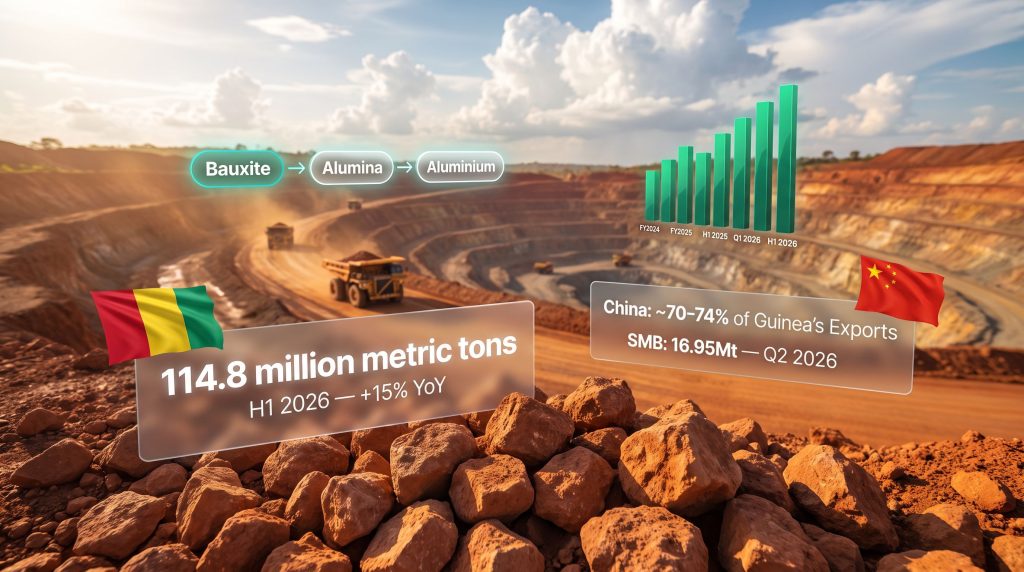
Bauxite is the foundational ore from which alumina is refined through the Bayer process, and alumina is the essential feedstock for aluminium smelting via electrolytic reduction. This three-stage chain — bauxite to alumina to aluminium — means that without reliable upstream ore supply, no amount of smelting capacity matters.
The Bayer Process and Why Grade Matters
Not all bauxite is created equal. Higher-grade ore, typically classified by its available alumina content and low levels of reactive silica, requires less caustic soda and energy input during refining.
Guinea's deposits are notably valued for their high aluminium oxide content and relatively low silica ratios compared to some competing sources, making them particularly economical for Chinese alumina refineries optimised around African-origin ore specifications. Furthermore, when reviewing global bauxite production, Guinea consistently ranks among the most strategically significant contributors to the supply chain.
China operates the world's largest aluminium smelting industry, and its domestic bauxite reserves are structurally inadequate — both in grade and in scale — to feed that capacity. This is not a short-term procurement gap. It is a geological and industrial reality that has driven China's overseas sourcing strategy for decades.
Guinea, sitting on the Fouta Djallon plateau and the coastal plains of the Boké region, holds an estimated 7.4 billion tonnes of bauxite reserves, representing approximately one-quarter of the world's known deposits. The ore is high-grade, near-surface, and accessible by river barge to deep-water port facilities, making it logistically competitive at scale.
Guinea Bauxite Exports to China: The Trade Flow Data in Full
The growth trajectory of Guinea bauxite exports to China across recent periods is not a cyclical uptick. It is a structural acceleration.
| Period | Guinea Total Exports | China's Share | Year-on-Year Change |
|---|---|---|---|
| Full Year 2024 | ~165 million metric tons (est.) | ~70% | Baseline |
| Full Year 2025 | 182.8 million metric tons | ~74% | ~+11% |
| H1 2025 | 99.8 million metric tons | ~70%+ | Reference period |
| Q1 2026 | 60.9 million metric tons | 70%+ | +25.3% YoY |
| H1 2026 | 114.8 million metric tons | ~70% | +15% YoY |
Source: Guinea Ministry of Mines data reported via Reuters, July 2026
Several features of this data deserve close attention beyond the headline growth figure:
- China's share of Guinea's total bauxite exports has remained locked in a 70–74% band across every measured period, suggesting the relationship is not diversifying in either direction
- H1 2026 exports of 114.8 million metric tons imply a full-year 2026 run rate approaching 220–230 million metric tons if the second half holds pace
- Q2 2026 shipments reached 53.9 million metric tons, a 5.3% year-on-year increase, demonstrating that growth is continuing even during Guinea's rainy season — historically a period of logistics disruption
The consistency of China's share is arguably the most analytically significant data point. It implies structural entrenchment rather than opportunistic procurement — a supply relationship reinforcing itself through equity ownership and long-term offtake commitments rather than responding to spot market price signals. According to reporting from CNBC Africa, Chinese demand was the primary driver behind Guinea's 25% export jump to 183 million tonnes in 2025.
Chinese Corporate Control: Who Actually Moves Guinea's Bauxite
One of the less widely appreciated dimensions of the Guinea-China bauxite relationship is the degree to which Chinese entities do not merely buy Guinea's bauxite — they produce it. Chinese-controlled and Chinese-consortium-backed operators account for more than 60% of Guinea's total bauxite shipments, creating a vertically integrated supply loop.
| Operator | Q2 2026 Shipment Volume | Ownership Structure |
|---|---|---|
| Societe Miniere de Boke (SMB) | 16.95 million metric tons | Chinese-consortium backed (SMB-Winning) |
| Chalco (Aluminum Corp. of China) | 7.73 million metric tons | Chinese state-owned enterprise |
| Compagnie des Bauxites de Guinee (CBG) | 4.13 million metric tons | Mixed international ownership |
Source: Guinea Ministry of Mines data via Reuters, July 2026
The SMB-Winning consortium is one of the more sophisticated upstream integration models in global mining. Its infrastructure investment in Guinea extends beyond mine development to include private port facilities, slurry pipelines, and a captive barge fleet — assets that would take a new entrant many years and billions of dollars to replicate. The leading bauxite mines globally illustrate just how dominant these Chinese-backed Guinean operations have become in shaping world supply.
This capital depth is precisely why SMB and Chalco are expanding throughput while smaller operators are exiting. The industry is bifurcating along a structural fault line that has little to do with ore quality and everything to do with capital intensity and logistics control.
Additionally, Guinea exported 238,563 tonnes of alumina within the H1 2026 reporting period, signalling the very early stages of downstream processing development inside Guinea. If this trend accelerates, it would represent a meaningful shift in value capture from raw ore to partially refined material.
The Cost Squeeze Reshaping Guinea's Competitive Landscape
Despite record export volumes at the headline level, the operating environment inside Guinea's bauxite sector is deteriorating for a significant portion of the industry. The two primary stress vectors are energy costs and freight economics.
Why Smaller Operators Are Exiting
Fuel prices in Guinea's mining sector have risen by more than 80%, driven by global energy market disruptions linked to the Middle East crisis. Simultaneously, rough sea conditions during the rainy season have extended voyage durations, compounding freight cost increases.
The market consequences are already visible:
- Dynamic Mining has halted operations entirely
- At least three additional operators have suspended or materially reduced activity
- These exits are concentrated among lower-grade producers who face a compounding disadvantage: higher costs and lower realised sale prices relative to premium-grade Guinean ore
The current Guinea Free On Board bauxite price range of $38–$39 per dry metric ton represents a notable softening from 2025 levels, driven by oversupply conditions. For high-cost producers, this environment is not cyclically survivable. For large, Chinese-backed operators with sunk infrastructure costs and long-term offtake structures, however, competitor exits reduce pressure on port scheduling and logistics capacity — making this environment advantageous.
The Export Control Question: Guinea's Unexercised Leverage
Guinea's government has been actively considering export volume restrictions, framed publicly as a mechanism to support smaller domestic miners and stabilise bauxite prices from below. As of mid-2026, no formal curbs have been implemented. However, Bloomberg has reported that Guinea was set to unveil export controls in June, underscoring that the policy debate has moved beyond theoretical discussion.
Why Export Controls Would Be Structurally Impactful
Guinea's 70–74% share of China's bauxite import base means any material reduction in Guinean export volumes creates an immediate feedstock gap for Chinese alumina refineries. Unlike manufactured goods, alumina refinery throughput cannot be quickly redirected to alternative feedstocks.
Refineries are typically engineered around specific ore grade profiles, meaning switching from Guinean high-grade ore to lower-quality alternatives would require process adjustments, chemical recalibration, and in some cases capital expenditure.
A hypothetical 15% export volume restriction applied to Guinea's 2025 full-year export base of 182.8 million metric tons would remove approximately 13–16 million metric tons of annual supply from Chinese alumina refineries. There is no readily available substitute at that scale.
Australia's bauxite production is largely committed to non-Chinese offtake arrangements or consumed domestically. Brazil's export capacity, while growing, is logistically disadvantaged for Chinese Pacific-coast refineries. Indonesia's effective removal from the Chinese bauxite import market following its 2023 export ban actually accelerated Guinea's share growth, removing one of the few alternative large-scale suppliers.
The policy tension for Guinea is acute. Implementing export controls would directly antagonise the Chinese-backed major operators who represent the country's primary source of mining royalties, port fees, and infrastructure investment.
The next major ASX story will hit our subscribers first
The Simandou Dimension: Guinea as China's Dual Raw Material Node
The bauxite dependency analysis cannot be fully understood in isolation from Guinea's broader position in Chinese resource strategy. Chinese entities control more than 60% of the Simandou iron ore project, widely regarded as the world's largest known untapped iron ore deposit, also located in Guinea.
This dual exposure — concentrated bauxite dependency and strategic iron ore exposure — in a single sovereign jurisdiction creates a compounding concentration risk. In the context of China's raw material demand, Guinea has become a uniquely critical node across multiple industrial supply chains simultaneously.
Should Guinea experience significant political instability, regulatory reversals, or a fundamental shift in government posture toward Chinese investment, the consequences would simultaneously affect:
- Chinese aluminium feedstock supply chains
- Chinese steel sector long-term iron ore diversification ambitions
- Tens of billions of dollars in Chinese infrastructure and equity investment
This dual exposure is structurally comparable to how Western nations describe their rare earth dependency on China — with the geographic concentration magnified by the fact that it sits within a single country rather than a single commodity.
Benchmarking the Dependency: How Does Guinea Compare?
| Commodity | Dominant Supplier | Concentration Level | Structural Parallel |
|---|---|---|---|
| Bauxite (Guinea to China) | Guinea | ~70–74% of Chinese imports | High, single-sovereign concentration |
| Rare Earths (China to Global) | China | ~60–70% of global supply | Comparable, inverse direction |
| Cobalt (DRC to Global) | DR Congo | ~70% of global mine output | Comparable geographic concentration |
| Lithium (Australia to China) | Australia | ~50%+ of Chinese imports | Moderate concentration |
The parallel between Guinea's leverage over Chinese bauxite supply and China's leverage over global rare earth supply is not merely rhetorical. Both represent situations where a single geography controls a disproportionate share of a non-substitutable industrial input.
The difference is that China's rare earth position is widely discussed and the subject of active diversification policy by consuming nations. Guinea's position over Chinese bauxite is far less visible in strategic planning discourse. This also has broader implications for iron ore market exposure and how investors assess single-jurisdiction raw material concentration risks.
Three Scenarios for the Guinea-China Bauxite Trade Through 2030
The forward trajectory of this supply relationship is not singular. Three divergent scenarios are plausible across the medium term.
Scenario 1: Continued Volume Expansion (Base Case)
Guinea's major exporters sustain capacity expansion, driving full-year 2026 exports toward 220–230 million metric tons. Chinese aluminium demand growth, supported by infrastructure spending cycles and electric vehicle production, maintains robust import requirements. Smaller operators continue exiting, consolidating production among Chinese-backed majors. Prices remain range-bound at $38–$42 per dry ton.
Scenario 2: Guinean Export Controls Formalised
Guinea implements volume restriction mechanisms to stabilise prices and support domestic miners. Chinese alumina refineries face near-term feedstock cost increases. The policy response from Chinese operators accelerates investment in Guinea's domestic alumina refining capacity, shifting the export mix from raw ore toward partially processed material over a 3–5 year horizon.
Scenario 3: Sovereign Realignment
External pressure from Western governments seeking to reduce Chinese critical mineral dominance opens preferential access arrangements for non-Chinese aluminium producers in Guinea. China's share of Guinea's exports begins declining from 74% toward 60% by 2030. This scenario is assessed as least likely given the depth of existing infrastructure investment and the absence of credible near-term Western capital to replace Chinese project financing. The major aluminium mining companies with Western backing would need to substantially increase their Guinea exposure to make this scenario viable.
Frequently Asked Questions: Guinea Bauxite Exports to China
How much bauxite does Guinea export to China annually?
In 2025, Guinea's total bauxite exports reached 182.8 million metric tons, with approximately 74% directed to China, equivalent to roughly 135 million metric tons. In the first half of 2026 alone, Guinea exported 114.8 million metric tons in total, with China maintaining approximately a 70% share.
Why does China import so much bauxite from Guinea?
China's domestic bauxite reserves are insufficient in both grade quality and volumetric scale to supply its aluminium smelting industry. Guinea holds high-grade, near-surface deposits that are logistically accessible, and Chinese companies have made substantial equity investments in Guinean operations, creating deeply integrated supply relationships rather than arm's-length commercial transactions.
What is the current price of Guinea bauxite?
As of mid-2026, Guinea Free On Board bauxite prices are holding in the $38–$39 per dry metric ton range, reflecting oversupply conditions following a price rally in 2025.
Which companies are the largest bauxite exporters from Guinea?
The largest operator is Societe Miniere de Boke (SMB), which shipped 16.95 million metric tons in Q2 2026. Chalco, a Chinese state-owned enterprise, shipped 7.73 million metric tons in the same quarter. Compagnie des Bauxites de Guinee (CBG) shipped 4.13 million metric tons.
What happened to smaller bauxite miners in Guinea in 2026?
Rising fuel costs of more than 80% combined with elevated freight costs linked to Middle East shipping disruptions have severely compressed margins for smaller, lower-grade ore producers. Dynamic Mining has halted operations entirely, while three additional operators have suspended or reduced activities as of mid-2026.
Key Takeaways
- Guinea exported a record 114.8 million metric tons of bauxite in H1 2026, a 15% year-on-year increase
- China consistently absorbs 70–74% of Guinea's total bauxite output, representing structural entrenchment rather than opportunistic procurement
- Chinese-controlled entities account for over 60% of Guinea's bauxite shipments, with SMB and Chalco as the two dominant operators
- Fuel costs in Guinea's mining sector have surged more than 80%, creating a two-tier market between capitalised majors and distressed smaller producers
- Guinea's potential export controls represent the primary policy tail risk to Chinese aluminium feedstock supply chain stability
- Chinese entities also control over 60% of the Simandou iron ore project in Guinea, creating compounded sovereign concentration risk across two critical industrial supply chains
- No credible large-scale alternative to Guinea exists for Chinese bauxite procurement within a 3–5 year horizon, making this one of the most structurally entrenched raw material dependencies in global commodity markets
Disclaimer: This article contains forward-looking scenarios, market projections, and analytical frameworks intended for informational purposes only. None of the content constitutes financial, investment, or trading advice. Commodity market conditions are subject to rapid change, and readers should conduct independent due diligence before making any investment decisions.
Want to Identify ASX Opportunities in the Commodities Driving These Supply Chain Shifts?
Discovery Alert's proprietary Discovery IQ model delivers real-time alerts on significant ASX mineral discoveries across bauxite, aluminium, and more than 30 other commodities, turning complex geological and market data into clear, actionable insights for investors at every level. Explore how major mineral discoveries have historically generated substantial returns by visiting Discovery Alert's dedicated discoveries page, and begin your 14-day free trial today to position yourself ahead of the market.