
June 30, 2026
The Hidden Economics of Mineral Wealth: Why Processing Power Beats Production Volume
For decades, the dominant narrative around African resource wealth has focused almost exclusively on what comes out of the ground. Tonnage, grade, reserve life, production growth — these metrics have defined how the continent's mining sector is measured and valued. Yet the more consequential question has rarely been asked with sufficient urgency: who actually captures the economic value once the ore is extracted?
The answer, historically, has been uncomfortable. Raw mineral exports flow outward while the majority of downstream processing value accumulates in refining centres far removed from the source. This structural imbalance is now being directly challenged across West Africa, and Guinea's move to establish itself as a Guinea regional gold refining hub represents one of the most ambitious attempts yet to rewrite that equation.
When big ASX news breaks, our subscribers know first
Why Exporting Raw Gold Is Economically Costly at Scale
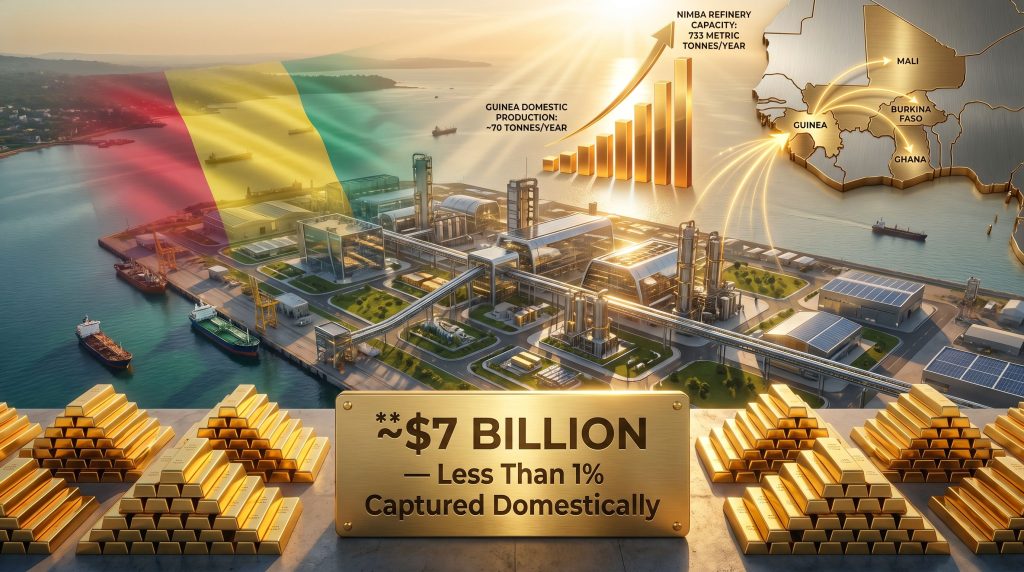
Understanding Guinea's strategic pivot requires first grasping the arithmetic of unrefined bullion exports. Guinea produces approximately 2.32 million ounces of gold per year, a figure that translates to roughly $7 billion in annualised market value at elevated current gold prices. Despite that substantial production volume, the country historically retains less than 1% of that value domestically through the raw export model.
That figure is striking. It means that for every dollar of gold value leaving Guinea's borders, less than one cent remains within the Guinean economy through wages, taxes, processing fees, and downstream services. The refinery pivot is designed to fundamentally restructure that equation by inserting a value-capture mechanism between extraction and export.
The mechanism at work here is straightforward in theory but complex in execution. When gold leaves a country in raw or doré form, all refining margins, assaying fees, casting premiums, and logistics value are captured by the receiving jurisdiction. Dubai, Switzerland, and the United Kingdom have historically been the primary beneficiaries of this arrangement. The London gold market dynamics are particularly instructive in understanding how processing infrastructure generates substantial economic activity purely through refining and trading, rather than mining.
Guinea's ambition mirrors this model precisely. The goal is not merely to refine Guinea's own output, but to position Conakry as the processing destination of choice for the broader West African region, capturing value from neighbouring producers who currently export their gold in unrefined form.
What Is the Nimba Gold Refinery and How Large Is It?
Facility Specifications and Processing Capacity
The centrepiece of Guinea's refining strategy is the Nimba Gold Refinery, a $30 million facility structured as a public-private partnership between the Guinean Government and UAE-based Emirates Minting Factory LLC. The choice of a UAE partner is symbolically significant given the explicit framing of Dubai as the aspirational model for Guinea's refining ambitions. Furthermore, Guinea's bauxite advantage in resource processing demonstrates the country's broader capacity to leverage its mineral wealth strategically.
| Metric | Detail |
|---|---|
| Location | Conakry, Guinea |
| Initial Annual Capacity | |
| Full Design Capacity | ~733 metric tonnes per year |
| Daily Processing Rate | 2 tonnes/day (expandable to 4 tonnes/day) |
| Estimated Capital Investment | USD $30 million |
| Ownership Structure | Public-private partnership (Guinean Government + Emirates Minting Factory LLC) |
| Commercial Operations Target | July 2026 (pending final regulatory approvals) |
| Regional Scale | Among the largest gold refineries in Africa |
The scale warrants careful attention. Guinea's domestic industrial gold production sits at approximately 70 tonnes per year, yet the refinery is designed to process up to 733 tonnes annually at full capacity. That discrepancy is not an oversight. It is a deliberate strategic signal that Guinea intends to attract feedstock from across the West African region, not simply process its own output.
Technology and Compliance Infrastructure
The refinery's commercial viability will depend heavily on the credibility of its technical and compliance infrastructure. Key elements include:
- Automated refining systems engineered to meet international bullion purity standards
- Digital traceability protocols integrated across the full refining chain to satisfy responsible sourcing requirements
- Internationally recognised assaying capabilities to support access to global precious metals markets
- An accreditation pathway targeting certification equivalent to London Bullion Market Association (LBMA) standards
The LBMA and COMEX gold markets accreditation point deserves particular emphasis. Without recognised certification, refined gold from Guinea would be excluded from the most liquid and premium-priced tier of the global bullion market. Achieving and maintaining that certification involves ongoing compliance audits, chain-of-custody documentation, and governance standards that extend well beyond the physical refining process itself.
How Is Guinea Structuring the Transition to Mandatory Local Refining?
The Raw Gold Export Ban and Its Immediate Market Impact
President Mamady Doumbouya enacted an executive prohibition on raw gold exports with immediate effect, requiring that all domestically produced gold be refined, cast into certified bullion, and assayed within Guinea before it can be exported. A supporting regulatory decree is being prepared to provide further incentives for local refining participation across the industrial and artisanal sectors.
This type of export restriction is a well-established policy tool in resource-rich economies seeking to capture downstream value. Indonesia used it with nickel, forcing battery-grade processing onshore. Zimbabwe applied it to raw chrome and lithium. The mechanism is consistent: remove the economic viability of raw exports to compel investment in domestic processing infrastructure.
Formalizing Artisanal and Small-Scale Mining
A frequently overlooked dimension of Guinea's refining strategy involves artisanal and small-scale mining (ASM). This sector represents a significant but historically untracked component of Guinea's total gold economy. Informal production flows that bypass official channels cannot enter a certified refinery stream without formalisation.
To address this, Guinea is establishing a gold buying centre in Kankan, a major inland city positioned near artisanal mining activity. The structural logic is to create an official procurement point where ASM operators can sell gold into the formal economy, receiving market-based pricing while supplying traceable feedstock to the refinery pipeline.
Traceability reforms targeting full implementation by 2026 form the compliance backbone of this approach. When artisanal output is formally documented and certified, it transitions from an untracked liability into a quantifiable national asset that can pass LBMA-aligned due diligence requirements.
How Does Guinea Compare to Other West African Gold Refining Contenders?
The Regional Competitive Landscape
Guinea is not operating in a vacuum. Multiple West African nations are simultaneously pursuing domestic refining capacity, driven by the same logic of value retention at elevated gold prices.
| Country | Refining Status | Key Driver |
|---|---|---|
| Ghana | Active refining development | Africa's largest gold producer; existing refinery base |
| Mali | Domestic push underway | Major output, political transition accelerating policy urgency |
| Burkina Faso | Capacity development | Significant artisanal and industrial production |
| Guinea | Nimba Refinery (2026 launch) | Export ban + $30M PPP facility; explicit regional hub ambition |
Guinea's Mines Minister Bouna Sylla has taken a notably pragmatic position on this regional competition. His view, shared publicly, is that if each West African country builds a refinery, the competitive outcome will be determined by economics rather than political arrangements. Refineries that are not cost-competitive or cannot secure sufficient feedstock will fail on their own merits. This framing positions Guinea's strategy as confident rather than defensive.
Feedstock Math and Regional Ambition
West Africa produced approximately 11 million ounces of gold in 2025 based on industry estimates. That combined output provides a substantial feedstock pool in theory. Guinea's full-capacity processing volume of ~733 metric tonnes (approximately 23.5 million ounces) actually exceeds the entire region's current production, underscoring that attracting cross-border gold flows is not optional for the refinery's economics — it is the entire premise.
Which Mining Companies Drive Guinea's Gold Output?
Dominant Industrial Producers and Regulatory Implications
Guinea's industrial gold sector is dominated by AngloGold Ashanti and Nordgold, both of which operate significant mining assets within the country. The export ban and mandatory local refining requirement create a meaningful operational shift for these producers. Existing offtake agreements, logistics chains, and export protocols that previously routed gold directly to international refiners must now be restructured to pass through the Nimba facility or other approved domestic refining infrastructure.
For large industrial operators, this introduces cost and logistical considerations that will need to be managed within their Guinea-specific operating frameworks.
The Artisanal Mining Dimension
Beyond industrial producers, Guinea's ASM sector contributes a difficult-to-quantify but material volume of gold annually. The Kankan buying centre is the structural mechanism designed to integrate this output into the formal refinery pipeline. Without ASM participation, the refinery's feedstock base remains heavily dependent on industrial producers alone, limiting utilisation rates below the levels needed to justify the facility's full design capacity.
The next major ASX story will hit our subscribers first
Is Guinea's Gold Refinery Strategy Part of a Larger Industrialization Blueprint?
Lessons from Guinea's Bauxite Sector
Guinea is the world's largest bauxite producer, and the country has pursued analogous downstream processing ambitions in that sector for years. The refinery represents a deliberate application of the same value-addition logic to gold, using a public-private partnership structure that mirrors mechanisms deployed in the bauxite space.
This cross-sector pattern matters for investors and analysts assessing the credibility of Guinea's refining ambitions. It suggests the strategy is not an isolated policy experiment but part of a consistent industrial development philosophy being applied across Guinea's resource base.
Value Chain Creation Beyond Revenue
The economic benefits of a functional Guinea regional gold refining hub extend considerably beyond refining margins. Furthermore, the broader value chain components are substantial:
- Direct employment across refining operations, quality control, and assaying functions
- Logistics and security services associated with moving certified bullion
- Financial services growth around gold trading, hedging, and settlement activity
- Customs and regulatory compliance industries supporting export certification
- Reputational and investment climate benefits from demonstrating downstream industrial capability
Conakry's long-term potential as a West African precious metals processing hub depends on successfully layering these secondary benefits onto the core refining operation.
What Are the Key Risks Facing Guinea's Regional Gold Refining Hub Ambition?
Accreditation and Market Access Risk
The single most consequential technical risk is the LBMA accreditation pathway. Producing refined gold at 99.5% purity or above is a necessary but insufficient condition for premium market access. LBMA Good Delivery accreditation requires documented chain-of-custody systems, independent auditing, anti-money laundering compliance frameworks, and evidence of consistent quality over time. The timeline to achieve this from a standing start is typically measured in years, not months.
If commercial operations begin in July 2026 but accreditation lags by two to three years, Guinea-refined gold may trade at a discount to London Good Delivery bars, undermining the economic case for the facility and potentially discouraging major industrial producers from routing their output through it.
Feedstock Security and Cross-Border Flow Challenges
Operating at full capacity requires attracting gold from neighbouring countries, many of which are simultaneously developing their own refining infrastructure. Key risks include:
- Ghana, Mali, and Burkina Faso all have policy incentives to retain their gold for domestic refining
- Political instability and security challenges across the Sahel create logistical barriers to cross-border gold transport
- Competing refinery incentive structures may offer more attractive commercial terms to regional producers
Governance, Transparency, and Investor Confidence
Guinea's extractive sector has historically faced governance challenges that complicate international investor engagement. The ASM formalisation agenda, while strategically sound, is operationally demanding. Bringing informal gold flows into a documented, auditable supply chain requires sustained regulatory enforcement, community-level buy-in, and anti-corruption measures that have proven difficult to sustain in analogous programmes across the continent.
The risk is circular: without clean, traceable feedstock, LBMA accreditation becomes harder to achieve. Without accreditation, premium market access is restricted. Without premium pricing, the refinery's economics deteriorate, reducing the incentive for ASM operators to participate in formal channels.
FAQs: Guinea's Gold Refinery and West Africa's Refining Race
What is the Nimba Gold Refinery's annual processing capacity?
Initial capacity is approximately 530 metric tonnes per year (roughly 17 million ounces), with an expansion pathway to 733 metric tonnes annually at full operation. Daily throughput starts at 2 tonnes and is expandable to 4 tonnes per day.
Why did Guinea ban raw gold exports?
The ban is designed to prevent Guinea from continuing to export the majority of gold value to foreign refiners. With annual production worth approximately $7 billion but domestic value retention below 1%, the export prohibition is the enforcement mechanism that makes local refining economically mandatory rather than merely incentivised.
Who owns the Nimba Gold Refinery?
The facility is structured as a public-private partnership between the Guinean Government and UAE-based Emirates Minting Factory LLC, with a total capital investment of approximately $30 million.
How does the refinery's capacity compare to Guinea's domestic gold production?
Guinea produces approximately 70 tonnes of gold per year domestically. The refinery's 733-tonne design capacity is roughly ten times that volume, confirming the facility's regional ambition rather than purely domestic focus.
When will the refinery begin commercial operations?
Commercial operations are targeted for July 2026, subject to the completion of final regulatory approvals.
What Does Guinea's Refinery Push Mean for the Future of African Gold Processing?
The trajectory Guinea is pursuing connects to a broader continental recalibration that extends beyond any single facility. Across Africa, resource-rich nations are increasingly questioning the development model that allowed raw material extraction to generate wealth primarily for processing nations rather than producing ones.
Gold is particularly suited to this shift at the current moment. Elevated gold price drivers have expanded refining margins, making capital investment in certified refining infrastructure more economically justifiable. In addition, geopolitical realignments and de-dollarisation trends are simultaneously elevating central bank gold demand globally, increasing the number of buyers willing to engage with newly established refining sources outside traditional Western channels.
The risk remains that Guinea's refinery, like many ambitious infrastructure projects in the region, encounters a gap between announced specifications and operational reality. Accreditation timelines, feedstock competition, and governance execution are non-trivial challenges that will determine whether the facility realises its regional hub potential or operates at a fraction of design capacity.
What is beyond dispute is the structural logic of the strategy. The UAE did not possess a single gold mine yet built one of the world's dominant precious metals processing and trading ecosystems. Guinea possesses abundant feedstock, strategic geography, and now a credible refining infrastructure commitment. Whether it can replicate that model at a West African scale will be one of the more consequential experiments in African industrial development over the next decade.
This article is intended for informational purposes only and does not constitute financial or investment advice. Statements regarding project timelines, capacity figures, and economic projections involve forward-looking assumptions and are subject to change. Readers should conduct independent due diligence before making any investment decisions.
Want to Track the Next Major Mineral Discovery Before the Market Moves?
Discovery Alert's proprietary Discovery IQ model delivers real-time alerts on significant ASX mineral discoveries, transforming complex mineral data into clear, actionable investment insights for traders and investors at every experience level — explore historic discoveries and their remarkable returns, then begin your 14-day free trial at Discovery Alert to position yourself ahead of the broader market.