
May 16, 2026
Understanding Guinea's Iron Ore Development Framework
Guinea's mineral wealth extends far beyond its established bauxite dominance, with iron ore deposits positioned to transform the nation's mining profile fundamentally. The southeastern Simandou mountain range contains what industry analysts consider among Africa's most significant undeveloped iron ore resources, featuring geological characteristics that distinguish it from typical mining ventures. Furthermore, the mining industry evolution demonstrates how large-scale infrastructure projects navigate complex development timelines.
Geographic and Geological Foundation
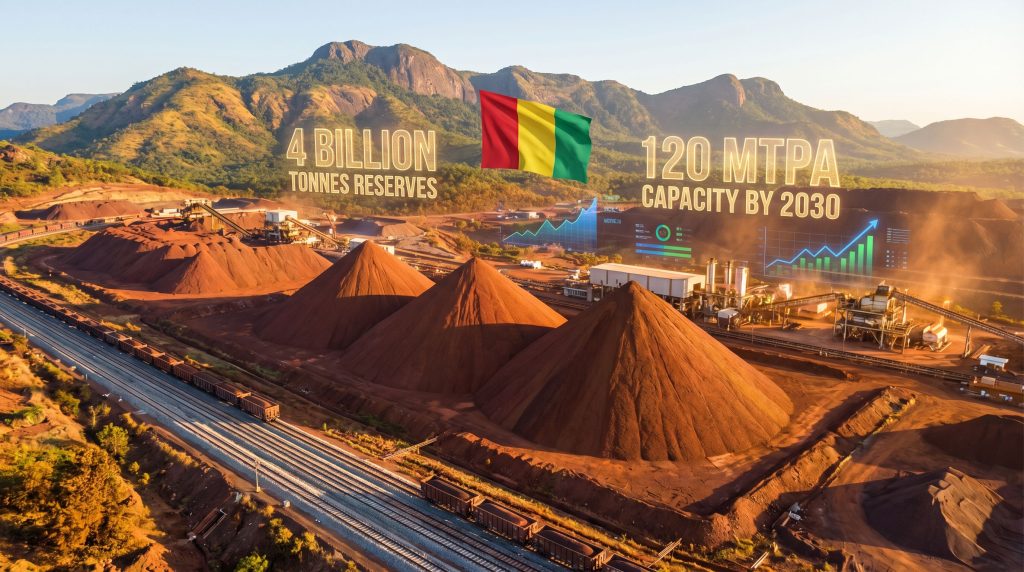
The Simandou deposits occupy a strategic position within Guinea's southeastern territory, where geological formations have concentrated 4 billion tonnes of high-grade iron ore reserves. This resource base features an average 65% iron content, positioning it among the world's premium-quality direct-shipping ore (DSO) deposits.
The geological advantages extend beyond simple tonnage metrics. Iron ore grading at 65% Fe content requires minimal beneficiation processing compared to lower-grade alternatives, translating directly into reduced operational costs and enhanced profit margins. Global iron ore benchmarks typically range between 60-62% Fe content, making Simandou's natural grade a competitive differentiator in international markets.
Mining engineering principles demonstrate that ore bodies exceeding 65% Fe content can support direct-shipping operations without extensive concentration facilities. This geological characteristic reduces infrastructure requirements, accelerates project development timelines, and minimises environmental processing impacts compared to lower-grade deposits requiring significant beneficiation.
Dual-Mine Production Architecture
The project's operational structure incorporates two distinct mining areas designed for phased development and coordinated production scaling. SimFer represents the primary operational component, while the Winning Consortium Simandou (WCS) mine constitutes the secondary development phase.
Current operational milestones indicate SimFer has successfully transitioned from construction to commercial production. According to industry reporting from April 2026, the SimFer joint venture achieved first commercial sales after years of development delays, with shipment volumes ramping throughout the quarter.
The strategic architecture enables 60 million tonnes per annum (Mtpa) capacity at SimFer's full operational scale, following a planned 30-month ramp-up trajectory from initial production. This phased approach reflects industry best practices for managing execution risk whilst optimising capital deployment across extended development timelines.
Combined production potential reaches 120 Mtpa when both SimFer and WCS achieve full capacity by 2028-2030. This dual-mine framework distributes geological risk across multiple ore bodies whilst providing operational flexibility during market fluctuations or infrastructure maintenance periods.
The following table summarises key operational metrics:
| Component | Capacity (Mtpa) | Development Status | Timeline |
|---|---|---|---|
| SimFer Mine | 60 | Commercial Production | Ramping 2026-2028 |
| WCS Mine | 60 | Development Phase | 2028-2030 |
| Combined Total | 120 | Phased Implementation | Full by 2030 |
When big ASX news breaks, our subscribers know first
Production Scaling and Infrastructure Integration
Large-scale mining ventures require coordinated infrastructure development spanning transportation networks, port facilities, and processing capabilities. The Simandou project's approach to these challenges demonstrates innovative solutions for African mining operations.
Transportation Infrastructure Revolution
The project's logistics foundation centres on a 650-kilometre railway connecting mining operations to dedicated port facilities. This infrastructure represents more than transportation—it establishes an integrated supply chain eliminating third-party bottlenecks that constrain many African mining operations.
Railway specifications accommodate the projected 120 Mtpa combined capacity whilst providing operational flexibility during peak production periods. The dedicated infrastructure eliminates port congestion issues affecting shared facilities, reducing demurrage costs and improving delivery reliability to international customers.
Port commissioning has progressed sufficiently to support initial commercial shipments, as evidenced by SimFer's April 2026 sales achievement. The facility's design accommodates large-capacity vessels typical of iron ore trade routes, particularly those serving Chinese steelmaking centres.
Key transportation advantages include:
- Dedicated capacity: No shared infrastructure constraints with other mining operations
- Integrated management: Single operational control across mine, rail, and port components
- Scalable design: Infrastructure capacity exceeds initial production requirements
- Strategic positioning: Direct shipping routes to primary Asian markets
Production Ramp-Up Strategy and Milestone Analysis
The transition from project development to commercial operation follows a carefully structured timeline designed to minimise execution risks whilst achieving production targets. SimFer's achievement of first commercial sales in April 2026 represents validation of this approach after years of construction and commissioning activities.
Production scaling typically follows an S-curve profile during ramp-up phases. Initial volumes remain modest whilst equipment optimisation, workforce training, and quality control systems achieve operational standards. Acceleration occurs during the middle phase as operational efficiency improves, before plateauing at nameplate capacity.
SimFer's 30-month ramp-up trajectory to full 60 Mtpa capacity reflects industry norms for large iron ore operations. This timeline allows for:
- Equipment break-in periods and mechanical optimisation
- Workforce skill development and productivity improvements
- Quality control standardisation and customer acceptance
- Logistics network optimisation across mine, rail, and port systems
The gradual scaling approach contrasts with aggressive ramp-up strategies that can compromise operational stability or product quality. Industry experience demonstrates that sustained production at nameplate capacity requires methodical capacity building rather than rushed expansion.
The quarter where Rio Tinto's diversification promise starts showing up in actual numbers, with copper growing visibly and Simandou transitioning from project status to revenue-generating operation.
Market Dynamics and Competitive Positioning
The introduction of large-scale, high-grade iron ore production from Guinea creates ripple effects across global commodity markets. Understanding these implications requires analysing both supply chain disruption and competitive repositioning among established producers.
Global Supply Chain Integration
Chinese steel industry demand continues driving approximately 70% of global seaborne iron ore trade, making Chinese steelmaker integration crucial for new supply sources. Simandou's premium 65% Fe content aligns with Chinese preferences for high-grade inputs, particularly as the industry transitions toward more efficient production methods.
High-grade ore provides tangible benefits for steel production economics. Premium iron content reduces energy consumption in blast furnace operations by 4-8% compared to standard 60% Fe ore, whilst improving sinter quality and reducing processing time. These advantages support pricing premiums for quality products in competitive markets.
Chinese steelmakers have demonstrated willingness to pay 2-3% premiums above benchmark pricing for direct-shipping ore exceeding 65% Fe content. This premium structure reflects the operational savings achieved through reduced processing requirements and improved furnace efficiency.
The strategic importance extends beyond operational benefits. Chinese steel security considerations encourage supply diversification away from excessive dependence on Australian sources. Simandou provides geographical diversification whilst maintaining quality standards expected by major steelmaking operations.
Competitive Landscape Transformation
Established iron ore producers must adapt to supply additions from new geographical sources offering comparable product quality. The competitive dynamics particularly affect Australian operations that have dominated high-grade ore markets for decades.
Rio Tinto's position as both a major Australian producer and Simandou development partner creates unique strategic advantages. The company gains geographical diversification across multiple continents whilst leveraging operational expertise developed in Pilbara operations.
The following competitive considerations emerge:
- Market share redistribution: New supply sources create competitive pressure on existing producers
- Pricing mechanism evolution: Multiple high-grade sources may reduce Australian pricing power
- Logistics optimisation: Dedicated infrastructure provides cost advantages over shared facilities
- Quality differentiation: Premium ore grades maintain pricing premiums despite increased supply
Brazilian Vale and Australian producers including BHP and Fortescue face increased competition for Chinese market share. However, the substantial scale of global iron ore demand suggests market expansion rather than zero-sum displacement. Additionally, current iron ore price trends indicate sustained demand fundamentals.
Investment Structure and Partnership Dynamics
Large-scale mining developments in frontier markets require sophisticated partnership structures balancing operational expertise, capital capacity, and political considerations. The Simandou project demonstrates how international mining companies navigate these complexities.
Joint Venture Architecture
Rio Tinto's participation through the SimFer joint venture provides operational leadership whilst sharing capital requirements and political risk with consortium partners. The partnership structure includes Chinese consortium involvement, reflecting the primary customer base for production output.
Rio Tinto's 27 Mtpa equity allocation at full combined capacity represents substantial production volumes comparable to major standalone mining operations. This allocation provides meaningful cash flow generation whilst maintaining manageable capital exposure relative to total project requirements.
The joint venture model offers several strategic advantages:
- Risk distribution: Capital requirements and political exposure shared among multiple partners
- Market access: Chinese partners provide customer relationships and market intelligence
- Operational expertise: International mining experience combined with regional knowledge
- Technology transfer: Advanced mining techniques adapted to local geological conditions
Strategic Portfolio Implications
For Rio Tinto, Simandou represents portfolio diversification beyond traditional Pilbara iron ore operations. The geographical spread reduces concentration risk whilst maintaining exposure to iron ore market fundamentals.
Operational benefits include knowledge transfer between mining regions. Techniques developed in Australian operations can be adapted to African conditions, whilst innovations from Simandou may benefit other Rio Tinto facilities. This approach aligns with broader critical minerals strategy considerations.
The project also supports Rio Tinto's positioning as a diversified mining company rather than purely an iron ore specialist. Recent operational results show copper production growing 9% quarter-on-quarter, with Oyu Tolgoi in Mongolia ramping as planned, whilst Simandou adds geographical and product diversification.
Risk Assessment and Execution Challenges
Despite promising geological and market fundamentals, large-scale mining developments face numerous execution risks that investors must carefully evaluate. Understanding these challenges provides realistic perspective on project timelines and potential returns.
Infrastructure Dependency Vulnerabilities
The project's integrated infrastructure creates operational efficiencies but also introduces concentration risks. The single 650km railway represents a critical bottleneck—any extended disruption would halt production regardless of mining operation status.
Railway maintenance requirements in tropical climates present ongoing challenges. Weather patterns in Guinea include seasonal rainfall that can affect rail operations, whilst equipment maintenance becomes more complex in remote locations with limited local support infrastructure.
Port facility concentration creates similar risks. Unlike established mining regions with multiple port options, Simandou depends on purpose-built facilities without alternative export routes. This dependency requires robust facility design and comprehensive maintenance planning.
Key infrastructure risks include:
- Single-point failures: Critical infrastructure without backup alternatives
- Weather disruption: Tropical climate effects on railway and port operations
- Remote maintenance: Limited local technical support and spare parts availability
- Capacity constraints: Infrastructure bottlenecks during peak production periods
For comparison, Australian operations benefit from multiple railway operations update examples that demonstrate infrastructure resilience approaches.
Political and Regulatory Environment
Mining operations in developing economies require careful navigation of evolving regulatory frameworks and political considerations. Guinea's mining sector has experienced policy changes affecting international projects, making regulatory stability a key risk factor.
Government participation in project economics through taxation, royalty structures, and potential equity requirements can significantly impact investment returns. Changes to fiscal terms during project lifecycles represent material risks for long-term financial projections.
Community relations and social licence maintenance require ongoing attention and resource allocation. Large-scale mining projects create both economic opportunities and environmental concerns for local communities, necessitating sustainable development approaches.
Consider these political risk factors:
- Regulatory stability: Potential changes to mining codes and taxation structures
- Community engagement: Social licence requirements and local development obligations
- Government relations: Political stability and policy continuity considerations
- International relations: Diplomatic factors affecting Chinese-Western partnerships
Long-Term Market Implications and Strategic Outlook
The successful development of Simandou creates precedents for other large-scale African mining projects whilst reshaping global iron ore market dynamics. Understanding these broader implications helps investors evaluate long-term sector trends.
Regional Development Catalyst Effects
Infrastructure investments extend benefits beyond immediate mining operations. The railway and port facilities create opportunities for other mineral projects, agricultural exports, and economic development initiatives throughout Guinea's southeastern region.
Similar infrastructure-led development patterns have emerged in other mining regions. Australia's Pilbara railway network supports multiple mining companies, whilst Brazilian mining railways facilitate agricultural and industrial development beyond their original mining purpose.
Regional economic impacts include:
- Infrastructure utilisation: Railway and port capacity available for other projects
- Skills development: Mining workforce creates transferable technical capabilities
- Supply chain establishment: Local service providers and equipment suppliers
- Economic multiplier effects: Increased regional income and employment opportunities
Technology Transfer and Industry Evolution
International partnerships facilitate technology transfer between developed mining regions and frontier markets. Advanced extraction techniques, environmental management systems, and safety protocols developed in established mining centres can be adapted to new geographical contexts.
The project serves as a demonstration case for future African mining developments. Successful execution validates the infrastructure-led approach to mining project development, potentially attracting investment to similar initiatives across the continent.
Industry observers note that Simandou copper mine production benefits from integrated infrastructure designed primarily for iron ore operations. This multi-commodity approach maximises infrastructure utilisation whilst diversifying revenue sources.
The next major ASX story will hit our subscribers first
Financial Performance and Investment Considerations
With Simandou achieving first commercial sales in April 2026, financial performance metrics become increasingly important for investment evaluation. The transition from development expenditure to operational cash flow generation marks a critical milestone for project economics.
Operating Cost Structure and Competitiveness
High-grade ore deposits typically achieve lower operating costs per unit of contained iron due to reduced processing requirements and higher product pricing. Simandou copper mine production shares similar advantages through its integrated infrastructure design.
Integrated infrastructure eliminates third-party logistics costs common in other mining regions. Direct control over mine, rail, and port operations reduces transaction costs whilst improving operational coordination and scheduling flexibility.
Labour costs in Guinea provide competitive advantages compared to established mining regions in Australia or North America. However, remote location operations require premium compensation packages and extensive training programmes to attract and retain skilled workers.
Key cost considerations include:
- Processing advantages: Minimal beneficiation requirements for high-grade ore
- Transportation efficiency: Integrated infrastructure reduces logistics costs
- Labour competitiveness: Regional wage structures versus developed mining centres
- Energy requirements: Power generation and transmission for remote operations
Revenue Generation and Market Positioning
Initial commercial sales validation demonstrates successful market entry and customer acceptance of Simandou production. The achievement of first sales represents proof-of-concept for product quality and logistics capabilities.
Premium iron ore typically commands pricing advantages over standard-grade alternatives. Market conditions and customer relationships will determine the specific premiums achieved, but industry precedents suggest 2-5% premiums are achievable for consistent high-grade supply.
Long-term contract structures with Chinese steelmakers provide revenue stability compared to spot market exposure. However, contract terms and pricing mechanisms require careful evaluation to understand revenue predictability and inflation protection. Furthermore, iron ore demand insights suggest sustained market fundamentals.
Strategic Investment Framework and Risk-Return Analysis
Evaluating Simandou as an investment opportunity requires balancing significant potential returns against execution risks and market uncertainties. The project's scale and complexity demand sophisticated risk assessment approaches.
Portfolio Diversification Benefits
For Rio Tinto shareholders, Simandou represents geographical diversification and commodity exposure expansion beyond traditional Australian iron ore operations. The project adds African production capacity whilst maintaining focus on high-demand commodities.
Recent operational performance demonstrates the diversification benefits in practice. While Australian operations faced weather-related disruptions from cyclones Mitchell and Narelle, affecting 8 million tonnes of shipments in Q1 2026, Simandou copper mine production provided offsetting growth through successful commercial sales achievement.
Diversification advantages include:
- Geographical spread: Reduced concentration risk across multiple mining regions
- Weather pattern differences: African and Australian seasonal variations provide natural hedging
- Market access variety: Different customer bases and shipping route options
- Operational learning: Cross-pollination of best practices between mining regions
Scenario Analysis and Future Projections
Investment success depends on multiple variables including production ramp-up execution, commodity price trends, infrastructure performance, and political stability. Scenario modelling helps evaluate potential outcomes across different assumptions.
Optimistic scenario: Full production capacity achieved by 2028, sustained premium pricing for high-grade ore, stable regulatory environment, and efficient infrastructure operations could generate substantial cash flows and attractive investment returns.
Base case scenario: Gradual ramp-up to nameplate capacity by 2030, market-level pricing with modest quality premiums, normal infrastructure maintenance requirements, and stable political conditions provide reasonable returns commensurate with project risks.
Pessimistic scenario: Extended ramp-up timelines, commodity price weakness, infrastructure disruptions, or regulatory changes could significantly impact project economics and investment returns.
The successful achievement of first commercial sales in April 2026 supports base case assumptions whilst providing validation for more optimistic projections. However, sustained operational performance over multiple years remains necessary to fully validate investment thesis assumptions. Additionally, mining production analysis indicates broader operational success across Rio Tinto's portfolio.
Investment Disclaimer: This analysis contains forward-looking statements and projections based on current information and industry trends. Mining investments involve significant risks including commodity price volatility, operational challenges, regulatory changes, and political risks. Past performance and current projections do not guarantee future results. Investors should conduct independent due diligence and consider their risk tolerance before making investment decisions.
Ready to Invest in the Next Major Mineral Discovery?
Discovery Alert instantly alerts investors to significant ASX mineral discoveries using its proprietary Discovery IQ model, turning complex mineral data into actionable insights. Understand why historic discoveries can generate substantial returns by visiting Discovery Alert's dedicated discoveries page, showcasing historic examples of exceptional outcomes, and begin your 14-day free trial today to position yourself ahead of the market.