August 2, 2026
When Geography Becomes Destiny: The Structural Fragility of Gulf Aluminium
Few industrial ecosystems on earth are as structurally exposed to geographic risk as the Gulf aluminium complex. Decades of investment in world-class smelting infrastructure have produced a region capable of generating roughly 6.5 million tonnes of aluminium annually, yet Gulf tensions and alumina supply chains remain critically intertwined, with that same infrastructure almost entirely dependent on raw materials arriving through one of the world's most geopolitically volatile shipping corridors.
The Strait of Hormuz is not simply a shipping lane. For Gulf aluminium producers, it is simultaneously the entry point for the alumina that feeds their smelters and the exit corridor for the finished metal they sell to global markets. When tensions along that corridor escalate into active disruption, the entire value chain faces pressure from both ends at once.
That is precisely the situation that unfolded in early 2026, and the consequences are reshaping alumina trade flows, aluminium production balances, and the competitive dynamics between the Gulf and China in ways that may prove difficult to reverse.
When big ASX news breaks, our subscribers know first
Why the Gulf's Aluminium Ambition Outgrew Its Raw Material Base
The Refining Capacity Gap That Makes Everything Fragile
The Gulf's position in global aluminium is deceptively strong on the surface. The region operates six aluminium smelters and contributes roughly 9 to 10 percent of global primary aluminium output, a share that significantly exceeds the region's economic footprint in most other industrial sectors.
However, beneath that smelting capability lies a critical structural imbalance: the Gulf operates only two alumina refineries to feed six smelters. Alumina, the white powder intermediate between bauxite ore and finished aluminium metal, must be imported in enormous volumes to sustain regional production. The Gulf has historically accounted for more than 20 percent of global alumina import volumes, with Australia supplying approximately 83 percent of alumina inflows to the region as recently as 2025. For further context on global bauxite supply dynamics, the upstream pressures feeding into this structural gap are well documented.
The region mines almost no bauxite domestically. Saudi Arabia's Ma'aden represents the notable exception, operating an integrated complex at Ras Al-Khair that spans bauxite extraction, alumina refining, and aluminium smelting. Every other major Gulf producer depends on supply chains that must cross open water through the Strait of Hormuz.
This configuration creates what commodity analysts describe as a structural mismatch: the Gulf built world-scale smelting capacity without building proportional upstream refining depth, leaving its production base chronically exposed to import disruption.
The Strait as Both Gateway and Vulnerability
The Strait of Hormuz handles a remarkable dual function for Gulf aluminium. It serves as the primary import gateway for alumina cargoes arriving from Australia and other origins, and simultaneously as the principal export corridor for aluminium metal destined for European and Asian buyers. More than 60 percent of Gulf aluminium exports are routed through Hormuz-adjacent shipping lanes.
What makes this exposure particularly acute is the storability constraint of alumina itself. Unlike oil, which benefits from strategic petroleum reserves and purpose-built storage infrastructure across consuming nations, alumina cannot be economically stockpiled at scale. Gulf smelters typically maintain only three to four weeks of operational buffer stock under normal conditions. This window is sufficient to manage routine shipping delays but offers almost no runway against a sustained disruption.
Furthermore, freight insurance escalation and vessel rerouting complexity under active geopolitical stress compound this vulnerability, raising delivered costs even when physical cargoes eventually reach their destinations. As aluminium and steel tariffs have already demonstrated in recent years, trade disruptions rarely confine their effects to a single commodity or corridor.
Facility Shutdowns, Force Majeure, and the March 2026 Trade Shock
What Happened Across the Gulf Smelting Complex
The escalation of Iran-related tensions in late March 2026 triggered a cascade of operational responses across Gulf aluminium producers. According to the International Aluminium Institute, infrastructure damage at key facilities, combined with shipping disruption through Hormuz-adjacent corridors, forced producers into decisions that would have been unthinkable under normal market conditions.
| Producer | Facility | Reported Status | Operational Response |
|---|---|---|---|
| Emirates Global Aluminium | Al-Taweelah (approx. 1.6M tonne capacity) | Infrastructure damage reported | Exports rerouted via Oman |
| Aluminium Bahrain (Alba) | 1.623M tonne capacity | Force majeure declared | Contracted deliveries suspended |
| Qatalum | Qatar | Controlled shutdown initiated | Output curtailed |
| Ma'aden | Ras Al-Khair, Saudi Arabia | Operational | Supplying alumina to regional peers |
Ma'aden's ability to continue operating while peers shut down or curtailed reflects the strategic advantage of vertical integration. As the only Gulf producer with meaningful domestic bauxite resources, its own refinery, and smelting capacity, it remained insulated from the import dependency that crippled competitors.
Force Majeure and Its Market Consequences
Alba's force majeure declaration carries implications that extend well beyond the company's own operations. Force majeure clauses in commodity supply contracts release a party from delivery obligations when circumstances beyond its control prevent fulfilment. For contracted alumina buyers globally, this meant scrambling for alternative supply in an already volatile spot market.
The cascading effect of multiple simultaneous force majeure events across a region responsible for more than a fifth of global alumina import demand created immediate ripple effects through international trade flows.
The Coal Tar Pitch Complication
One operational vulnerability that receives far less attention than alumina supply is coal tar pitch, the binding agent used to manufacture the carbon anodes essential to the Hall-Heroult electrolytic smelting process.
Coal tar pitch is non-substitutable in conventional aluminium production. It has a softening point of approximately 240 to 260 degrees Celsius, requires heated storage at around 150 to 160 degrees Celsius, and demands specialised heated tanker vessels for transport. These logistical requirements make it disproportionately difficult to reroute or stockpile compared to most other smelting inputs.
When a geopolitical disruption simultaneously restricts alumina imports and coal tar pitch deliveries, the compounding effect on smelter operability is severe. Producers facing shortages of both materials simultaneously have far fewer options than those managing a single input constraint.
The March 2026 Trade Collapse in Numbers
A Statistical Breakdown of the Disruption's Scale
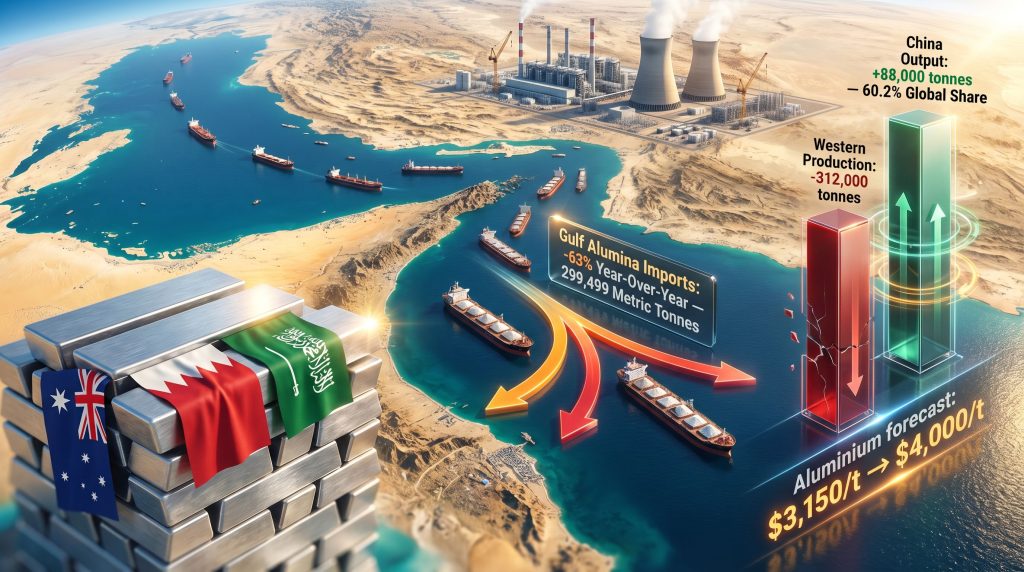
The trade data from March 2026 captures the magnitude of the disruption with unusual clarity. Gulf alumina imports collapsed by approximately 63 percent year-over-year to around 299,499 metric tonnes, a contraction that represents one of the sharpest single-month trade declines recorded for this corridor.
Australian exports to the Gulf, which had previously dominated regional supply at around 83 percent of import volumes, fell by approximately 76 percent to roughly 179,311 metric tonnes in the same period.
| Trade Metric | Pre-Disruption Baseline | March 2026 | Year-on-Year Change |
|---|---|---|---|
| Gulf alumina imports (total) | Approx. 800,000+ mt/month | 299,499 mt | -63% |
| Australian exports to Gulf | Dominant, approx. 83% share | 179,311 mt | -76% |
| China's alumina imports | Elevated but below recent peaks | 338,315 mt | Highest since Jan 2024 |
The Paradox of Redirected Cargoes
Here lies one of the more counterintuitive dynamics produced by the Gulf disruption: cargoes originally contracted for delivery to Gulf smelters were diverted to spot markets globally, adding volume to a market that was already structurally oversupplied.
The short-term effect has been to add downward pressure on FOB Australia alumina prices even as Gulf producers face acute local scarcity. This paradox of simultaneous global oversupply and regional shortage reflects the geographic and logistical constraints that prevent surplus material from easily flowing to where it is most needed.
Macquarie Bank revised its 2026 global alumina surplus forecast upward to 2.2 million tonnes, partly attributing the increase to this redirection of Gulf-bound cargoes. The bank's analysis suggests the structural oversupply in alumina existed independently of Gulf tensions, driven by expanded output from China and Indonesia, and that the disruption has layered additional complexity onto an already difficult pricing environment.
Alumina Price Context
The LME alumina price entered 2026 at approximately $300 per tonne, a level dramatically below the $800-plus per tonne peaks recorded during 2024. The structural oversupply narrative, combined with redirected cargoes from the Gulf flooding alternative markets, has kept prices suppressed in the near term despite the significant physical disruption occurring in the region.
| Pricing Indicator | Level | Context |
|---|---|---|
| LME Alumina (2026) | Approx. $300/t | Down from $800+/t in 2024 |
| Macquarie 2026 Surplus Forecast | 2.2 million tonnes | Revised upward post-disruption |
| Key supply drivers | China and Indonesia output expansion | Pre-dates Gulf tensions |
A prolonged shutdown of Gulf smelter capacity could consequently shift this dynamic. If aluminium production curtailments deepen and sustained supply disruption reduces alumina demand globally, the market faces a scenario where surplus alumina coexists with tightening aluminium supply, creating divergent pressure on two parts of the same value chain simultaneously.
Aluminium Prices and the Production Share Shift Toward China
How Gulf Curtailments Are Feeding Chinese Market Share
The International Aluminium Institute's March 2026 data captures a structural shift playing out in real time. Western aluminium production fell by 312,000 tonnes during the month, while Chinese output expanded by 88,000 tonnes in the same period. China's share of global aluminium production reached 60.2 percent in March 2026, and analysts expect that share to grow further if Gulf disruptions persist. Indeed, China steel demand pressures have similarly illustrated how Beijing's industrial priorities shape global commodity markets in ways that extend well beyond steel alone.
This divergence is not coincidental. Elevated aluminium prices driven by Gulf supply fears are supporting strong smelter margins across Chinese operations, creating direct financial incentives to increase capacity utilisation. Chinese producers are simultaneously benefiting from high output prices and absorbing redirected alumina cargoes at competitive spot prices.
Aluminium Price Forecasts Under Escalating Scenarios
The range of analyst price targets published during the disruption reflects genuine uncertainty about how far the situation will escalate.
| Scenario | Analyst House | Price Target |
|---|---|---|
| Base case, H1 2026 | Goldman Sachs | $3,150/t |
| Full one-month Gulf supply loss | Goldman Sachs | $3,600/t |
| Upside risk scenario | ING | Above $4,000/t |
| Potential deficit projection | TD Securities | 1.9M+ tonne global deficit |
| US physical premium | Market data | Approx. $2,300/t above LME |
Physical premiums in Europe and the United States are rising disproportionately relative to LME benchmark moves, reflecting the Gulf region's outsized role in traded metal volumes rather than just total production. Smelters in the Gulf tend to export a higher proportion of their output as tradeable metal rather than semi-fabricated products, which means curtailments there remove more fungible supply from international markets than equivalent curtailments elsewhere might.
China's Structural Consolidation of the Global Aluminium Market
Record Import Volumes and the Strategic Logic Behind Them
China imported 338,315 tonnes of alumina in March 2026, the highest monthly volume recorded since January 2024. This figure reflects both opportunistic purchasing of redirected Gulf cargoes at competitive prices and the underlying strength of Chinese smelter economics supported by elevated aluminium prices.
The dynamic creates a feedback loop with significant long-term implications. As Chinese producers increase output to capture market share vacated by Gulf curtailments, they absorb more alumina from global markets, potentially providing a floor for prices that might otherwise fall further. At the same time, higher Chinese production reinforces a structural shift in where global aluminium is made.
A Decade of Investment Behind a Single Month's Data
China's rise to 60.2 percent of global aluminium production did not happen because of Gulf tensions in 2026. It reflects a decade-long investment programme that has systematically expanded domestic refining capacity, diversified bauxite import sources across Guinea, Australia, and Indonesia, and constructed new smelting infrastructure at scale.
Indonesia's expanding alumina refinery base has emerged as a secondary supply source for Chinese smelters, reducing dependence on Australian material and creating a more diversified input supply chain than most Western or Gulf producers can claim.
The strategic implication is significant: if Gulf production does not recover to pre-disruption levels, Chinese market share could structurally exceed 65 percent of global output within the medium term, fundamentally altering the competitive dynamics of the global aluminium industry.
The next major ASX story will hit our subscribers first
Scenario Modelling: How Deep Could the Disruption Go?
Three Pathways and Their Consequences
Scenario A: Short-Term Disruption (One to Four Weeks)
- Gulf smelters draw down existing three to four week alumina stockpiles
- Freight and insurance costs rise but alternative routing via Oman and the Red Sea maintains partial supply continuity
- Aluminium prices firm toward the $3,400 to $3,600 per tonne range
- Alumina prices remain suppressed globally due to redirected cargo volumes
Scenario B: Extended Disruption (One to Three Months)
- Stockpile exhaustion forces additional smelter curtailments beyond Qatalum and Alba
- The alumina surplus paradox deepens as global oversupply coexists with Gulf scarcity
- Aluminium prices approach $4,000 per tonne and physical premiums in the US and Europe surge
- Chinese producers accelerate output to capture elevated margins, entrenching the production share shift
Scenario C: Full Hormuz Closure or Sustained Conflict
- Simultaneous halt to aluminium exports and alumina imports from and to the Gulf
- TD Securities' 1.9 million tonne global deficit scenario materialises
- Cascading force majeure declarations across the smelting complex
- Structural realignment of global aluminium trade routes that may prove difficult to reverse even after resolution
The Stockpile Problem and Why Strategic Reserves Are Not Available Here
A detail worth noting for those comparing the Gulf aluminium situation to oil market disruptions: there is no equivalent to the Strategic Petroleum Reserve for alumina. The oil market benefits from a globally coordinated strategic reserve architecture designed precisely for supply disruption scenarios. Alumina has no equivalent.
The physical properties of alumina create their own constraints. While it does not require the heated storage demanded by coal tar pitch, large-scale stockpiling introduces moisture management challenges and bulk handling costs that make reserve-building economically unattractive during periods of low prices. The result is an industry structurally reliant on just-in-time supply chains with minimal buffer against sustained disruption.
Supply Chain Lessons and Industry Responses
Structural Vulnerabilities the 2026 Disruption Has Exposed
The events of early 2026 have crystallised several supply chain vulnerabilities that industry participants had understood theoretically but had not previously been forced to manage in practice simultaneously. In the broader context of the global steel outlook and metals markets more generally, these vulnerabilities reflect a systemic pattern of underinvestment in upstream resilience.
- Geographic concentration risk: Routing both alumina imports and aluminium exports through a single contested waterway creates compounding exposure
- Refining capacity gap: Building smelting scale without proportional upstream refining depth leaves producers structurally dependent on import continuity
- Storability constraints: Alumina's physical properties limit the feasibility of large-scale strategic stockpiling as a disruption buffer
- Specialised input dependencies: Coal tar pitch's logistical complexity represents an underappreciated compounding vulnerability alongside alumina
What Industry Participants Are Doing in Response
Several practical responses have emerged from the disruption, with varying degrees of scalability.
- EGA's rerouting of exports through Oman demonstrates that alternative export pathways exist but add cost and logistical complexity
- Ma'aden's integrated model is receiving renewed attention as a structural template for supply chain resilience in geopolitically exposed regions
- Longer-term discussions about Gulf investment in domestic alumina refining capacity have intensified, though the capital requirements and timeline for such projects are substantial
- The contrast between long-term supply contracts and spot market exposure has become a focal point for risk management discussions across the industry
Frequently Asked Questions: Gulf Tensions and Alumina Supply Chains
Why Does the Gulf Import So Much Alumina Despite Producing Significant Aluminium?
The Gulf's smelting capacity was built far ahead of its domestic refining infrastructure. With only two alumina refineries serving six smelters, the region structurally requires large-scale alumina imports, primarily from Australia, to sustain its production base. This mismatch reflects decades of investment decisions that prioritised smelting expansion over upstream integration.
How Long Can Gulf Smelters Operate Without Fresh Alumina Deliveries?
Industry estimates place the typical alumina buffer stock at approximately three to four weeks under normal operating conditions. Beyond this window, production curtailments become unavoidable without alternative supply arrangements or emergency procurement from spot markets at elevated prices.
What Is the Current Alumina Price and How Has the Gulf Crisis Affected It?
Alumina was trading at approximately $300 per tonne in early 2026, well below the $800-plus per tonne levels seen during 2024. The disruption has paradoxically added short-term downward pressure as redirected Gulf-bound cargoes flood global spot markets, though a prolonged smelter shutdown scenario could eventually shift the balance. Analysts tracking green steel pricing have noted similar paradoxes where near-term oversupply masks deeper structural tightening ahead.
Why Is China Positioned to Benefit From Gulf Aluminium Disruptions?
Chinese smelters are operating with strong margins supported by elevated aluminium prices. As Gulf production curtails, Chinese producers are increasing output to capture market share, while simultaneously absorbing redirected alumina cargoes at competitive spot prices. This dual benefit accelerates China's structural consolidation of global production share.
Could Hormuz Disruption Permanently Alter Global Aluminium Trade Routes?
A sustained closure would likely accelerate structural changes already underway, including expanded Chinese market share, alternative routing through Oman and other corridors, and renewed pressure on Gulf producers to invest in domestic alumina refining. Whether these shifts prove permanent depends on the duration and resolution of the underlying geopolitical situation. Commodity analysts at Argus Media have outlined several scenarios in which even a partial resolution leaves lasting imprints on trade architecture.
What Is Force Majeure in the Context of Alumina Supply Contracts?
Force majeure is a contractual clause invoked when extraordinary circumstances beyond a party's control prevent fulfilment of delivery obligations. Alba's declaration signals that contracted alumina buyers must source alternative supply, adding further volatility to spot markets already adjusting to redirected cargo volumes from the Gulf disruption. Gulf tensions and alumina supply chains are, consequently, now central to virtually every risk management conversation across the global metals sector.
Key Takeaways: What the Gulf Alumina Crisis Reveals About Commodity Fragility
The events of early 2026 offer a case study in how structural vulnerabilities that appear manageable during stable conditions can become acute and mutually reinforcing under geopolitical stress. Several conclusions stand out with particular clarity.
- The Gulf's structural import dependency on alumina, representing more than 20 percent of global trade flows, makes it uniquely exposed to any sustained Hormuz disruption
- March 2026 trade data confirms the severity of the shock, with a 63 percent year-over-year collapse in regional alumina imports
- Aluminium price forecasts range from $3,150 per tonne under base case conditions to above $4,000 per tonne under extended disruption scenarios
- China's production share has reached 60.2 percent of global output and is structurally positioned to grow further regardless of how Gulf tensions resolve
- Coal tar pitch supply constraints represent an underappreciated compounding risk layer beyond alumina availability
- Ma'aden's vertically integrated model demonstrates measurable strategic value in geopolitically exposed regions, a lesson that may reshape investment decisions across the Gulf over the medium term
This article contains forward-looking statements, analyst forecasts, and scenario projections that involve assumptions and uncertainties. Market prices, trade flows, and geopolitical developments can change rapidly. Readers should not rely on this content as financial or investment advice. Independent verification of current market data is recommended before making any investment or commercial decisions.
Want to Position Yourself Ahead of the Next Major Commodity Disruption?
When geopolitical shocks reshape global supply chains overnight — as the Gulf aluminium crisis has demonstrated — identifying the right ASX opportunities requires real-time intelligence, not delayed analysis. Discovery Alert's proprietary Discovery IQ model instantly alerts subscribers to significant ASX mineral discoveries across aluminium, bauxite, and more than 30 other commodities, turning complex market signals into actionable opportunities the moment they emerge — explore historic discoveries that have delivered exceptional returns and begin your 14-day free trial at Discovery Alert to secure your market-leading edge.