July 11, 2026
The Invisible Chokepoint: How Gulf Aluminum Output Due to Iran War Has Reshaped Global Supply
Industrial metals rarely command public attention the way oil does during geopolitical crises. Yet aluminium, the backbone of modern manufacturing, is quietly experiencing one of its most severe supply disruptions in recent memory. The mechanism is straightforward but devastating: remove access to a single maritime corridor, and an entire regional production ecosystem begins to collapse — not from bombs or infrastructure damage, but from the slow strangulation of raw material supply. This is precisely what is unfolding across Gulf aluminum output due to Iran war pressure today.
When big ASX news breaks, our subscribers know first
Why Gulf Aluminium Holds a Disproportionate Position in Global Trade
Most commodity market analyses focus on China when discussing aluminium, and understandably so. China accounts for roughly 62% of global primary aluminium production, dwarfing every other producer by an enormous margin. However, the aluminium market that actually determines international prices, trade flows, and manufacturing input costs for non-Chinese buyers operates on an entirely different axis — and the Gulf sits at its centre.
The Gulf region contributes approximately 8% of global primary aluminium production according to the International Aluminium Institute, a figure that understates its true market influence. Because Gulf producers operate almost exclusively as exporters rather than domestic consumers, their output feeds directly into international trade lanes. Furthermore, roughly 75% of Gulf aluminium output is shipped internationally, making consistent logistics not a competitive advantage but an absolute operational prerequisite.
The import dependency figures for major consuming nations are particularly instructive:
| Importing Nation | Share of Aluminium Imports Sourced from Gulf |
|---|---|
| Japan | ~28% |
| United States | ~21% |
| Key European buyers | Significant but variable |
Japan's exposure is especially acute. With almost no domestic primary aluminium smelting capacity, Japan represents the world's most import-dependent major aluminium market, and the Gulf supplies more than a quarter of its total import requirements. The United States, despite its larger economic base, faces a comparable structural vulnerability due to decades of domestic smelting capacity closures driven by high energy costs. The top aluminium mining companies operating outside the Gulf region simply do not possess the spare capacity to compensate for this level of disruption.
"The Gulf is not merely a large producer. It is the primary engine of the internationally traded, non-Chinese aluminium market. Its disruption cannot be quietly absorbed by alternative suppliers operating at existing capacity."
The Strait of Hormuz, the narrow maritime corridor separating Iran from the Arabian Peninsula, serves as the singular logistics gateway through which more than 5 million metric tonnes of aluminium transit annually. Critically, this figure encompasses both exports of finished aluminium and imports of alumina — the primary feedstock that Gulf smelters require to operate. The corridor therefore functions simultaneously as the region's output channel and its raw material lifeline.
April 2026: Gulf Aluminium Output Collapses to Its Weakest Level in Over a Decade
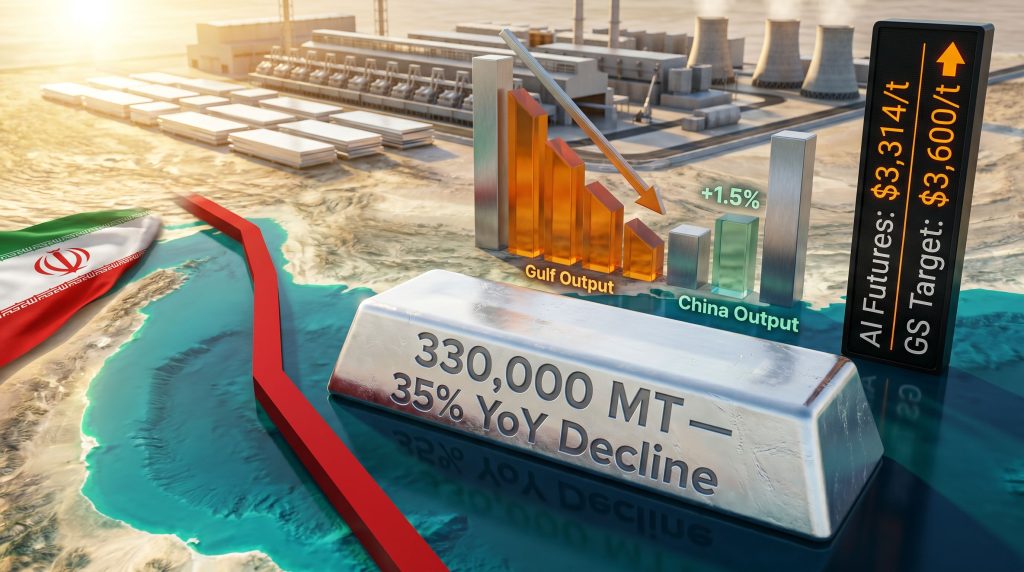
Preliminary data released by the International Aluminium Institute in May 2026 confirmed what market participants had feared: gulf aluminium output due to Iran war pressure had deteriorated dramatically. Production across the Gulf region reached just 330,000 metric tonnes in April 2026, representing a 35% decline compared to April 2025 and the weakest monthly output figure recorded in more than ten years.
To contextualise this figure: normal monthly Gulf production runs at approximately 540,000 to 550,000 metric tonnes. April's result represents operations running at barely 60% of typical capacity — a contraction so severe that it returned the region to production levels not seen since approximately the mid-2010s.
IAI Secretary General Jonathan Grant made clear that this figure does not represent stabilisation. Grant indicated publicly that April's numbers likely do not represent the floor of the decline, characterising the situation as one of continued deterioration rather than a plateau. The reasoning is grounded in operational reality: Gulf smelters cannot replenish raw material stockpiles through the Strait of Hormuz and are attempting to use alternative overland routes to sustain any level of activity at all.
The broader global production data published alongside the Gulf figures reinforces the severity of the regional decline:
| Production Metric | April 2026 Value | Year-on-Year Change |
|---|---|---|
| Gulf primary aluminium output | 330,000 metric tonnes | -35% |
| Global primary aluminium output | 5.92 million tonnes | -2.1% |
| Estimated Chinese production | 3.68 million tonnes | +1.5% |
The divergence between Chinese output growth and Gulf output collapse captures the structural bifurcation now defining the global aluminium market. Chinese production continues to expand within a largely self-contained ecosystem, while the internationally traded non-Chinese market faces acute supply pressure with no rapid substitution mechanism available. Consequently, the China steel and iron ore market dynamics offer a useful parallel for understanding how regional dominance shapes global pricing when supply chains are stressed.
The Real Cause: Raw Material Starvation, Not Infrastructure Destruction
A critical misconception in early reporting on the Gulf aluminium crisis involved assumptions about physical smelter damage. The Gulf Aluminium Council clarified that the primary constraint is not destruction of smelting infrastructure but rather supply chain failure for essential raw materials — specifically alumina.
Understanding why this distinction matters requires a brief look at how aluminium smelting actually works.
The aluminium production process involves two distinct stages:
- Bauxite ore is refined into alumina (aluminium oxide) through the Bayer process, typically carried out in processing facilities located near bauxite deposits in Australia, Guinea, Brazil, and Jamaica
- Alumina is then shipped to smelting facilities where it undergoes electrolytic reduction (the Hall-Héroult process) to produce primary aluminium metal
Gulf smelters operate at the second stage entirely. They possess no domestic bauxite resources or alumina refining capacity, making them 100% dependent on imported alumina feedstock. Under normal conditions, this alumina arrives via maritime shipping through the Strait of Hormuz.
With the Strait disrupted, Gulf smelters face an existential raw material shortage. The overland alternatives being explored face severe practical limitations:
- Capacity constraints: Road and rail infrastructure across the Arabian Peninsula cannot physically handle the volume of alumina required by large-scale smelting operations
- Cost escalation: Overland transport costs for bulk materials like alumina are substantially higher than maritime shipping, compressing already-thin smelting margins
- Speed limitations: Overland logistics move far more slowly than bulk shipping, meaning stockpile depletion continues to outpace alternative supply delivery
- Insurance and risk premiums: Freight insurance costs for any vessels transiting or operating near the Strait have risen sharply, compounding cost pressures even on shipments that do proceed
The technical constraints of the smelting process itself amplify the problem. Aluminium electrolytic cells cannot simply be throttled down gradually. Once alumina feed rates fall below operational thresholds, cells must be shut down to prevent thermal damage to expensive cathode infrastructure. This operational characteristic means that production curtailments tend to be abrupt and severe rather than gradual, explaining why April's output figure appears so dramatically lower than preceding months.
How Gulf Producers Are Navigating an Operational Crisis
Gulf aluminium producers have responded to the supply chain disruption through a combination of operational adjustment and strategic positioning, though neither approach fully compensates for the raw material shortage.
Emirates Global Aluminium (EGA), the largest aluminium producer in the Gulf, has indicated it may draw on inventory stockpiles held outside the region to fulfil customer commitments rather than relying on shipping fresh production through contested waters. EGA has publicly maintained its long-term aluminium investment strategy, signalling that it views the current disruption as temporary rather than a reason to curtail its broader capital plans.
Rio Tinto reportedly withdrew an initial second-quarter aluminium supply offer to Japanese buyers, citing elevated risk levels associated with proximity to the conflict zone. This decision by a major international aluminium supplier effectively removed an alternative source of supply for Japanese buyers already facing reduced Gulf availability. In addition, the Alcoa downgrade impact on alumina markets further compounds the feedstock pressures now affecting Gulf smelters.
A particularly complex dimension of the producer response involves deliberate inventory management:
"Gulf producers are selectively withholding portions of their output from export, building local stockpiles as a hedge against further logistics disruption. While rational from an individual producer's perspective, this behaviour amplifies the supply tightness experienced by international buyers in the near term."
This inventory-withholding dynamic creates a paradoxical situation where physical aluminium exists in Gulf warehouses while international buyers face escalating supply shortages. Japanese and US buyers, as the most import-dependent markets for Gulf production, bear the sharpest near-term exposure to this dynamic.
Price Implications: From Conflict Premium to Structural Repricing
Aluminium futures markets have incorporated a meaningful conflict premium in response to the Gulf disruption, with prices rising approximately 10% since the conflict's escalation. Current aluminium futures are trading at approximately $3,314 per tonne, a level that reflects partial but incomplete pricing of worst-case supply disruption scenarios.
Goldman Sachs has modelled a scenario combining Gulf production losses with elevated European energy costs that could push aluminium prices toward $3,600 per tonne — a level that would represent a significant structural shock to downstream manufacturing sectors globally. For context, the US aluminium tariffs already introduced a layer of pricing complexity into global trade flows that this latest disruption now compounds significantly.
The following scenario framework illustrates the range of potential price outcomes:
| Scenario | Core Assumption | Estimated Price Range |
|---|---|---|
| Base Case (partial disruption) | Overland routes partially compensate; exports resume within 60–90 days | $3,100–$3,400/tonne |
| Escalation Case (extended blockage) | Hormuz remains contested; raw material shortages deepen through Q3 2026 | $3,400–$3,600/tonne |
| Worst Case (production suspension) | Gulf smelters forced to halt operations; Chinese output cannot bridge gap | $3,600+/tonne |
Disclaimer: Price scenario modelling involves inherent uncertainty and should not be interpreted as investment advice. Actual price outcomes will depend on geopolitical developments, policy responses, and market dynamics that cannot be predicted with precision.
The current trading level of $3,314 per tonne sits within the base case range, suggesting markets are pricing a partial disruption outcome rather than an extended blockage scenario. If raw material stockpile depletion accelerates Gulf production curtailments through Q3 2026, the gap between current pricing and the escalation case scenario could close rapidly.
A less-discussed but operationally important price dynamic involves the regional premium structure for aluminium. Even when aluminium futures prices normalise, the war risk premiums embedded in Gulf aluminium freight and insurance costs may persist well beyond active hostilities, effectively creating a permanent premium wedge between Gulf-sourced aluminium and alternative supply sources.
The next major ASX story will hit our subscribers first
Differential Exposure: Which Markets and Industries Face the Greatest Risk
Japan: The Most Structurally Exposed Economy
Japan's position as the world's most import-dependent major aluminium economy makes it the nation facing the most acute near-term supply pressure. With Gulf sources supplying approximately 28% of total Japanese aluminium imports and negligible domestic primary production capacity, Japanese manufacturers have limited substitution options in the short term.
The industries facing the greatest exposure in Japan include:
- Automotive manufacturing: Japanese automakers are among the world's heaviest users of aluminium for vehicle bodies, engines, and components
- Electronics manufacturing: Consumer electronics and industrial equipment production require consistent aluminium input availability
- Packaging sector: Aluminium packaging for food and beverage applications requires a reliable supply of specific alloy grades
The United States: Structurally Weakened by Domestic Capacity Decline
The US relies on Gulf aluminium for approximately 21% of its total aluminium imports — a dependency that has grown in significance as domestic smelting capacity has contracted substantially over the past two decades. The US currently operates only a handful of primary aluminium smelters, leaving the country with limited ability to substitute Gulf supply with domestic production on any meaningful timescale.
Downstream US industries most exposed to supply tightening include aerospace, construction, automotive, and packaging sectors, all of which have built supply chains around consistent aluminium availability at predictable price points. Aluminium's foundational role in national defence further elevates the strategic stakes of this supply pressure beyond purely commercial concerns.
Europe: Caught in a Compounding Cost Squeeze
European aluminium consumers face a particularly difficult position, managing the dual pressures of elevated domestic energy costs — a structural challenge persisting since 2022 — alongside reduced access to Gulf-sourced primary metal. This combination creates a compounding margin squeeze for European downstream manufacturers that neither problem alone would generate. Furthermore, the green steel pricing dynamics reshaping European industrial metals markets add yet another layer of complexity for manufacturers navigating input cost inflation.
Short-Term Shock or Structural Realignment? Two Competing Frameworks
The Case for Temporary Disruption
Commodity markets have historical precedent for recovering from geopolitical supply disruptions within relatively compressed timeframes. Several factors support a temporary disruption interpretation:
- Gulf smelting infrastructure remains largely intact, meaning recovery can be rapid once raw material supply resumes
- Chinese production growth of 1.5% year-on-year in April 2026 provides a partial global offset, preventing a complete collapse in global supply
- Historical examples from other regional conflicts suggest supply chains adapt through a combination of rerouting, inventory drawdowns, and price-driven demand adjustments within three to six months
- Gulf producers' stated commitment to long-term investment plans signals industry confidence in eventual normalisation
The Case for Prolonged Structural Impact
However, several structural factors argue against a rapid return to pre-crisis conditions:
- The Strait of Hormuz has no viable large-scale alternative for bulk aluminium shipping. Overland routes are logistical stopgaps, not genuine substitutes for maritime bulk transport at the volumes required by major smelting operations
- If the conflict extends into the second half of 2026, raw material stockpile depletion at Gulf smelters will force production curtailments that exceed April's already severe figures
- War risk premiums on freight and insurance may persist long after active hostilities cease, permanently elevating the delivered cost of Gulf aluminium relative to pre-war benchmarks
- Import-dependent nations like Japan and the United States may accelerate sourcing diversification efforts, initiating a structural trade reorientation with decade-long consequences for Gulf aluminium market share
"A critical but underappreciated risk is that even a temporary Hormuz disruption may permanently alter buyer behaviour. Supply chain managers who experience a major disruption typically restructure sourcing toward redundancy — a behavioural shift that does not reverse simply because the original disruption ends."
The supply chain disruption risks stemming from the Iran-Gulf conflict are already prompting procurement teams across Japan, the US, and Europe to reassess their long-term sourcing strategies in ways that could permanently reshape global aluminium trade architecture.
Three Compounding Risks That Define the Crisis Trajectory
Immediate Risk: Hormuz Shipping Disruption
The operational core of the crisis remains the inability to move alumina feedstocks into Gulf smelters while simultaneously preventing finished aluminium from reaching export markets. Until this fundamental logistics constraint is resolved, production recovery remains structurally impossible regardless of smelter condition or producer intent.
Medium-Term Risk: Smelter Stockpile Depletion
As overland supply routes prove insufficient to replace maritime volumes, Gulf smelter alumina stockpiles will progressively deplete toward operational minimums. This creates the conditions for a second, potentially deeper wave of production curtailments in Q3 2026, coinciding with seasonally strong downstream demand in key manufacturing markets. The International Aluminium Institute's explicit warning that April's figures are unlikely to represent the floor makes this the most quantitatively significant near-term concern for market participants.
Structural Risk: Permanent Trade Route Repricing
The longest-lasting consequence of the current disruption may not be measured in production volumes but in trade economics. War risk premiums embedded in Gulf aluminium freight and insurance costs could persist beyond the resolution of active conflict, creating a permanent competitive disadvantage for Gulf producers in price-sensitive export markets. Combined with accelerating diversification by major importing nations, this structural repricing risk represents the scenario most likely to produce lasting changes in global aluminium trade architecture.
Frequently Asked Questions: Gulf Aluminium Output and the Iran War
How much has Gulf aluminium production fallen due to the Iran war?
Gulf primary aluminium production fell to 330,000 metric tonnes in April 2026, a 35% year-on-year decline representing the region's lowest monthly output in more than a decade, according to International Aluminium Institute preliminary data.
Why is the Strait of Hormuz so critical to aluminium production?
The Strait serves as both the import corridor for alumina feedstocks and the export corridor for finished aluminium. More than 5 million tonnes of aluminium transit the Strait annually, and no large-scale alternative maritime route exists for bulk commodity shipping at the required volumes.
Will Gulf aluminium production fall further in 2026?
IAI Secretary General Jonathan Grant indicated in May 2026 that April's production figures are unlikely to represent the floor of the decline, with further deterioration anticipated as raw material stockpiles at Gulf smelters continue to be drawn down without adequate replenishment.
How high could aluminium prices rise because of the Gulf supply disruption?
Goldman Sachs has modelled a scenario combining Gulf production losses with European energy cost escalation that could push aluminium toward $3,600 per tonne. Current futures are trading around $3,314 per tonne, suggesting partial but incomplete pricing of worst-case scenarios. This does not constitute investment advice.
Which countries face the greatest exposure to Gulf aluminium supply disruptions?
Japan (approximately 28% of aluminium imports from Gulf) and the United States (approximately 21% of aluminium imports from Gulf) face the most acute near-term supply pressure, with limited domestic primary production capacity available to compensate for reduced Gulf availability.
Is Chinese aluminium production offsetting the Gulf decline?
Chinese production grew 1.5% year-on-year to an estimated 3.68 million tonnes in April 2026, providing a partial global offset. However, Chinese aluminium does not function as a direct substitute for Gulf material in all trade lanes or applications, particularly for quality-specific manufacturing requirements in Japan and the United States. Consequently, the gulf aluminum output due to Iran war remains one of the most consequential near-term supply risks in the global metals landscape.
Want to Stay Ahead of the Next Major Commodity Disruption?
Discovery Alert's proprietary Discovery IQ model scans ASX announcements in real time, instantly identifying significant mineral discoveries across aluminium, bauxite, and more than 30 other commodities — turning complex market shifts into clear, actionable investment insights. Explore how historic mineral discoveries have generated substantial returns and begin your 14-day free trial today to position yourself ahead of the market.