August 7, 2026
The global mining landscape operates through intricate supply chains where seemingly unrelated raw materials create cascading vulnerabilities across entire industries. Modern hydrometallurgical processing relies on precise chemical inputs that cannot be easily substituted, creating systemic risks that extend far beyond traditional geological or operational challenges. Understanding these interdependencies reveals how geopolitical tensions in one region can fundamentally alter production capabilities thousands of miles away, particularly regarding Gulf disruption sulphur supply impact on Indonesia nickel production.
Indonesia's Sulphur Supply Architecture Creates Global Vulnerability
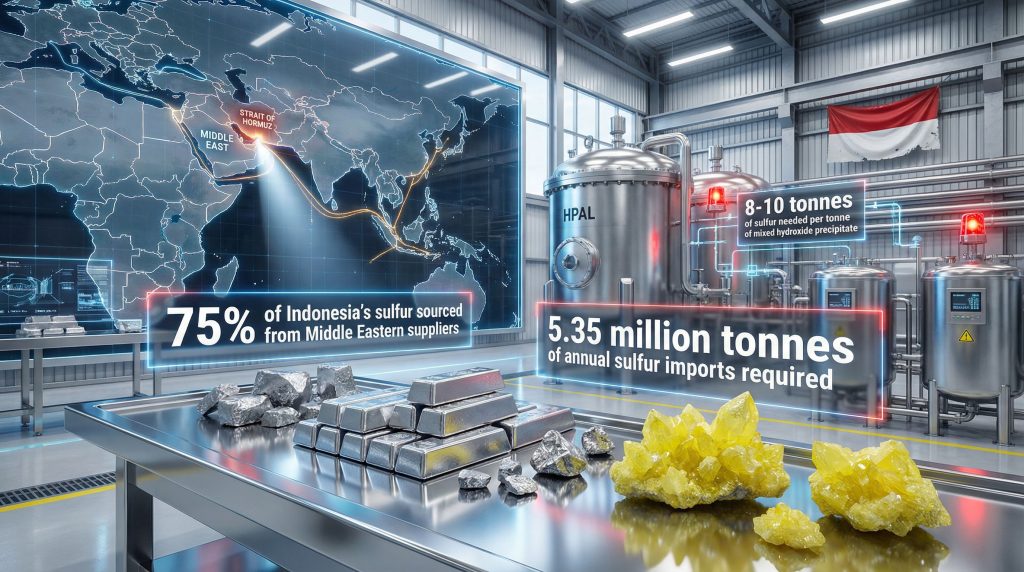
Indonesia's dominance in global nickel production stems from abundant laterite ore deposits and massive processing investments over the past decade. However, this production powerhouse depends on a critical chemical input that travels thousands of miles through volatile shipping corridors. The country sources approximately 75% of its sulphur requirements from Middle Eastern suppliers, according to analysts at CRU consultancy, creating a dependency that few market participants fully appreciate.
This sulphur dependency becomes particularly acute when considering Indonesia's market position. The nation controls over 50% of global nickel production, making any disruption to Indonesian operations a worldwide concern. The Middle East accounts for roughly 24% of global sulphur production at 83.87 million metric tons annually, based on US Geological Survey data, positioning the region as an irreplaceable supplier for sulphur-intensive industries.
Current stockpile levels at Indonesian processing facilities reveal the precarious nature of this supply chain. Sources at Chinese refiners operating in Indonesia indicate that high-pressure acid leaching (HPAL) plants maintain only 1-2 months of sulphur inventory on average. This limited buffer means production disruptions could commence within 30-60 days of sustained supply interruptions, creating an extremely narrow margin for supply chain resilience.
The economic implications extend beyond simple procurement challenges. Market analysis indicates that sulphur costs already represented approximately 50% of operational expenditure at HPAL facilities even before recent regional conflicts, according to Project Blue analysts. This cost structure amplifies the financial impact of any supply disruption, as alternative sources carry significant premium pricing that directly affects facility profitability. Furthermore, these developments reflect broader mining evolution trends that emphasise supply chain vulnerabilities.
When big ASX news breaks, our subscribers know first
The Chemical Foundation of Modern Nickel Processing
Sulphur's role in nickel production centres on sulphuric acid manufacturing, which serves as the primary leaching agent in hydrometallurgical processing. The chemistry cannot be simplified or substituted without fundamental changes to processing technology, equipment design, and operational parameters that would require years of development and capital investment.
HPAL Process Sulphur Requirements:
- Mixed Hydroxide Precipitate (MHP) Production: 8-10 tonnes of sulphur per tonne of nickel produced
- High-grade Matte Operations: 6-8 tonnes of sulphur per tonne of nickel
- Integrated Smelting Operations: Variable requirements depending on acid recovery systems
- Battery-grade Processing: Maximum acid purity requirements limit recycling options
The technical specifications for battery-grade nickel products create additional constraints on sulphur sourcing and acid quality. Unlike stainless steel applications, lithium-ion battery precursors require extremely pure mixed hydroxide precipitate with minimal impurities. This specification limits the ability to utilise recycled acid or lower-grade sulphur sources, maintaining dependency on primary sulphur supplies.
Processing facilities utilising pyrometallurgical approaches face significantly lower sulphur requirements, creating a bifurcated risk profile across Indonesia's nickel sector. Ferronickel production through electric arc furnace smelting requires minimal sulphuric acid inputs, typically consuming 0-2 tonnes of sulphur per tonne of nickel produced. However, these operations primarily serve stainless steel markets rather than the growing battery sector.
Integrated copper-nickel operations present an alternative model where sulphuric acid becomes a byproduct rather than an input cost. Operations demonstrate this approach, sourcing acid from internal smelters rather than external sulphur procurement. This integration model significantly reduces supply chain vulnerability but requires substantial capital investment and operational complexity.
Shipping Route Economics and Risk Transmission Mechanisms
The Strait of Hormuz represents more than a geographical chokepoint; it functions as a critical valve controlling sulphur flows to Asian processing centres. Recent regional conflicts have already triggered measurable impacts on commodity pricing and shipping logistics, with sulphur prices increasing 10-15% from pre-conflict baseline levels of approximately $500 per ton.
Risk transmission occurs through multiple channels beyond simple supply availability:
Insurance and Freight Cost Escalation
- War-risk insurance premiums increase exponentially during active conflicts
- Vessel routing diversions add 2-3 weeks to typical shipping schedules
- Port congestion cascades as traffic redirects through alternative terminals
- Force majeure clauses may trigger contract suspensions
Competitive Demand Intensification
- Indonesian nickel refiners compete against African copper producers
- Global fertiliser manufacturers increase bidding for alternative supplies
- Industrial users accelerate inventory building, amplifying demand spikes
- Spot market premiums emerge for immediate delivery commitments
The competitive landscape for sulphur extends beyond mining applications into agricultural and chemical sectors. A supply shortage creates multi-industry competition that can rapidly escalate pricing beyond levels sustainable for marginal processing operations. This dynamic particularly affects newer HPAL facilities without established supplier relationships or negotiating power.
Regional inventory data provides context for the potential scope of supply disruptions. Southern Africa maintains approximately 900,000 tons of sulphur in warehouses, representing only a few weeks of regional consumption according to logistics sources. This inventory burn rate suggests that even well-supplied regions face rapid depletion under disrupted supply conditions. Additionally, these vulnerabilities are compounded by broader supply chain crisis issues affecting critical minerals.
Facility-Level Vulnerability Assessment and Risk Stratification
Indonesian nickel operations exhibit dramatically different risk profiles based on processing technology, supply chain integration, and inventory management strategies. Understanding these distinctions becomes crucial for evaluating individual company exposure to Gulf disruption sulphur supply impact on Indonesia nickel production scenarios.
High-Risk Operational Characteristics:
- Process Dependency: HPAL-exclusive facilities without integrated acid production
- Supply Concentration: Single-source or heavily Middle East-dependent procurement
- Product Focus: Battery-grade MHP requiring consistent acid quality and availability
- Inventory Strategy: Just-in-time sourcing without strategic reserve buffers
- Scale Disadvantages: Newer facilities lacking established supplier relationships
Lower-Risk Operational Features:
- Technology Diversification: Ferronickel production with minimal acid requirements
- Supply Integration: Access to smelter-generated acid byproducts
- Geographic Diversification: Procurement from Canadian, Kazakhstani, or Chinese sources
- Strategic Reserves: 3-4 month inventory buffers at critical facilities
- Recycling Infrastructure: Closed-loop acid recovery systems reducing fresh sulphur dependency
The distinction between these risk categories reflects fundamental differences in business models and capital allocation strategies. Integrated operations demonstrate the practical advantages of vertical integration. Such capacity represents significant advantages if integrated into Indonesian operations.
Market analysis suggests that facilities with diversified supply chains maintain significant competitive advantages during disruption periods. Operations sourcing from multiple continents can redirect procurement flows without major operational adjustments, while single-source facilities face potential production curtailments. Consequently, the development of strategic reserves initiative becomes increasingly important for national security.
Price Scenario Modelling and Market Impact Analysis
Current sulphur market conditions provide a baseline for projecting potential disruption scenarios. Pre-conflict pricing around $500 per ton has already experienced preliminary increases of 10-15%, establishing a new floor around $550-575 per ton for immediate delivery commitments.
Scenario Analysis Framework:
| Disruption Duration | Sulphur Price Impact | MHP Premium Increase | Production Capacity Effect |
|---|---|---|---|
| 2-4 weeks (Limited) | +15-25% from baseline | +$500-800 per tonne | 5-10% utilisation reduction |
| 1-3 months (Extended) | +40-60% sustained | +$1,200-1,800 per tonne | 15-25% capacity cuts |
| 3+ months (Severe) | +80-120% peak levels | +$2,500+ per tonne | 30-40% capacity offline |
These scenarios assume normal seasonal demand patterns and exclude potential demand destruction from prolonged high prices. Extended disruption periods could trigger fundamental market structure changes as consumers seek alternative materials or delay project timelines.
Critical Threshold Analysis:
CRU analysts indicate that vessel flow constraints exceeding two weeks would likely force consumption deferrals or production slowdowns. This timeline provides a narrow window for inventory management and alternative sourcing before operational impacts become unavoidable.
The competitive dynamics during shortage periods favour facilities with established supplier relationships and flexible contract terms. Spot market premiums can escalate rapidly during supply crunches, creating significant cost disadvantages for operations dependent on immediate procurement rather than strategic inventory management. These issues contribute to broader global trade impacts affecting commodity markets worldwide.
Supply Chain Adaptation Strategies and Risk Mitigation
Indonesian nickel producers are implementing various tactical and strategic responses to reduce sulphur supply vulnerability, though options remain constrained by economics, infrastructure limitations, and technical requirements.
Immediate Tactical Responses:
- Inventory Acceleration: Building 3-4 month strategic reserves where storage capacity permits
- Contract Restructuring: Negotiating flexibility clauses and alternative sourcing provisions
- Logistics Diversification: Securing freight capacity through multiple shipping routes
- Supplier Qualification: Accelerating approval processes for non-Middle Eastern sources
Long-Term Strategic Initiatives:
- Vertical Integration: Investment in sulphur-burning sulphuric acid production facilities
- Partnership Development: Joint ventures with copper smelters generating acid byproducts
- Technology Innovation: Research into lower-sulphur processing methods
- Geographic Diversification: Establishment of processing capacity in lower-risk regions
The economics of vertical integration present both opportunities and challenges. Constructing dedicated sulphuric acid plants requires substantial capital investment but provides long-term supply security. Some models demonstrate successful implementation at scale, though adapting this approach to Indonesian conditions requires significant infrastructure development.
Acid recycling technologies offer potential for reducing fresh sulphur requirements by 20-30% in some applications, though implementation requires substantial capital expenditure and operational expertise. Most existing Indonesian HPAL facilities lack the infrastructure for large-scale recycling, creating a multi-year implementation timeline for retrofit projects.
The next major ASX story will hit our subscribers first
Global Market Structure Implications and Competitive Dynamics
Indonesia's sulphur vulnerability creates opportunities for alternative nickel sources and processing technologies that may gain competitive advantages during disruption periods. This dynamic could accelerate investment in previously marginal projects or processing methods.
Market Structure Evolution:
Supply Chain Rebalancing
- Enhanced value proposition for non-Indonesian nickel sources
- Increased strategic importance of North American and Australian laterite projects
- Accelerated development of sulphide ore processing capabilities
- Government policy support for domestic processing infrastructure
Technology Differentiation
- Competitive advantages for pyrometallurgical processing methods
- Investment focus on integrated smelting-refining operations
- Development of alternative leaching technologies requiring different chemical inputs
- Innovation in closed-loop processing systems
Financial Market Impact
- Risk premiums for Indonesian-focused nickel producers
- Enhanced valuations for geographically diversified operations
- Increased investor interest in sulphur production assets
- Strategic importance of supply chain transparency in investment decisions
The implications extend beyond immediate production costs to fundamental questions about global battery supply chain resilience. Electric vehicle manufacturers increasingly prioritise supply chain security alongside cost optimisation, potentially favouring suppliers with diversified sourcing strategies even at premium pricing. Moreover, these concerns reflect broader tariff market impact considerations affecting international trade.
Investment Positioning and Risk Management Framework
The sulphur-nickel supply chain nexus creates distinct investment opportunities and risks across the battery metals value chain. Understanding these dynamics enables more sophisticated portfolio construction and risk management approaches.
Risk Assessment Matrix:
| Investment Category | Risk Level | Key Vulnerabilities | Mitigation Potential |
|---|---|---|---|
| Indonesian HPAL Operators | Very High | Sulphur dependency, limited alternatives | Low-Medium |
| Integrated Nickel-Copper | Medium | Diversified inputs, acid byproducts | High |
| Non-Indonesian Sources | Low-Medium | Geographic diversification | Very High |
| Sulphur Producers | Opportunity | Supply-demand imbalance | N/A |
| Alternative Technologies | Opportunity | Substitution potential | High |
Portfolio Construction Strategies:
Defensive Positioning
- Emphasis on geographically diversified nickel exposure
- Focus on integrated operations with acid production capabilities
- Consideration of sulphur producer investments as natural hedges
- Evaluation of companies with robust supply chain management track records
Opportunistic Approaches
- Investment in alternative nickel processing technologies
- Exposure to non-Indonesian laterite and sulphide projects
- Strategic positions in logistics and shipping companies
- Technology companies developing sulphur efficiency solutions
The investment landscape reflects broader trends toward supply chain resilience and geographic diversification in critical mineral sourcing. Companies demonstrating proactive risk management and alternative sourcing capabilities may command valuation premiums as investors prioritise operational stability alongside growth potential.
Structural Market Evolution and Future Scenarios
Beyond immediate supply disruption management, the Gulf disruption sulphur supply impact on Indonesia nickel production crisis may catalyse fundamental changes in industry structure, technology adoption, and geographic distribution of processing capacity.
Technology Acceleration Pathways:
- Process Innovation: Development of atmospheric leaching techniques requiring lower acid consumption
- Recycling Integration: Closed-loop systems recovering and purifying acid for reuse
- Alternative Chemistry: Research into non-sulphuric acid leaching methods
- Biotechnology Applications: Biological leaching processes with reduced chemical requirements
Geographic Restructuring Trends:
- Processing Migration: Movement of capacity toward sulphur-producing regions
- Regional Integration: Development of sulphur-acid-nickel industrial clusters
- Strategic Stockpiling: Government and industry investment in strategic reserves
- Infrastructure Development: Port and logistics capacity in alternative supply corridors
Market Structure Implications:
The crisis may accelerate the transition from Indonesia's current market dominance toward a more geographically distributed global supply chain. This evolution could reduce concentration risk while potentially increasing overall supply chain costs due to the loss of Indonesia's scale advantages and favourable ore characteristics.
Long-term competitive dynamics may favour integrated operations capable of managing complex supply chains and maintaining operational flexibility during disruption periods. This trend could drive industry consolidation as smaller, single-asset operators face increasing operational and financial pressures during volatile input cost periods.
The intersection of geopolitical risk and industrial chemistry creates a complex challenge extending beyond immediate operational concerns to the fundamental architecture of global battery supply chains. Understanding these dynamics becomes crucial for navigating an increasingly interconnected and vulnerable commodity landscape where remote conflicts can rapidly cascade into worldwide industrial impacts. However, these challenges also drive innovation in Gulf region disruptions and alternative supply strategies.
This analysis is based on available market data and expert assessments as of March 2026. Commodity markets and geopolitical situations remain highly volatile, and investors should conduct independent research and consult qualified professionals before making investment decisions. Price projections and scenario analyses represent potential outcomes rather than forecasts and should be considered alongside other risk factors in investment planning.
Looking to capitalise on supply chain disruptions in the battery metals sector?
Discovery Alert's proprietary Discovery IQ model delivers real-time alerts on significant nickel and battery metal discoveries, instantly empowering subscribers to identify actionable opportunities ahead of the broader market during periods of heightened geopolitical risk. Begin your 14-day free trial today and secure your market-leading advantage while supply chain vulnerabilities create new investment dynamics across the critical minerals landscape.